
Features
Karu Jayasuriya’s time as Mayor of Colombo:revenue gains and effective administration

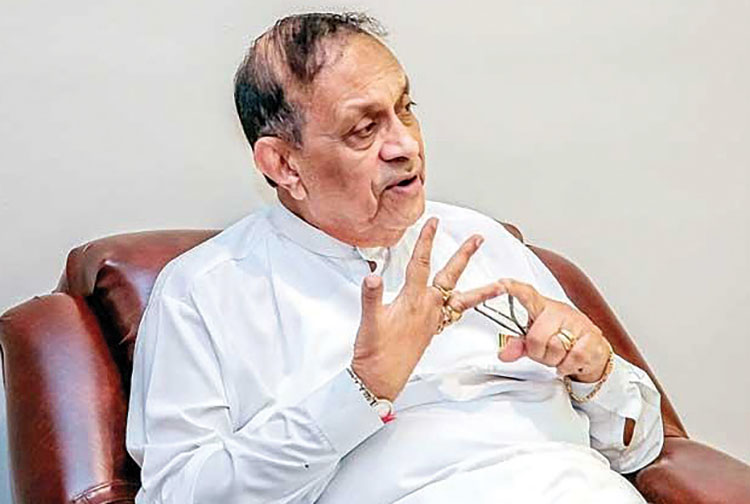
Back stabbing within his own party, CBK keeps to time
During his time as Mayor of Colombo, Karu Jyasuriya had refused to avail himself of benefits and entitlements, opting to spend his own funds for necessary expenditure. These included the monthly allowance, refreshment allowance and fuel allowance allocated to the Mayor. Instead, he ensured that all allocated allowances were routed to the Mayor’s Fund and were utilized for the betterment of the City and its residents.
Karu even declined to accept the official vehicle provided by the Colombo Municipal Council (CMC) and instead used his own vehicle for official Mayoral work. But this did not dissuade opposition members of the CMC from questioning Karu at every council meeting demanding to know details of CMC funds spent by his administration. “What is your monthly fuel allowance?” or “How much did you spend on fuel last month?” were common questions thrown at him.
These questions and jibes by the opposition often made it to the headlines of the government-run ‘Lake House’ newspapers the very next day. The headlines featured were along the lines of “Council member questions Colombo’s Mayor on his fuel allowance…!!” or “CMC members express suspicion that Mayor has secretly increased refreshment allowance in the past months…!!”
According to Karu, despite replying to these unfounded allegations, the rejoinders were not featured prominently in print. “More often than not they were completely ignored by the newspapers…” he says. To his dismay, Karu was to later find out that certain politicians of his own party were behind the acts of these opposition council members. Feeling insecure and threatened by Karu’s rising popularity among the people, these United National Party (UNP) politicians had allegedly bribed several opposition councilors to pose embarrassing questions to the UNP Mayor.
“I heard that sums up to five thousand rupees were paid to ask certain questions. The same tactic was being used to publish them in government-owned Lake House” Karu alleges. He believes this was yet another unfortunate result of the competitive preferential voting system in the country that often pits party colleagues against each other.
But an unruffled Karu had merely continued with his work. In addition to the special committee consisting of councilors, Karu also took steps to form an advisory committee of professionals from various sectors to provide necessary advice and guidance to the administration of the CMC.
According to Karu, these professionals were unpaid and provided their services voluntarily. “Several experts and professionals were also called in to analyze and provide feedback on the CMC and its functions in the hope of receiving constructive criticism…” Karu says.
Housing for the underprivileged in Colombo was also an issue during Karu’s time as mayor. Several families living in Colombo city limits at the time had sought shelter in dilapidated shipping containers due to the lack of adequate housing. As Mayor, Karu had taken steps to construct new houses in Slave Island for these families, allowing them to leave their unsafe shelters behind and move into better housing provided by the city.
At that time Crow Island in Mattakkuliya was notorious as a paradise for criminals such as thieves, bandits and rapists. Shockingly, in just a short period several women had been raped and killed in the area. The gruesome incidents created a sense of fear among people. As Karu recalls, many had expressed their reluctance to travel through the area even during the daytime. Hearing these reports as Mayor, a concerned Karu visited Crow Island. What he saw was that the area was indeed enveloped in a dark and sinister feeling. Determined to change this image Karu directed the CMC to give Crow Island a much-needed face-lift. The result was a much more pleasant and welcoming Crow Island devoid of criminal activities.
According to Karu, by this time many of the roundabouts in Colombo were in a state of neglect. Coming up with an ingenious plan he decided to allow private companies in the area to maintain these roundabouts. “They were expected to beautify and maintain the roundabout allocated to them. The CMC did not pay them but instead, they were allowed to put up promotional signs saying they were maintaining the roundabout. This method was later adopted by many other municipalities of towns across Sri Lanka.
It was also Karu who first introduced high pressure water guns to rid the city of the poster menace. At the time Colombo’s walls and public spaces were covered with promotional posters of politicians, and tuition teachers as well as films and teledramas creating an unsightly scene. Several gangs of thugs had begun putting up these posters for a fee, and fights among them also became a common occurrence.
Karu says as a solution he decided to put up CMC sponsored notice boards on major roads and streets in Colombo for posters and other promotional material to be displayed. Next, he took steps to ban posters on walls and in any other public spaces. But as some groups continued to ignore the CMC’s directives, Karu refusing to back down introduced high pressure water guns dubbed ‘Poster Killers’ by the public to remove any material displayed on any surfaces not allowed by the CMC. Every day after midnight CMC workers would set out to remove posters in the city as directed by the mayor. According to Karu, the poster wars were significantly reduced thereafter.
During his time, Karu says the CMC funded the development and restoration of various places of worship located within the city of Colombo. Funds were provided to all religions with Karu ensuring no particular religion was favoured. One place of worship that benefited through this program was the Thai Temple located in Mattakkuliya, Colombo which was in a state of disrepair at the time.
As Mayor, Karu had also taken steps to renovate the popular Viharamahadevi open-air theatre to provide more space and facilities to hold various types of shows. The Old Town Hall building in Pettah and the Town Hall theatre were other venues that were renovated and modernized during his tenure.
Seeking to further improve facilities available to the public, Karu also observed that many public children’s parks dotting the city of Colombo were in a dilapidated state. He ordered them to be renovated and more facilities added so that children could play safely. The city’s public swimming pool also got a much needed face lift during this time.
According to Karu, the assessment of private properties to levy municipal rates on them, which was a key income stream of the CMC, was in total disarray at the time. “It was discovered that assessment taxes had not been collected for over a decade from many luxury houses in the affluent Cinnamon Gardens area in Colombo while others had only been taxed meagre amounts…” Karu recalls. He says this was a failure on the part of his predecessors who had failed to launch a proper investigation or assessment of the situation.
“The CMC was found to have lost millions of rupees in revenue as a result. I ensured the situation was rectified through the advisory committees and the income of the CMC shot up thereafter…” he says.
Meanwhile, in a bid to further end all corrupt practices and to address any shortcomings of the CMC, Karu decided to introduce a 24-hour investigation unit. The public could inform the newly formed unit of any issues at any time of the day by calling on the hotline introduced.
But Karu was also keen on giving Colombo’s residents the opportunity to approach him directly. To this end, he introduced the phone number 077 771 2345 on which the public could call him directly with any queries or issues faced by them. Karu says he would even receive calls in the middle of the night but took steps to provide immediate solutions to the many problems related to him by Colombo’s citizenry.
One day as Karu was having lunch, he received a call from Prime Minister Sirimavo Bandaranaike. “Karu the street lights in front of my house on Rosmead Place have not been switched off for three days. I saw your phone number in the newspaper and decided to call as I could not stand this waste any longer… she had said. Following the short conversation, Karu called the Municipal Engineer and instructed him to immediately rectify the issue.
While heads of organizations often prefer to hold on to all administrative powers, Karu during his 16-month tenure as Mayor of Colombo attempted to maintain a distribution of his powers instead. “I granted all necessary powers to my deputy Omar Kamil. Meanwhile, the required powers to take necessary action were also granted to the advisory committees headed by Municipal councilors, he recalls.
According to Karu, he was inspired to do so through his own personal experience. “I understood that people tend to work better when they are given the freedom and necessary powers to do so…” he says.
Karu notes therefore he ensured all Municipal Councilors in spite of their political party affiliations received the required administrative powers. “For example, though the UNP held the power of the CMC, I even appointed councilors from the opposition to head numerous standing committees in an attempt to distribute these powers…” Karu says.
It was during his time as Mayor of Colombo that it was announced Prince Charles, the heir to the British throne would visit Sri Lanka to attend the country’s 50th Independence celebrations. Karu engaged in conversation with Prince Charles during this visit and as Mayor of Colombo, was tasked with presenting the ‘Golden Key to the City’ to this Royal visitor.
To discuss the necessary arrangements, the then President, Chandrika Kumaratunga summoned Karu to ‘Temple Trees’ one morning. But with an already scheduled meeting at 10:30 a.m. with the West German ambassador, Karu found himself in an unexpected dilemma. This was because President Kumaratunga was notorious for her lack of punctuality. She would often arrive fashionably late even to official government engagements. Years later Kumaratunga would say this was because she would only move on to a task after finishing the one at hand, often making her late for the next appointment.
“Madam President, I will attend the discussion at 9 a.m. But if you get late I will have to leave as I must keep an already scheduled appointment for 10.30 a.m. with the West German ambassador…” Karu had responded. On the day Karu arrived at Temple Trees several minutes ahead of the 9 a.m. meeting only to be informed that the President was yet to arrive. “I will wait for thirty minutes…” Karu had thought to himself. But to everyone’s surprise, Kumaratunga had hurried in just two minutes past 9 a.m. saying “Karu I am sorry for the delay..!”
“The president was known to get late for hours on end. Some high-level diplomatic visitors were even forced to leave without having met her due to her tardiness. On the day though she was only delayed by two minutes and I was quite surprised that she apologized politely for having kept me waiting for that short time…” Karu says.
While the discussion that followed was cordial, President Kumaratunga had even humbly apologized for the false allegations she had leveled against him during the previous local council election.
During his 16-month tenure as the Mayor of Colombo, Karu believes he was able to serve the people of Colombo and also increase the revenue of the CMC due to his policy of delegating the administrative responsibilities of the Council to work as a team. Karu had only given leadership when necessary and worked towards improving the management of the CMC.
A prime example of this is the ’99 Day Rapid Development Program’ initiated by him. Karu says the program proved more successful than he had initially expected due to the time and effort put in by all staff of the CMC. “We worked on all holidays and weekends during this program…” Karu recalls. Even though senior staffers of the CMC are not entitled to overtime pay and therefore could not be forced to work on holidays, Karu says certain female engineers had chosen to report to work even on holidays during this program despite being pregnant at the time.
Moved by their commitment and dedication Karu was able to later provide these employees with a oneoff allowance for the work carried out during holidays after obtaining permission from the Chief Minister of the Province and the Attorney General after getting a motion passed at a CMC meeting.
Karu recalls the program and the relevant development activities carried out had so impressed the West German Friedrich Naumann Foundation that it led to the program getting international attention.
Perhaps due to his background, Karu had always attempted to carry out many development programs with the assistance of the private sector. This was made easy due to the image he had built over the years as a successful entrepreneur in the private sector. Towards the end of his tenure, Karu had sought to commence a recycling project in the town of Meepe which was to be funded by the Asian Development Bank (ADB). The results of the feasibility study confirmed the project would pose no harm or threat to the environment.
However, politicians of the People’s Alliance representing the areas of Avissawella, Homagama and Maharagama not only voiced their strong opposition to the proposed project but also propagated a negative view about it among residents of the area. As a part of this campaign, all politicians of the Colombo district representing all political parties hoping to contest the then upcoming provincial council elections were called to make a public pledge promising to not allow its implementation if elected. Among those who chose to take this pledge were all the provincial council hopefuls of the UNP. According to Karu, possible environmental impacts of the project had been exaggerated to obtain this result. Karu’s opposition was to no avail. Faced with stiff public opinion from residents of Meepe, the ADB decided to withdraw from the project and commit the funds elsewhere in the region.
At the time a well-known care home for senior citizens in Borella was managed by the CMC. While this institution was home to many elderly women and men, it was no secret that the place was riddled with corruption. Having ordered an investigation into these allegations, Karu discovered that many of them were true. “Some were even profiting off the meals and food items intended for the elderly living in the care home. Even though it was required that healthy and nutritious meals be provided to the residents more often than not the meals were paltry and far from nutritious…” Karu recalls.
He not only put a stop to the corrupt practices, but was also able to obtain the support of various private businesses, the Lions Club and the Rotary Club to organize volunteer programs at the care home. Karu was also able to move the care home to a better fully equipped facility in the town of Battaramulla during his tenure as mayor.
But even as Karu implemented various new plans while working towards the betterment of Colombo’s citizenry, this resulted in a number of UNP stalwarts feeling insecure and threatened by him. Many thought Karu would overshadow them and become more popular among the people. This prompted them to launch a secret campaign against their own colleague. According to Karu, it was this campaign against him that eventually forced him to shift his political career from Colombo to the Gampaha district.
(Excerpted from the biography of Karu Jayasuriya by Nihal Jagathchandra)


The Trump paradox is easily explained at one level. The US President unleashes American superpower and tariff power abroad with impunity and without contestation. But he cannot exercise unconstitutional executive power including tariff power without checks and challenges within America. No American President after World War II has exercised his authority overseas so brazenly and without any congressional referral as Donald Trump is getting accustomed to doing now. And no American President in history has benefited from a pliant Congress and an equally pliant Supreme Court as has Donald Trump in his second term as president.
Yet he is not having his way in his own country the way he is bullying around the world. People are out on the streets protesting against the wannabe king. This week’s killing of 37 year old Renee Good by immigration agents in Minneapolis has brought the City to its edge five years after the police killing of George Floyd. The lower courts are checking the president relentlessly in spite of the Supreme Court, if not in defiance of it. There are cracks in the Trump’s MAGA world, disillusioned by his neglect of the economy and his costly distractions overseas. His ratings are slowly but surely falling. And in an electoral harbinger, New York has elected as its new mayor, Zoran Mamdani – a wholesale antithesis of Donald Trump you can ever find.
Outside America it is a different picture. The world is too divided and too cautious to stand up to Trump as he recklessly dismantles the very world order that his predecessors have been assiduously imposing on the world for nearly a hundred years. A few recent events dramatically illustrate the Trump paradox – his constraints at home and his freewheeling abroad.
Restive America
Two days before Christmas, the US Supreme Court delivered a rare rebuke to the Trump Administration. After a host of rulings that favoured Trump by putting on hold, without full hearing, lower court strictures against the Administration, the Supreme Court by a 6-3 majority decided to leave in place a Federal Court ruling that barred Trump from deploying National Guard troops in Chicago. Trump quietly raised the white flag and before Christmas withdrew the federal troops he had controversially deployed in Chicago, Portland and Los Angeles – all large cities run by Democrats.
But three days after the New Year, Trump airlifted the might of the US Army to encircle Venezuela’s capital Caracas and spirit away the country’s President Nicolás Maduro, and his wife Celia Flores, all the way to New York to stand trial in an American Court. What is not permissible in any American City was carried out with absolute impunity in a foreign capital. It turns out the Administration has no plan for Venezuela after taking out Maduro, other than Trump’s cavalier assertion, “We’re going to run it, essentially.” Essentially, the Trump Administration has let Maduro’s regime without Maduro to run the country but with the US in total control of Venezuela’s oil.
Next on the brazen list is Greenland, and Secretary of State Marco Rubio who manipulated Maduro’s ouster is off to Copenhagen for discussions with the Danish government over the future of Greenland, a semi-autonomous part of Denmark. Military option is not off the table if a simple real estate purchase or a treaty arrangement were to prove infeasible or too complicated. That is the American position as it is now customarily announced from the White House podium by the Administration’s Press Secretary Karolyn Leavitt, a 28 year old Catholic woman from New Hampshire, who reportedly conducts a team prayer for divine help before appearing at the lectern to lecture.
After the Supreme Court ruling and the Venezuela adventure, the third US development relevant to my argument is the shooting and killing of a 37 year old white American woman by a US Immigration and Customs Enforcement (ICE) officer in Minneapolis, at 9:30 in the morning, Wednesday, January 7th. Immediately, the Administration went into pre-emptive attack mode calling the victim a “deranged leftist” and a “domestic terrorist,” and asserting that the ICE officer was acting in self-defense. That line and the description are contrary to what many people know of the victim, as well as what people saw and captured on their phones and cameras.
The victim, Renee Nicole Good, was a mother of three and a prize-winning poet who self-described herself a “poet, writer, wife and mom.” A newcomer to Minneapolis from Colorado, she was active in the community and was a designated “legal observer of Immigration and Customs Enforcement (ICE) activities,” to monitor interactions between ICE agents and civilian protesters that have become the norm in large immigrant cities in America. Renee Good was at the scene in her vehicle to observe ICE operations and community protesters.
In video postings that last a matter of nine seconds, two ICE officers are seen approaching Good’s vehicle and one of them trying to open her door; a bystander is heard screaming “No” as Good is seen trying to drive away; and a third ICE officer is seen standing in front of her moving vehicle, firing twice in the direction of the driver, moving to a side and firing a third time from the side. Good’s car is seen going out of control, careening and coming to a stop on a snowbank. Yet America is being bombarded with two irreconcilable narratives – one manufactured by Trump’s Administration and the other by those at the scene and everyone opposed to the regime.
It adds to the explosiveness of the situation that Good was shot and killed not far from where George Folyd was killed, also in Minneapolis, on 25th May, 2020, choked under the knee of a heartless policeman. And within 48 hours of Good’s killing, two Americans were shot and injured by two federal immigration agents, in Portland, Oregon, on the Westcoast. Trump’s attack on immigrants and the highhanded methods used by ICE agents have become the biggest flashpoint in the political opposition to the Trump presidency. People are organizing protests in places where ICE agents are apprehending immigrants because those who are being aggressively and violently apprehended have long been neighbours, colleagues, small business owners and students in their communities.
Deportation of illegal immigrants is not something that began under Trump. It has been going on in large numbers under all recent presidents including Obama and Biden. But it has never been so cruel and vicious as it is now under Trump. He has turned it into a television spectacle and hired large number of new ICE agents who are politically prejudiced and deployed them without proper training. They raid private homes and public buildings, including schools, looking for immigrants. When faced with protesters they get into clashes rather than deescalating the situation as professional police are trained to do. There is also the fear that the Administration may want to escalate confrontations with protesters to create a pretext for declaring martial law and disrupt the midterm congressional elections in November this year.
But the momentum that Trump was enjoying when he began his second term and started imposing his executive authority, has all but vanished and all within just one year in office. By the time this piece appears in print, the Supreme Court ruling on Trump’s tariffs (expected on Friday) may be out, and if as expected the ruling goes against Trump that will be a massive body blow to the Administration. Trump will of course use a negative court ruling as the reason for all the economic woes under his presidency, but by then even more Americans would have become tired of his perpetually recycled lies and boasts.
An Obliging World
To get back to my starting argument, it is in this increasingly hostile domestic backdrop that Trump has started looking abroad to assert his power without facing any resistance. And the world is obliging. The western leaders in Europe, Canada and Australia are like the three wise monkeys who will see no evil, hear no evil and speak no evil – of anything that Trump does or fails to do. Their biggest fear is about the Trump tariffs – that if they say anything critical of Trump he will magnify the tariffs against their exports to the US. That is an understandable concern and it would be interesting to see if anything will change if the US Supreme Court were to rule against Trump and reject his tariff powers.
Outside the West, and with the exception of China, there is no other country that can stand up to Trump’s bullying and erratic wielding of power. They are also not in a position to oppose Trump and face increased tariffs on their exports to the US. Putin is in his own space and appears to be assured that Trump will not hurt him for whatever reason – and there are many of them, real and speculative. The case of the Latin American countries is different as they are part of the Western Hemisphere, where Trump believes he is monarch of all he surveys.
After more than a hundred years of despising America, many communities, not just regimes, in the region seem to be warming up to Trump. The timing of Trump’s sequestering of Venezuela is coinciding with a rising right wing wave and regime change in the region. An October opinion poll showed 53% of Latin American respondents reacting positively to a then potential US intervention in Venezuela while only 18% of US respondents were in favour of intervention. While there were condemnations by Latin American left leaders, seven Latin American countries with right wing governments gave full throated support to Trump’s ouster of Maduro.
The reasons are not difficult to see. The spread of crime induced by the commerce of cocaine has become the number one concern for most Latin Americans. The socio-religious backdrop to this is the evangelisation of Christianity at the expense of the traditional Catholic Church throughout Latin America. And taking a leaf from Trump, Latin Americans have also embraced the bogey of immigration, mainly influenced by the influx of Venezuelans fleeing in large numbers to escape the horrors of the Maduro regime.
But the current changes in Latin America are not necessarily indicative of a durable ideological shift. The traditional left’s base in the subcontinent is still robust and the recent regime changes are perhaps more due to incumbency fatigue than shifts in political orientations. The left has been in power for the greater part of this century and has not been able to provide answers to the real questions that preoccupied the people – economic affordability, crime and cocaine. It has not been electorally smart for the left to ignore the basic questions of the people and focus on grand projects for the intelligentsia. Exhibit #1 is the grand constitutional project in Chile under outgoing President Gabriel Borich, but it is not the only one. More romantic than realistic, Boric’s project titillated liberal constitutionalists the world over, but was roundly rejected by Chileans.
More importantly, and sooner than later, Trump’s intervention in Venezuela and his intended takeover of the country’s oil business will produce lasting backlashes, once the initial right wing euphoria starts subsiding. Apart from the bully force of Trump’s personality, the mastermind behind the intervention in Venezuela and policy approach towards Latin America in general, is Secretary of State Marco Rubio, the former Cuban American Senator from Florida and the principal leader of the group of Cuban neocons in the US. His ultimate objective is said to be achieving regime change in Cuba – apparently a psychological settling of scores on behalf Cuban Americans who have been dead set against Castro’s Cuba after the overthrow of their beloved Batista.
Mr. Rubio is American born and his parents had left Cuba years before Fidel Castro displaced Fulgencio Batista, but the family stories he apparently grew up hearing in Florida have been a large part of his self-acknowledged political makeup. Even so, Secretary Rubio could never have foreseen a situation such as an externally uncontested Trump presidency in which he would be able to play an exceptionally influential role in shaping American policy for Latin America. But as the old Burns’ poem rhymes, “The best-laid plans of men and mice often go awry.”
by Rajan Philips ✍️
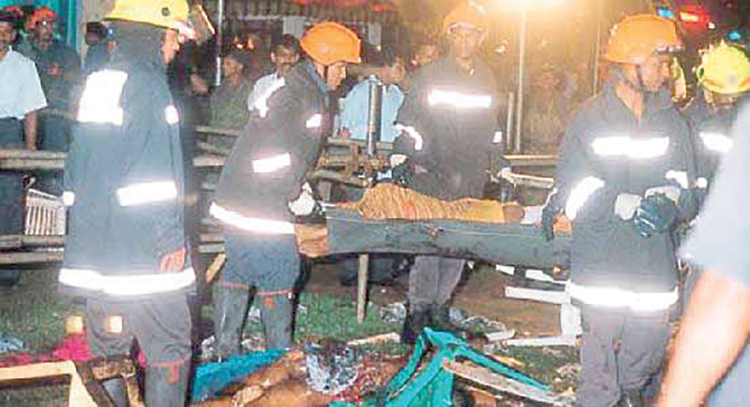
The Presidential election campaign was drawing to a close. We had campaigned hard but everyone knew that it would be a keenly contested election. A final meeting was scheduled for Saturday December 18, 1999. It was to be held near the Town Hall in Colombo and CBK was to be the chief speaker. I was accommodated in the front row of the stage together with other party leaders.
Ratnasiri Wickremanayake, the Prime Minister, had invited me to be a speaker at his final meeting in Horana. I waited till CBK arrived, spoke briefly to her and left for Horana. I had barely reached Havelock Town when I heard the sound of a blast from near the Town Hall. It was a well planned attempt on the life of CBK by the LTTE. Suicide bombers had come into the well packed grounds with a group of supporters of a Colombo district SLFP MP. Fortunately they had been prevented from coming close to the stage by the barriers set up by the Police.
CBK had finished her speech to a packed audience and was going down the gangway from the stage to her car when the bomber had detonated his bomb killing himself, several policemen, CBKs driver and many onlookers. But for the fact that her driver had driven up to the steps, thereby interposing the steel reinforced Mercedes Benz car between the bomb and CBK she would have been torn to shreds.
When we inspected the Benz it was a mass of twisted metal like a futuristic sculpture. I forgot about Horana and immediately rushed to the general hospital where to my relief I was told that the President was alive and out of danger. Since I had experience of the bombing of the UNP group meeting in Parliament during JRJs time, I rushed to Temple Trees to find that Sunethra Bandaranaike had fortunately promptly come there and was with the children upstairs.
The Temple Trees staff congregating downstairs were wandering about in shock till the arrival of President’s Secretary Balapatabendi. I urged that we should immediately get down Anuruddha Ratwatte -the Deputy Defence Minister, who at that time was in Kandy. A problem arose because helicopters could not fly at night. He was asked to come immediately by road and he did arrive in the shortest time.

Town Hall bomb scene CBK’s
In the meanwhile I suggested that Balapatabendi should broadcast the news that CBK was alive and out of danger as we had done with JRJ after the Parliament bombing. Already news about the attack was swirling because international media was using it as “Breaking News”. Bala and I went to the TV station and as he was getting into the studio I noticed that he was dressed in a black shirt which could have given a bad message to the country. I quickly took off my shirt and exchanged it for Balas black shirt. He then spoke on camera trying to calm the country wide audience dressed in an over-sized shirt.
We went back to Temple Trees and found that the PM and other Cabinet Ministers and relatives had arrived there and were taking charge of the situation. I then went to the General Hospital to see GL Peiris and Alavi Moulana who were in a state of shock and awaiting medical attention. Alavi’s shirt was blood stained and his sons were helplessly moving around asking for immediate medical attention.
After that both sides did not campaign in the remaining few days. The whole country was in a state of shock and disbelief. To the credit of Ranil Wickremesinghe he immediately visited CBK to wish her a speedy recovery and virtually called off his campaign. The shock of the Town Hall blast was compounded when almost at the same time a bomb was set off by the LTTE in Wattala where the UNP was holding a propaganda meeting. Major General Lucky Algama who was in charge of security was killed in this blast together with several UNP supporters.
Presidential Election December 2019
The presidential election was held as scheduled. We witnessed a clear shift of the sentiments of voters towards CBK after the bombing. I went to Kandy to cast my vote early as usual at the Nugawela voting centre. Immediately after that I left for Colombo. All along the road women of all ages were gathering in great numbers to cast their votes. It became clear that a sympathy vote was in the offing, especially among women. They could empathize with CBK who had lost a father and husband and now nearly lost her own life in the cause of public service.
The election results when announced proved that our hunch was correct. The declared results were as follows;
CBK
4,312,157 Votes [51.1 Percent]
Ranil
3,602,748 Votes [42.71 Percent]
Nandana Gunatillake
[JVP] 344,173 [4.08 Percent]
CBK then took a courageous decision which unfortunately backfired on her many years on as I will describe in a succeeding chapter. In the light of possible confusion following the bombing she decided to take her oath of office as the new President immediately though she had several months more to serve in terms of her earlier mandate. Though she had a team of brilliant lawyers including H L de Silva and R K W Goonesekere to advice on constitutional matters such details were not analyzed by her political staff. She took oaths before Chief Justice Sarath Nanda Silva and on the following day left for UK for medical treatment.
(Excepted from Vol. 3 of the Sarath Amunugma autobiography) ✍️

LESSONS FROM MY CAREER: SYNTHESISING MANAGEMENT THEORY WITH PRACTICE – PART 29
The last episode covered the final stages of my work as Advisor to the National Productivity Drive at the Ministry of Industrial Development. Soon after, in September 1998, I accepted the position of Managing Director of the Merchant Bank of Sri Lanka (MBSL). This chapter shares key events and lessons from my time there.
First few weeks at MBSL
The Board agreed that, for the first month, I would work only half-days, as I still had obligations I could not abandon. I was organising the International Convention on Quality Circles 1998, which attracted many foreign participants, and although we had appointed an event organiser, numerous arrangements still required my involvement. I will write more about that Convention later in these memoirs.
Those half-days turned out to be useful. They allowed me to quietly observe and understand the situation. MBSL was in worse shape than I had expected. The financial problems were visible to anyone who read the statements. The bigger crisis, however, was the staff’s morale and the rapid loss of staff members.
During the interim management period, many staff benefits had been cut, and several senior executives had already left. In the first few months, farewell gatherings became routine. It felt like rats leaving a sinking ship. And indeed, the organisation was sinking. Yet I had accepted the challenge — largely because I sensed that the Chairperson could secure government support, which she had already begun to do.
The broader environment added to the tension. The LTTE conflict was still active. Our office building, a very tall building located near the Colpetty junction, was a prime target. It had an Air Force unit with anti-aircraft guns on the rooftop one floor above he boardroom.. No one was allowed there without special permission, even though the area had originally been designed as a rooftop function space.
The first board meeting was quite hilarious because, while we were discussing important strategic issues, the upper floor was reverberating with a baila session, with boots tapping the floor keeping time. Apparently, the unit had an assurance that there would be no air strikes, and they could take a break.
My own office was spacious, but the windows were blocked because Temple Trees — the official residence of the Prime Minister — was clearly visible if not. At first, working without any outside view felt quite oppressive. Eventually, I grew accustomed to it.
Once I began full-time work in October, I carefully examined the situation with the help of my capable team. Several senior employees were not leaving for higher-paying opportunities or foreign jobs — they were committed, though uncertain about the future.
Then came investigations by the Central Bank and the Securities and Exchange Commission. Much of my time was spent responding to information requests and ensuring that all releases of information were approved. Many years previously, MBSL had unintentionally become a subsidiary of the Bank of Ceylon (BOC) when BOC’s investment arm purchased shares that pushed ownership above 50 per cent.
Hence although we were not a deposit taking institution and therefore not under the regulatory oversight of the Central Bank, we were under the Central Bank scrutiny because we were a subsidiary of the BOC. Although we were independent in operations, the customary practice was that the BOC Chairman would also chair MBSL, together with other BOC directors serving on our board. Our Chairperson, Mrs Dayani de Silva, was determined to turn MBSL around.
At that time, we operated two main divisions:
· Corporate finance, including advisory and investment banking; and
· Leasing, including trade finance.
In addition, there were the service divisions such as Human Resources, Secretarial and Finance and Accounting
Staff matters and the trade union
Morale was low. staff resisted the benefit cuts and the shift toward rules that resembled those of government departments. Signing an attendance register was particularly disliked.
I reviewed the situation carefully. Some of the removed benefits saved only trivial amounts. I reinstated those. I also installed an electronic time-card system for everyone — including myself. I announced clearly that I would clock in every day, just as they did. Naturally, the first few months were not easy.
I began holding monthly staff meetings to explain what we were doing, why we were doing it, and where we stood financially. Communication had clearly been lacking earlier, and these meetings helped rebuild trust. I also operated an “open door” policy, welcoming any employee who wished to meet me. The performance appraisal system was another issue. Instead of motivating staff, it had become a source of resentment. I suspended it for two years and asked everyone to work together as one team.
Most employees up to the Deputy Manager level were unionised, affiliated with the Ceylon Bank Employees Union (CBEU), headed by Mr M. R. Shah. The collective agreement was due, and the union presented a long list of demands — many of them impossible, given our financial state. Normally, negotiations take place between the Employers’ Federation of Ceylon (EFC) and the CBEU. The Director General of the EFC, Mr Gotabhaya Dassanayake, advised me first to build mutual confidence, especially as I had never met Mr Shah before.
I invited Mr Shah to my office. Over tea, I openly explained the crisis we were facing, our restructuring plan, and the management approach we intended to adopt. He listened carefully and asked sensible questions. We parted on friendly terms, and more importantly, with a shared understanding.
A month later, negotiations began at the EFC. To my surprise, Mr Shah began by saying that, after speaking with the new Managing Director, he understood our difficulties and accepted the direction we were taking. He then withdrew several demands on the spot. I was relieved, not because demands were dropped, but because he had recognised our sincerity and our plan. Later, Mr Dassanayake telephoned to say he had rarely seen such cooperation. In time, as restructuring succeeded, we gradually restored many benefits. That entire episode reinforced a powerful lesson: honest communication and genuine leadership build trust far faster than confrontation.
Expanding leasing
The board was deeply concerned about the leasing division. Non-performing loans were very high, and they urged me to restrict new business and focus solely on recoveries. I informed the board that management was partly to blame because the staff was pressured to meet stretch targets, and all we got were substandard leasing facilities. Targets without safeguards are never beneficial.
My thinking differed. Aggressive recovery efforts often demoralise good customers and overburden staff. In addition, the customers were already in great difficulty because they had no financial means to meet their leasing obligations. Instead, I believed we needed to build a new, healthier portfolio, while also expanding fee-based advisory work with lower risk. I had also abandoned my consultancy business when I joined MBSL, and proposed creating a new subsidiary to bring that kind of business into the bank. The board rejected it – understandably, given past failures with subsidiaries, including one in Nepal.
We decided that if our leasing operations were to grow, they needed to feel more connected to ordinary Sri Lankans. Research revealed that many people viewed us as an “English-speaking bank.” That perception alone discouraged potential customers.
So, we refreshed our leasing brand. The new logo carried the Sinhala word for “leasing,” applications were printed in Sinhala, and signboards carried both languages. Even the telephone operator’s greeting changed. Instead of the polished “Good morning, MBSL,” which sometimes intimidated Sinhala-speaking callers, we switched to “Ayubowan, MBSL.” It was friendly, respectful, and immediately accepted across all segments.
When an SME business owner comes for a lease, they have already selected the vehicle, and the decision is more based on ego than on a business requirement. We would discourage them and enlighten them that the vehicle does not match their requirements, and advise them to select a smaller one. They look unhappy, but they finally agree when presented with the maths of repayment.
We also organised short educational sessions for our customers on how to maintain vehicles, extend tyre life, the importance of the correct lubricants, and improve customer service. These simple initiatives created goodwill, strengthened customer relationships, and soon, the leasing business began to grow. At the same time, we were tough on recoveries, and some unpleasant moments included we seized a vehicle when a couple was on their honeymoon. The board, while pressuring me to recover, also constantly reminded me that no strong-arm tactics should ever be used.
Improving cash availability
Before I joined, two government institutions had agreed to provide debentures, with Treasury comfort letters. However, a condition required us to build a monthly sinking fund for repayment. To me, this made little sense. We were already short of operating cash. Locking more away would only weaken us further.
The head of finance had faithfully followed the rule. I instructed him to stop doing so and to use the funds for business expansion. When the board asked how we planned to repay the debentures, my answer was simple: growing organisations borrow when repayment comes due — that is how business operates.
We also began selling off our minority shareholdings from our share portfolio wherever possible even at a loss. The market was depressed, and those investments in shares contributed nothing to our survival. We retained only the Merchant Credit of Sri Lanka and divested the others. Gradually, liquidity improved, and operations stabilised.
The thorny bonus issue
Before my arrival, the board had approved bonuses despite the 1997 crisis. I was surprised how it happened soon after chalking up a billion rupee loss. However, just three months into my tenure, the board refused the December 1998 bonus. I found myself in a painful position. The EFC warned that withholding payment was risky because bonuses were written into appointment letters. Yet, reality was clear — we simply could not afford it.
I addressed the staff personally, explained the situation frankly, and announced the decision. The disappointment was visible everywhere. But given the circumstances, they accepted it.
There were more challenges and many more lessons still to come. In the next article, I will continue the story of how, step by step, we navigated those difficulties and rebuilt the organisation.
(The writer is a Consultant on Productivity and Japanese Management Techniques
Retired Chairman/Director of several listed and unlisted companies
Recipient of the APO Regional Award for Promoting Productivity in the Asia-Pacific Region
Recipient of the Order of the Rising Sun, Gold and Silver Rays from the Government of Japan
Email: bizex.seminarsandconsulting@gmail.com)
By Sunil G. Wijesinha ✍️

National Communication Programme for Child Health Promotion (SBCC) has been launched. – PM

Level I landslide early warnings issued to the Districts of Badulla, Kandy, Matale and Nuwara-Eliya extended

Rescuers race to find dozens missing in deadly Philippines landfill collapse

Trump seeks $100bn for Venezuela oil, but Exxon boss says country ‘uninvestable’

US military strikes Islamic State group targets in Syria, officials say

Gardner and Wareham lead Giants to opening-game victory

‘Dates have the highest sugar content to fight Coronavirus’

Sunday Island 27 December – Headlines

#SundayIsland 17th December – Headlines

Sunday Island – 28th March

Sunday Island Headlines – 21 March

Sunday Island – 21st February – Headlines
-

 News5 days ago
Interception of SL fishing craft by Seychelles: Trawler owners demand international investigation
-
 News5 days ago
Broad support emerges for Faiszer’s sweeping proposals on long- delayed divorce and personal law reforms
-
 News8 hours ago
Sajith: Ashoka Chakra replaces Dharmachakra in Buddhism textbook
-

 Opinion2 days ago
The minstrel monk and Rafiki, the old mandrill in The Lion King – II
-

 Features2 days ago
The Venezuela Model:The new ugly and dangerous world order
-

 Latest News2 days ago
Rain washes out 2nd T20I in Dambulla
-
 Business1 day ago
Sevalanka Foundation and The Coca-Cola Foundation support flood-affected communities in Biyagama, Sri Lanka
-

 News4 days ago
Prez seeks Harsha’s help to address CC’s concerns over appointment of AG