
News
JVP policies differ from those of NPP – SB spokesman


NPP will retain constitutional provision that guarantees foremost place for Buddhism nor weaken unitary status – Vijitha
By Shamindra Ferdinando
Sarvajana Balaya spokesman Gevindu Cumaratunga, MP, has alleged that the NPP manifesto differs quite significantly from what the party is propagating in support of its presidential candidate Anura Kumara Dissanayake.
The dissident SLPPer said among contestable issues were the constitution making process and the 13th Amendment to the Constitution.
Referring to page 230 of the NPP manifesto, released in the run-up to the Sept. 21 presidential election, Cumaratunga, who appeared on behalf of Sarvajana Balaya candidate Dilith Jayaweera at a public forum organised by All Ceylon Buddhist Congress, questioned the NPP’s intention to expedite the constitution making process undertaken by the Yahapalana administration during the 2015-2019 period. The then Prime Minister Ranil Wickremesinghe led the process that was brought to an end with the election of Gotabaya Rajapaksa at the 2019 presidential election.
MP Cumaratunga explained how the JVP had surreptitiously backed Wickremesinghe’s strategies.
Cumaratunga questioned why the government had tabled the National Land Commission Bill and the Commission for Truth, Unity and Reconciliation in Sri Lanka Bill in Parliament ahead of the presidential election.
Declaring that land and police powers hadn’t been fully granted yet, regardless of the enactment of the 13th Amendment, MP Cumaratunga warned of dire consequences in the event of forming a separate provincial police unit for each province. He said that the real issue was not the provincial police coming under the purview of a Senior DIG answerable to the relevant Chief Minister, but the formidable challenge posed by a police force empowered to procure arms.
Against the developing situation, the NPP declaration that it would revive the Yahapalana constitution making process amounted to an extremely serious threat to the country, MP Cumaratunga said, alleging that the constitution proposed during the Yahpalana regime had been aimed at doing away with Sri Lanka’s unitary status. The MP said that the NPP wanted to resume a project that had been defeated by the nationalistic forces at that time.
While condemning the Commission for Truth, Unity and Reconciliation in Sri Lanka Bill, MP Cumaratunga pointed out that the NPP, in its manifesto assured that measures proposed in terms of the new law would be further expanded. He said the NPP was determined to go ahead with a controversial law that had been enacted at the behest of President Wickremesinghe.
MP Cumaratunga sought a clarification from the NPP regarding its assurance regarding the full implementation of the 13th Amendment pending enactment of a new Constitution within 2 years.
However, by then NPP MP Herath had left the forum after making his presentation.
Addressing the gathering on behalf of Anura Kumara Dissanayake, Gampaha District MP Herath assured that they wouldn’t under any circumstances resort to an agenda inimical to the country.
MP Herath declared that Article 09 of the Constitution that dealt with Buddhism wouldn’t be altered in anyway. The JVPer also assured the gathering of the country’s unitary status while declaring that the NPP wouldn’t proceed beyond the current status of the 13th Amendment.
Recalling their initial rejection of the 13th Amendment to the Constitution in 1987, MP Herath said that particular law never addressed the national issue or facilitated development.
Referring to Article 14 of the Constitution, MP Herath said that their administration upheld and would guarantee the freedom of speech, and other rights of the public.
Herath also dismissed often repeated allegations that the NPP would bring in laws targeting law enforcement and military officers in respect of accountability issues though they wouldn’t interfere with crimes being dealt with according to the law.
One-time Cultural Affairs and National Heritage Minister Herath said that the JVP wouldn’t move against Buddhism. The JVPer said that their presidential candidate, Dissanayake, had been the Chairman of the Buddhist Society of the Kelaniya University.
MP Cumaratunga, in his presentation discussed how the government had used Parliament to enact laws that were inimical to the country’s interest. The MP named Sri Lanka Electricity Bill as one such law that should be abolished.
MP Cumaratunga said that MPs merely rubber-stamped bills that were contrary to Sri Lanka’s interests and in fact undermined national security. Parliament passed Sri Lanka Electricity Bill by a majority of 44 votes on June 06 this year.
At the end of the debate on the Second Reading of the Bill held yesterday, the Opposition called for a division and accordingly, 59 votes were cast against and 103 were cast in favour.
Referring to ECTA (Economic and Technology Co-operation Agreement), MP Cumaratuga said that they intended to review all international agreements and agreements under consideration and discussion.


Latest News
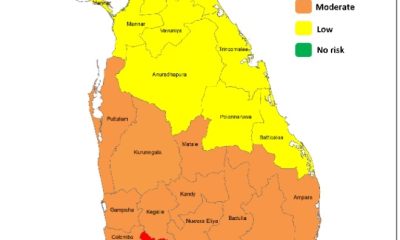
Heat Index likely to increase up to ‘Caution level’ at some places in the Western, Sabaragamuwa, Southern and North-western provinces and in Anuradhapura, Monaragala, Mannar and Vavuniya districts


Warm Weather Advisory
Issued by the Natural Hazards Early Warning Centre of the Department of Meteorology
at 3.30 p.m. on 21 March 2026, valid for 22 March 2026.
Heat index, the temperature felt on human body is likely to increase up to ‘Caution level’ at some places in the Western, Sabaragamuwa, Southern and North-western provinces and in
Anuradhapura, Monaragala, Mannar and Vavuniya districts.
The Heat Index Forecast is calculated by using relative humidity and maximum temperature and this is the condition that is felt on your body. This is not the forecast of maximum temperature. It is generated by the Department of Meteorology for the next day period and prepared by using global numerical weather prediction model data.

Effect of the heat index on human body is mentioned in the above table and it is prepared on the advice of the Ministry of Health and Indigenous Medical Services.
ACTION REQUIRED
Job sites: Stay hydrated and takes breaks in the shade as often as possible.
Indoors: Check up on the elderly and the sick.
Vehicles: Never leave children unattended.
Outdoors: Limit strenuous outdoor activities, find shade and stay hydrated.
Dress: Wear lightweight and white or light-colored clothing.
Note:
In addition, please refer to advisories issued by the Disaster Preparedness & Response Division, Ministry of Health in this regard as well. For further clarifications please contact 011-7446491.
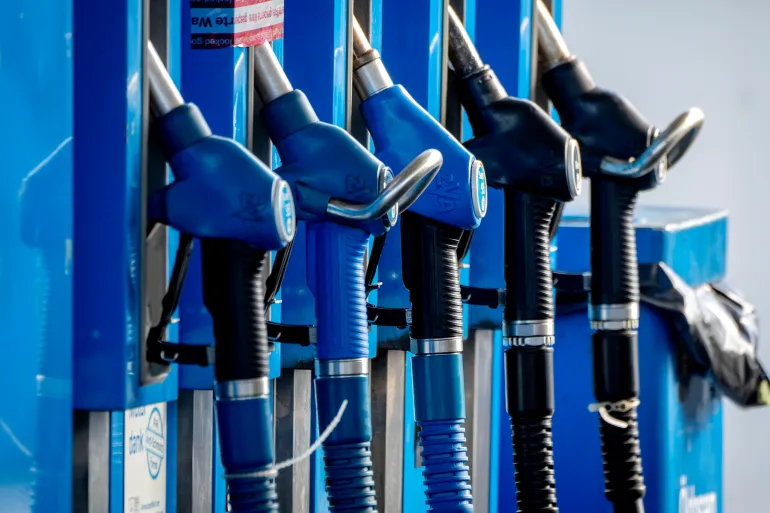
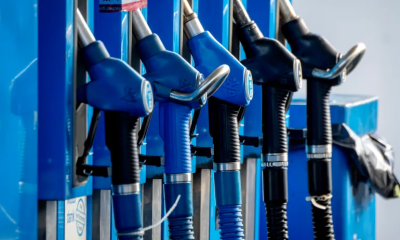
The Ceylon Petroleum Corporation (Ceypetco) has announced a revision of fuel prices, effective from midnight today (21).
Accordingly,
Auto Diesel – Rs. 382 (increased by Rs. 79)
Super Diesel – Rs. 443 (increased by Rs. 90)
Petrol 92 Octane – Rs. 398 (increased by Rs. 81)
Kerosene – Rs. 255. (increased by Rs. 60)
Petrol 95 Octane – Rs. 455 (increased by Rs. 90)

Latest News
Advisory for Severe Lightning issued for Galle, Matara, Kaluthara and Rathnapura districts
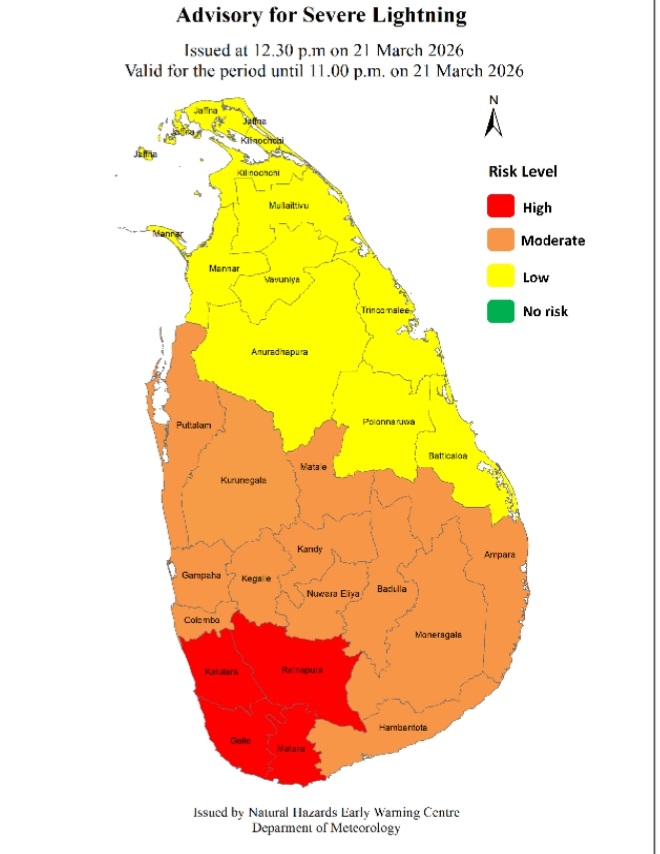
Advisory for Severe Lightning Issued by the Natural Hazards Early Warning Centre Issued at 12.30 p.m. 21 March 2026, valid for the period until 11.00 p.m. 21 March 2026
Thundershowers accompanied with severe lightning are likely to occur at some places in the Galle, Matara, Kaluthara and Rathnapura districts after 1.00 p.m.
There may be temporary localized strong winds during thundershowers. General public is kindly requested to take adequate precautions to minimize damages caused by lightning activity.
ACTION REQUIRED:
The Department of Meteorology advises that people should:
Seek shelter, preferably indoors and never under trees.
Avoid open areas such as paddy fields, tea plantations and open water bodies during thunderstorms.
Avoid using wired telephones and connected electric appliances during thunderstorms.
Avoid using open vehicles, such as bicycles, tractors and boats etc.
Beware of fallen trees and power lines.
For emergency assistance contact the local disaster management authorities.

Heat Index likely to increase up to ‘Caution level’ at some places in the Western, Sabaragamuwa, Southern and North-western provinces and in Anuradhapura, Monaragala, Mannar and Vavuniya districts

CEYPETCO Fuel prices increased from midnight today (21)

Advisory for Severe Lightning issued for Galle, Matara, Kaluthara and Rathnapura districts

Sri Lanka says it denied US request to land two aircraft at Mattala airport

Eid celebrations dimmed by war and displacement across Middle East

Showers may occur at several places in the Western, Sabaragamuwa, Northwestern and Uva provinces and in Galle, Matara, Kandy and Nuwara-Eliya districts after 1.00 pm.

‘Dates have the highest sugar content to fight Coronavirus’

Sunday Island 27 December – Headlines

#SundayIsland 17th December – Headlines

Sunday Island – 28th March

Sunday Island Headlines – 21 March

Sunday Island – 21st February – Headlines
-

 Business6 days ago
Browns EV launches fast-charging BAW E7 Pro at Rs. 5.8 million
-

 Life style7 days ago
From culture to empowerment: Indonesia’s vision for Sri Lanka
-

 News4 days ago
CIABOC questions Ex-President GR on house for CJ’s maid
-

 Life style7 days ago
Ranjith Fernando celebrates cricketing journey with Hob Nails to Spikes
-

 News5 days ago
Sri Lankan marine scientist Asha de Vos honoured at UNGA opening
-

 Features6 days ago
Achievements of the Hunduwa!
-
 Latest News7 days ago
QR code system will be implemented for fuel with effect from 06.00 a.m. today (15th)
-

 News5 days ago
Australian HC debunks misleading travel risk claims for Sri Lanka