
Sports
Jaffna Stallions highly impressive in LPL

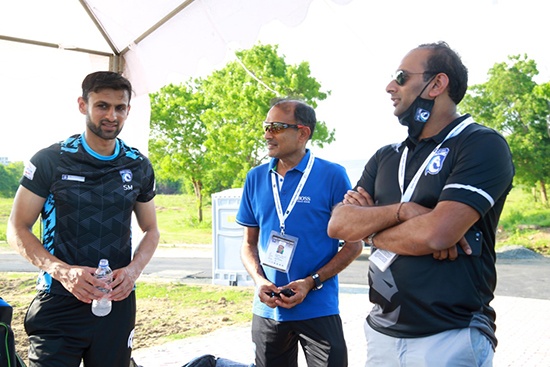
Jaffna Stallions’ CEO Ananthan Arnold (middle) in conversation with the team’s overseas signing Shoaib Malik. COO Paven Savuntharasa is also in the picture.
by Rex Clementine
With most cricket playing nations initiating a franchise based tournament in their calendar, Sri Lankan cricket was left stranded for years not being able to start something of their own. However, with the launch of Lanka Premier League, there was a shot in the arm. Interest for franchise ownerships were mostly shown by Indian and Pakistani business entities. Jaffna Stallions’ ownership though is different.
Anandan Arnold, who played cricket for St. John’s, Jaffna is the founder CEO of Jaffna Stallions and leading investor. Canadian born Rahul Sood, who now lives in Seattle is a major co-owner in the consortium which also consists of Sri Lankan expatriates living in the UK, Canada, Australia and Europe. The owners are multi-ethnic, multi-faith Sri Lankans of diverse backgrounds.
Jaffna Stallions are also the most organized franchise in the competition. While most franchises were putting through the logistics in the 11th hour, according to Thisara Perera, the captain of the team, all his players were taken to Kandy for a five-day residential training camp. While no doubt the training camp helped develop skills it also enabled the team to bond well.
The franchise has a formidable outfit. Their fast bowlers – Suranga Lakmal, Duanne Olivier, Kyle Abbott and Usman Shinwari are good enough to form the nucleus of any international side.
But the franchise has not forgotten the development of young talent as well and hence they have picked a few uncapped players – from north and south – Sebastianpillai Vijeyaraj, Vijayakanth Viyaskanth, Kanagarathinam Kabilraj, Theivendram Dinoshan and Nuwanidu Fernando.
Among the four youngsters Viyaskanth had an impressive debut last week but there is another exciting talent in Vijeyaraj, who bowls like Lasith Malinga. He has been nicknamed ‘Killinochchi Express.’
Viyaskanth was the talk of the town as he debuted last week. His line and length were impeccable and the leg-spinner foxed Angelo Mathews of all players. His efforts came in for high praise from all and sundry – both team mates and opposition.
The Stallions are the in form side in the competition as they recorded four straight wins while the others were playing catch up. For the fifth game, with a slot in the semi-final certain, the team rested four of their front line players and gave a break to some others. If they continue to rotate players, that will be a good idea as well as when the business end of the tournament comes along, the leading players will be fresh and raring to go.
The team’s motto is to be a cricket club that provides a pathway to excellence for local and national athletes. They have made huge strides in the LPL and don’t be surprised if they win the maiden title for they say, ‘well begun is half done.’







Why did David Miller refuse a single off the penultimate delivery with Delhi Capitals needing 2 off 2? It’ll be spoken of for a while, but not inside the Gujarat Titans change room. Because Prasidh Krishna bowled a nerveless slower bouncer off the final delivery that Miller missed, and Jos Buttler then nailed a direct hit with an underarm throw from behind the stumps to run out Kuldeep Yadav, clinching a dramatic first win for GT in IPL 2026.
Despite being adjudged run out on the field, Miller wasn’t in the mood to concede defeat, and reviewed the final ball for a possible wide. But when replays confirmed what he had perhaps known, he was crestfallen. Equally distraught in the dugout was K L Rahul, whose 52-ball 92 set the game up for DC but for one run.
It was GT’s first win of the tournament and the first loss for DC after starting the campaign with two wins in a row.
Thirty-six needed off 12. A bruised finger that didn’t make it easy for him to grip the bat had forced Miller to retire hurt with DC needing 81 off 42. But when Tristan Stubbs was run-out in the 17th over, Miller returned hoping to play second fiddle to Rahul. Instead, he was now expected to deliver a box-office hit with Rahul nicking behind off a full Mohammed Siraj delivery two balls later.
Miller nearly delivered what was expected, as he went 6, 4, 6 off Siraj, repeatedly peppering the short leg-side boundary. At the other end, Vipraj Nigam also ramped four off a short delivery to bring the equation down to a manageable 13 off the final over.
Prasidh was tasked to bowl the final over. His three overs prior to that had been walloped for 41; Rahul, his state mate, had climbed into him earlier in the night. But all that would’ve been forgiven if Prasidh delivered a gun final over. That GT could only have four fielders out due to a slow over rate added to his challenge. And he nearly succumbed.
Nigam made room and swung cleanly to hit the first ball to the long-off fence, but a rush of blood had him swipe the second delivery to Shubman Gill at mid-off. With DC now needing nine off four, Kuldeep gently deflected his first ball to deep third to leave the chase in Miller’s hands.
With the equation down to 8 off 3, Prasidh bowled a slot-ball that Miller walloped over long-off. But with two needed, Miller inexplicably refused a single to take it all upon himself to finish the deal. He couldn’t connect on the final ball, and Prasidh belted a roar. GT had pulled one from under DC’s rug in dramatic circumstances.
After scores of 1 and 0 in his first two games, Rahul announced himself with a 29-ball half-century that was as pleasing as they come for large parts. It was also one that didn’t have the baggage of him playing run-accumulator, like he has tended to in the past while opening the batting. This Rahul was fun, free and fearless and he helped DC overcome a few roadblocks along the way, like when they lost two wickets in two deliveries to Rashid Khan at the halfway mark.
Rahul was particularly menacing against the fast bowlers, and it began with a wristy flick that he sent way back over deep square off Kagiso Rabada. The early jitters out of the way – if he even had some inkling of them – he batted like a man possessed, fearlessly climbing into length balls from Prasidh over cover, and slapping disdainfully over point.
He is good, but where is the Rashid of old, they asked. Turns out he hadn’t gone anywhere. After he conceded just nine in his first two with DC rampant, he returned to dismiss Nitish Rana in his dramatic third over, the 10th of the innings. Having been given out lbw earlier, only for Rana to overturn the decision through DRS, he was out a few balls later when he miscued a googly to Sai Sudharsan at long-off. This was Rana’s third sub-20 score of the season.
This brought the in-form Sameer Rizvi to the middle, and he lasted all of one delivery as Rashid snuck through his inside-edge with a ripping googly to briefly elicit jitters in the DC camp. This is when Miller entered, before briefly exiting with seven overs left. But in the same over, when Rashid had Axar Patel slice one to Glenn Phillips running back from cover, GT started to have an opening.
On any other night, Rashid’s spell would have cracked open the game. The fact that DC were still in it despite these wickets was down to Rahul. It needed the skilful Siraj to dismiss him with DC needing 45 off three overs. By then, the pressure was telling.
That GT were eventually able to get over the line was down to their run cushion, made possible thanks to half-centuries from Jos Buttler, Gill and Washington Sundar. Buttler looked unshackled, hitting four sixes off his first 15 deliveries en route a bruising half-century, while Gill played himself in and then allayed fears of neck spasms during his takedown of Kuldeep with the slog sweep. Then Washington, promoted to No. 4, struck his maiden IPL fifty to shore up the innings.
Even so, GT managed just 49 off the last five. On another day, this may have proved to be costly. It didn’t on Wednesday, and for that, they have Rashid to thank.
Brief scores:
Gujarat Titans 210 for 4 in 20 overs (Sai Sudarshan 12, Shubman Gill 70, Jos Buttler 52, Washington Sundar 55, Glenn Phillips 14*; Mukesh Kumar 2-55, Lungi Ngidi 1-24, Kuldeep Yadav 1-42 ) beat Delhi Capitals 209 for 8 in 20 overs (Pathum Nissanka 41, KL Rahul 92, David Miller 41*, Vipraj Nigam 12; Mohammed Siraj 1-42, Rashid Khan 3-17, Prasidh Krishna 2-52) by one run
[Cricinfo]

A stunning hundred by opening bat Lasith Croospulle helped Sri Lanka ‘A’ to post a commanding 368 for nine in their allotted 50 overs and then restrict New Zealand ‘A’ to 158 for three and a secure a 44 run win [DLS method] at Suriyawewa yesterday. The win helped Sri Lanka to take an unassailable 2-0 series lead.
The star for Sri Lanka ‘A’ was the former Maris Stella College, Negombo cricketer Lasith Croospulle as he smashed 103 off just 76 balls hitting 13 fours and six sixes as the hosts piled up the runs.
Croospulle has represented Sri Lanka in one T20I and performances such as these are sure to earn him a regular spot in the white ball sides.
The middle order then ensured that they didn’t spoil the good work of the top order with captain Sahan Arachchige and Sonal Dinusha posting half-centuries.
Arachchige smashed 76 in 68 balls with five fours and two sixes while young Sonal Dinusha put the bowling to the sword during the death overs. His 93 came off 77 deliveries with six fours and four sixes.
Dinusha, who has already made his Test debut and impressed many with his electric fielding could have gone on to post his hundred but sacrificed his wicket in a bid to score quick runs.
With the World Cup less than a year away and the selectors keeping a close eye on the second string, performances like these are sure to get their attention.
Rain reduced the game to 28 overs and New Zealand were given a revised target of 203 but they only managed 158 for three to hand Sri Lanka a comfortable win.
Sri Lanka ‘A’ had won the first game by 140 runs in Galle. Saturday’s third one-dayer will be a dead rubber.
The teams will stay back at Suriyawewa for two further weeks where the two match unofficial Test series will be played.
The composition for the four day games is set to change with Pasindu Sooriyabandara set to lead the side.

BCCI curbs movement of benched IPL players in latest rules

Prasidh trumps Miller in last-ball finish as Gujarat Titans clinch thriller

Greece to ban social media for under-15s from next year

Showers will occur at a few places in the Western, Sabaragamuwa and North-western provinces and in Galle, Matara, Kandy, Nuwara-Eliya and Mannar districts after 2.00 p.m.

Sun directly overhead Chilaw, Bingiriya, Halmillawewa, Panduwasnuwara, Gokarella, Kawudupelella, Koppaveli and Kirankulam about 12:12 noon. today (09)

Heat Index at Caution Level in the Western, Sabaragamuwa, Southern, Eastern, North-western, Northern and North-central provinces and in Monaragala district

‘Dates have the highest sugar content to fight Coronavirus’

Sunday Island 27 December – Headlines

#SundayIsland 17th December – Headlines

Sunday Island – 28th March

Sunday Island Headlines – 21 March

Sunday Island – 21st February – Headlines
-

 Features4 days ago
Ranjith Siyambalapitiya turns custodian of a rare living collection
-

 News4 days ago
Global ‘Walk for Peace’ to be held in Lanka
-

 News2 days ago
Lankan-origin actress Subashini found dead in India
-

 Opinion6 days ago
Hidden truth of Sri Lanka’s debt story: The untold narrative behind the report
-

 Features4 days ago
Beyond the Blue Skies: A Tribute to Captain Elmo Jayawardena
-

 Features4 days ago
Aspects of Ceylon/Sri Lanka Foreign Relations – 1948 to 1976
-

 Features6 days ago
The Ramadan War
-

 Editorial5 days ago
Brouhaha over a book