
Sports
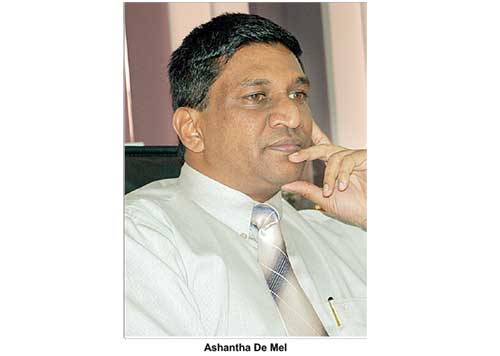
It’s all De Mel’s faults

by Rex Clementine
A senior sports writer warned us that less than ten percent of people who read this article are going to like it. But facts are stubborn. As one visionary priest – late Fr. Bernard Quintus OMI used to say, ‘cheap popularity is not going to get us anywhere.’ With the stepping down of Ashantha De Mel, cricket has found a scapegoat on whom all sins are pinned. It’s as if Sri Lankan cricket hit rock bottom due to De Mel’s blunders. The truth is far from it.
De Mel has been shredded to pieces in social media. At this rate, he will be even blamed for the extreme heat that people are experiencing in Mannar these days and not Rishad. Most of the things said about De Mel are not true. For example that his wife is related to Shiranthi Rajapaksa, the wife of Prime Minister Mahinda Rajapaksa! That’s a total fabrication.
However, what is true is that De Mel was Chairman of Selectors when Sri Lanka reached the finals of three World Cups – in 2007 in the Caribbean, in 2009 in London and in 2012 at RPS. For record’s sake, he was also Chairman of Selectors when Sri Lanka whitewashed England in their own backyard 5-0 in 2006. During his tenure, the national cricket team won Test matches in Pakistan, New Zealand, England, West Indies and South Africa.
There’s a lot to like about De Mel; lot of things that people dislike. The foremost of them being that he minces no words and calls a spade a spade. Selectors are supposed to take unpopular decisions. He has taken plenty of them, including the sacking of Arjuna Ranatunga. He was the Chairman when Marvan Atapattu was picked in the 2007 World Cup squad but benched for all games. When Marvan vented his anger calling his selection panel ‘a bunch of puppets headed by a joker’, at the Gabba, De Mel bore the brunt of it and never spoke against Marvan. That’s a hallmark of someone who has matured doing the job.
People who have stoned and crucified him have conveniently forgotten that he was Chairman of Selectors when Sri Lanka recorded one of their greatest wins in the history 18 months ago – a Test series win in South Africa. He was vilified when he picked Oshada Fernando and Lasith Embuldeniya out of the blues. The press, including yours truly, asked what they had done to merit selections. But as uncle Percy says, ‘De Mel knows his onions’. He has this rare ability to spot talent and persevere with them.
Those two selections proved to be a masterstroke. Both players made match winning contributions as Sri Lanka became the first Asian nation to win a Test series in South Africa.
We Sri Lankans by nature tend to find quick fixes rather than going to the bottom of an issue. So as our batting crumbled against England, all blame was placed on De Mel’s doorstep. Is he also doubling up as Batting Coach apart from his multiple roles as Chairman of Selectors and Manager? It’s so sad to see that nobody is holding Grant Flower accountable.
This is not to say that we agree with all decisions of De Mel. His biggest blunder was appointing Lasith Malinga as T-20 and ODI captain. Once he gave the captaincy to Lasith, it was extremely difficult to get it back. Lasith and captaincy is like Ranil and UNP leadership. Cricket being a gentleman’s game Lasith eventually gave in. Ranil bats on regardless – no shame whatsoever. Sir John Kotelawala must be spinning in his grave.
De Mel’s other biggest fault was giving in to political pressure and accommodating that ‘three dimensional’ cricketer Jeevan Mendis into the World Cup squad in 2019. We always think that Jeevan Mendis is the Michael Jordan of Sri Lanka. Once in every four years the Bulls legend made a cameo appearance for the Dream Team during the Olympics and so does our hero who is indispensable when a World Cup is around the corner. His Thomian pedigree took him places – if you can read between the lines.
You can blame De Mel as much as you want but you better find out a new scapegoat by April when Bangladesh are going to be here. We have already got one in mind – Ashley de Silva.
Cricket authorities need to take both long term and short term steps to avoid a catastrophe against Bangladesh. The short term answers are getting two ‘A’ teams to visit Sri Lanka and get our second string to play competitive cricket and try and see whether the replacements for Dilruwan Perera and Niroshan Dickwella can be found. At the moment, these guys have had it too easy. There’s no one breathing down their neck.
The long term solution is fixing domestic cricket. This SLC is hell bent on not doing because they will be antagonizing those clubs who vote them into positions. The Sports Minister has promised to address the issue to introduce a competitive domestic tournament. So did his predecessors. The only thing that is certain about a politician and his promises are that they can be broken.
So instead of blaming De Mel, we need to address the real issues. Unless we do that, we are fooling ourselves. No individual is at fault for this mess. The blame needs to be placed on the doorstep of SLC and their short sighted policies. The initial plan was to have eight teams play First Class cricket. When people triple it, we are asking for trouble. And then we are blaming De Mel for all our problems.
As said at the start, there is a good possibility of 90% of our readers not liking this article. Thank you for being one of them.






Ireland and Australia have both been eliminated from the T20 World Cup as rain prevented play in the Group B game between the Irish and Zimbabwe at Pallekele Cricket Stadium in Kandy.
Zimbabwe’s shock victory over Australia left them needing just a point on Tuesday to advance to the Super 8s with the match being a must-win for Ireland to retain any hope of advancing.
Australia, who suffered an eight wicket defeat to Sri Lanka on Monday, were also banking on a win for Ireland to remain in the hunt for the next phase.
But with the rain unrelenting in Kandy the match was ultimately abandoned with both Ireland and Zimbabwe taking a point apiece.
That left Zimbabwe on five points and Ireland – whose four-game campaign is complete – on three, with Australia sitting on two and just one game remaining against Oman on Friday (13:30 GMT) which is now a dead rubber.
Zimbabwe will take on Sri Lanka in Colombo on Thursday (09:30 GMT) with the winner topping Group B, but they are both guaranteed a place in the next phase of the tournament.
[BBC Sports]
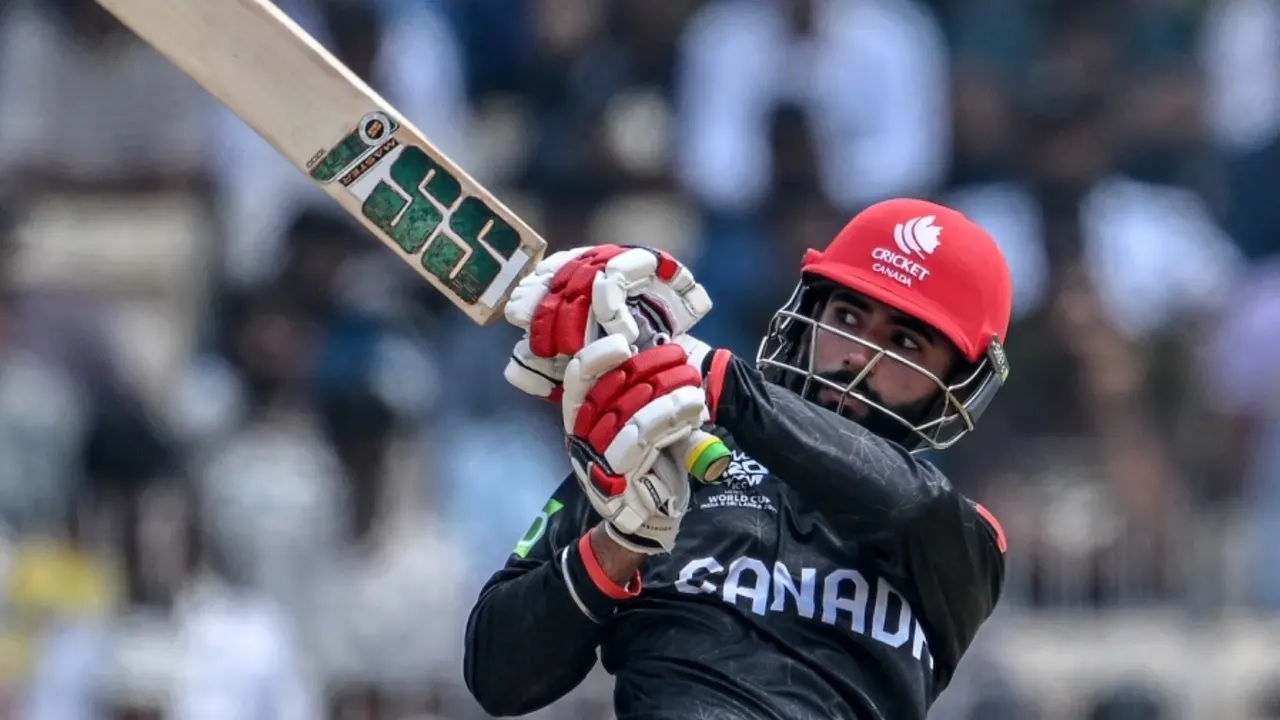
Yuraj Samra’s record-breaking hundred went in vain as New Zealand beat Canada by eight wickets in Chennai to qualify for the Super Eight stage of the 2026 T20 World Cup.
Batting first, Canada posted a competitive 173 for 4, thanks to Samra’s 110 off 65 balls, the highest score by an Associate batter against a Full Member in the tournament’s history. At 19 years and 141 days, the left-hand opener also became the youngest to cross 50 in a men’s T20 World Cup match.
Canada’s bowlers and fielders, though, let them down. They did send back Tim Seifert and Finn Allen inside the first four overs, but Glenn Phillips and Rachin Ravindra snatched the game away from them and ran away with it.
Phillips smashed 76 not out off 36 balls and Ravindra 59 not out off 39. The two added 146 off just 73 balls for the third wicket and took New Zealand home with 4.5 overs to spare.
Matt Henry started the proceedings with four dots to Samra but the opener got going with back-to-back fours off the last two deliveries. Samra faced only five balls in the next four overs but took James Neesham down in the final over of the powerplay. With Neesham operating from around the wicket, he pulled to fine leg, muscled over midwicket, drilled down the ground, and slashed over the covers after coming down the ground. The first three went for fours, the last carried all the way.
Samra kept the scoreboard ticking even after the powerplay. He smashed Kyle Jamieson’s slower ball through extra cover before pulling Cole McConchie for a flat six. Soon, he reached his fifty, off 36 balls.
New Zealand were without Lockie Ferguson and Mitchell Santner. Ferguson has returned home for the birth of his first child and Santner was ruled out because of a “dodgy burger”. In their absence, New Zealand’s bowling attack looked toothless, and Samra took full advantage of it. He started the 13th over by smashing McConchie for 6, 6, 4. Dilpreet Bajwa and he added 116 in 14 overs for the first wicket; Bajwa’s contribution was only 36 off 39 balls.
Samra brought up his hundred off 58 balls, getting there with a toe-ended four past short third. He had a reprieve on 103 when Neesham dropped him at long-on off Henry. The ball burst through Neesham’s hands and went for four. Samra was eventually dismissed in the final over, caught at deep-backward square-leg by Phillips on the second attempt.
Canada’s indiscipline with the ball was evident from the very first over. Jaskaran Singh’s second delivery was down the leg side, which Allen helped to the fine-leg boundary. It was followed by an off-side wide and a front-foot no-ball. Allen attempted a quick single off the latter. The short midwicket fielder missed with the throw at the bowler’s end, and a sloppy effort from the fielder backing up resulted in four overthrows.
Allen then took apart Dilon Heyliger, hitting his first two balls for a four and a six. Seifert also threw his bat around and got one over the covers. Shivam Sharma, the chasing fielder, was casual in his effort near the boundary line and failed to flick the ball back.
Saad Bin Zafar provided temporary relief by having Seifert caught at mid-off. When Allen was caught in the covers off a Heyliger delivery that stuck in the pitch, New Zealand were 30 for 2 in 3.1 overs. But Canada continued to be profligate in the field. Bajwa started the fifth over with a no-ball, and also bowled a wide before Ravindra hit him for two fours in three balls. That allowed New Zealand to finish the powerplay on 60 for 2.
Phillips took the lead after the powerplay. He hit Saad for back-to-back fours before launching Bajwa for a straight six. When Ansh Patel came on to bowl, Phillips treated him with the same disdain, hitting the left-arm wristspinner for three sixes in eight balls. The last of those sixes brought up Phillips’ fifty, off 22 balls.
By the end of the 11th over, New Zealand needed only 53 from 54 balls. Phillips, though, was in a hurry. Against Saad, he switched his hands and pulled him for a six over deep extra-cover, even though there was a fielder at the boundary line. Ravindra, who had taken the backseat, finished the over with another six. A few minutes later, he pulled Jaskaran through midwicket to bring up the victory.
Brief scores:
New Zealand 176 for 2 in 15.1 overs (Finn Allen 21, Glenn Phillips 76*, Rachin Ravindra 59*, Dilon Heyliger 1-42, Saad Bin Jaffar 1-29) beat Canada 173 for 4 in 20 overs (Yuraj Samra 110, Dilpreet Bajwa 36, Navneet Dhaliwal 10; Matt Henry 1-28, Jacob Duffy 1-25, Kyle Jamieson 1-41, James Neesham 1-38) by eight wickets
[Cricinfo]
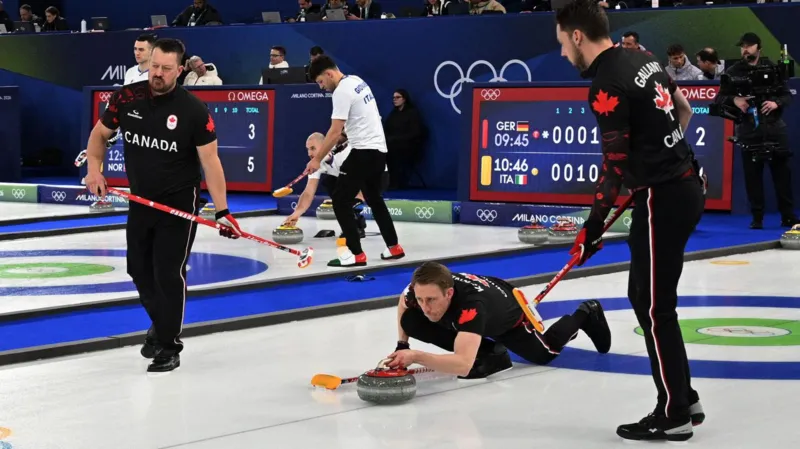
A scandal at the Winter Olympics has left the Canadian curling teams on the defensive and Canadians reeling over the crack in their country’s polite persona.
Over the weekend, Canadian curler Marc Kennedy had an expletive-filled outburst after Sweden accused him of cheating during a match, and later said his team might be the target of a “premeditated” attack by their rivals.
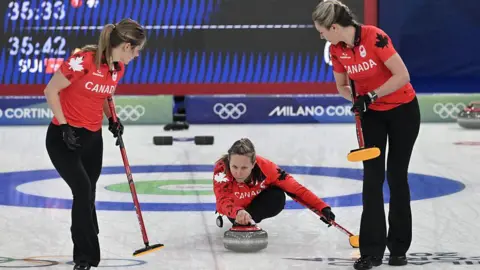
Kennedy was accused of “double-touching” – touching the stone a second time after initially releasing it down the ice. The next day, Canadian women’s captain Rachel Holman was accused of using the same move.
Both have denied the accusations, but Canada’s curling teams, who historically have dominated the sport, now face questions over their tactics.
While the curlers have shown their anger over the situation during matches, fans of the sport and Canadians have questioned whether the team acted in the spirit of curling.
“It’s a sad day for Canadian sport,” Tim Gray, from Alberta, told the BBC. “Integrity in the sport is important, even if you have to call it on yourself.”
An opinion piece in the Canadian news outlet, the Globe and Mail, pointed to some of the frustration: “These Canadian curling teams are not fun bad guys. They come off like the sort of competitors who need so desperately to win that they will do anything – even things that are pointless – in order to get there.”
Cathal Kelly, the writer of the opinion piece, continued: “There’s an easy way out of this – stop struggling. Stop acting like our curling reputation matters more than our national one. Be the bigger man and woman, even if you don’t think you did anything wrong.”
The controversy began on Friday when Swedish player Oskar Eriksson accused Kennedy of double-touching.
As the game continued, Kennedy and Eriksson got into a verbal back-and-forth that included expletives.
Their exchange quickly went viral as a video appearing to show Kennedy touching the stone on occasion.
Kennedy got a verbal warning from World Curling for using foul language, but he was not formally charged with cheating by the governing body.
The next day Kennedy said: “I probably could have handled it better. But we’re human out there and there’s a lot of emotions. I’m not going to apologise for defending my teammates and standing up for myself.”
“I’ve curled my whole life, never once with the intention of getting an advantage through cheating,” he added.
Then, Canadian curling had another instance of purported cheating.
Match officials accused the Canadian women’s team on Saturday of the same double-touch violation.
Rachel Homan who said there was a “zero percent chance” of the violation, as she and her teammates looked on frustratingly. The Canadians lost to the Swiss, 8-7.
On Sunday, Great Britain’s men’s team was accused of the same violation.
Both Homan and British men’s curler Bobby Lammie had stones removed from play due to alleged violations.
Homan later slammed the officials’ decision to remove her stone during a defeat to Switzerland, saying it was “insane”.
All of the incidents led World Curling to clarify that double-tapping is not allowed.
“During forward motion, touching the granite of the stone is not allowed. This will result in the stone being removed from play,” they said.
World Curling does not use video to review play, but they did send two officials to monitor how players released their stones in subsequent games.
“Following a meeting with representatives of the competing National Olympic Committees, an update in the stone monitoring protocol has been confirmed, beginning with the evening session on Sunday 15 February,” World Curling said in a statement.
“This change in protocol will see the two umpires who had previously been actively monitoring athlete deliveries remain available in the field of play, but will now only monitor athlete deliveries at the request of the competing teams.”
Reaction to the controversy in Canada has been mixed.
“Do I think the finger affects the rock, no I do not,” Ankara Leonard from the Royal Montreal Curling Club told the BBC. “Do I think we have to play within the rules? Yes.”
While curling columnist and Olympian Tomi Rantamaki, in an article for The Curling News, warned that Canada’s dominance in the world of curling means its players should be mindful of the influence they have.
“Young players in Finland, Korea, Italy, Sweden – everywhere – often copy what Canadian teams do. They copy the athlete’s delivery, the sweeping, the tactics, the communication,” Rantamaki wrote. “And they copy the behaviour.”
[BBC]

‘Treat him with dignity’ – Gavaskar, Chappell among 14 former captains to come out in support of Imran Khan

PM participates in special Shiva Pooja held at the Thirukedeswaran Temple in Mannar

Rain ends Ireland and Australia’s T20 World Cup hopes

“Sri Lanka Set to Become the First South Asian Country to Enter the Global Charter on Children’s Care Reform”

Incoming Bangladesh PM Tarique Rahman, lawmakers sworn into parliament

Samra’s record 110 in vain as Phillips and Ravindra put New Zealand in Super Eights

‘Dates have the highest sugar content to fight Coronavirus’

Sunday Island 27 December – Headlines

#SundayIsland 17th December – Headlines

Sunday Island – 28th March

Sunday Island Headlines – 21 March

Sunday Island – 21st February – Headlines
-
 Life style3 days ago
Marriot new GM Suranga
-

 Business2 days ago
Ministry of Brands to launch Sri Lanka’s first off-price retail destination
-

 Features3 days ago
Monks’ march, in America and Sri Lanka
-

 Midweek Review7 days ago
A question of national pride
-

 Business7 days ago
Autodoc 360 relocates to reinforce commitment to premium auto care
-
 Opinion6 days ago
Will computers ever be intelligent?
-

 Features3 days ago
The Rise of Takaichi
-

 Features3 days ago
Wetlands of Sri Lanka: