
News
It is the responsibility of the government to ensure that the advantages of economic growth benefits the rural communities – President

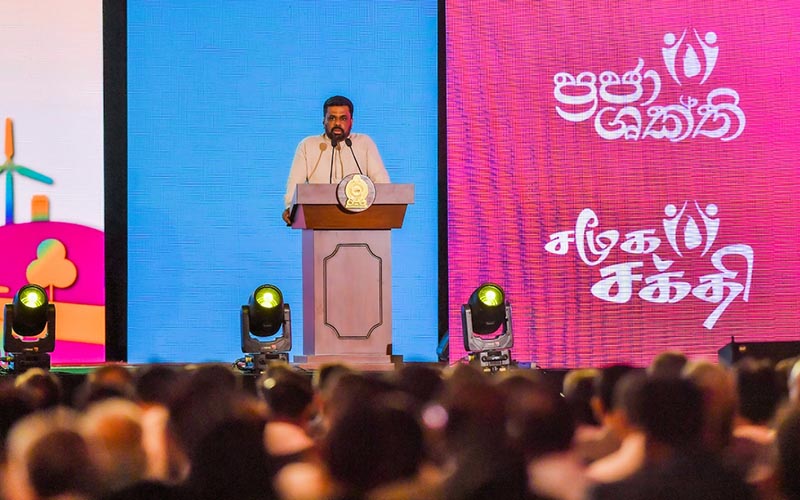
President Anura Kumara Disanayake emphasized that it is the responsibility of the government to ensure that the advantages of economic growth benefits the rural communities.
The President made these remarks on Friday (04) at the launch of the “Prajashakthi” National Programme held at Temple Trees.
The “Prajashakthi” National Programme is a key initiative of the current government, aiming to empower communities and ensure the fair distribution of economic benefits across society.
The Secretary to the Ministry of Rural Development, Social Security and Community Empowerment, Sampath Manthrinayake, welcomed participants to the programme while the Secretary to the President, Dr. Nandika Sanath Kumanayake outlined the objectives of the initiative.
Following this, the Chairman of the “Prajashakthi” National Operations Committee and Minister of Rural Development, Social Security and Community Empowerment, Dr. Upali Pannilage, introduced the national movement.
The official “Prajashakthi” website was also launched by the President during the event.
The Full Text of the Speech delivered by President Anura Kumara Disanayake:
“A few years ago, our country experienced a severe economic collapse. While there were various contributing factors to this collapse, we must not forget that ordinary people in rural areas, who played no part in its cause, endured the greatest hardships.
They were affected in areas such as food affordability, access to quality healthcare, educational opportunities and the development of rural infrastructure. Therefore, the present government has both a responsibility and a challenge to uplift rural lives. This is a duty that cannot be abandoned.
One of the top priorities of our government is to eradicate rural poverty as a key step towards national progress.
Today, we have managed to bring the economy to a relatively stable state. We have maintained the dollar’s value close to Rs. 300, steadily raised foreign reserves, directed treasury revenue to meet our goals and reduced interest rates to single digits. These are notable indicators of economic stability. We have also been able to gradually restore investor confidence in the country.
Numerous stalled projects have been successfully renegotiated and restarted. In addition, we have received a substantial number of proposals for new investment projects, many of which were approved at the recent Cabinet meeting. Therefore, our focus is now on new investments and development projects. Through these effective and results-driven investments, we can simultaneously achieve economic stability and economic growth.
However, if these economic benefits do not benefit the rural population, then even achieving growth in statistical terms is not important.. This is why we must pursue economic growth on one hand and economic expansion on the other. If rural people are not given economic opportunities and included as stakeholders in the economy, they will become marginalised. Our core approach must therefore be to expand the economy and integrate rural communities into it.
This is possible only if the current rural economic activities are transformed into more productive, efficient and profitable ventures. These sectors should be developed to become thriving businesses. Widening their access to economic opportunities is also vital. Hence, we are prioritising the creation of new economic avenues for the rural population, making them active players in the economy.
Poverty has gone beyond being an economic issue and become a deep-rooted social problem. Poor communities have become isolated from society. Therefore, eliminating rural poverty is one of the government’s primary responsibilities. Education plays a key role in this. There is a direct correlation between poverty and lack of education. Thus, we must expand educational opportunities further. Despite all efforts, every society has a segment of people who will face difficulties. Even in so-called developed nations, such communities exist. A welfare system is required to support these groups.
Welfare is not inherently a bad tool. If a population is vulnerable at a given time, it is the government’s responsibility to protect them. However, welfare has often been misused, turning into a political tool. This has led to growing criticism of such programmes due to their politicisation.
The policy of the National People’s Power government is to provide targeted welfare. Assistance must be given to the right people for the right reasons. I believe the government holds this responsibility and society must also understand its importance. In our society, there is a belief that anything given by the state must be received by all. That is a mistaken belief. Our state is not built on such a culture of entitlement. Our culture is to protect those who need protection. Because of distortions in past practices, those who don’t need aid often compete to obtain it, making it harder to support those who truly do.
We must therefore foster a new culture. People must be self-aware enough to recognise whether they truly deserve government support. Even if you have the ability, the person next door may not have that ability. It is essential to cultivate a sense of responsibility to assist others. But today’s mentality is to claim whatever is available, regardless of whether one needs it or not. This is the reason we strive to create a strong data system, ensuring that support is provided solely to those who truly require it.
However, we all know that a society cannot rely on welfare programmes forever . There will always be a need for welfare systems, but they must not serve the same individuals or communities indefinitely.
A significant amount of government funds have been expended for this purpose. Approximately, Rs. 230 billion has been allocated solely for the ‘Aswesuma’ programme. Large sums of money have also been spent on other aid programmes. However, have these funds reached the targeted communities? Have the intended benefits been realised from these funds? The answer is no.
Various international organisations implement aid programmes in this country. Looking at these, more than 50% of the expenditure goes towards establishing the mechanism for delivering the aid. An official waits to see how they can personally benefit from a project once it is received. They have their job, but the project is not within their purview. They then claim that an allowance is required to implement the project. Consequently, a substantial portion of these aid funds is spent on the aid delivery mechanism rather than reaching the intended beneficiaries. Furthermore, a significant amount has been spent on training within this mechanism. These practices must cease. As a government and as state officials, you have a responsibility to ensure that aid reaches the targeted communities.
We assure you that we will absolutely not allow any misuse of these funds. An operation must be launched to ensure that aid reaches those who deserve it. Similarly, there is a tendency for every Ministry to believe that they must provide something. However, based on a very accurate data system, it should be determined what should be provided and for what purpose. But what is happening now is not in that manner. Every institution and department is inclined to provide aid. Yet, all aid flowing to rural communities and programmes aimed at empowering their economies must be integrated. A large portion of our aid has been provided merely for subsistence. It has not succeeded in improving the living standards of these people. That is why an integrated operation is necessary. We are launching the ‘Prajashakthi’ programme as that operation. It is a targeted operation. The programme must be structured down to the Divisional Secretariat level.
Currently, a significant administrative structure has been built. I do not believe a child will be born without a birth certificate anymore. When they reach the appropriate age, they obtain an identity card. In the next two years, we will move towards a digitisation mechanism. So, what is the responsibility of the lowest administrative unit in this mechanism? The responsibility of the lower administrative unit is to understand the nature of its unit and to create a plan to advance that unit based on its characteristics. We must advance the Divisional Secretariat from this point onwards. A programme should be prepared for that. There is a need to spend money there and we are prepared for it.
I also acknowledge that our state mechanism is dilapidated. If you consider all the vehicles owned by state officials, they are all more than 15 years old. More than 50% of the buses on the road are vehicles unfit for road use. The computers in offices are significantly outdated. The systems in our institutions have not been updated. Buildings are deteriorating. From every angle, we have a dilapidated state mechanism. We come to the office like ordinary villagers. That is the honest truth. In the last budget, salaries were increased and necessary support was provided to human resources.
Therefore, in the upcoming budget, we will work to build the physical resources of the state mechanism. Relative to building physical resources, we will introduce new software systems and modernise the state mechanism. However, this is for the benefit of the citizens.
This is the only way we can overcome this challenge. Otherwise, if we scatter, thinking this is a political task, a job for the political authority, or for the Grama Niladhari , the Development Officer, or the Divisional Secretary, it cannot be achieved. To do this, an unyielding, integrated operation involving both the political authority and the state mechanism is required. The objective of the ‘Prajashakthi’ programme is to bring together the state mechanism, state officials and citizens into an integrated framework. Without this, nothing can be accomplished. Our aim is not merely to maintain the existing state; if that were the case, the current situation would suffice.
To rebuild a fallen state, the political authority, the state mechanism and the citizens must be brought together into an integrated operation. Therefore, there is a community that has lost economic opportunities in this fallen state. An integrated operation is needed to create economic opportunities for that community. I urge all of us to work together to make this ‘Prajashakthi’ project a success.
Dr. Upali Pannilage, Convenor of the ‘Prajashakthi’ National Policy Council and Chairman of the National Operations Committee, Minister of Rural Development, Social Security and Community empowerment :
“When discussing poverty in our country, the village holds a special place. Not only in Sri Lanka, but internationally, especially when looking at Asia, Africa and Latin American regions, we cannot discuss poverty by forgetting the village. That is why the United Nations declared July 6th as World Rural Development Day.
Although rural poverty in our country has been a subject of discussion for decades, various attempts have been made to change it. However, for example, looking at the statistics for the year 2000, 1.1 million people in our country were dependent on aid. By 2010, this number had increased to 1.5 million. By the end of 2024, the number of people dependent on aid had reached close to 1.8 million.
These statistics confirm that despite numerous programmes implemented to eradicate poverty, the impoverished community in our country is growing steadily. Although the world’s population is rapidly urbanising, nearly 79% of our country’s total population lives in rural or estate areas. Therefore, as the National People’s Power government, when planning our policies, we made the eradication of rural poverty a central theme.
Before launching this programme, we thoroughly studied the weaknesses of the poverty eradication programmes implemented in our country. We designed this programme by addressing those weaknesses and providing answers to the question: How can we truly eradicate poverty in our country? Primarily, we expect to achieve several objectives through this programme.
Prime Minister Dr. Harini Amarasuriya; Sunil Handunnetti, Minister of Industry and Entrepreneurship Development; Wasantha Samarasinghe, Minister of Trade, Commerce, Food Security and Cooperative Development; Professor Chandana Abeyratne, Minister of Public Administration, Provincial Councils and Local Government; Samantha Viddyarathna, Minister of Plantation and Community Infrastructure; Saroja Paulraj, Minister of Women and Child Affairs; Mahinda Jayasinghe, Deputy Minister of Labour; along with other Ministers and MPs; Dr. Nandalal Weerasinghe, Governor of the Central Bank; Provincial Governors; Ministry Secretaries; state officials; and representatives from international organisations were among those who attended the launch.


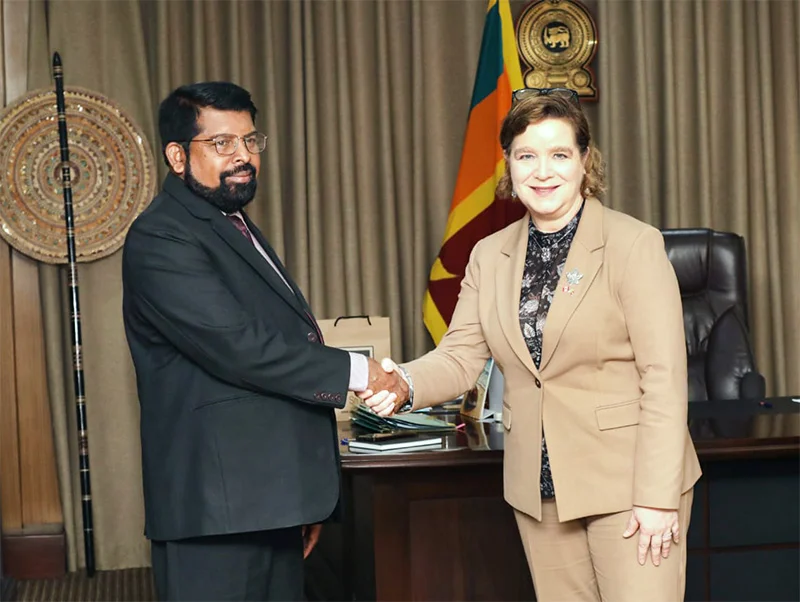
Canada, said to be the home to the largest Tamil Diaspora community, has expressed concern over the delay in holding Provincial Council (PC) elections. Canadian High Commissioner Isabelle Martin, on Monday (16), took up the issue with Public Administration, Provincial Councils and Local Government Minister Professor Chandana Abayaratne.
Sources quoted Prof. Abayaratne as having told the Canadian HC that the delay was not deliberate on the part of the government. The Minister blamed, what the sources called, certain legal, technical and delimitation issues for the delay.
India compelled Sri Lanka to enact the 13th Amendment to the country’s Constitution to enable the setting up of the Provincial Council system, in line with the Indo-Lanka Peace Accord, which Sri Lanka signed under duress in July 1987.
Prof. Abayaratne has assured the Canadian HC that President Anura Kumara Dissanayake, too, recognised the importance of strengthening the Provincial Council system as a solution to ethnic issues and that urgent steps would be taken in that regard.
During the discussion, matters relating to strengthening political, economic and social relations between the two countries were discussed.
In May 2020, Canada declared that Sri Lanka had perpetrated genocide during the war against the LTTE. Canada also sanctioned former Presidents Mahinda Rajapaksa and Gotabaya Rajapaksa in January 2023 over alleged war crimes.
The Canadian HC also explained her country’s ‘Indo-Pacific’ strategy and how Sri Lanka could benefit from it.
In particular, Canada’s “Pathways to Peace” project will support reconciliation between nations, and to improve communication by encouraging the learning of mutual languages as a second language, and it was also agreed to provide more opportunities for Sri Lankan students to pursue higher studies in Canada.
The Canadian delegation also expressed its willingness to provide the necessary technical assistance to solve the drinking water problems in Puttalam, Mannar and the North-Eastern provinces under technical cooperation, and to implement the relevant projects after a preliminary study.
by Shamindra Ferdinando
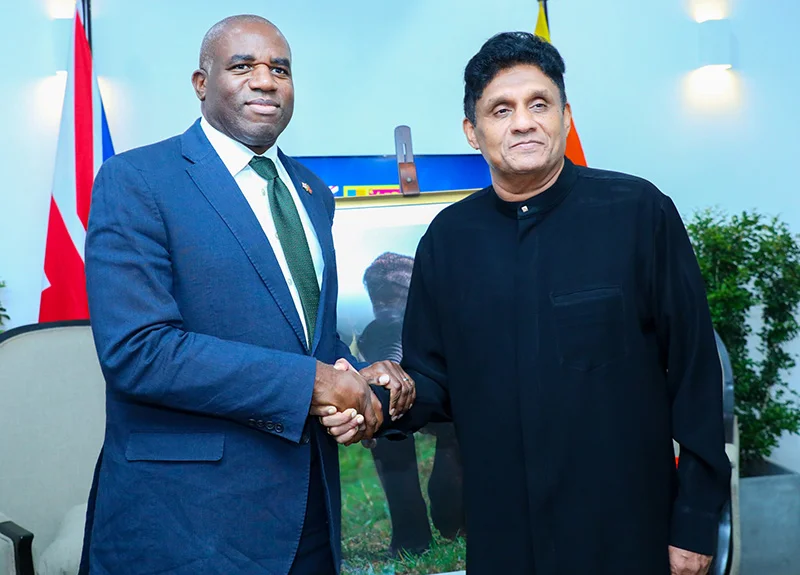
SJB and Opposition Leader Sajith Premadasa has briefed Deputy PM of the UK, David Lammy, on the dangers posed by the proposed Protection of the State from Terrorism Act (PSTA) and the Online Safety Act.
They met at the Office of the Leader of the Opposition, in Colombo, on Tuesday (17). Discussions focused on democratic governance, trade expansion, and bilateral humanitarian cooperation.
The British delegation included High Commissioner for Sri Lanka Andrew Patrick.
Head of the Deputy Prime Minister’s International Unit David Meyer, Special Advisor Ms. Fiona Meagher, and First Secretary (Political) Tom Soper,
According to a statement issued by the Opposition Leader’s Office, Premadasa has cautioned against what he called draconian applications of the law, specifically warning against broad definitions of terrorism that could criminalize political dissent and trade union activities. Premadasa reiterated that the judiciary, not the executive, must drive legal interpretations. Regarding online safety, while acknowledging the need to protect children, he stressed that regulations must align with UK standards and international norms without infringing on civil liberties.
The Opposition Leader welcomed the UK’s leadership as the President of the Group of States against Corruption (GRECO) and its global Anti-Kleptocracy Campaign. The SJBer highlighted the critical need for transparent institutions, noting that strengthening accountability mechanisms is central to rebuilding public trust and ensuring sustainable economic recovery in Sri Lanka.
Premadasa conveyed sincere appreciation for the UK’s “Sovereign Solidarity” following the devastation caused by Cyclone Ditwah in late 2025. He thanked the UK government for increasing its humanitarian aid package to £1 million (approx. $1.32 million) in December 2025. This funding, channelled through the Red Cross, UNOPS, and local partners, has provided: Emergency shelter and repairs for damaged homes; Clean water and sanitation facilities to prevent disease; and essential medicines and food supplies for the 1.8 million people affected.
Premadasa also proposed enhanced cooperation in protecting Sri Lanka’s wild elephant population and addressing the growing human–elephant conflict. He emphasised the need for sustainable conservation strategies, scientific land-use planning, community protection measures, and international technical support to safeguard biodiversity while ensuring the safety and livelihoods of rural communities affected by human–elephant interactions.
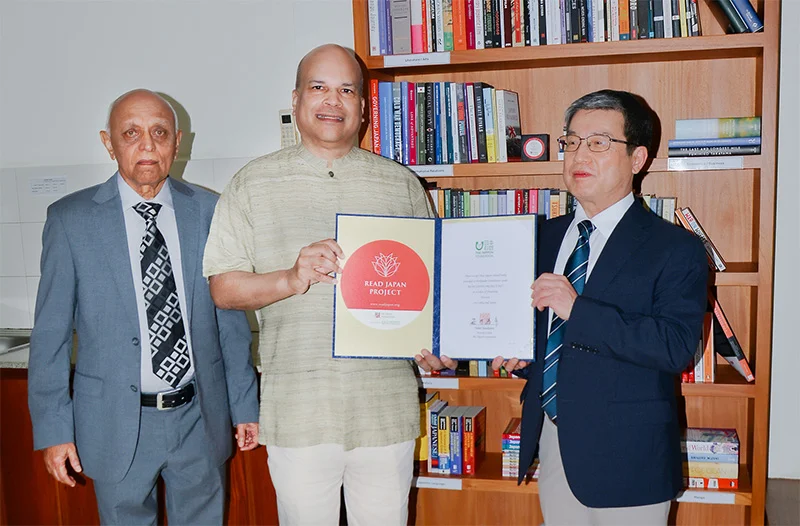
The Pathfinder Foundation has established the Entsuji Room, a Japan-themed space at its headquarters at Riverpoint, Peliyagoda, as the first step toward setting up a Japan Studies Centre.
The Entsuji Room will house an important collection of books on Japan, donated under the READ JAPAN Project, administered by the Tokyo Foundation and financed by the Nippon Foundation, under the leadership of Yohei Sasakawa.
The collection was formally presented by the Ambassador of Japan to Sri Lanka, Akio Isomata, at a ceremony held yesterday (18) at Pathfinder Headquarters, at Riverpoint, and received by Milinda Moragoda, Founder of the Pathfinder Foundation.
The establishment of the Entsuji Room marks a significant step in strengthening intellectual and cultural engagement between Sri Lanka and Japan.

Canada concerned about delay in holding PC polls

Sajith briefs visiting UK Deputy PM on constitutional issues

Pathfinder houses Read Japan Project

Sri Lanka looks to join global charter on children’s care reform

Sri Lanka eye England rematch after sealing Super Eight berth

A nation reframed through food: Sri Lanka’s historic National Geographic debut

‘Dates have the highest sugar content to fight Coronavirus’

Sunday Island 27 December – Headlines

#SundayIsland 17th December – Headlines

Sunday Island – 28th March

Sunday Island Headlines – 21 March

Sunday Island – 21st February – Headlines
-
 Life style4 days ago
Marriot new GM Suranga
-

 Business3 days ago
Ministry of Brands to launch Sri Lanka’s first off-price retail destination
-
 Features4 days ago
Monks’ march, in America and Sri Lanka
-
 Features4 days ago
The Rise of Takaichi
-

 Features4 days ago
Wetlands of Sri Lanka:
-

 News4 days ago
Thailand to recruit 10,000 Lankans under new labour pact
-
 News4 days ago
Massive Sangha confab to address alleged injustices against monks
-
 News2 days ago
IMF MD here