
Foreign News
Israel accepts ‘bridging proposal’ for ceasefire deal – Blinken

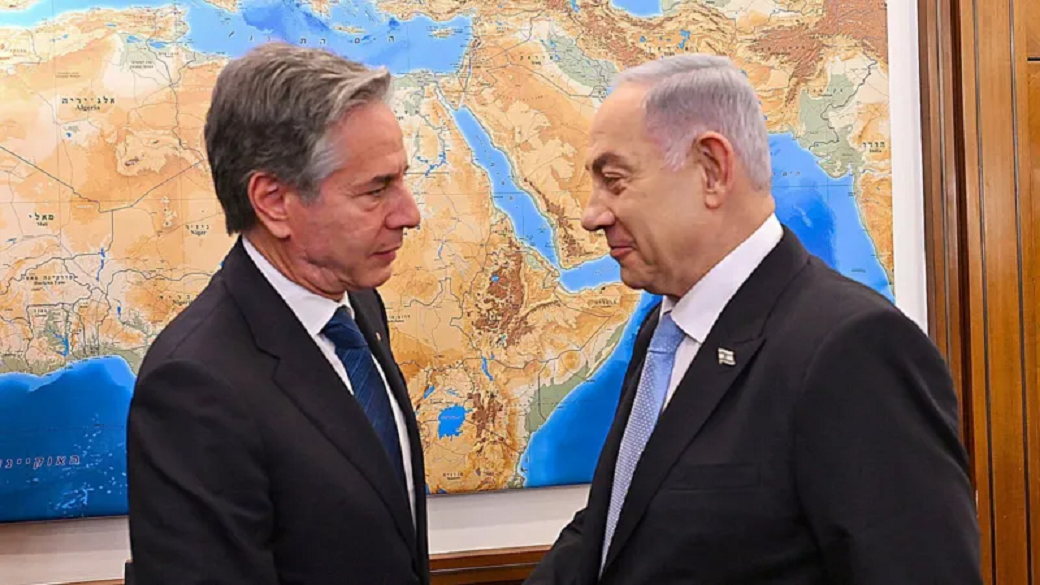
US Secretary of State Antony Blinken says Israeli Prime Minister Benjamin Netanyahu has agreed to an American “bridging proposal” for a ceasefire deal in Gaza.
It is now up to Hamas to agree, Mr Blinken added.
The pair met in Tel Aviv for talks that Mr Netanyahu has described as “positive”, with his office adding that he had reiterated his commitment to an American proposal on the release of the hostages still held by Hamas, which took into account Israel’s security needs.
Mr Blinken had earlier warned this was “maybe the last opportunity” to secure a ceasefire agreement, as the US hopes to push a deal over the finish line.
The Americans hope that could happen perhaps as soon as this time next week, but that level of optimism is not shared by the Israeli leadership or Hamas.
Each accuses the other of obstinate cynicism, and blocking a deal.
Speaking in Tel Aviv after the talks, Mr Blinken described “the fierce urgency” of progressing towards a truce and hostage release deal. “We’re never giving up”, he added, saying more delays could mean more hostages could die and further obstacles could hamper any agreement.
The US secretary of state will now travel on to Egypt and then Qatar, to try and drive forward progress on a deal.
Mr Netanyahu reportedly told Mr Blinken that he planned to send a negotiating team to Cairo later this week for a new round of talks with Egyptian, Qatari and US mediators.
Meanwhile, reports from Gaza speak of a worsening humanitarian situation amid continuing Israeli military activity.
Israel said its aircraft and troops had killed “eliminated dozens of terrorists” over the past day and destroyed Hamas compounds and a tunnel network where rockets and missiles were found.
Palestinian media reported that six people had been killed in an Israeli air strike near an internet access point near the southern city of Khan Younis on Monday, and that another four were killed in a strike on a car in Gaza City, in the north.
The Israeli military launched a campaign in Gaza to destroy Hamas in response to an unprecedented attack on southern Israel on 7 October, during which about 1,200 people were killed and 251 taken hostage.
More than 40,130 people have been killed in Gaza since then, according to the territory’s Hamas-run health ministry.
A deal agreed in November saw Hamas release 105 of the hostages during a week-long ceasefire in return for some 240 Palestinian prisoners in Israeli jails. Israel says 111 hostages are still being held, 39 of whom are presumed dead.
Mr Blinken was in Israel on Monday for a series of talks with key Israeli leaders.
After one meeting – with Defence Minister Yoav Gallant – a large crowd of protesters outside could be heard chanting “SOS USA, hostage deal now” and “Blinken we trust you, bring them home”. Some were holding pictures of hostages.
That sense of urgency was in Mr Blinken’s messages was clear.
“This is a decisive moment, probably the best, maybe the last opportunity to get the hostages home, to get a ceasefire and to put everyone on a better path to enduring peace and security,” he said before talks with President Isaac Herzog in Tel Aviv.
“I’m here as part of an intensive diplomatic effort on President Biden’s instructions to try to get this agreement to the line and ultimately over the line,” he added. “It is time for everyone to get to ‘yes’ and to not look for any excuses to say ‘no’.”
Speaking alongside him, President Herzog blamed what he called “the refusal of Hamas to move forward” with a deal.
Mr Blinken then had a three-hour meeting in Jerusalem with Mr Netanyahu, whose office said was “positive and was held in a good atmosphere”.
“The prime minister reiterated Israel’s commitment to the current American proposal on the release of our hostages, which takes into account Israel’s security needs, which he strongly insists on,” a brief statement added.
On Sunday, the prime minister accused Hamas of being “completely obstinate” and insisted that “pressure needs to be directed” at the group – which Israel, the US and other countries proscribe as a terrorist organisation.
A Qatar-based member of Hamas’s political bureau told the BBC on Monday that it was “still interested” in reaching a deal, although he said it would not be participating in the Cairo meetings.
“We agreed a deal [through mediators] on 2 July… and therefore we don’t need a new round of negotiations or to discuss the new demands of Benjamin Netanyahu,” Basem Naim said.
“We have shown maximum flexibility and positivity and the other party has understood this as a weakness and met it with more force – he is not interested in reaching a ceasefire, only in flaring up the region… and serving his own personal political interests.”
The US is holding out hope that in the coming days, it can bridge the gaps on a ceasefire deal.
However, that deadline is being imposed by Washington, rather than the warring parties. And the Israeli prime minister and the leaders of Hamas do not seem to feel that same sense of urgency.
Their statements last night were very defiant, sticking to their positions and digging in.
On Tuesday, Mr Blinken will fly from Israel to Egypt, which has been an important mediator along with Qatar and is able to pass messages directly to Hamas.
The mediators announced last Friday that they had presented “a proposal that narrows the gaps between the parties” and was consistent with the principles set out by President Joe Biden on 31 May, which would run in three phases:
• The first would include a “full and complete ceasefire” lasting six weeks, the withdrawal of Israeli forces from all populated areas of Gaza, and the exchange of some of the hostages – including women, the elderly and the sick or wounded – for Palestinian prisoners held in Israel
• The second phase would involve the release of all other living hostages and a “permanent end to hostilities”
• The third would see the start of a major reconstruction plan for Gaza and the return of dead hostages’ remains
The Americans have not provided details about bridging proposal, but major differences are said to remain on issues including Israel’s continuing military presence in Gaza, the rights of displaced Palestinians to move freely from north to south and the number and identity of Palestinian prisoners who’d be released from Israeli jails in exchange for Israeli hostages.
Brett McGurk, one of the Biden administration’s key envoys in the region, has been working with the Egyptians over the past couple of weeks to address the sticking point of the Philadelphi corridor, a strip of land that runs along Gaza’s border with Egypt.
Mr Netanyahu says he insists that Israel will remain present there to stop smuggling and Hamas rearming. Hamas says it simply means continued Israeli occupation and therefore not a stop to the war.
[BBC]







Two Britons and one French person have died in an avalanche in the French Alps on Friday.
The British pair were part of a group of five people skiing off-piste with an instructor in the Manchet valley, near Val d’Isère, a spokeswoman for the resort told the BBC.
The French national was skiing alone when the avalanche struck at 11:30 local time (10:30 GMT), Albertville prosecutor Benoit Bachelet said in a statement announcing the deaths.
Another British person has minor injuries, he added.
A spokesperson for the Foreign Office told the BBC they are aware of the death of the two British men and they are “in contact with the local authorities and stand ready to offer consular assistance”.
A manslaughter investigation has now been launched by the Albertville public prosecutor’s office and will be carried out by CRS Alpes mountain rescue police.
The ski instructor, who was unharmed, tested negative after taking alcohol and drug tests, according to Bachelet.
Val d’Isère already experienced avalanches this winter, with one person dying in the resort of Tignes nearby last month.
France’s national weather service had issued a red alert for avalanche risk across the Savoie region on Thursday, which was then lifted on Friday. But the risk level remained high across the Alps with “very unstable snow cover”.
The avalanche comes in the wake of Storm Nils, which passed through France the day before, leaving between 60cm and 100cm of snow, the weather service said.
There have been a number of fatal avalanches in the region in recent weeks, including the death of a British man off-piste skiing at the La Plagne resort in January.
“We have had some very complicated, very unstable snow since the beginning of the season,” Luc Nicolino, slopes manager at La Plagne, told AFP.
“It’s a kind of mille-feuille with many hidden, fragile layers.”
[BBC]

Two Mexican ships bearing humanitarian aid have docked in the harbour of Cuba’s capital Havana, as the United States continues its efforts to cut the island off from outside fuel supplies.
On Thursday, pedestrians on Havana’s seawall watched as the ships, one of which was the Papaloapan, unloaded white pallets on shore.
Mexican President Claudia Sheinbaum addressed the delivery in her morning news conference, promising that more help was on the way.
“We are sending different forms of help, different forms of support,” Sheinbaum said. “Today, the ships arrive. When they return, we are going to send more support of a different type.”
She also described her country’s role as “opening the doors for dialogue to develop” between Cuba and the US, but she insisted that maintaining Cuba’s sovereignty would be paramount among her priorities.
Since January, the administration of US President Donald Trump has sought to cut off the oil supplies that power Cuba’s energy grid and other critical infrastructure.
The campaign is part of a long-running series of sanctions imposed by the US on the Caribbean island nation, stretching back to the Cold War.
But the latest effort, under Trump, has experts at the United Nations warning of an imminent humanitarian “collapse” in Cuba, as oil supplies dwindle.
The oil embargo began on January 3, when Trump authorised a US military operation to attack Venezuela and abduct its then-leader, President Nicolas Maduro, and his wife Cilia Flores.
[Aljazeera]
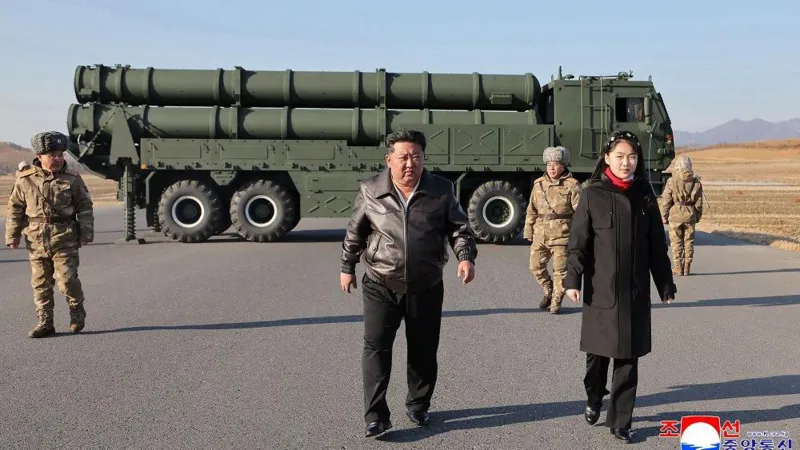
North Korean leader Kim Jong Un has selected his daughter as his heir, South Korea’s spy agency told lawmakers on Thursday.
Little is known about Kim Ju Ae, who in recent months has been pictured beside her father in high-profile events like a visit to Beijing in September- her first known trip abroad.
The National Intelligence Service (NIS) said it took a “range of circumstances” into account including her increasingly prominent public presence at official events” in making this assessment.
The NIS also said it would keep close tabs on whether she will attend the North’s party congress later this month – its largest political event that is held once every five years.
The party Congress is where Pyongyang is expected to give more details about priorities like foreign policy, war planning and nuclear ambitions for the next five years.
On Thursday lawmaker Lee Seong-kwen told reporters that Ju Ae, who was previously described by the NIS as being “trained” to be a successor, was now at the stage of “successor designation”.
“As Kim Ju Ae has shown her presence at various events, including the founding anniversary of the Korean People’s Army and her visit to the Kumsusan Palace of the Sun, and signs have been detected of her voicing her opinion on certain state policies, the NIS believes she has now entered the stage of being designated as successor,” Lee said.
Ju Ae is the only known child of Kim Jong Un and his wife, Ri Sol Ju. The NIS believes Kim Jong Un has an older son, but this son has never been acknowledged nor shown on North Korean media.
News of Ju Ae’s existence first emerged through an unlikely source: the American basketball player Dennis Rodman, who revealed to The Guardian newspaper back in 2013 that he “held baby Ju Ae” during a trip to the secretive state.
Ju Ae – who is believed to be 13 – made her first appearance on state television in 2022. She was shown inspecting North Korea’s latest intercontinental ballistic missile while holding her father’s hand.
She has since made frequent appearances on on state media, softening her father’s image of a ruthless dictator. She accompanied him to Beijing for China’s largest-ever military parade, where she was seen stepping off his armoured train at Beijing Railway Station.
She is often seen wearing her hair long, which is forbidden for her peers, and wearing designer clothes, which are out of reach for most in her country.
Another lawmaker, Park Sun-won said the role Ju Ae had taken on during public events indicated that she has started to provide policy input and is being treated as the de facto second-highest leader.
The North Korean power had passed down the three generations of the Kim family, and it is widely believed that Kim Jong Un will pass on the throne to Ju Ae.
In recent months, she was shown standing taller than her father, walking beside him, rather than following him.
In North Korea, where photos published by the state media are believed to carry a great symbolic weight, it is rare for individuals other than Kim Jong Un to be positioned equally prominently in the frame.
Although the South Korean spy agency now believes Ju Ae is the designated heir, it still raises questions.
It is puzzling why Ju Ae, a daughter, would be selected as the heir above an older son in North Korea’s deeply patriarchal society.
Many defectors and analysts had previously dismissed the idea of a woman leading North Korea as an unlikely scenario, referring to the country’s entrenched traditional gender roles. But Kim Jong Un’s sister – Kim Yo Jong – does offer a precedent for female authority in the regime.
Kim Yo Jong currently holds a senior position in the Central Committee of the Workers’ Party of Korea, and is reported to have influence over her brother.
However, it is also a mystery why Kim Jong Un, who is still young and appears relatively healthy, is already designating a 13-year-old child as his heir now.
It is unclear what changes Ju Ae’s succession may bring to North Korea.
Many North Koreans hoped that Kim Jong Un, a Western-educated young man, would open their country up to the outside when he succeeded his father.
Yet such hope was unfulfilled. Whatever plans this teenager may have for her country, she would likely have the singular power to shape it however she likes.
[BBC]

Russia killed opposition leader Alexei Navalny using dart frog toxin, UK says

Tom Banton 63* sets up nervy win for England

Landslide Early Warnings issued to the districts of Kandy and Nuwara Eliya extended

Advisory for Severe Lightning issued to the Western, Sabaragamuwa and Southern provinces and Badulla and Nuwara-Eliya districts

Tucker 94* headlines Ireland’s thrashing of Oman

High risk of rain in marquee India vs Pakistan T20 World Cup game in Colombo

‘Dates have the highest sugar content to fight Coronavirus’

Sunday Island 27 December – Headlines

#SundayIsland 17th December – Headlines

Sunday Island – 28th March

Sunday Island Headlines – 21 March

Sunday Island – 21st February – Headlines
-

 Features7 days ago
My experience in turning around the Merchant Bank of Sri Lanka (MBSL) – Episode 3
-

 Business7 days ago
Remotely conducted Business Forum in Paris attracts reputed French companies
-

 Business7 days ago
Four runs, a thousand dreams: How a small-town school bowled its way into the record books
-

 Business7 days ago
ComBank and Hayleys Mobility redefine sustainable mobility with flexible leasing solutions
-

 Business4 days ago
Autodoc 360 relocates to reinforce commitment to premium auto care
-

 Midweek Review4 days ago
A question of national pride
-

 Opinion3 days ago
Will computers ever be intelligent?
-

 Midweek Review4 days ago
Theatre and Anthropocentrism in the age of Climate Emergency