
News
Indo-Lanka talks: Trinco issue, foreign reserve crisis on agenda

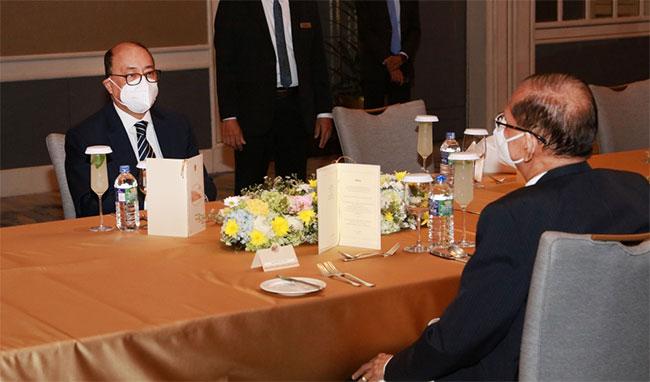
Why was the Minister tasked by Prez to settle the ‘oil tank farm’ problem not involved …
By Shamindra Ferdinando
Foreign Minister Prof. G.L. Peiris says that although the further development of Trincomalee oil tank farm was on the agenda during the recently concluded three-day visit undertaken by Indian Foreign Secretary Harsh Vardhan Shringla, it has not been decided how to proceed with the project.
Declaring that India hadn’t pressured the government over the issue at hand, Prof. Peiris said a consensus could be reached on the Trincomalee project in a way beneficial to both countries.
The Minister said so when The Island sought his response to the growing criticism of the incumbent government’s handling of the controversial Trincomalee oil tanks project and recent heated exchanges in Parliament between Energy Minister Attorney-at-Law Udaya Gammanpila and members of the main Opposition Samagi Jana Balavegaya (SJB).
Shringla, who last served as India’s top diplomat in Washington, recently succeeded Vijay Keshav Gokhale.
Referring to a series of meetings, Shringla had with President Gotabaya Rajapaksa, Premier Mahinda Rajapaksa, Finance Minister Basil Rajapaksa and himself during the Oct 2-5 period, Prof. Peiris emphasised that the Trincomalee oil tank farm was subject to two agreements finalised in the 80’s during President JRJ’s tenure and in 2003.
Shringla also met Foreign Secretary Admiral (retd). Prof. Jayanath Colombage and Defence Secretary General (retd.) G.D.H. Kamal Gunaratne.
Prof. Peiris had served the UNP Cabinet at the time the then Premier Ranil Wickremesinghe’s administration entered into the second agreement. Prof. Peiris stressed that the further development of the project would be discussed taking into consideration two existing agreements.
Eldos Mathew Punnoose, Head – Press, Information and Development Cooperation at the Indian High Commission in Colombo, dealt with a range of issues taken up during the high profile visit. Referring to Shringla’s visits to Kandy, Trincomalee and Jaffna, signifying their cultural, economic and historical importance, respectively, the Indian HC spokesperson said: “In Kandy, the visiting Foreign Secretary offered prayers at Sri Dalada Maligawa. In Trincomalee, the Foreign Secretary visited the Oil Tank Farms, a symbol of the potential and strong energy partnership between the two countries, where LIOC briefed him about the development undertaken by it at the Lower Tank Farms and its advantages to Sri Lanka’s economy. During his visit to Jaffna, the Foreign Secretary inspected the Jaffna Cultural Centre and interacted with the Governor of the Northern Province, several Members of Parliament, academicians and business leaders.”
Prof. Peiris said that various interested parties deceived the public as regards newly appointed Indian Foreign Secretary’s visit to Colombo. The FM strongly denied accusations that the visit was meant to finalise a deal on the Trincomalee oil tank farm. “Instead, the entire gamut of issues was taken up,” Prof. Peiris said, asserting the possible amendments to existing agreements.
Reference was made to such amendments when Prof. Peiris addressed the media at the SLPP office, Battaramulla early this week.
Prof. Peiris, who succeeded SLPP’s first Foreign Minister Dinesh Gunawardena, on Aug 16, declared that the recently concluded talks dealt with a range of issues, including strengthening of Sri Lanka’s foreign reserves. Prof. Peiris said that the matter received special attention with various alternatives discussed in line with overall objectives.
He was of the opinion that India was ready to make major investments here, with the primary focus on producing medicine and the computer industry.
The Indian HC spokesperson said that at the meeting with the Finance Minister both sides agreed to proceed with joint projects, including those under the loan and grant assistance extended by India.
“The Foreign Secretary held wide-ranging and comprehensive discussions with the Minister of Foreign Affairs and his counterpart on all areas of mutual interest, including on the need to face the challenges posed by the Covid-19 pandemic together to mitigate its economic impact,” the spokesperson said.
Prof. Peiris said that Indian Ocean security, counter-terrorism and training for Sri Lankan armed forces, too, had been on the agenda. Interestingly, a statement issued by the President’s Media Division (PMD), following President Gotabaya Rajapaksa’s meet with Shringla referred to two issues that hadn’t been touched by the Foreign Ministry here and the Indian High Commission, in its press release issued on Oct 5.
The PMD quoted President Rajapaksa as having told Shringla that Sri Lanka wouldn’t allow the use of its territory in any way that threatened India’s security. The assurance has been given having explained the country’s relationship with China.
The PMD also quoted President Rajapaksa as having said that the responsibility for resolving the Trincomalee oil tank farm issue had been given to the Minister in charge of the subject.
However, Shringla hadn’t met Minister Gammanpila during his three day stay here. The Energy Minister on a number of occasions said that efforts were meant to address the issue at hand in a way not inimical to Sri Lanka.
A trade union grouping has declared what it has termed a sellout, an accusation strongly countered by Foreign Minister Prof. Peiris. Those who had been opposed to foreign investment in vital sectors continue to hinder the much required progress on the economic front, Prof. Peiris said, urging the critics to be mindful of politically motivated campaigns.
Prof. Peiris, who had been present when Shringla met Premier Mahinda Rajapaksa on Oct 4 at Temple Trees, said that the relations with India would be further strengthened with the signing of an inter-governmental MoU for the USD 15 mn ‘Buddhism grant.’
Prof. Peiris said that India also agreed to support the maintenance of the India built Jaffna Cultural Centre. Foreign Minister Peiris described the inaugural flight on Oct 20 from Sri Lanka to Kushinagar which would further bolster cultural links between the two countries a significant. Shringla also held political talks with the Tamil National Alliance (TNA) delegation led by Member of Parliament and Leader of TNA R. Sampanthan; Tamil Progressive Alliance (TPA) delegation led by Member of Parliament Mano Ganesan and Ceylon Workers Congress (CWC) delegation led by State Minister for Estate Housing and Community Infrastructure Jeevan Thondaman.
The Indian spokesperson quoted Foreign Secretary as having reiterated India’s longstanding support for the reconciliation that addresses aspirations of the Tamil community for equality, justice, peace and dignity within a united Sri Lanka and in accordance with the 13th Amendment.
Prof. Peiris also appreciated the inauguration/handing over of four development cooperation projects implemented by India. The projects had been implemented at the Vadamaradchi Central Ladies College and Saraswathi Central College in Pussellwa, Kandy, handing over of 1235 houses built under Indian Housing Project Phase III and handing over of houses built under the Model Village Housing Project in Vavuniya District.

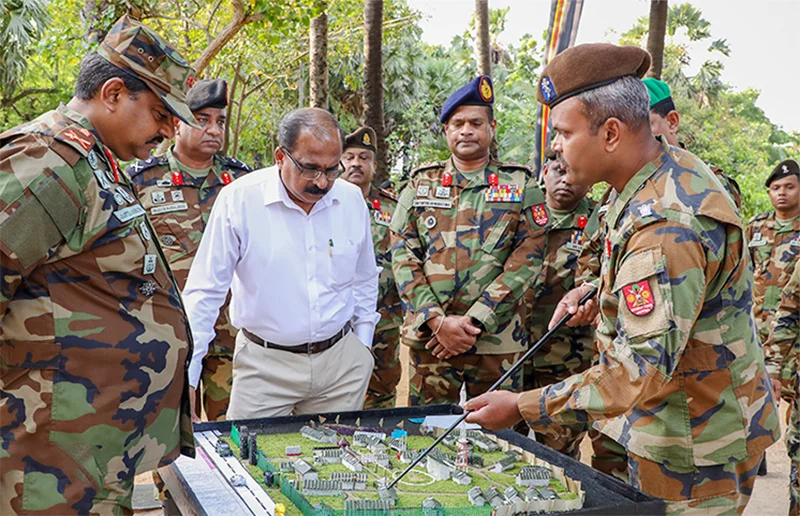
The NPP government is trying to maintain a balance between continuing demands for releasing north-east land held by the military and post-war security requirements, says Deputy Defence Minister Major General Aruna Jayasekera (Retd), who has undertaken a series of visits to the northern and eastern provinces in the recent past to explore ways and means of releasing the land, without compromising national security requirements.
Since the armed forces brought the war to a successful conclusion in May, 2009, releasing of both privately- and state-owned land began cautiously in October, 2009, and by now over 90 percent of both categories have been released. At the height of the war, before the launch of Eelam War IV, in August 2006, Jaffna peninsula had the largest concentration of troops assigned to four Divisions.
In the first week of June, Deputy Minister Jayasekera visited the Trincomalee District to ascertain the situation. The Defence Ministry said that the Deputy Minister had assessed the current status of such lands and received briefings from senior military officers and relevant officials on security and administrative aspects regarding the properties.
Following the field inspection, the Deputy Minister chaired a meeting at the Governor’s Secretariat Office where the discussion focused on what the Defence Ministry called a balanced and practical approach to address land-related issues, protect the livelihoods of the people, and ensure that national security requirements were properly managed.
Jayasekera, with a career spanning well over three decades, retired in November, 2019, after having last served as the Eastern Commander for about a year.
During his June visit, the Deputy Minister visited various security forces establishments, including the 22 Infantry Division.
A senior retired military official said that those who had been demanding that all security forces held land, both state- and privately-owned, be released, have conveniently forgotten that this was made possible due to the eradication of the LTTE.
The Deputy Defence Minister conducted a series of field visits in the Jaffna and Wanni regions to assess the security situation and operational commitments. According to the Defence Ministry, the Deputy Minister addressed senior tri forces personnel at the Security Forces Headquarters – Jaffna (SFHQ-J) and the Security Forces Headquarters – Wanni (SFHQ-Wanni).
The Deputy Minister chaired civil-military coordination meetings in the Mannar and Jaffna districts to the ongoing land ownership issues, fostering socio economic growth, and streamlining local infrastructure layout in close cooperation with the regional administrative mechanism. The Ministry said that the Deputy Minister inspected agricultural zones, private residences and public common areas, presently placed within the operational infrastructure of the Sri Lanka Navy across several locations, in Mullikulam, Silawathura, Talaimannar, Wankalapadu, and Pallimune.
Members of Parliament for the Vanni Electoral District, Selvam Adaikalanathan, Kader Masthan, Thurairasa Ravikaran and the District Secretary for Mannar were also present at the meeting where matters related to socio economic grievances, local infrastructure demands, and land rights of the local residents were central topic in the agenda.
The Deputy Minister of Defence chaired a second meeting at the Governor’s Office in Jaffna where the main focus was existing land issues in the districts of Vavuniya, Mannar, Mullaitivu, Kilinochchi, and Jaffna.
The Jaffna proceedings were co-chaired by the Minister of Fisheries, Aquatic and Ocean Resources and Chairman of the District Coordinating Committee for the Jaffna and Kilinochchi Districts Ramalingam Chandrasekar and Deputy Minister of Co-operative Development Upali Samarasinghe.
The Defence Ministry said that stability depended on striking an optimal balance between prioritising national security obligations and resolving outstanding issues related to both state owned and privately used lands. “We are implementing a transparent mechanism to swiftly transition designated lands back into the hands of local communities for housing, fishing, and agriculture.”
The participation of the Commander of the Army and the Commander of the Navy underscored the importance of the discussions held in the north.
In the Mannar region the focus was on lands, presently used by the Navy, in the areas of Mullikulam, Silawathura, Talaimannar, Wankalapadu, and Pallimunai.
Authoritative sources said that since the end of the war, the military had given up held areas and what remained occupied were essential for security purposes. The depletion of the area under direct control should be examined taking into consideration gradual overall reduction of combined security forces strength over the years. At the end of the war, the Army had approximately 205,000 officers and men, both regular and volunteer. That figure has been reduced to 150,000 to 160,000. In line with the government thinking the Army strength would be brought down to 100,000 by 2030, a plan first announced by President Ranil Wickremesinghe.
By Shamindra Ferdinando

Colombo Chief Magistrate Lahiru de Silva yesterday granted bail to Yoshitha Rajapaksa, second son of former President Mahinda Rajapaksa, on three sureties of Rs. 5 million each, and imposed an overseas travel ban.
The Commission to Investigate Allegations of Bribery or Corruption (CIABOC) arrested Yoshitha yesterday morning when he called over to make a statement regarding an ongoing investigation into his recruitment to the Sri Lanka Navy and training at the UK Royal Naval Academy.
CIABOC said that the arrest had been made in connection with an investigation into the 2006 recruitment of cadet officers to the executive branch of the Sri Lanka Navy.
It has been alleged that individuals were recruited without meeting the required qualifications and state funds were used outside established procedures for their training at the Royal Naval Academy in the UK.
News
EV Adoption critical for renewable energy growth and economic stability, says Minister Karunathilaka
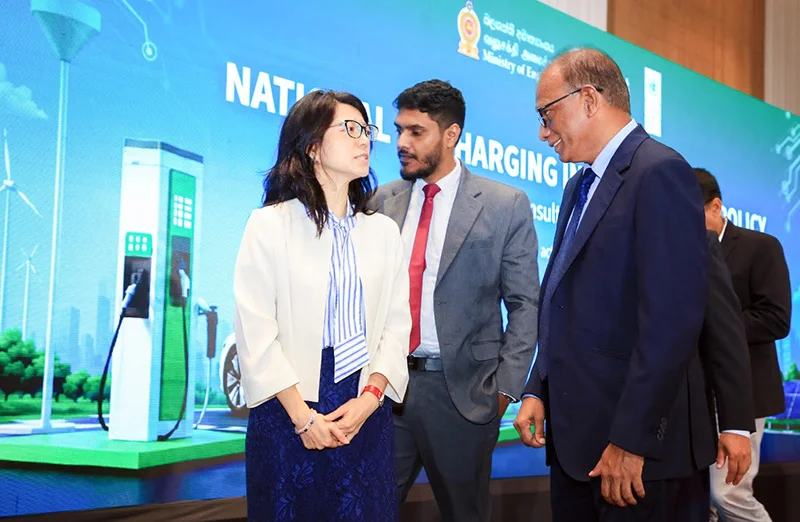
Expanding the use of electric vehicles (EVs) in Sri Lanka is not only vital for reducing the country’s dependence on costly fossil fuel imports but also essential for unlocking the full potential of renewable energy and strengthening the national economy, Power and Energy Minister Anura Karunathilaka said yesterday.
Addressing a stakeholder consultation workshop on the formulation of the National EV Charging Infrastructure Policy, Minister Karunathilaka stressed that Sri Lanka’s transition towards cleaner transport could yield substantial economic and environmental benefits.
“At present, electric vehicles account for only about one per cent of the country’s vehicle fleet. If we can significantly increase that share and ensure that these vehicles are charged using renewable energy, Sri Lanka can save billions of rupees currently spent on importing fossil fuels,” the Minister said.
He noted that such a shift would also enable the country to maximize its renewable energy potential while making a meaningful contribution to economic growth.
The workshop, held in Colombo, brought together policymakers, regulators, energy experts and industry stakeholders to discuss strategies for developing a comprehensive EV charging infrastructure network across the country.
Minister Karunathilaka acknowledged that several barriers continue to limit the growth of EV adoption in Sri Lanka. He said the government was identifying these challenges and exploring practical solutions to overcome them.
Among the measures under consideration are the introduction of lower electricity tariffs for vehicle charging during off-peak daytime hours, the establishment of charging stations outside major urban centres, and the strengthening of the national power grid to accommodate future demand from electric mobility.
“The objective is to create an enabling environment that encourages more Sri Lankans to switch to electric vehicles while ensuring that the necessary infrastructure is available throughout the country,” he said.
The consultation forms part of a broader initiative jointly organized by the Ministry of Energy, the United Nations Development Programme and the Climate and Clean Air Coalition.
Representatives from the Public Utilities Commission of Sri Lanka, Sri Lanka Sustainable Energy Authority, the National System Operator, electricity distribution companies and other key institutions participated in the discussions.
Deputy Minister of Energy Arkam Ilyas, Energy Ministry Secretary Russel Aponsu, Director General (Engineering) K.I.D. Jayasundara, and UNDP Resident Representative Azusa Kubota were among the senior officials and experts attending the event.
Energy sector observers say the development of a robust charging infrastructure and supportive policy framework will be crucial if Sri Lanka is to accelerate the adoption of electric mobility, reduce greenhouse gas emissions and lessen its vulnerability to volatile global fuel prices.
The proposed National EV Charging Infrastructure Policy is expected to provide the roadmap needed to drive that transformation and position Sri Lanka for a cleaner and more sustainable transport future.
By Ifham Nizam

Gill and Kishan hundreds carry India past 400 and to victory

Arnautovic scores penalty as Austria beat World Cup debutants Jordan 3-1

Ghana beat Panama 1–0 in chaotic, charged World Cup Group L match

Diplomat confirms that US and Iran have signed MoU electronically

Dercksen, Kapp help South Africa stumble past Pakistan, despite Sana heroics

Bowlers, Voll power Australia to huge win over Bangladesh

‘Dates have the highest sugar content to fight Coronavirus’

Sunday Island 27 December – Headlines

#SundayIsland 17th December – Headlines

Sunday Island – 28th March

Sunday Island Headlines – 21 March

Sunday Island – 21st February – Headlines
-
 News6 days ago
CIABOC summons Yoshitha over his participation in British Navy training programme
-

 News3 days ago
Release of 2025 O/L results likely to be delayed
-

 News6 days ago
Justice Minister responds to social media claims he represented Easter Sunday ringleader
-

 Sports3 days ago
Tharanga set for high-profile javelin clash in Ostrava
-

 Features4 days ago
Politics of protected species
-

 News3 days ago
Theft of USD 2.5 mn from Treasury: CoPF accused of complicity in NPP cover-up
-

 News5 days ago
Commonwealth lawyers urge Lanka to uphold rule of law
-

 News2 days ago
Beijing Capital Airlines to resume flights to Colombo signalling boost to tourism