
Foreign News
India ‘engaging with US’ after shackled deportees spark anger


India’s Foreign Minister S Jaishankar has told parliament the government is working with the US to ensure Indian citizens are not mistreated while being deported.
His statement came a day after a US military flight brought back 104 Indians accused of entering the US illegally.
One of the deportees told the BBC they had been handcuffed throughout the 40-hour flight, sparking criticism.
But Jaishankar said he had been told by the US that women and children were not restrained. Deportation flights to India had been taking place for several years and US procedures allowed for the use of restraints, he added.
Deportation in the US is organised and executed by the Immigration and Customs Enforcement (ICE).
“We have been informed by ICE that women and children are not restrained,” Jaishankar said.
He added that according to ICE, the needs of deportees during transit, including for food and medical attention, were attended to and deportees could be unrestrained during bathroom breaks.
“There has been no change from past procedure,” he added.
However Jaspal Singh, one of the deportees on the flight that landed in Amritsar city in the state of Punjab on Wednesday, told BBC Punjabi that he was shackled throughout the flight.
“We were tortured in many ways. My hands and feet were tied after we were put on the plane. The plane stopped at several places,” he said, adding that he was unshackled only after the plane landed in Amritsar.

The US has not given further details of how deportees were treated on the flight. Officials have said that enforcing immigration laws is “critically important to the national security and public safety of the United States” and it was US policy to “faithfully execute the immigration laws against all inadmissible and removable aliens”.
The US border patrol chief posted video showing deportees in shackles, saying the deportation flight to India was the “farthest deportation flight yet using military transport”.
President Donald Trump has made the mass deportation of undocumented foreign nationals a key policy. The US is said to have identified about 18,000 Indian nationals it believes entered illegally.
Trump has said India’s Prime Minister Narendra Modi had assured him that the country would “do what’s right” in accepting US deportations.
In his statement on Thursday, Jaishankar said all countries had an obligation to take back their nationals who had entered other countries illegally. They often faced dangerous journeys and inhumane working conditions once they had reached their destinations, he said.
Fraudulent Indian travel agencies are known to take huge sums of money from people desperate to travel abroad for work, and then make them undertake dangerous journeys to avoid being caught by immigration officials.
Jaspal said he had taken a loan of 4m rupees ($46,000; £37,000] to travel to the US, a dangerous journey that took months and during which he saw bodies in the jungle of other migrants who had died on the route.
[BBC]

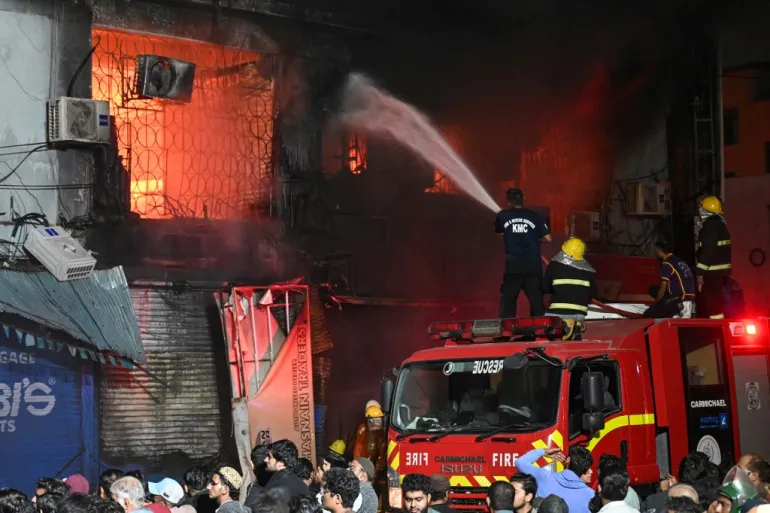
At least six people have been killed and about 20 injured when a fire tore through a shopping mall in Karachi, Pakistani officials say, as firefighters try to bring the blaze under control.
The fire broke out on Saturday at the Gul Plaza shopping mall, a densely packed commercial complex, and continued to burn for hours. By early Sunday, authorities said crews had managed to control about 30 percent of the fire.
South Deputy Inspector General Syed Asad Raza told the Dawn newspaper that the death toll had risen from an initial three to five. The Edhi Foundation, a medical complex, later confirmed a sixth death in a statement.
Rescue officials said the mall contains roughly 1,200 shops, raising fears that people could still be trapped inside. The Edhi Foundation said part of the building collapsed due to the intensity of the fire, complicating rescue efforts.
Garden subdivision police officer Mohsin Raza said initial findings suggested the fire started due to a short circuit in one of the shops before rapidly spreading throughout the complex.
He said the exact cause must be determined through a detailed investigation and warned that the structure needs to be secured to prevent further damage.
President Asif Ali Zardari and Prime Minister Shehbaz Sharif expressed condolences over the loss of life.
In a statement carried by PTV, Sharif ordered authorities to take “all possible measures” to protect lives and property, provide assistance to affected traders and ensure medical care for the injured.
Zardari urged the government of Sindh province, whose capital is Karachi, to offer “immediate and every possible assistance” and said: “No stone should be left unturned in providing the best medical facilities to the injured.”

[Aljazeera]

Chilean President Gabriel Boric has declared a state of catastrophe in two regions where deadly wildfires are raging.
At least 16 people are confirmed dead in the Ñuble and Biobío regions, about 500km (300 miles) south of the capital Santiago. At least 20,000 have been evacuated.
The most dangerous fire has swept through dry forests bordering the coastal city of Concepción. About 250 homes have been destroyed, disaster officials said.
Local media show pictures of charred cars in the streets. Chile has experienced a series of devastating fires in recent years, worsened by long-term drought.
Chile’s forestry agency, Conaf, said firefighters were battling a total of 24 fires across the country on Sunday. The most threatening, it added, were in Ñuble and Biobío.
“In light of the serious ongoing wildfires, I have decided to declare a state of catastrophe” in the two regions, Boric said in a post on X. “All resources are available,” he added.
The fires have affected 20,000 hectares (50,000 acres) in the two regions so far, local media say.
The bulk of the evacuations were carried out in the cities of Penco and Lirquen, just north of Concepción, which have a combined population of 60,000.
Strong winds have fanned the flames amid summer temperatures, endangering communities and hampering firefighting efforts.
Much of Chile is under heat alerts, with temperatures expected to reach 38C between Santiago and Biobío in the next two days.
Two years ago, forest fires killed at least 120 people in the Valparaíso region near Santiago.
[BBC]

Torrential rains have killed more than 100 people across Southern Africa, forcing mass evacuations and rescue operations as authorities warn that more destructive weather may still be to come.
Weeks of heavy rainfall have battered South Africa, Mozambique and Zimbabwe, overwhelming rivers and infrastructure and leaving entire communities cut off. Weather services across the region have issued further alerts, raising fears of additional flooding.
In South Africa, officials said on Friday that flooding in the northern provinces of Limpopo and Mpumalanga had killed at least 30 people.
Army helicopters have been deployed to rescue residents trapped on rooftops and in trees as swollen rivers swept through towns and villages. Security personnel were also evacuated from a border checkpoint with Zimbabwe after floodwaters surrounded the area.
President Cyril Ramaphosa toured affected parts of Limpopo on Thursday, saying the province had received about 400mm (16 inches) of rain in less than a week. In one district, he said, “there are 36 houses that have just been wiped away from the face of the earth.”
Limpopo Premier Phophi Ramathuba said more than 1,000 homes had been damaged across the province. “It’s so terrible,” she said.
In neighbouring Zimbabwe, the government’s disaster management agency reported at least 70 deaths since the start of the year, with more than 1,000 homes destroyed, and schools, roads and bridges collapsing under the force of the floods.
Mozambique has been the hardest hit. Its disaster management authorities said 103 people had died during an unusually severe rainy season since late last year. The figure includes deaths caused by flooding, lightning strikes, infrastructure collapse and a cholera outbreak linked to contaminated water supplies.
More than 200,000 people have been affected nationwide, with thousands of homes damaged and tens of thousands facing evacuation, according to the World Food Programme. The agency warned that flooding has submerged more than 70,000 hectares (173,000 acres) of crops, deepening food shortages for small-scale farmers in a country already struggling with poverty and repeated cyclones.

The United States Famine Early Warning System said flooding was reported or expected in at least seven Southern African countries, possibly linked to the La Nina phenomenon, which often brings heavier rainfall to the region.
South Africa’s Kruger National Park has also been hit, with about 600 tourists and staff evacuated from flood-affected camps. Park authorities said no deaths or injuries had been reported, but large areas remain inaccessible after rivers burst their banks.
Southern Africa has endured a series of extreme weather events in recent years, from deadly cyclones to severe droughts, exposing the region’s vulnerability to climate-driven disasters and fragile infrastructure.

At least six killed in Pakistan as fire rips through Karachi shopping mall

Chile declares ‘state of catastrophe’ as deadly wildfires menace cities

At least 21 killed in Spain after crash involving high-speed trains

U – 19 World Cup: Mahboob, Sadat star for Afghanistan against West Indies

U – 19 World Cup: Rew, Mayes lead England to victory

Mitchell, Phillips centuries trump Kohli’s as New Zealand win first-ever ODI series in India

‘Dates have the highest sugar content to fight Coronavirus’

Sunday Island 27 December – Headlines

#SundayIsland 17th December – Headlines

Sunday Island – 28th March

Sunday Island Headlines – 21 March

Sunday Island – 21st February – Headlines
-

 Editorial2 days ago
Illusory rule of law
-

 News3 days ago
UNDP’s assessment confirms widespread economic fallout from Cyclone Ditwah
-

 Business5 days ago
Koaloo.Fi and Stredge forge strategic partnership to offer businesses sustainable supply chain solutions
-

 Editorial3 days ago
Crime and cops
-

 Features2 days ago
Daydreams on a winter’s day
-

 Editorial4 days ago
The Chakka Clash
-

 Features2 days ago
Surprise move of both the Minister and myself from Agriculture to Education
-

 Business5 days ago
SLT MOBITEL and Fintelex empower farmers with the launch of Yaya Agro App