
Editorial
Independence


Thursday 4th February, 2021
The national flag is fluttering majestically and grand preparations have been made for today’s celebrations to mark the day when the British retroceded this land to its rightful owners. Patriotic excitement has reached fever-pitch. Newspapers traditionally strike a positive note in their editorial comments on a day like this, but why should depressing political, economic and social realities be ignored?
Sri Lankans are known for celebrating what they lack; they are celebrating Independence today. Their leaders, who never miss an opportunity to wrap themselves in the flag, suck in their king-sized pots, puff out their chests and belt out the national anthem with great gusto, religiously, on 04 Feb. They bellow rhetoric, making propaganda mountains out of the molehills of their achievements, year in, year out. The sobering reality dawns when the Independence hangover goes away. This, we have seen for more than seven decades under successive governments perhaps save the first couple of decades after Independence.
During the early years of Independence, students called Sri Lanka a developing country, in their school essays; seven decades on, their grandchildren are saying the same thing, as someone has rightly pointed out. If this is not an indictment on successive governments, what is it? However, it may be wrong to say the country has not achieved anything since 1948. There have, of course, been some achievements, most of which are in the health and education sectors, but sadly they are the exception that proves the rule.
Sri Lanka can be proud of some impressive health and education indicators. But whether they can be maintained is in doubt because the country’s economic performance has been below par, all these decades, as can be seen from the tumble of the rupee against major currencies, the alarming increase in national debt and the difficulties successive governments face in honouring debt commitments. True, a protracted war and two bloody insurrections took a heavy toll on the country’s economy, but it has been more than a decade since the war ended, and there had been no healthy expansion of the economy even before the commencement of the armed conflict. The current pandemic has only aggravated an extremely bad situation.
Those who are languishing in the political wilderness, aka the Opposition, having failed to live up to people’s expectations and been exposed for ineptitude, abuse of power and corruption, among other things, flay their rivals at the levers of power for not doing what needs to be done to develop the country! Rulers try to cover up their failure by criticising their rivals in the Opposition. This is the name of the game in Sri Lankan politics. It is thanks to these ‘leaders’ that the country is in a pretty pass so much so that it has had to beg for COVID-19 vaccines. President of the College of Medical Laboratory Sciences, Ravi Kumudesh, has recently told this newspaper that the Medical Research Institute, which once produced vaccines, is today without facilities even to test imported vaccines! So much for the progress the country has achieved in the fields of science and research! It is only natural that shamans go places during health emergencies, and superstition has taken precedence over science.
Perhaps, the way to make the Independence Day somewhat meaningful may be for all political leaders responsible for the unholy mess the country has got into, over the decades, to kneel at the Independence Square, on 04 Feb. and ask for forgiveness from the nation. Others, however, are not free from blame. Most of those whom people elect as their representatives are political dregs; the voting public has to take responsibility for this. A national work ethic is conspicuous by its absence; the state service is characterised by bureaucratic red tape, lethargy, inefficiency, and bribery and corruption. Trade unions do precious little to increase national productivity; they only make demands.
Sri Lankan leaders, both past and present, ought to learn from the experience of other nations that rose, under the guidance of visionary statespersons, from the depths of poverty. Let Lee Kuan Yew’s book, ‘From Third World to First’ be made mandatory reading for them.


Tuesday 23rd December, 2025
What’s this world coming to when the police cringe and cower before politicians? The JVP has a history of attacking the police. It even murdered the family members of the police personnel who dared defy its illegal orders during its reign of terror in the late 1980s. Old habits are said to die hard. A policeman attached to the Suriyakanda police station has complained that a gang led by a JVP/NPP MP assaulted him following a raid on a cannabis cultivation in Bulutota in the Suriyakanda area. The victim was first admitted to the Kolonna hospital and thereafter transferred to the District General Hospital, Embilipitiya.
NPP MP Shantha Pathmakumara Subasinghe has denied any involvement in the aforesaid assault incident. He has claimed that the policeman confronted him and there was a heated argument; the assault incident was a total fabrication and part of a conspiracy against him, he has alleged. If so, why was the policeman hospitalised and transferred to a District General Hospital? Another police officer has been transferred over the cannabis cultivation issue, according to media reports.
Worse, the policeman receiving treatment was arrested yesterday while his assailants were moving about freely! Thankfully, he was granted bail.
If the land used for cannabis cultivation in Bulutota had belonged to an Opposition politician, IGP Priyantha Weerasooriya himself would have rushed there and held a press conference. Most of all, if the assailants of the policeman had been political rivals of the ruling JVP/NPP, they would have been arrested immediately.
The JVP/NPP politicians have apparently graduated from roughing up their political rivals to assaulting policemen. Such transgressions brought about the collapse of the Mahinda Rajapaksa government, which gave free rein to the likes of Mervyn Silva, who together with his son, reduced the police to a bunch of lackeys. The culture of impunity persists despite last year’s regime change.
The JVP leaders asked for stern action against Mervyn, his son and other goons—and rightly so. They sought a popular mandate to govern the country, break what they called a 76-year curse, eliminate bribery and corruption and political violence and restore the rule of law. But today the ruling party politicians have risen above the law. The police mysteriously ran out of breathalyzers when NPP MP Asoka Ranwala met with an accident. He was subjected to a blood alcohol test more than 12 hours after the crash, and his blood and urine samples were sent to the Government Analyst’s Department. It was a foregone conclusion that those samples would test negative for alcohol. There have been instances where heroin samples sent to the Government Analyst’s Department for testing turned out to be flour! Such is the integrity of that institution.
The police unashamedly sided with a group of JVP cadres who stormed a Frontline Socialist Party office and forcibly occupied it a few months ago. The JVP/NPP members can park their vehicles anywhere on the expressway with impunity. Drunk driving is not a problem for the government MPs, for they can undergo blood alcohol tests leisurely after they become fully sober in case of accidents. When raids happen to expose ruling party politicians’ involvement in drug dealing, police officers who conduct them are transferred or assaulted.
One of the worst things that can happen to a country is for its citizens to lose faith in its legal system. A perquisite for bringing order out of chaos in any society is to restore the rule of law, and this is a task for statespersons and not a bunch of self-righteous politicians posing as messiahs.
Politicians take leave of their senses when power goes to their heads. This may explain why they rough up policemen, subvert the legal process, hold ceremonies to mark the resumption of train services after disasters and dance like clowns at railway stations while the country is mourning hundreds of its citizens who perished in disasters.


Monday 22nd December, 2025
Maan Pharmaceuticals Ltd., the manufacturer of Ondansetron, which has been withdrawn from hospitals here pending a probe, is reported to have asked the Sri Lankan health authorities to have the drug tested by an internationally accredited laboratory. The use of nine other Maan products too has been suspended in Sri Lanka over quality concerns. Maan’s reaction has come as no surprise; all companies ardently defend their products. However, its concerns should be heeded. The National Medicines Regulatory Authority (NMRA) and the Ministry of Health ought to furnish irrefutable evidence in support of their decision to suspend the use of the drugs at issue. The manner in which the NMRA has carried out its duties and functions, especially granting approval for drugs and investigating complaints of their quality, over the years, does not inspire public trust.
The subtext of what has been reported of the Maan’s letter to the Sri Lankan health authorities is worth taking note of. It can be argued that in corporate newspeak, Maan has questioned the competence of the NMRA to test its products. As Maan would have us believe that its products meet international standards, it should be asked to state whether it has gained access to stringent regulatory destinations, such as the US and EU, and, if not, why.
It is being argued in some quarters that the degradation of pharmaceuticals can happen due to improper storage and transport. Maan’s aforesaid letter reportedly has reference to drug storage here. There are allegations that the Sri Lankan health authorities leave imported drugs in freight containers under inappropriate conditions for extended periods. However, the phials of Ondansetron which were tested at the Kandy National Hospital and found to be affected by microbial contamination had been stored properly and their seals were intact, according to media reports, quoting doctors. Thus, the contamination of the drug points to issues in manufacturing and packaging rather than storage and transport.
Meanwhile, a news item in this newspaper today reveals the pivotal importance the pharmaceutical industry has assumed in the Indian economy; India’s pharmaceutical exports have crossed USD 30 billion. Therefore, some critics of the Indian pharmaceutical products are of the view that India will do everything in its power to protect the interests of its drug companies, including Maan. But the fact remains that India itself has cracked down on some of its pharmaceutical companies involved in scandals. It severely dealt with the Indian companies that manufactured contaminated cough syrups which killed 66 children in Gambia in 2022 and 22 children in India in September 2025.
In the greed-driven corporate world, profits take precedence over human life, and there is hardly anything that Big Pharma spares in pursuing profit maximisation. As we pointed out in a previous comment, the World Health Organization has revealed that at least one in 10 medical products in low-and middle-income countries fails to meet quality standards or is falsified. This shows the enormity of the problem of fake and substandard drugs. Hence the need for robust mechanisms to protect patients.
All issues related to substandard and falsified drugs and their adverse effects in this country boil down to the failure of successive governments to address multiple problems pertaining to drug regulation and testing and find long-term solutions. Flaws in regulatory oversight and the absence of proper testing facilities have helped corrupt politicians and bureaucrats enrich themselves by turning this country into a dumping ground for poor-quality and fake medicines. Health Minister Dr. Nalinda Jayatissa himself has said that not all drugs approved by the NMRA undergo rigorous testing, and thorough tests are conducted on drugs only when there are complaints about their quality.
Most of all, the NMRA has to be cleansed, as a national priority. Its history is replete with numerous scandals, including allegations of corrupt drug registrations, data manipulation, issues with substandard and fake medicines leading to patient deaths prompting investigations, suspensions, legal action, and internal turmoil with officials resigning amidst claims of threats and cover-ups.

Sri Lanka has a very ‘promising’ government and a perennially protesting Opposition. The government makes various promises, which are like piecrusts made to be broken. The Opposition in a perpetual state of agitation bursts into protests at the drop of a hat. The two sides have been clashing in Parliament instead of sinking their political differences and cooperating at least in the aftermath of a disaster.
The Opposition has requested Speaker Dr. Jagath Wickramaratne to appoint a Parliamentary Select Committee (PSC) to probe the government’s alleged failure to mitigate the impact of Cyclone Ditwah despite repeated warnings issued by the Meteorology Department and the Irrigation Department. The government is determined to avoid a fate similar to that which befell the Yahapalana government following the Easter Sunday terror attacks, which became the undoing of that dysfunctional regime. It is therefore very unlikely to meet the Opposition’s demand at issue. Even if it agrees to appoint a PSC to probe its own alleged lapses, by any chance, it will not allow an Opposition MP to chair the committee and will go all out to frustrate its rivals’ efforts to ruin its political future.
Interestingly, some of the key Opposition members are former Yahapalana MPs who sought to derail a PSC probe into the 2015 Treasury bond scam. They craftily appointed a member of the JVP, which was a Yahapalana partner in all but name, as the Chairman of that PSC, and incorporated a slew of footnotes into the committee report in a bid to dilute it.
In this country, PSCs rarely help get to the bottom of the issues they probe. The PSC on the Treasury bond scam went out of its way to clear the then Prime Minister Ranil Wickremesinghe’s name, and helped the UNP scapegoat former Central Bank Governor Arjuna Mahendran and throw him to the wolves. In 2012, Mahinda Rajapaksa government turned a PSC probe into a witch-hunt against then Chief Justice Dr. Shirani Bandaranayake, who was subsequently wrongfully impeached. The PSC that investigated the Easter Terror attacks (2019) gathered a lot of valuable information but its findings, conclusions and recommendations were tainted by a glaring political bias.
Going by the government’s determined bid to let its MP Asoka Ranwala off the hook, following a road accident, how ruthless the JVP-led NPP will be in warding off threats to its political survival is not difficult to imagine. The Opposition can go on shouting until it is blue in the face but it will not be able to have the government’s alleged failure to heed disaster warnings and save lives investigated properly as long as the JVP/NPP is in power.
What we are witnessing on the political front, especially in Parliament, is like a drunken brawl at a funeral. The government and the Opposition are fighting while the country is mourning those who perished in recent floods and landslides.
What the political parties represented in Parliament ought to do at this juncture is to get their priorities right. They must stop clashing and make a concerted effort to carry out post-disaster rebuilding operations and strengthening the economy. They must not lose sight of the rapid depreciation of the rupee, and the disconcerting forecasts of an economic slowdown. The much-advertised revenue bubble, created by an unprecedented increase in vehicle imports, is about to burst, and the possibility of the country having a rupee crisis to contend with again cannot be ruled out. Foreign reserve targets are far from achieved, and there is a pressing need to boost the forex inflow and ensure that the country will be able to honour its pledge to resume foreign debt repayment in 2028.
All political parties have done precious little for the disaster victims. They have been only visiting the welfare centres and distributing relief materials collected from the considerate public. They ought to engage in post-disaster rebuilding actively. Reconstruction is a labour-intensive task. The self-righteous political leaders should mobilise their community level organisation for post-disaster rebuilding. Sadly, they have not even helped clean flood-hit houses.

PM meets UN Resident Coordinator

Showers may occur in the Uva and Eastern provinces and in Matale, Nuwara-Eliya, Polonnaruwa and Hambantota districts.

Suspension of Indian drug part of cover-up by NMRA: Academy of Health Professionals

Dr. Jayatissa visits India amidst Ondansetron controversy

Inquiry launched into burnt elephant death at Seeppukulama as toll mounts

Members of Lankan Community in Washington D.C. donates to ‘Rebuilding Sri Lanka’ Flood Relief Fund

‘Dates have the highest sugar content to fight Coronavirus’

Sunday Island 27 December – Headlines

#SundayIsland 17th December – Headlines

Sunday Island – 28th March

Sunday Island Headlines – 21 March

Sunday Island – 21st February – Headlines
-

 Midweek Review6 days ago
How massive Akuregoda defence complex was built with proceeds from sale of Galle Face land to Shangri-La
-
 News5 days ago
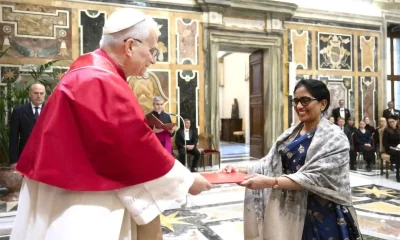
Pope fires broadside: ‘The Holy See won’t be a silent bystander to the grave disparities, injustices, and fundamental human rights violations’
-

 News5 days ago
Pakistan hands over 200 tonnes of humanitarian aid to Lanka
-

 Business4 days ago
Unlocking Sri Lanka’s hidden wealth: A $2 billion mineral opportunity awaits
-
 News6 days ago
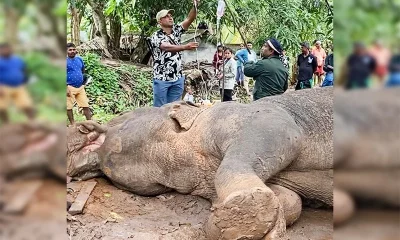
Burnt elephant dies after delayed rescue; activists demand arrests
-

 Editorial6 days ago
Colombo Port facing strategic neglect
-

 News4 days ago
Army engineers set up new Nayaru emergency bridge
-

 News6 days ago
Sri Lanka, Romania discuss illegal recruitment, etc.