
News
IMF diagnostic on Lanka damning verdict – Harsha

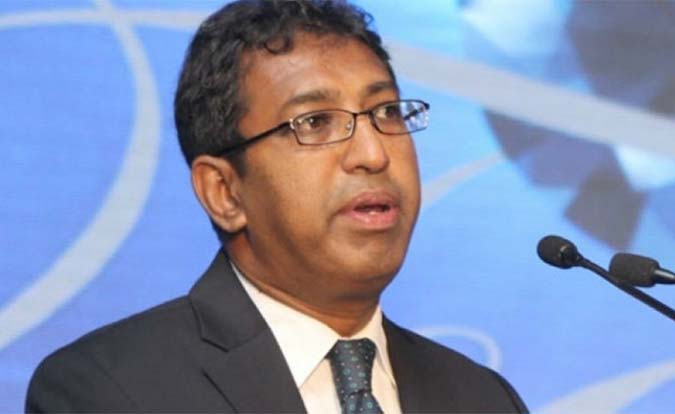
In a scathing indictment of Sri Lanka’s governance landscape, the International Monetary Fund (IMF) had handed down a damning verdict, Samagi Jana Balawegaya (SJB) MP Harsha de Silva told Parliament on Wednesday.
Discussing the contents of the IMF’s Governance Diagnostic Assessment report, he said that the IMF’s verdict was clear: corruption had eaten into all state institutions from top to bottom.
MP de Silva said that one of the main reasons for the delay in disbursing the second tranche of IMF funds was the shortfall in government revenue as well as the sluggish progress in foreign debt restructuring. However, perhaps the most significant roadblock to financial recovery lies in the government’s persistent failure to address its deep-rooted problem of corruption, he said.
The SJB MP urged the Sri Lankan government to swallow the bitter medicine it so desperately needs. With a history of approaching the IMF for assistance a staggering 16 times without lasting success, Sri Lanka now had to adopt comprehensive reforms. The government must seize the opportunity to eliminate corruption and pave the way for a meaningful change, Dr. de Silva said.
The IMF has laid out a rigorous 16-point plan, a blueprint for Sri Lanka’s revival. Those directives, while formidable in scope, were essential steps towards transparency and accountability, the MP said.
They include establishing an Advisory Committee by November 2023 to nominate commissioners for the Commission to Investigate Allegations of Bribery or Corruption (CIABOC).
Dr. de Silva said: “This committee will ensure that the nominations for key anti-corruption positions are not influenced by political interests, which is a critical step in tackling corruption.”
Another IMF recommendation is publishing asset declarations for senior officials by July 2024, an act that brings much-needed transparency, with only 12 out of 225 MPs having disclosed their assets.
“This move will shed light on potential conflicts of interest among top government officials, promoting accountability and integrity,” said Dr. de Silva.
The following are among the IMF recommendations: Enacting Crime legislation by April 2024 to align with international standards, combating money laundering and illicit financial activities, amending the National Audit Act to hold officials accountable for the use of public resources, finalising and implementing regulations for beneficial ownership information and creating a public registry by April 2024, publishing reports on increasing competitive tendered procurement contracts, targeting agencies with low levels of competition, requiring the publication of all public procurement contracts above LK 1 billion and other critical financial information on a designated website, implementing the State-Owned Enterprise Reform Policy to ensure ethical management, abolishing or suspending the Strategic Development Projects Office Act until a transparent process for evaluating proposals is established, and enacting a Public Procurement Law by December 2024, addressing the alarming procurement and corruption issues.
Harsha de Silva said: “It is quite evident the failure in procurement and corruption with the mess that’s going on in the Ministry of Health with emergency procurement but yet no action was taken. If one may recall what happened at COPF not too long ago, when a tax holiday was given to one company for 17 years, I asked only one question: What is the benefit or revenue generated to the government? But they were unable to answer that; they removed me as the Chair of the COPF. Now, the IMF has made it mandatory to reveal the cost of such tax holidays.”
MP de Silva said Sri Lankan citizens were struggling to make ends meet while corruption remained unchecked. Professionals were fleeing the country; public trust in the government was eroding and that the IMF’s intervention was not a burden but a blessing.
“The ball is now in the court of Ranil Wickremesinghe and his SLPP government. Opposition to these measures is not an option, as they represent the only viable path forward. The IMF’s directives are a lifeline, an opportunity for Sri Lanka to cleanse its system, regain trust, and pave the way for a brighter future,” Dr. de Silva said.










Latest News
Heat Index at Caution level’ in the Northern, North-central, North-western, Western and Southern provinces and in Trincomalee district.


Warm Weather Advisory
Issued by the Natural Hazards Early Warning Centre
Issued at 3.30 p.m. on 12 April 2026, valid for 13 April 2026.
Heat index, the temperature felt on human body is likely to increase up to ‘Caution level’ at some places in the Northern, North-central, North-western, Western and Southern provinces and in Trincomalee district.
The Heat Index Forecast is calculated by using relative humidity and maximum temperature and this is the condition that is felt on your body. This is not the forecast of maximum temperature. It is generated by the Department of Meteorology for the next day period and prepared by using global numerical weather prediction model data.

Effect of the heat index on human body is mentioned in the above table and it is prepared on the advice of the Ministry of Health and Indigenous Medical Services.
ACTION REQUIRED
Job sites: Stay hydrated and takes breaks in the shade as often as possible.
Indoors: Check up on the elderly and the sick.
Vehicles: Never leave children unattended.
Outdoors: Limit strenuous outdoor activities, find shade and stay hydrated.
Dress: Wear lightweight and white or light-colored clothing.
Note:
In addition, please refer to advisories issued by the Disaster Preparedness & Response Division, Ministry of Health in this regard as well. For further clarifications please contact 011-7446491.

On the apparent northward relative motion of the sun, it is going to be directly over the latitudes of Sri Lanka from 05th to 15th of April in this year.
The nearest areas of Sri Lanka over which the sun is overhead today (13th) are Pesalai, Mankulam and Nedunkerny about 12:11 noon.
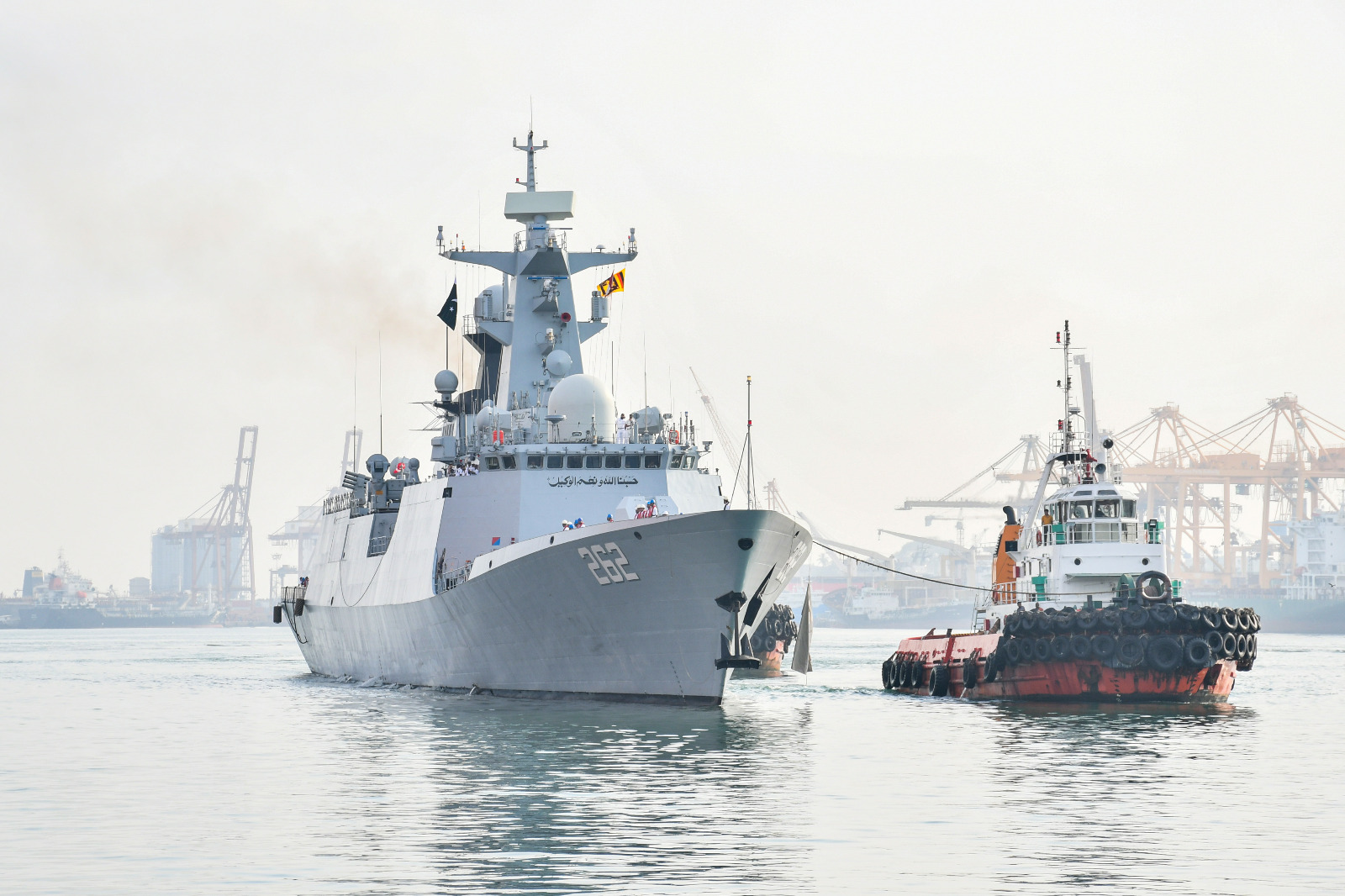
The Pakistan Navy Ship (PNS) TAIMUR and ASLAT arrived at the Port of Colombo on a goodwill visit on 12 Apr 26.
The visiting ships were welcomed by the Sri Lanka Navy in
compliance with naval traditions.
The duo of ships is commanded by Captain NIAMAT SAEED KHAN (PNS TAIMUR) and Captain NADIR MATEEN AFRIDI (PNS ASLAT).
Meanwhile, the ships are expected to conduct a Bilateral Naval Exercise LION STAR V with the Sri Lanka Navy in Colombo seas.

Salt and Patidar power RCB past Mumbai Indians

Prasidh, Buttler set up comfortable win for Gujarat Titans

Heat Index at Caution level’ in the Northern, North-central, North-western, Western and Southern provinces and in Trincomalee district.

Showers above 75 mm are likely at some places in the Western, Sabaragamuwa, Central, Southern and North-western provinces.

Sun directly overhead Pesalai, Mankulam and Nedunkerny about 12:11 noon

PNS TAIMUR & ASLAT arrive in Colombo

‘Dates have the highest sugar content to fight Coronavirus’

Sunday Island 27 December – Headlines

#SundayIsland 17th December – Headlines

Sunday Island – 28th March

Sunday Island Headlines – 21 March

Sunday Island – 21st February – Headlines
-

 News7 days ago
Lankan-origin actress Subashini found dead in India
-

 News2 days ago
CEB orders temporary shutdown of large rooftop solar systems
-

 News5 days ago
AG: Coal procurement full of irregularities
-

 Business4 days ago
Israeli attack on Lebanon triggers local stock market volatility
-

 Business5 days ago
Hayleys Mobility introduces Premium OMODA C9 PHEV
-

 News7 days ago
UN Regional Director launches SL’s first Country Gender Equality Profile during official visit
-

 Business4 days ago
HNB Assurance marks 25 years with strategic transformation to ‘HNB Life’
-

 News7 days ago
Dialog Launches ‘GanuDenu QR’, Making Cashless Transfers Free for All with eZ Cash and Dialog Finance