
Features
History made; voice of people victorious but at an immeasurable price

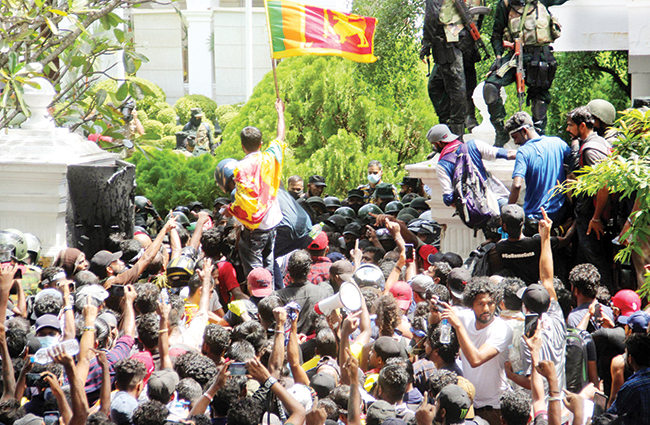
“How senseless is everything that can ever be written, done, or thought, when such things are possible.” Erich Maria Remarque in ‘All quiet on the Western Front’.

Disgraceful – slinking away in fear Thoughts roiled and boiled within Cassandra’s mind ever since near two million people converged in Colombo on Saturday July 9, repeating the people’s call made about 100 days earlier for the immediate resignation of Prez Gotabaya Rajapaksa. And then the most disgraceful, deplorable, cowardly act of all was enacted. He hid and then disappeared WITHOUT resigning and leaving the Speaker to announce he would give in his resignation on July 13. An auspicious time to die politically and as an ex-military man who the many thought was the savior of Sri Lanka, promising ‘splendor and prosperity’? He delivered misery, near death to the farmers and tea industry, poverty to the people and bankruptcy to the nation. His older brother had started the looting of the country’s money to waste on vanity projects and also stash away, and his younger brother, now known as Kaputu Kaak Kaak, was the cunning mind behind every damn move. And now where is this hero turned traitorous renegade? In Malé, as I write this on Wednesday 13 night, loudly hounded out by resident Sri Lankans and Maldivians – the nadir of disgrace. He is said to be waiting for a jet to take him and his wife minus other passengers to Singapore. He clings on to the presidency for his own ends, causing worse burning in this country; his skin against the entirety of Sri Lanka. However, already he has suffered much mentally: fear, disgrace, being treated like a pariah and refused entry by some countries.
Cassandra shivers that she speaks of the Sri Lankan President, hopefully very soon to be ex, in degrading terms. How else speak of him? His worst crime in her opinion is he did not resign no sooner the concerted cry rose “Gota Go”. If he resigned at least a month or better six weeks ago, the country and its people would have been spared so very much. The President’s house and the Secretariat would not have been breached by hordes who are now overstaying. Ranil W’s house with its invaluable books and artwork may still be standing intact. His office down Flower Road not vandalized by violent riff raff calling themselves members of the Aragalaya. Gotabaya would have been eventually excused but not forgiven for his crimes (word ‘crime’ deliberately used). He could even have stayed peacefully in retirement here in Sri Lanka until his visa to the US was granted, perchance citizenship too eventually.
World attention
Another offshoot: Sri Lanka is top on BBC World news and prestigious newspapers worldwide. The BBC reporting on the entry of protesters to the President’s House kept mentioning ‘Presidential Palace’ thus conveying an incorrect impression and also hinted at the Prez’s luxurious life style which is not quite correct. Of the R family he was unostentatious and even simple in dress, protocol etc. Of course we do not know how he ate and drank!!
The New York Times
carried a lead article titled A Reckless Dynasty brought calamity to Sri Lanka written by Kapil Komireddi dated 11/7. He summarises all matters accurately and succinctly; precisely too. I quote bits and pieces. “IT technician in US … came to be known as Terminator in 2009; Islamic suicide bombing stirred renewed fondness for the ruthless ayes of …” “Power blocked country on precipice of collapse”; “Family tightened its grip on the country and embarked on a wanton borrowing spree to entrench its cult. The Rajapaksas surrendered Sri Lanka’s sovereignty as collateral”. Subservience to Chinese loans and buildings is mentioned “The Rajapaksas have fled into hiding, the depredations of their reign are out in the open.”
One huge flaw
Yes, most if not all Sri Lankans deplore the gutting of Ranil and Maithree Wickremasinghe’s home down Fifth Lane, Kollupitiya. Books inherited and also meticulously collected by an avid, intelligent reader and added to by an academic – probably gone up in flames. A home destroyed is part of one’s very life destroyed. This wanton act of destruction was the one blot on a day that heralded the victory of the voice and will of the People.
The less good of Sri Lankan nature evident
Deplorable and uncouth is Cass’ summation of the crowds queuing up to gawk at the President’s residence in Fort. Breaching it was bad enough, now the indecency is compounded by making this most dignified colonial building/residence made open Sesame for anyone and everyone to enter and maybe pilfer something or break something else. It is said the swimming pool within is murkier than the Beira. The behaviour of the infiltrators after entering President’s House and now occupying it cannot be condoned; it is condemned totally.
We, as a nation, are great gawkers with very malleable rubber necks. A vehicle accident draws crowds to gather round instantly but very few will offer help of any sort. Getting into the President’s official residence, the Old Parliament and the PM’s office has a tinge of the kaduwa complex. You thought you were better than me? Not so – is the attitude. The original Aragalaya protesters are not like this. They were very decent, well mannered and knew what to do and what not to. No triumphant gawking for them.
And thus the fear that entangles my mind and makes my body go week. Will some of these protesters take it upon themselves to protest at every turn and attempt running the interim government and even thereafter? I boldly say I do not have faith and trust in the more radical and yes, even given to violence groups of university students. In fact my feelings towards them border on contempt and dislike. They and another group of radicals seem to claim victory for the ousting of Prez Gota. The Editor of The Island has, as his usual way, expressed extremely well the thoughts of the general public. In his editorial on July 12 he writes under the heading Let Sanity Prevail: “Likewise those who take credit for having extricated the country from the clutches of the Rajapaksas could become a huge problem if they are allowed to have their own way, given their violent past; they made themselves out to be messiahs and used the blood of the youth to fuel their politico-military projects.” We know of three or four such groups of now, one more radical than the other two with difficult-to-control interuniversity student unions.
Cassandra suffered a spasm of stress at 3.00 am on Thursday 14. She mentions this because it is a common symptom suffered by the many. Difficulty in breathing, heart and pulse racing, no emotional agreement to having a hot drink, read or sleep again. Most sufferers are not worried about themselves, they being of advanced age. They consider the children of the country and they manifestly ache and suffer emotional agitation. Such an urgent need for sanity to prevail specially among the infiltrators of the true, peaceful aragalaya; for Gotabaya to stop being so brashly selfish and tender his resignation immediately; for a stable interim government to be set up with or without Ranil W as Acting Prez. He is useful at this juncture to wield power as admittedly he is one of the few who have clout with world powers and we need their cooperation and assistance prioritized.
Since men seem incapable of coming together to help Sri Lanka; egos being large and power proving to be a magnet calling for self promotion, may the gods intervene and push people to sane, unselfish thinking and doing.



 When the National People’s Power won elections in 2024, there was much hope that the country’s education sector could be made better. Besides the promise of good governance and system change that the NPP offered, this hope was fuelled in part by the appointment of an academic who was at the forefront of the struggle to strengthen free public education and actively involved in the campaign for 6% of GDP for education, as the Minister of Education.
Reforms in the education sector are underway including, a key encouraging move to mainstream vocational education as part of the school curriculum. There has been a marginal increase in budgetary allocations for education. New infrastructure facilities are to be introduced at some universities. The freeze on recruitment is slowly being lifted. However, there is much to be desired in the government’s performance for the past one year. Basic democratic values like rule of law, transparency and consultation, let alone far-reaching systemic changes, such as allocation of more funds for education, combating the neoliberal push towards privatisation and eradication of resource inequalities within the public university system, are not given due importance in the current approach to educational and institutional reforms. This edition of Kuppi Talk focuses on the general educational reforms and the institutional reforms required in the public university system.
General Educational Reforms
Any reform process – whether it is in education or any other area – needs to be shaped by public opinion. A country’s education sector should take into serious consideration the views of students, parents, teachers, educational administrators, associated unions, and the wider public in formulating the reforms. Especially after Aragalaya/Porattam, the country saw a significant political shift. Disillusionment with the traditional political elite mired in corruption, nepotism, racism and self-serving agendas, brought the NPP to power. In such a context, the expectation that any reforms should connect with the people, especially communities that have been systematically excluded from processes of policymaking and governance, is high.
Sadly, the general educational reforms, which are being implemented this year, emerged without much discussion on what recent political changes meant to the people and the education sector. Many felt that the new government should not have been hasty in introducing these reforms in 2026. The present state of affairs calls for self-introspection. As members affiliated to the National Institute of Education (NIE), we must acknowledge that we should have collectively insisted on more time for consultation, deliberations and review.
The government’s conflicts with the teachers’ unions over the extension of school hours, the History teachers’ opposition to the removal of History from the list of compulsory exam subjects for Grades 10 and 11, the discontent with regard to the increase in the number of subjects (now presented as modules) for Grade 6 classes could have been avoided, had there been adequate time spent on consultations.
Given the opposition to the current set of reforms, the government should keep engaging all concerned actors on changes that could be brought about in the coming years. Instead of adopting an intransigent position or ignoring mistakes made, the government and we, the members affiliated to NIE, need to keep the reform process alive, remain open to critique, and treat the latest policy framework, the exams and evaluation methods, and even the modules, as live documents that can be made better, based on constructive feedback and public opinion.
Philosophy and Content
As Ramya Kumar observed in the last edition of Kuppi Talk, there are many refreshing ideas included in the educational philosophy that appears in the latest version of the policy document on educational reforms. But, sadly, it was not possible for curriculum writers to reflect on how this policy could inform the actual content as many of the modules had been sent for printing even before the policy was released to the public. An extensive public discussion of the proposed educational vision would have helped those involved in designing the curriculum to prioritise subjects and disciplines that need to be given importance in a country that went through a protracted civil war and continue to face deep ethno-religious divisions.
While I appreciate the statement made by the Minister of Education, in Parliament, that the histories of minority communities will be included in the new curriculum, a wider public discussion might have pushed the government and NIE to allocate more time for subjects like the Second National Language and include History or a Social Science subject under the list of compulsory subjects. Now that a detailed policy document is in the public domain, there should be a serious conversation about how best the progressive aspects of its philosophy could be made to inform the actual content of the curriculum, its implementation and pedagogy in the future.
University Reforms
Another reform process where the government seems to be going headfirst is the amendments to the Universities Act. While laws need to be revisited and changes be made where required, the existent law should govern the way things are done until a new law comes into place. Recently, a circular was issued by the University Grants Commission (UGC) to halt the process of appointing Heads of Departments and Deans until the proposed amendments to the University Act come into effect. Such an intervention by the UGC is totalitarian and undermines the academic and institutional culture within the public university system and goes against the principle of rule of law.
There have been longstanding demands with regard to institutional reforms such as a transparent process in appointing council members to the public university system, reforms in the schemes of recruitment and selection processes for Vice Chancellor and academics, and the withdrawal of the circular banning teachers of law from practising, to name a few.
The need for a system where the evaluation of applicants for the post of Vice Chancellor cannot be manipulated by the Council members is strongly felt today, given the way some candidates have reportedly been marked up/down in an unfair manner for subjective criteria (e.g., leadership, integrity) in recent selection processes. Likewise, academic recruitment sometimes penalises scholars with inter-disciplinary backgrounds and compartmentalises knowledge within hermetically sealed boundaries. Rigid disciplinary specificities and ambiguities around terms such as ‘subject’ and ‘field’ in the recruitment scheme have been used to reject applicants with outstanding publications by those within the system who saw them as a threat to their positions. The government should work towards reforms in these areas, too, but through adequate deliberations and dialogue.
From Mindless Efficiency to Patient Deliberations
Given the seeming lack of interest on the part of the government to listen to public opinion, in 2026, academics, trade unions and students should be more active in their struggle for transparency and consultations. This struggle has to happen alongside our ongoing struggles for higher allocations for education, better infrastructure, increased recruitment and better work environment. Part of this struggle involves holding the NPP government, UGC, NIE, our universities and schools accountable.
The new year requires us to think about social justice and accountability in education in new ways, also in the light of the Ditwah catastrophe. The decision to cancel the third-term exams, delegating the authority to decide when to re-open affected schools to local educational bodies and Principals and not change the school hours in view of the difficulties caused by Ditwah are commendable moves. But there is much more that we have to do both in addressing the practical needs of the people affected by Ditwah and understanding the implications of this crisis to our framing of education as social justice.
To what extent is our educational policymaking aware of the special concerns of students, teachers and schools affected by Ditwah and other similar catastrophes? Do the authorities know enough about what these students, teachers and institutions expect via educational and institutional reforms? What steps have we taken to find out their priorities and their understanding of educational reforms at this critical juncture? What steps did we take in the past to consult communities that are prone to climate disasters? We should not shy away from decelerating the reform process, if that is what the present moment of climate crisis exacerbated by historical inequalities of class, gender, ethnicity and region in areas like Malaiyaham requires, especially in a situation where deliberations have been found lacking.
This piece calls for slowing-down as a counter practice, a decelerating move against mindless efficiency and speed demanded by neoliberal donor agencies during reform processes at the risk of public opinion, especially of those on the margins. Such framing can help us see openness, patience, accountability, humility and the will to self-introspect and self-correct as our guides in envisioning and implementing educational reforms in the new year and beyond.
(Mahendran Thiruvarangan is a Senior Lecturer attached to the Department of Linguistics & English at the University of Jaffna)
Kuppi is a politics and pedagogy happening on the margins of the lecture hall that parodies, subverts, and simultaneously reaffirms social hierarchies
by Mahendran Thiruvarangan

Looking back at the past year, the anxiety among influential sections of the population that the NPP government would destabilise the country has been dispelled. There was concern that the new government with its strong JVP leadership might not be respectful of private property in the Marxist tradition. These fears have not materialised. The government has made a smooth transition, with no upheavals and no breakdown of governance. This continuity deserves recognition. In general, smooth political transitions following decisive electoral change may be identified as early indicators of democratic consolidation rather than disruption.
Democratic legitimacy is strengthened when new governments respect inherited institutions rather than seek to dismantle them wholesale. On this score, the government’s first year has been positive. However, the challenges that the government faces are many. The government’s failure to appoint an Auditor General, coupled with its determination to push through nominees of its own choosing without accommodating objections from the opposition and civil society, reflects a deeper problem. The government’s position is that the Constitutional Council is making biased decisions when it rejects the president’s nominations to the position of Auditor General.
Many if not most of the government’s appointments to high positions of state have been drawn from a narrow base of ruling party members and associates. The government’s core entity, the JVP, has had a traditional voter base of no more than 5 percent. Limiting selection of top officials to its members or associates is a recipe for not getting the best. It leaves out a wide swathe of competent persons which is counterproductive to the national interest. Reliance on a narrow pool of party affiliated individuals for senior state appointments limits access to talent and expertise, though the government may have its own reasons.
The recent furor arising out of the Grade 6 children’s textbook having a weblink to a gay dating site appears to be an act of sabotage. Prime Minister (and Education Minister Harini Amarasuriya) has been unfairly and unreasonably targeted for attack by her political opponents. Governments that professionalise the civil service rather than politicise them have been more successful in sustaining reform in the longer term in keeping with the national interest. In Sri Lanka, officers of the state are not allowed to contest elections while in service (Establishment Code) which indicates that they cannot be linked to any party as they have to serve all.
Skilled Leadership
The government is also being subjected to criticism by the Opposition for promising much in its election manifesto and failing to deliver on those promises. In this regard, the NPP has been no different to the other political parties that contested those elections making extravagant promises. The problem is that the economic collapse of 2022 set the country back several years in terms of income and living standards. The economy regressed to the levels of 2018, which was not due to actions of the NPP. Even the most skilled leadership today cannot simply erase those lost years. The economy rebounded to around five percent growth in the past year, but this recovery now faces new problems following Cyclone Ditwah, which wiped out an estimated ten percent of national income.
In the aftermath of the cyclone, the country’s cause for shame lies with the political parties. Rather than coming together to support relief and recovery, many focused on assigning blame and scoring political points, as in the attacks on the prime minister, undermining public confidence in the state apparatus at a moment when trust was essential. Despite the politically motivated attacks by some, the government needs to stick to the path of inclusiveness in its approach to governance. The sustainability of policy change depends not only on electoral victory but on inclusive processes that are more likely to endure than those imposed by majorities.
Bipartisanship recognises that national rebuilding and reconciliation requires cooperation across political divides. It requires consultation with the opposition and with civil society. Opposition leader Sajith Premadasa has been generally reasonable and constructive in his approach. A broader view of bipartisanship is that it needs to extend beyond the mainstream opposition to include ethnic and religious minorities. The government’s commitment to equal rights and non-discrimination has had a positive impact. Visible racism has declined, and minorities report feeling physically safer than in the past. These gains should not be underestimated. However, deeper threats to ethnic harmony remain.
The government needs to do more to make national reconciliation practical and rooted in change on the ground rather than symbolic. Political power sharing is central to this task. Minority communities, particularly in the north and east, continue to feel excluded from national development. While they welcome visits and dialogue with national leaders, frustration grows when development promises remain confined to foundation stones and ceremonies. The construction of Buddhist temples in areas with no Buddhist population, justified on claims of historical precedent, is perceived as threatening rather than reconciliatory.
Wider Polity
The constitutionally mandated devolution framework provided by the Thirteenth Amendment remains the most viable mechanism for addressing minority grievances within a united country. It was mediated by India as a third party to the agreement. The long delayed provincial council elections need to be held without further postponement. Provincial council elections have not been held for seven years. This prolonged suspension undermines both democratic practice and minority confidence. International experience, whether in India and Switzerland, shows that decentralisation is most effective when regional institutions are electorally accountable and operational rather than dormant.
It is not sufficient to treat individuals as equal citizens in the abstract. Democratic equality also requires recognising communities as collective actors with legitimate interests. Power sharing allows communities to make decisions in areas where they form majorities, reducing alienation and strengthening national cohesion. The government’s first year in office saw it acknowledge many of these problems, but acknowledgment has not yet translated into action. Issues relating to missing persons, prolonged detention, land encroachment and the absence of provincial elections remain unresolved. Even in areas where reform has been attempted, such as the repeal of the Prevention of Terrorism Act, the proposed replacement legislation falls short of international human rights standards.
The New Year must be one in which these foundational issues are addressed decisively. If not, problems will fester, get worse and distract the government from engaging fully in the development process. Devolution through the Thirteenth Amendment and credible reconciliation mechanisms must move from rhetoric to implementation. It is reported that a resolution to appoint a select committee of parliament to look into and report on an electoral system under which the provincial council elections will be held will be taken up this week. Similarly, existing institutions such as the Office of Missing Persons and the Office of Reparations need to be empowered to function effectively, while a truth and reconciliation process must be established that commands public confidence.
Trust in institutions requires respect for constitutional processes, trust in society requires inclusive decision making, and trust across communities requires genuine power sharing and accountability. Economic recovery, disaster reconstruction, institutional integrity and ethnic reconciliation are not separate tasks but interlinked tests of democratic governance. The government needs to move beyond reliance on its core supporters and govern in a manner that draws in the wider polity. Its success here will determine not only the sustainability of its reforms but also the country’s prospects for long term stability and unity.
by Jehan Perera
While agreeing wholeheartedly with most of the sentiments expressed by Dr Geewananda Gunawardhana in his piece “Pharmaceuticals, deaths, and work ethics” (The Island, 5th January), I must take exception to what he stated regarding corruption: “Enough has been said about corruption, and fortunately, the present government is making an effort to curb it. We must give them some time as only the government has changed, not the people”
With every change of government, we have witnessed the scenario of the incoming government going after the corrupt of the previous, punishing a few politicians in the process. This is nothing new. In fact, some governments have gone after high-ranking public servants, too, punishing them on very flimsy grounds. One of the main reasons, if not the main, of the unexpected massive victory at the polls of this government was the promise of eradication of corruption. Whilst claiming credit for convicting some errant politicians, even for cases that commenced before they came to power, how has the NPP government fared? If one considers corruption to be purely financial, then they have done well, so far. Well, even with previous governments they did not commence plundering the wealth of the nation in the first year!
I would argue that dishonesty, even refusal to take responsibility is corruption. Plucking out of retirement and giving plum jobs to those who canvassed key groups, in my opinion, is even worse corruption than some financial malpractices. There is no need to go into the details of Ranwala affairs as much has been written about but the way the government responded does not reassure anyone expecting and hoping for the NPP government to be corruption free.
One of the first important actions of the government was the election of Ranwala as the speaker. When his claimed doctorate was queried and he stepped down to find the certificate, why didn’t AKD give him a time limit to find it? When he could not substantiate obtaining a PhD, even after a year, why didn’t AKD insist that he resigns the parliamentary seat? Had such actions been taken then the NPP can claim credit that the party does not tolerate dishonesty. What an example are we setting for the youth?
Recent road traffic accident involving Ranwala brough to focus this lapse too, in addition to the laughable way the RTA was handled. The police officers investigating could not breathalyse him as they had run out of ‘balloons’ for the breathalyser! His blood and urine alcohol levels were done only after a safe period had elapsed. Not surprisingly, the results were normal! Honestly, does the government believe that anyone with an iota of intelligence would accept the explanation that these were lapses on the part of the police but not due to political interference?
The release of over 300 ‘red-tagged’ containers continues to remain a mystery. The deputy minister of shipping announced loudly that the ministry would take full responsibility but subsequently it turned out that customs is not under the purview of the ministry of shipping. Report on the affair is yet to see the light of day, the only thing that happened being the senior officer in customs that defended the government’s action being appointed the chief! Are these the actions of a government that came to power on the promise of eradication of corruption?
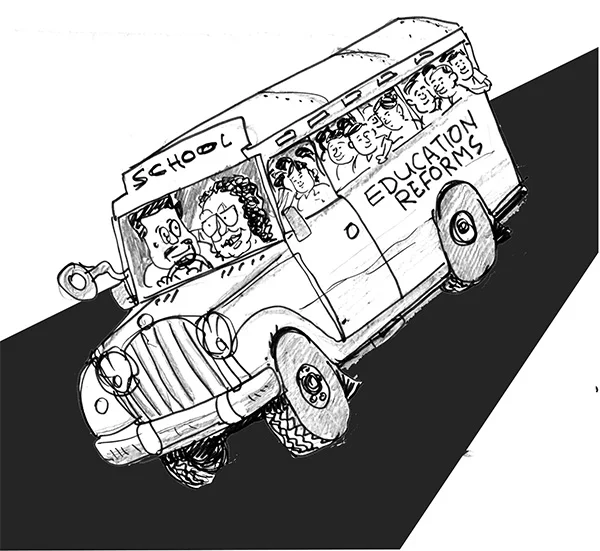
The new year dawned with another headache for the government that promised ‘system change.’ The most important educational reforms in our political history were those introduced by Dr CWW Kannangara which included free education and the establishment of central schools, etc. He did so after a comprehensive study lasting over six years, but the NPP government has been in a rush! Against the advice of many educationists that reforms should be brought after consultation, the government decided it could rush it on its own. It refuses to take responsibility when things go wrong. Heavens, things have started going wrong even before it started! Grade Six English Language module textbook gives a link to make e-buddies. When I clicked that link what I got was a site that stated: “Buddy, Bad Boys Club, Meet Gay Men for fun”!
Australia has already banned social media to children under 15 years and a recent survey showed that nearly two thirds of parents in the UK also favour such a ban but our minister of education wants children as young as ten years to join social media and have e-buddies!
Coming back to the aforesaid website, instead of an internal investigation to find out what went wrong, the Secretary to the Ministry of Education went to the CID. Of course, who is there in the CID? Shani of Ranjan Ramanayake tape fame! He will surely ‘fix’ someone for ‘sabotaging’ educational reforms! Can we say that the NPP government is less corrupt and any better than its predecessors?
by Dr Upul Wijayawardhana

Venezuelan security forces detain journalists as armed police patrol streets

Selfies and smiles: South Korea seeks ‘new phase’ in ties with China

M/s South Asian Technologies awarded contract to supply vehicle number plates

A new act for National Lotteries Board to be introduced
Motor Vehicles (Driving License Levy) Regulations No. 3 of 2022 to be amended
Mrs. P. K. L. S. Panduwawala appointed to the post of Surveyor General

‘Dates have the highest sugar content to fight Coronavirus’

Sunday Island 27 December – Headlines

#SundayIsland 17th December – Headlines

Sunday Island – 28th March

Sunday Island Headlines – 21 March

Sunday Island – 21st February – Headlines
-
 News24 hours ago
Broad support emerges for Faiszer’s sweeping proposals on long- delayed divorce and personal law reforms
-
 News2 days ago
Private airline crew member nabbed with contraband gold
-

 News24 hours ago
Interception of SL fishing craft by Seychelles: Trawler owners demand international investigation
-

 News4 days ago
Health Minister sends letter of demand for one billion rupees in damages
-

 Opinion6 days ago
Remembering Douglas Devananda on New Year’s Day 2026
-
 Features2 days ago
Pharmaceuticals, deaths, and work ethics
-
 News7 days ago
Leading the Nation’s Connectivity Recovery Amid Unprecedented Challenges
-
 News23 hours ago
US raid on Venezuela violation of UN Charter and intl. law: Govt.