
Features
HIGH JINKS AT MEDICAL COLLEGE


by ECB Wijeyesinghe
Just after I left school I thought I should help in a small way to solve the over-population problem, which was then beginning to rear its head. I joined the Medical College in the hope that some day I would become a doctor. A merciful Providence, however, had other plans for me.
Among the students who joined with me were men who later acquired fame in different fields of medicine or surgery. Many others did not specialize at all and preferred to be general practitioners, which was probably much more remunerative. Some of the specialists like Dr. G.R. Handy, are now at the top of the cardiac curve, while GPs like the beloved Dr. G.R. (Raddy) Muttumani of Wellawatte also continue to flourish. Despite the fact that the hair on Dr. Muttumani’s head is grey, the grey matter within remains unimpaired.
Dr. Shelton Karunaratne, of blessed memory, who passed away a few years ago, was the life and soul of the batch of students who entered the portals of the college with us. For some unknown reason someone called him “Carroty” and the name stuck. He was an old Josephian with an extraordinary sense of humour and his best cracks were directed at his numerous relatives, some of whom were near-millionaires. Dr. C.H. Gunasekere, the All-Ceylon cricketer, was his brother-in-law.
`RAGS’
Though he was a Buddhist, Shelton was a great believer in the Biblical aphorism that “the love of money is the root of all evil,” and did his best to drive it into the heads of his richer colleagues like Dr. Reggie Allen. Shelton was a good footballer and a light-footed dancer. He also possessed a fair singing voice. But he had a special gift for perpetrating bizarre practical jokes and he figured prominently in every “rag” and extra-mural activity of the student population.
Among our seniors at the time were Dr. Wijesena de Zoysa, (affectionately known as ‘Walhamu’), Dr. Albert Rajasingham, Dr. M.V.P. Peiris, Dr. Arden Ratnayake and Dr. Nicholas Attygalle.
The acknowledged leader, however, was Wijesena de Zoysa, whose impromptu speeches, delivered with such grace and in a beautiful mellow voice, gave one the impressions that he had lost his vocation in Hulftsdorp.
He would have made a mark just as his brother, the late Gunasena de Zoysa did in the Civil Service. But Fate plays strange tricks, and Wijesena vegetated in the Medical College, while less intelligent but more studious colleagues overtook him in the race for the licentiateship.
Almost as soon as we became medical students, the Ceylon University College was inaugurated and we came under the wing of Professor R. Marrs, the Principal, a stern disciplinarian, who came with university experience in Calcutta. His office was at Regina Walauwa, the old Thurstan Road home of Mr. and Mrs. T.H.A. de Soysa, and students in their leisure hours used to leave the lecture rooms with the notes in their hands and a song on their lips.
During one of these ebullient intervals, Professor. Marrs was disturbed by a gang of singing students. He stopped them, summoned his clerk and asked him to take down their names. The students co-operated readily and the clerk, with a weak smile, noted down the names of numerous Pereras, Silvas and Fernandos. I do not think there was a single correct name in the clerk’s list.
DIPLOMAT
Marrs was a diplomat. He invited all the office-bearers of the University College Union to tea and clock-golf after the annual general meeting. There, in his bungalow near the race-course, he must have noticed some of the faces he saw earlier near his office. I had to be there, because incredible as it may sound, I had been elected captain of cricket in succession to Lalita Rajapakse.
Marrs, however, put on a poker face, while we consumed the sandwiches wearing absolutely innocent looks. My early days at the Medical College were uneventful, except that during the first week I cycled under a ladder after a zoology lecture. Some superstitious spectators held up their hands in horror and said it was very unlucky and that I had had it.
They were right. Or maybe they were wrong. But the fact remained I could not attend another lecture for a long time to come. I contracted enteric fever, which kept me in bed for nearly two months, and then as I was about to get back to work, I developed para-typhoid. Thus my first three months in the Medical College were disastrous and I felt that my hopes of becoming a doctor and reducing the population were being dashed to the ground.
DR. V GABRIEL
In course of time I went on to the Anatomy Block, on probation as it were. The lecturer was Dr. V. Gabriel, a handsome young man who had just returned from England, glowing with the FRCS degree. The man fascinated us, especially when he started speaking. He clothed the dead bones of his subject in almost poetic language and Gray’s popular text-book on Anatomy was like a rubbish heap of dull prose, compared with Dr. Gabriel’s picturesque descriptions of the devious ways of nerves, veins and arteries.
We concentrated not on what he said, but on the way he said it. Very soon I had to meet Dr. Gabriel in another capacity. University College was engaged in a soccer match against a club called the Chums at Campbell Park and our team which was captained by my friend, Shelton Karunaratne, was one man short. Shelton asked me to deputise for the goal-keeper and I promptly removed my shoes and stood between the posts.
But alas, instead of kicking the ball at one critical moment, I missed. the ball and kicked one of the hard wooden goal posts. The impact broke two metatarsal bones in my right foot. I dropped down in agony and was immediately rushed to the OPD, where Dr. Gabriel was on duty. I was given to understand then that it was one of his first assays in setting broken bones. I believe it. There is a big knob on my right foot to prove it.
Dr. Gabriel, however, starting with me gained so much experience that eventually he became one of Ceylon’s most skilful surgeons and during his eventful career his knife had probed the insides of half the socialites in Colombo. One thing I must say about Dr. Vraspillai Gabriel. His English diction was impeccable. There were few other I know who spoke with the same fluency. One was the late H.A.P. Sandrasagara, K.C. and another is G.G. Ponnambalam, Q.C., who is still in active practice. If you placed them behind a screen and asked them to say something no one would say they were not natives of the United Kingdom.
My stay in the dissecting room of the Anatomy Block was short but breezy. One of the few things that annoyed me was to find the dried-up sector of a male reproductive organ in my coat pocket when I went home. The following day I did some detective work among the cadavers laid out in the block and was almost sure who the culprit was. But I could not have my revenge as I was dissecting a female body. There was a tit for tat I could have perpetrated, but it revolted against my aesthetic senses and I rejected it as being flat, stale and unprofitable.
RAGGING
When so many blood-curdling stories are told about ragging in campuses these days, I must say that the freshers in my time had a very easy time. The most they were asked to do was to shell out some cash according to their means. As the hat was passed round the seniors stood round them and solemnly intoned the words: “Let us prey.” The students theme song followed. The words of the song consisted of most of the deadly drugs and tinctures in the British Pharmacopoeia.
The ditty, as it was in Latin, sounded suspicious to untrained ears. While the chorus “Glory, glory, alleluia” was intoned the party marched in procession to the tuck-shop, where ‘kalu dodol’ and cakes were consumed with avidity till the stocks were exhausted. With the freshers own money their health was drunk to in hot milk tea.
But the other “rags” in which the whole college participated were of a different order. They were organized on a grand scale and had the elements of a dramatic extravaganza. One such “rag” was got up to protest against the Salaries Commission’s report of the early twenties, which ignored the claims of the medical profession to higher emoluments. A hearse and all the trappings of woe were hired from an undertaker and within the hearse, drawn by a black horse, was a small black coffin which contained the Salaries Commission’s report.
A special hymn condemning the report was composed to the tune of the Dead March in “Saul” and hundreds of students in black arm-bands and carrying appropriate banners followed the hearse. The chief mourners were the senior students, who were soon to feel the pinch of the miserable recommendations. We, the juniors, were in the rear but gained Importance owing to the fact that some of the best singers – S.C.Thurairajah, Botha de Kretser, Daniel de Alwis and Claude Fernando – were in our batch.
And so we proceeded, slowly and sadly to the Galle Face Green, our destination and crematorium. En route people raised their hats in salute to the “corpse”, not being aware of what the coffin contained. On the Green the funeral orations were delivered. “Walhamu” de Zoysa, with his voice of silver, excelled himself and convulsed the listeners, bringing them to the verge of tears.
One bottle of kerosene and a match did the rest. As the coffin and its contents crumbled in flames a mighty roar went up and mingled with the roar of the waves beating on the rocks. It was a great day and a great “rag” — something that the whole country applauded. It was original as well as clever, and the entire proceeding was conducted on the highest intellectual plane. A protest such as that had never been staged before nor since.
The rest of the evening was devoted to merry-making or what some people would call a “wake.” Every pub in Slave Island and the Fort did a roaring business. Five or six students they say, were carried home. But that is an exaggeration. They were merely taken back to college as they could not remember where they lived.
(Excerpted from The Good At Their Best first published in 1976)


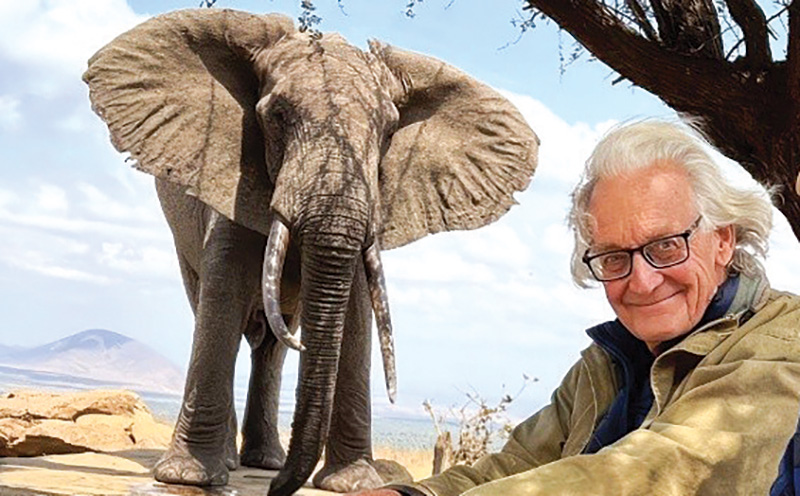
Passing of Iain Douglas-Hamilton, a man who dedicated his life to conservation and whose life’s work leaves a lasting impact on our appreciation for, and understanding of, elephants.
– Prince William
In Africa on 08 December, 2025, when the sun slipped below the horizon, it did not only give an end for that day, but it also marked the end of a man whose knowledge and courage saved Africa’s elephants. This gentleman was none other than Iain Douglas-Hamilton! There is a beautiful African proverb that says, “When an old man dies, a library burns to the ground,” and it resonates well with Iain’s demise.
Iain pioneered behaviour research on elephants, and he was the first to highlight the elephant poaching crisis in Africa. Also, the adventures he went through to save the elephants will inspire generations.
From Oxford to Africa
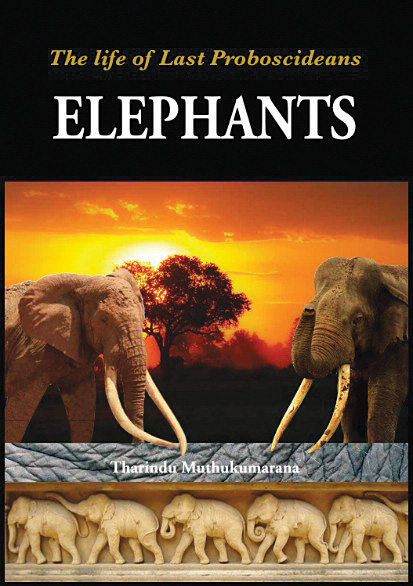
The Life of the Last Proboscideans: Elephants”, authored by Muthukumarana, stands as an awardwinning, comprehensive study that integrates elephant evolution, anthropology, biology, behaviour, and conservation science.
Iain was born on 16 August, 1942, into an aristocratic family, the son of Lord David Douglas-Hamilton and Ann Prunella Stack. His parents were a distinguished couple in Britain: his father, a Scottish nobleman, served as a squadron leader in the Royal Air Force, while his mother was a pioneering figure in physical fitness and a prominent advocate for women’s rights. After finishing his school, Iain was admitted to Oxford University to study zoology. At the age of 23, for his PhD, Iain travelled to Tanzania to study the behaviour of elephants at Lake Manyara National Park. This was a daring and humble beginning that would change how the world understood elephants. He learnt to recognise individual animals based on their tusks and ears. He observed their family bonds, their grief, and their intelligence. These findings made the scientific community identify elephants as sentimental beings. During this period, he married Oria Rocco, and together they had two children, Saba and Mara.
Battle for the elephants
When ivory poaching swept across Africa and devastated elephant populations, Iain did not withdraw in despair. He confronted the crisis head-on, guided by science, rigorous data, and unwavering resolve. Through extensive aerial counts and field studies, he laid bare the scale of the tragedy—revealing that Africa’s elephant numbers had collapsed from an estimated 1.3 million to just about 600,000 in little more than 10 years.
It was largely thanks to his work that the global community saw—perhaps for the first time—the full scope of the crisis. His efforts played a pivotal role in pushing forward the 1989 international ban on ivory trade, a landmark moment for wildlife conservation.
In 1993, Iain founded Save the Elephants (STE), an organisation that would become the heart of elephant conservation efforts in Kenya and across Africa.
At STE, he pioneered the use of GPS-tracking and aerial survey techniques to monitor elephant movements, protect them from poaching, and plan safe corridors for them in increasingly human-dominated landscapes. These methods have since become standard tools in wildlife conservation worldwide.
Beyond technology and science, Iain was a mentor. He inspired — and continues to inspire — generations of conservationists, researchers, and everyday people who care deeply about wildlife. Through his books (such as Among the Elephants and Battle for the Elephants), documentaries, lectures, and personal example, he invited the world to see elephants not as trophies or commodities, but as sentient beings — worthy of awe, study, and protection.
Iain and Sri Lanka
In 2003 Iain came to Sri Lanka for the first time to attend the “Symposium on Human-Elephant Relationships and Conflict” as the keynote speaker. On that day he concluded his address by saying, “When I hear the talk of Problem Animal Control, I always wonder whether our species has the capacity for its own self-regulation or Problem Human Control in a humane and wise manner. HEC stands for Human Elephant Conflict, one of our focuses of this conference. How I wish it could come to stand for Human Elephant Coexistence, based on a recognition that other beings also need their space to live in. We are a long way from that, but I am sure that many of the findings of the talented body of researchers in this room will begin a stepwise progress in answering some of these fundamental problems.”
A few years ago Iain’s organisation STE collaborated with the Sri Lankan Wildlife Conservation Society for research activities aimed at reducing human-elephant conflict. In 2016 when the Sri Lankan government was going to destroy the confiscated illegal African elephant ivory, I made a request for Iain to write a congratulatory message to Sri Lanka’s President and Prime Minister for the wise decision they had taken. Iain sent me a four-page meaningful letter written by him, and he was joined by 18 other conservation organisations. In his letter he mentioned, “I want to offer my congratulations to the government of Sri Lanka for the laudable decision to destroy ivory stocks…” Sri Lanka is sending a message to the world that ivory should be without worth; elephants have value when alive. This is a critical message to send, particularly to the religious world, as they are sensitised about the threat religious ivory poses to elephant populations in Africa.”
Fortunately, Iain’s conservation is taken up by his children, especially his eldest daughter, Saba. In 2016 and 2024 she came to Sri Lanka for a lecture hosted by the Galle Literary Festival. Also in 2019, for the Wildlife and Nature Protection Society’s 125th Anniversary, Saba and her husband visited a gala dinner that was held to fundraise for conservation projects.
A difficult path
Iain’s path was never easy. He endured personal peril many times: from hostile terrain and unpredictable wild animals to being shot at by poachers while conducting aerial patrols over war-torn national parks.
Yet despite the danger, despite setbacks — flooded camps, lost data, shifting political tides — his conviction never wavered. His was a life marked by resilience. He refused complacency. He refused to surrender. And through every hardship, he remembered why he began: to give elephants a future.
Iain was also a pilot, and as the old English saying goes, “Pilots don’t die; they simply fly higher.” In that spirit, I wish the same peaceful ascent for Iain. My heartfelt condolences are with Iain’s family.
by Tharindu Muthukumarana ✍️
tharinduele@gmail.com
(Author of the award-winning book “The Life of Last Proboscideans: Elephants”)
When you hear the word gratitude the first impression you get is a tail-wagging dog. If you feed a dog one day, it will wag its tail even if you meet it after a few years. That is gratitude. In addition, dogs are great teachers. They are at home in the world. They live in the moment and they force us to stay with them. Dogs love us and remain grateful unconditionally not for our bodies or bank accounts.
Small children are taught to say ‘Thank you’ for any favour they receive from others. They do not know that the two words can have positive effects on your health and the well-being of others.
Some time ago I had to call emergency services as I found one of my family members was unconscious. Within minutes an ambulance arrived and the paramedics whisked the patient away to the nearest hospital. He was in intensive care for a few days and returned home. We were marvelled at the impact of a handful of strangers who took charge of the patient at a critical time. I immediately wrote thank you notes to those who saved the patient’s life. I knew that it was a small gesture on my part. However, it was the only way I could express my gratitude to a dedicated team.
Selfless people
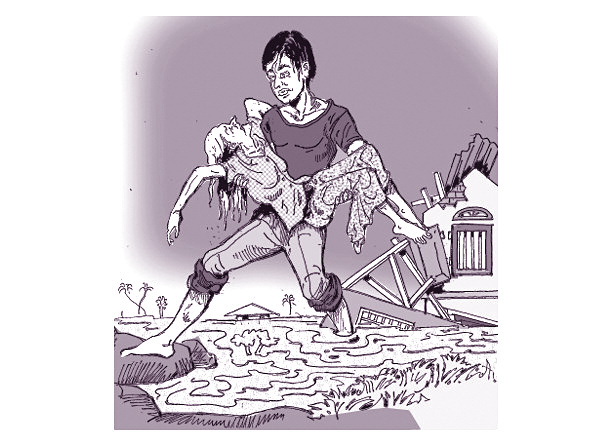
Later I realized that there are a large number of selfless people who do life-saving work, but they never expect anything in return. How volunteers saved a large number of flood victims is a case in point. The flood victims may not have expressed their gratitude in so many words. However, they would have felt a deep sense of gratitude to the volunteers who saved them.
Why do people come forward to help those facing natural disasters and other dangerous situations? A recent research in the United States shows that sharing thoughts of gratitude and performing acts of kindness can boost your mood and have other positive effects on your health. Almost all religions teach that gratitude does have a good impact on your happiness. Professor of Psychology Willibald Ruch says that gratitude is among the top five predictors of happiness.
By showing gratitude you can make positive changes in your own life. If you feel a sense of gratitude whenever you receive something that is good for you, it will be a healthy sign. You cannot get such a feeling in a vacuum because others have to play their roles. They can be your loved ones, friends, strangers or even people in authority. Gratitude is how you relate to them when you see yourself in connection with things larger than yourself.
Gratification lifestyle
Strangely, many people do not pause to appreciate what others are doing for them. For this you have to blame your gratification lifestyle. With the popularity of social media the young people feel that they are the centre of the universe. They seem to think there is no necessity to thank those who help them.
Why should we thank others even for minor favours? Recent studies show that those who express gratitude increase their own happiness levels. They also lower their blood pressure levels to a great extent. On the other hand, they will be able to sleep well and improve their relationships. They are also less affected by pain because of the positive impact on their depression.
They may not know that positive effects of gratitude are long lasting. Research shows that those who write thank you notes improve their mental health. There was also a decrease in their bodily pains. What is more, they feel more energetic in completing their daily activities. Unfortunately, schools and universities do not teach the value of gratitude since it is fairly a new field of study. Researchers are still trying to find out its cause and effect relationship. We know that those who perform acts of gratitude can sleep well. However, we do not know the reason for it. Researchers are wondering whether gratitude leads to better sleep or sleep leads to more gratitude. They also probe whether there is another variable that leads to gratitude and improved sleep.
Children
Despite such controversies, we know for certain that gratitude can benefit people at any stage of life. Most elderly people remain grateful for their children and grandchildren who support them. Elderly people cannot regain their physical strength or mental agility. Therefore they focus on gratitude. They are thankful to their children and grandchildren for their present situation.
How do gratitude recipients react? Research shows that those who receive thank you notes or acts of kindness experience positive emotions. You feel happy when someone holds a door open for you. Similarly, you are happy if you receive some unexpected help. Recently I was pleasantly surprised to see that someone has credited a big sum of money to my bank account in appreciation of a small favour I had done.
When you thank someone they are more likely to return the favour or pay kindness forward. Psychologically, people feel very happy when you thank them. However, some people hesitate to say thank you. The give-and-take of gratitude deepens relationships. In a close relationship husbands and wives do not thank each other. However, there are other ways of showing gratitude. A wife can make her husband feel appreciated. Such a feeling of appreciation will go a long way to strengthen their relationship.
Some people are ungrateful by nature. However, they can learn the art of being grateful. Such people will do well to maintain a gratitude journal. It is something similar to Pinpotha maintained by Buddhists in the past. They can record positive events in the journal. At the beginning this may not be easy. With practice, however, you can do it well. I knew of a man who kept a gratitude journal. Although his family members laughed at him, he did not give up the habit. When he was diagnosed with a terminal disease he used to read his gratitude journal very happily.
By R.S. Karunaratne ✍️

The 2004 Asian Tsunami erupted the day after Christmas. Like the Boxing Day Test Match in Brisbane, it was a boxing day bolt for Indonesia, Thailand, Sri Lanka, India and Maldives. Twenty one years later, in 2025, multiple Asian cyclones hit almost all the old victims and added a few more, including Malayasia, Vietnam and Cambodia. Indonesia and Sri Lanka were hit hard both times. Unlike the 2004 Tsunami, the 2025 cyclones made landfalls weeks before Christmas, during the Christian Season of Advent, the four-week period before Christmas preparing for the arrival of the Messiah. An ominously adventus manifestation of the nature’s fury.
Yet it was not the “day of wrath and doom impending … heaven and earth in ashes ending” – heavenly punishment for government lying, as an opposition politician ignorantly asserted. By that token, the gods must have opted to punish half a dozen other Asian countries for the NPP government’s lying in Sri Lanka. Or all those governments have been caught lying. Everyone is caught and punished for lying, except the world’s Commander in Chief for lying – Donald J. Trump. But as of late and none too sooner, President Trump is getting his punishment in spades. Who would have thought?
In fairness, even the Catholic Church has banished its old hymn of wrath (Dies irae, dies illa) that used to be sung at funerals from its current Missals; and it has on offer, many other hymns of peace and joy, especially befitting the Christmas season. Although this year’s Christmas comes after weeks of havoc caused by cyclonic storms and torrential rains, the spirit of the season, both in its religious and secular senses, will hopefully provide some solace for those still suffering and some optimism to everyone who is trying to uplift the country from its overflowing waterways and sliding slopes.
As the scale of devastation goes, no natural disaster likely will surpass the human fatalities that the 2004 Tsunami caused. But the spread and scale of this year’s cyclone destruction, especially the destruction of the island’s land-forms and its infrastructure assets, are, in my view, quite unprecedented. The scale of the disaster would finally seem to have sunk into the nation’s political skulls after a few weeks of cacophonic howlers – asking who knew and did what and when. The quest for instant solutions and the insistence that the government should somehow find them immediately are no longer as vehement and voluble as they were when they first emerged.
NBRO and Landslides
But there is understandable frustration and even fear all around, including among government ministers. To wit, the reported frustration of Agriculture Minister K.D. Lalkantha at the alleged inability of the National Building Research Organization (NBRO) to provide more specific directions in landslide warnings instead of issuing blanket ‘Level 3 Red Alerts’ covering whole administrative divisions in the Central Province, especially in the Kandy District. “We can’t relocate all 20 divisional secretariats” in the Kandy District, the Minister told the media a few weeks ago. His frustration is understandable, but expecting NBRO to provide political leaders with precise locations and certainty of landslides or no landslides is a tall ask and the task is fraught with many challenges.
In fairness to NBRO and its Engineers, their competence and their responses to the current calamity have been very impressive. It is not the fault of the NBRO that local disasters could not be prevented, and people could not be warned sufficiently in advance to evacuate and avoid being at the epicentre of landslides. The intensity of landslides this year is really a function of the intensity and persistence of rainfall this season, for the occurrence of landslides in Sri Lanka is very directly co-related to the amount of rainfall. The rainfall during this disaster season has been simply relentless.
Evacuation, the ready remedy, is easier said than socially and politically done. Minister Lal Kantha was exasperated at the prospect of evacuating whole divisional secretariats. This was after multiple landslides and the tragedies and disasters they caused. Imagine anybody seriously listening to NBRO’s pleas or warnings to evacuate before any drop of rainwater has fallen, not to mention a single landslide. Ignoring weather warnings is not peculiar to Sri Lanka, but a universal trait of social inertia.
I just lauded NBRO’s competence and expertise. That is because of the excellent database the NBRO professionals have compiled, delineating landslide zones and demarcating them based on their vulnerability for slope failure. They have also identified the main factors causing landslides, undertaken slope stabilization measures where feasible, and developed preventative and mitigative measures to deal with landslide occurrences.
The NBRO has been around since the 1980s, when its pioneers supplemented the work of Prof. Thurairajah at Peradeniya E’Fac in studying the Hantana hill slopes where the NHDA was undertaking a large housing scheme. As someone who was involved in the Hantana project, I have often thought that the initiation of the NBRO could be deemed one of the positive legacies of then Housing Ministry Secretary R. Paskaralingam.
Be that as it may, the NBRO it has been tracking and analyzing landslides in Sri Lanka for nearly three decades, and would seem to have come of age in landslides expertise with its work following 2016 Aranayake Landslide Disaster in the Kegalle District. Technically, the Aranayake disaster is a remarkable phenomenon and it is known as a “rain-induced rapid long-travelling landslide” (RRLL). In Kegalle the 2016 RRLL carried “a fluidized landslide mass over a distance of 2 km” and caused the death of 125 people. International technical collaboration following the disaster produced significant research work and the start of a five-year research project (from 2020) in partnership with the International Consortium on Landslides (ICL). The main purpose of the project is to improve on the early warning systems that NBRO has been developing and using since 2007.
Sri Lankan landslides are rain induced and occur in hilly and mountainous areas where there is rapid weathering of rock into surface soil deposits. Landslide locations are invariably in the wet zone of the country, in 13 districts, in six provinces (viz., the Central, Sabaragamuwa, Uva, Northwestern, Western and Southern, provinces). The Figure below (from NBRO’s literature) shows the number of landslides and fatalities every year between 2003 and 2021.
Based on the graphics shown, there would have been about 5,000 landslides and slope failures with nearly 1,000 deaths over 19 years between 2003 and 2021. Every year there was some landslide or slope failure activity. One notable feature is that there have been more deaths with fewer landslides and vice-versa in particular years. In 2018, there were no deaths when the highest number (1,250) of landslides and slope failures occurred that year. Although the largest number in an year, the landslides in 2018 could have been minor and occurred in unpopulated areas. The reasons for more deaths in, say, 2016 (150) or 2017 (250+), could be their location, population density and the severity of specific landslides.
NBRO’s landslide early warning system is based on three components: (1) Predicting rainfall intensity and monitoring water pressure build up in landslide areas; (2) Monitoring and observing signs of soil movement and slope instability in vulnerable areas; and (3) Communicating landslide risk level and appropriate warning to civil authorities and the local public. The general warnings to Watch (Yellow), be Alert (Brown), or Evacuate (Red) are respectively based on the anticipated rainfall intensities, viz., 75 mm/day, 100 mm/day; and 150 mm/day or 100 mm/hr. My understanding is that over the years, NBRO has established its local presence in vulnerable areas to better communicate with the local population the risk levels and timely action.
Besides Landslides
This year, the rain has been relentless with short-term intensities often exceeding the once per 100-year rainfall. This is now a fact of life in the era of climate change. Added to this was cyclone Ditwah and its unique meteorology and trajectory – from south to north rather than northeast to southwest. The cyclone started with a disturbance southwest of Sri Lanka in the Arabian Sea, traversed around the southern coast from west to east to southeast in the Bay of Bengal, and then cut a wide swath from south to north through the entire easterly half of the island. The origin and the trajectory of the cyclone are also attributed to climate change and changes in the Arabian Sea. The upshot again is unpredictability.
Besides landslides, the rainfall this season has inundated and impacted practically every watershed in the country, literally sweeping away roads, bridges, tanks, canals, and small dams in their hundreds or several hundreds. The longitudinal sinking of the Colombo-Kandy Road in the Kadugannawa area seems quite unparalleled and this may not be the only location that such a shearing may have occurred. The damages are so extensive and it is beyond Sri Lanka’s capacity, and the single-term capacity of any government, to undertake systematic rebuilding of the damaged and washed-off infrastructure.
The government has its work cutout at least in three areas of immediate restoration and long term prevention. On landslides warning, it would seem NBRO has the technical capacity to do what it needs to do, and what seems to be missing is a system of multi-pronged and continuous engagement between the technical experts, on the one hand, and the political and administrative powers as well as local population and institutions, on the other. Such an arrangement is warranted because the landslide problem is severe, significant and it not going to go away now or ever.
Such an engagement will also provide for the technical awareness of the problem, its mitigation and the prevention of serious fallouts. A restructuring could start from the assignment of ministerial responsibilities, and giving NBRO experts constant presence at the highest level of decision making. The engagement should extend down the pyramid to involve every level of administration, including schools and civil society organizations at the local level.
As for external resources, several Asian countries, with India being the closest, are already engaged in multiple ways. It is up to the government to co-ordinate and deploy these friendly resources for maximum results. Sri Lanka is already teamed with India for meteorological monitoring and forecasting, and with Japan for landslide research and studies. These collaborations will obviously continue but they should be focused to fill gaps in climate predictions, and to enhance local level monitoring and prevention of landslides.
To deal with the restoration of the damaged infrastructure in multiple watershed areas, the government may want to revisit the Accelerated Mahaweli Scheme for an approach to deal with the current crisis. The genesis and implementation of that scheme involved as many flaws as it produced benefits, but what might be relevant here is to approach the different countries who were involved in funding and building the different Mahaweli headworks and downstream projects. Australia, Britain, Canada, China, Italy, Japan, Sweden and Germany are some of the countries that were involved in the old Mahaweli projects. They could be approached for technical and financial assistance to restore the damaged infrastructure pieces in the respective watershed areas where these countries were involved.
by Rajan Philips ✍️

Financial contributions received for ‘Rebuilding Sri Lanka’ Fund

UNICEF representatives and PM discuss rebuilding schools affected by the Disaster

A few showers may occur in the Uva province and in Ampara, Batticaloa, Matale, Nuwara-Eliya, and Hambantota districts

NMRA laboratory lacks SLAB accreditation

Air quality deteriorating in Sri Lanka

Cardinal urges govt. not to weaken key socio-cultural institutions

‘Dates have the highest sugar content to fight Coronavirus’

Sunday Island 27 December – Headlines

#SundayIsland 17th December – Headlines

Sunday Island – 28th March

Sunday Island Headlines – 21 March

Sunday Island – 21st February – Headlines
-

 Midweek Review5 days ago
How massive Akuregoda defence complex was built with proceeds from sale of Galle Face land to Shangri-La
-
 News4 days ago
Pope fires broadside: ‘The Holy See won’t be a silent bystander to the grave disparities, injustices, and fundamental human rights violations’
-

 News4 days ago
Pakistan hands over 200 tonnes of humanitarian aid to Lanka
-
 News5 days ago
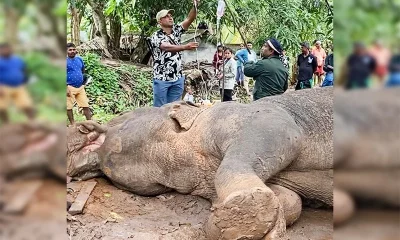
Burnt elephant dies after delayed rescue; activists demand arrests
-

 Business3 days ago
Unlocking Sri Lanka’s hidden wealth: A $2 billion mineral opportunity awaits
-

 Editorial5 days ago
Colombo Port facing strategic neglect
-

 News3 days ago
Army engineers set up new Nayaru emergency bridge
-

 News5 days ago
Sri Lanka, Romania discuss illegal recruitment, etc.