
Sports
Herath creates history at Paralympics, Dulan wins bronze


Sri Lanka Army’s Dinesh Priyantha Herath created history winning country’s first Paralympics gold medal and proved his coach Pradeep Nishantha’s prediction right as he beat India’s defending champion and world record holder in the men’s F46 javelin throw in Tokyo yesterday.
In his third attempt, Herath hurled the javelin to a distance of 67.79 metres, the furthest a Para athlete in the F46 category had ever thrown in the history. The world and Paralympics record holder Devendra Jhajharia who was attempting to defend his title, also improved on his previous mark but the Indian’s best throw fell more than three metres behind the Sri Lankan’s new mark. The previous World Record mark was 63.97 metres.
While the 35-year-old Herath stormed to gold, the reigning Rio 2016 champion Devendra claimed silver with a throw of 64.35 metres.
Last week in an interview with The Island Pradeep Nishantha, the Gateway College coach who also trained country’s Olympic thrower Sumeda Ranasinghe said that his charges were ready to create history in Tokyo on Monday. And it was exactly what Herath and Dulan Kodithuwakku did. While Herath won country’s first ever gold, Kodithuwakku won a bronze in the F64 javelin throw making it the first time the country had won more than one medal at Paralympics.
For Herath it was the second Paralympics medal. Herath first won bronze at the Rio Paralympics in 2016.
While acknowledging the support given by the Sports Minister, Sports Council, Army Commander, his coach, Paralympics Committee and the officials of his regiment, the Gajaba Regiment athlete dedicated his gold medal to his wife.
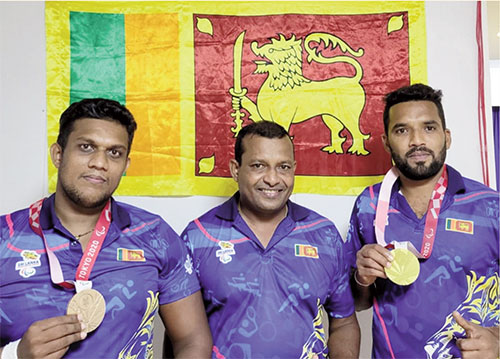 Coach Pradeep Nishantha flanked by gold medal winner Dinesh Priyantha Herath (right) and bronze winner Dulan Kodithuwakku (left) after their historic achievement at Tokyo Paralympics on Monday.
“I am very happy because my dream came true. I have no words to describe the feeling,” said Priyantha, who kissed the Sri Lankan flag after claiming victory.
Commenting on his historic feat Army Commander Gen. Shavendra Silva yesterday told The Island that he had an opportunity to meet Sgt. Dinesh Priyantha Herath before the Sri Lankan Paralympics team left for Tokyo. “Javelin thrower Sgt. Herath was confident of securing the Gold at F 46 event,” Gen. Silva, who is also the Chief of Defence Staff said. Responding to a query, Gen. Silva said that Sgt Herath of the Gajaba Regiment was wounded in action on Dec 16, 2008 during fierce fighting in the Kilinochchi area.
Enlisted to the Army on 18 March 2004 as a recruit, Herath completed basic training at Saliyapura. Following the Kilinochchi incident, he took part in Army-organized Para Athletic training events at the GR Regimental HQ. In 2012, he won Gold in Javelin Throw (52 m) in Army Para Athletic Meet, first place in Malaysia’s Para Athletic Meet (52.95 m) in 2012, second place in Germany’s Para Athletic (Qualifying) Meet (53.09m) in 2017 and again the second place in London Para Athletic Meet-2017 recording 59.90m in the same event.
In the F64 javelin throw event held in the afternoon yesterday, Kodithuwakku was in the second place until his final attempt. While India’s Sumit Sumit led from the first throw, Kodituwakku commenced his attempts with a throw of 62.11 metres before making his best feat in the fourth attempt, a throw of 65.61 metres. But he had to settle for bronze medal after Australia’s Burian Michal delivered a throw of 66.29 metres in the final round.
Sri Lanka has participated in every Paralympics since 1996 but until yesterday had won only bronze medals at the quadrennial event. Country won the first Paralympics medal, a bronze when Pradeep Sanjaya was placed third in the T46 400 metres at the 2012 Paralympics in London. Dialog has been the main sponsor of Sri Lanka’s Paralympics teams during the last two decades.







Kolkata Knight Riders picked up their fourth win on the trot, their spin bowlers (12-0-76-3) capturing Delhi Capitals in a vice-like grip and never letting go Finn Allen made sure that wouldn’t repeat in the second innings. He pulverised DC’s spinners (9-0-102-1) to score his first IPL century even though he only had 143 to chase.
Pathum Nissanka scored a good half-century. He made 50 of DC’s first 85 runs at a strike rate of 172. The other end could only contribute 33 at a strike rate of 103. It was symbolic of how hard it was for a new batter to settle in and how much pressure comes on the set batter on a pitch like this. Even though he was going at a good clip, and had hit the previous ball for four, he still left his crease looking for more and was stumped off Anukul Roy. The left-arm spinner took another wicket, four balls later.
DC were 74 for 2 after eight overs. But only four of those overs were from spin bowlers and three of them were inside the powerplay. Given the comfort of five fielders on the boundary, and a pitch that was slow and turning, Roy, Sunil Narine and Varun Chakravarthy started to dictate proceedings. At one point, DC scored just 11 runs in 30 balls. This was between overs 12 to 16. No IPL team in nearly two decades has ever been this sluggish in this period of play.
Roy set this choke up, stumping Nissanka out with a slower and wider delivery and bowling Tristan Stubbs out with the exact opposite of that. That was solid range for a bowler with no mystery about him.
With DC at 89 for 5, Axar Patel in wretched form (his 44 runs, with only three boundaries, are the fewest by any batter this season having faced at least 50 balls) and the conditions not helping run-scoring, all Narine and Varun had to do was what they do so well. Amp up the mystery. Aim at the stumps. Narine finished with 4-0-17-1. Varun, badly limping when he bowled his final over which cost 16 runs, finished with 4-0-28-0.
Ashutosh Sharma broke a boundary drought that last 38 balls in the 17th over. He reverse swept Vaibhav Arora, coming around the wicket, for six in the 19th over. His cameo – 39 off 28 balls – carried KKR to 142 for 8.
For the first time in his IPL career, Allen played through the powerplay. This was his eighth innings. He might have felt bad for running out his captain Ajinkya Rahane when his straight drive flicked Mitchell Starc’s outstretched finger and deflected onto the stumps but he quickly got over it. DC played a part in that a well with Kuldeep Yadav and Vipraj Nigam bowling balls right in the slot. Allen is superb down the ground and needed no second invitation. From 20 off 17, he launched 10 sixes, the last of them when KKR needed two to win and he needed six to bring up 100.
Allen had a strike rate of 235 against spin (73 off 31). The next best, from both teams, was Rahane with 167, benefiting from playing just three balls and scoring five runs.
In a match where his former team’s spinners held so much sway (economy rate 6.33), Kuldeep suffered, going at 13.66 an over even though he was spared the trouble of bowling in the powerplay. Axar bowled three with the field up and still finished with figures of 4-0-27-1.
Brief scores:
Kolkata Knight Riders 147 for 2 in 14.2 overs (Ajinkya Rahane 13, Finn Allen 100*, Cameron Green 33*; Axar Patel 1-27 ) beat Delhi Capitals 142 for 8 in 20 overs (Pathum Nissanka 50, KL Rahul 23, Axar Patel 11, Ashutosh Sharma 39; Kartik Tyagi 2-25, Anukul Roy 2-31, Vaibhav Arora 1–29, Sunil Narine 1-17, Cameron Green 1-12) by eight wickets
[Cricinfo]

Pakistan won the toss, but Bangladesh went on to win all three sessions. A majestic hundred from Bangladesh captain Najimul Hossain Shanto put his side in firm control at the end of the first day in Mirpur, finishing with 301 for the loss of four wickets. As a measure of the degree of control they exercised, they scored 101, 100, and 100 in each session respectively, pacing the innings exactly as required across the day.
Alongside Monimul Haque , who missed out on his own century by nine runs, Shanto put on 170 for the third wicket that Pakistan’s bowlers appeared largely at a loss to disrupt for the first two sessions, guiding them away from a perilous first hour that saw them lose their openers cheaply. When Pakistan finally prised the two out, an unbeaten 48 from Mushfiqur Rahim held the innings together, ensuring his side did not lose the cluster of wickets, that, so often at the end of days, tend to shift momentum.
This was billed as a series that would not rely on spin bowling to the extent it has come to be expected in Bangladesh. A look at the surface convinced both sides, too, with each playing just the one specialist spinner and three seamers. It was evident both captains would rather have bowled first to have a first crack at a wicket that had seen a generous coating of grass left on it.
Shan Masood’s decision looked to have paid off early after Bangladesh stumbled to 31 for 2, with Shaheen Afridi and Mohammad Abbas making decent use of the conditions. The first two balls of the Test went for two boundaries, but the visitors pulled things back over the next hour. Off the first ball of his fourth over, Shaheen probed the fourth-stump channel to draw a poke from Mahmudul Hasan Joy to draw first blood. Abbas was perhaps a touch unlucky not to find himself among the wickets earlier, but it set the stage for Hasan Ali to find a bit of nip and coax an edge from Shadman Islam that Salman Agha pouched in the slips.
The danger signs were flashing in neon for Bangladesh at that point, but Mominul and Shanto calmed proceedings. While the scoring rate was sluggish, they began to take the sting out of the attack. In the final 45 minutes before drinks, as conditions eased and the batters settled, the runs began to flow. Afridi, who bowled nine overs in the session, saw his potency fade away towards the back-end, with Bangladesh milking nine runs in each of the first two overs of his second spell. Shanto, in particular, would become much more expressive with his shot-making, opening up his body and driving expansively through the offside against pacers.
The afternoon saw the pair merely pick up where they left off in the morning, almost completely unencumbered by any Pakistan bowler, seam or spin. The early movement Pakistan’s quicker bowlers got off the surface had all but evaporated, and with no genuine speed in Pakistan’s pace battery, there was little for two set batters to fear.
After a pair of maidens to kick the session off, Bangladesh hurried the scoring rate along, a boundary from Shanto off Abbas getting the scoreboard running. Masood rotated his bowlers fervently, with all five featuring in the session at some point or other. But Bangladesh milked the spinners, with Shanto especially belligerent against Noman Ali, unafraid of using his feet and being in supreme control when going over cover or mid-off. It was in that cover region that he threaded the gap which fetched his milestone-reaching boundary, celebrating getting to his ninth hundred with a gallop into the air and a pump of his fists.
However, that delight would turn into anguish the very next delivery. Abbas, coming around the wicket with Rizwan standing up to pin the batter, found some tail back in that beat Shanto’s inside edge to hit him on the knee roll. The umpire initially ruled against Pakistan on height, but Hawk-Eye found it to be hitting top of middle.
Meanwhile, Mominul deployed the late cut to canny effectiveness against the quicker bowlers time and again, toying with the field Masood set, no matter how novel or unconventional. He was, for much of the session, content to take a backseat to his more free-scoring captain, comfortably absorbing any pressure Pakistan were trying to put the hosts under.
Therein, perhaps, was the story of the day, one senior batter accepting responsibility when another fell. Mominul assumed a more dominant role in the final session with Mushfiqur bedding in, keeping the run rate up while starving Pakistan of realistic wicket-taking opportunities. Soon enough, though, Mushfiqur began to find his touch. He targeted Noman, arguably Pakistan’s least effective bowler of the day, for consecutive boundaries that got his innings going.
Bangladesh’s hold continued to solidify over the innings as the partnership stretched to 75 and evening approached, but finally, Noman got something to take out of his torrid day. At the start of the 74th over, Pakistan reviewed a close lbw shout only to find out Noman had overstepped for the seventh time the day. But he kept one low that darted straight through to Mominul, who couldn’t get bat on it and found himself trapped in front of leg stump.
Once more, Pakistan sniffed, with Litton Das in and the new ball approaching. Some inconsistent bounce began to discomfort the batters. Hasan hit Mushfiqur with a nasty blow as the ball reared up into his pads, while Shaheen managed to get a couple to sniff past the batters. But even with a late new-ball burst, Pakistan were unable to find the swing or the menace to threaten any late damage. Mushfiqur and Das held firm, refusing to loosen Bangladesh’s grip on the game, and positioning the hosts perfectly to tighten it even further on day two.
Brief scores:
Bangladesh 301 for 4 in 85 overs (Najimul Hossain Shanto 101, Mominul Haq 91, Mushfiqur Rahim 48*; Mohammad Abbas 1-51) vs Pakistan
[Cricinfo]

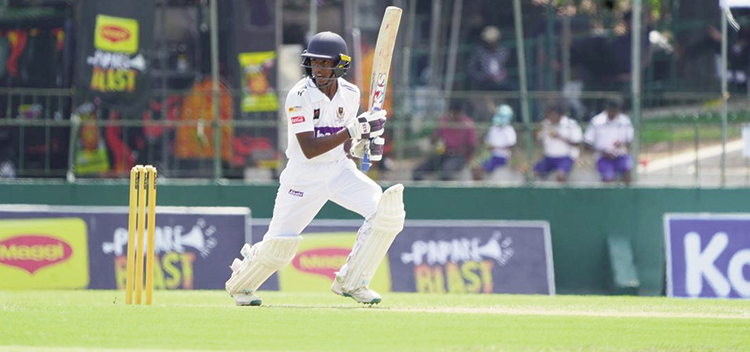
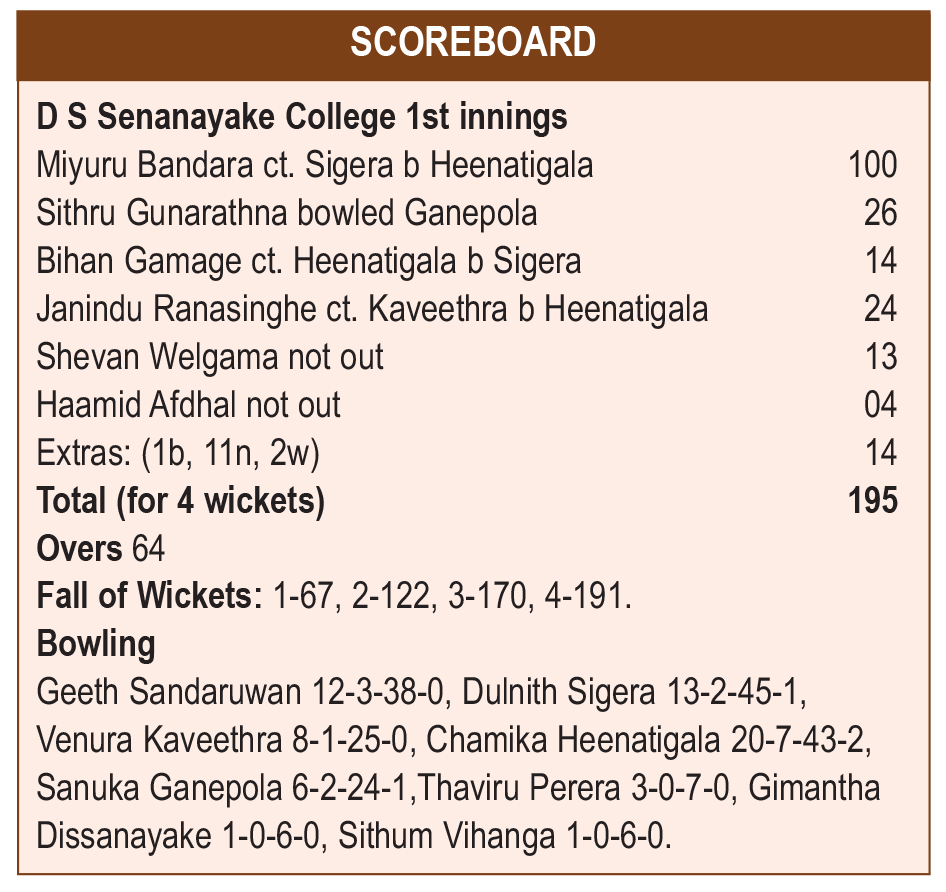
Fourteen-year-old opener Miyuru Bandara produced a remarkable batting performance to guide DS Senanayake College to a commanding position on the opening day of their annual Big Match against arch rivals Mahanama College at the Sinhalese Sports Club Ground on Friday.
Electing to bat first in a weather-interrupted day one, D. S. Senanayake ended on 195 for four wickets, largely due to the vauable century by their Under-15 opening batsman Bandara.
Displaying maturity beyond his age, Bandara anchored the innings while building two crucial partnerships at the top of the order. He first added 67 runs for the opening wicket with Sithru Gunarathna before combining in a 51-run stand for the second wicket with Bihan Gamage.
The young opener occupied the crease for more than 55 overs and frustrated the Mahanama bowling attack with a patient yet authoritative knock. His innings finally came to an end when he became the first wicket claimed by Chamika Heenatigala, who finished the day with two wickets.
Bandara’s memorable innings included 13 boundaries and a six as he faced 156 deliveries, placing DS Senanayake firmly in control at the close of play on the rain-affected first day.

Trade, Investment and Tourism Cooperation Forum strengthens economic ties between Sri Lanka and Vietnam

Accelerate projects related to resolving the public’s drinking water issues – President Instructs Officials

President of Vietnam and delegation departs Sri Lanka

Trump announces three-day ceasefire in Russia-Ukraine war

Heat Index is likely to increase up to ‘Caution level’ at some places in the North-central and Eastern provinces and in Mannar, Vavuniya and Monaragala districts during the daytime

Finn Allen’s 47-ball ton powers Kolkata Knight Riders to huge win over Delhi Capitals

‘Dates have the highest sugar content to fight Coronavirus’

Sunday Island 27 December – Headlines

#SundayIsland 17th December – Headlines

Sunday Island – 28th March

Sunday Island Headlines – 21 March

Sunday Island – 21st February – Headlines
-

 News3 days ago
MIT expert warns of catastrophic consequences of USD 2.5 mn Treasury heist
-
 News5 days ago
CJ urged to inquire into AKD’s remarks on May 25 court verdict
-

 News6 days ago
USD 3.7 bn H’tota refinery: China won’t launch project without bigger local market share
-

 News7 days ago
Easter Sunday Case: Ex-SIS Chief concealed intel, former Defence Secy tells court
-

 Business7 days ago
Dialog Surpasses 1,000 5G Sites, Strengthening Nationwide 5G Coverage
-

 Editorial3 days ago
Clean Sri Lanka and dirty politics
-

 Editorial6 days ago
Deliver or perish
-

 Opinion5 days ago
Security, perception, and trust: Sri Lanka’s delicate balancing act