
News
GTF assures it won’t undertake political negotiations at any level


The Global Tamil Forum (GTF) and (Sangha for Better Sri Lanka (SBSL), in a joint statement issued from the UK on Wednesday (20), assured that they weren’t engaged in a negotiation process with the government or other leaders of the country for a political solution.
They said it would be the responsibility of the elected Tamil leaders who should undertake political negotiations at the appropriate time.
The statement was issued by its spokesperson Suren Surendiran in the wake of continuing criticism of the GTF-SBSL initiative. A group of representatives during Dec 7-15 period met political party leaders, including President Ranil Wickremesinghe, SLPP leader Mahinda Rajapaksa and Opposition Leader Sajith Premadasa and key political leaders representing Sri Lankan Tamils, Upcountry Tamils and Tamil speaking Muslim communities, and past Presidents and former Speaker of Parliament involved in reconciliation efforts.
However, some political parties and other groups declined to meet the delegation. They alleged the GTF was engaged in a project to safeguard the interests of the Sri Lankan government. “We have noted some of the criticisms aimed at this initiative from some Tamil groups in Sri Lanka and in the Diaspora. Our humble view is that these views are grossly misplaced. However, we are very much encouraged by them expressing their views,” the GTF spokesperson said.
Declaring that this was continuation of a dialogue GTF and SBSL had at Nagarkot, Nepal in April 2023, where both parties arrived at the ‘Himalaya Declaration’ to facilitate ‘our engagement and advocacy efforts among different communities in Sri Lanka”. Surendiran stated: “We have noted some of the criticisms aimed at this initiative from some Tamil groups in Sri Lanka and in the Diaspora. Our humble view is that these views are grossly misplaced. However, we are very much encouraged by them expressing their views.”
The group declared that they wanted to promote what was called a national conversation involving leaders of political parties with substantial support base among the majority community or leaders with limited parliamentary seats in the minority communities. The group appealed to those who declined to meet them because of their skepticism of the joint initiative to judge them by their actions.
They had met the diplomatic community based in Colombo including those representing India, US, UK, Switzerland, Japan, Australia, South Africa, France, Canada, ICRC, UN. “This is an initiative exclusively between two groups, SBSL and GTF with no involvement of any external political stakeholders or countries.”
“We recognise that 75 years of mistrust cannot be reversed in 7 days. But we firmly believe considering the extreme political and economic challenges the country was, and is, undergoing and the new awakening these conditions have led to, present fresh opportunities to reconcile and the National Conversation to start in earnest.”
The Declaration at its core is a framework agreement between SBSL and GTF that articulates – a shared vision for a better Sri Lanka for all its peoples. We believe this is a guiding document that a vast amount of people from all communities can identify with, hence, serve as a useful starting point for a national conversation on peace building.
“Ultimately it is the national conversation among people and communities in Sri Lanka, and the political processes available to them that can lead to political outcomes in the Country. Our joint initiative is limited to facilitating such a process (led by senior Buddhist monks and GTF) and creating a trusting environment where the political outcomes are likely to satisfy the aspirations of all citizens and communities.”
The Himalaya Declaration promoted pluralistic character and equal citizenship in the country; called for devolution of power to all the provinces (without referring to unitary state), including full implementation of the existing constitutional provisions; and stresses the importance of accountability measures and complying with international obligations.
“We are very much encouraged this initiative and the declaration articulating for pluralism, power devolution and accountability have received the approval and blessings from almost all important stakeholders in the Country, including from the chief prelates of the Buddhist chapters. These are truly remarkable outcomes that could potentially transform the Country for the better.”
“The declaration isn’t set in stone. The “National Conversation”, which we believe have kick started in earnest, will be shaped by the people who participate in them – GTF, along with senior Buddhist monks and other religious clergy will be one of many parties to this Conversation.”
“It is important that all views are heard and listened to by each other and all parties contribute and shape the National Conversation which has now truly begun. Both, the senior Buddhist monks and GTF are clear that only promoting National Conversation to facilitate a good and durable outcome, rather than prescribing a particular solution or outcome.”
Referring to the accountability process, the GTF statement declared that the GTF would continue to articulate to keep Sri Lanka under international scrutiny for its past and present human rights and international and local laws violations.







News
Financial allocations for the development of infrastructure in provincial schools have been provided to all provinces – PM

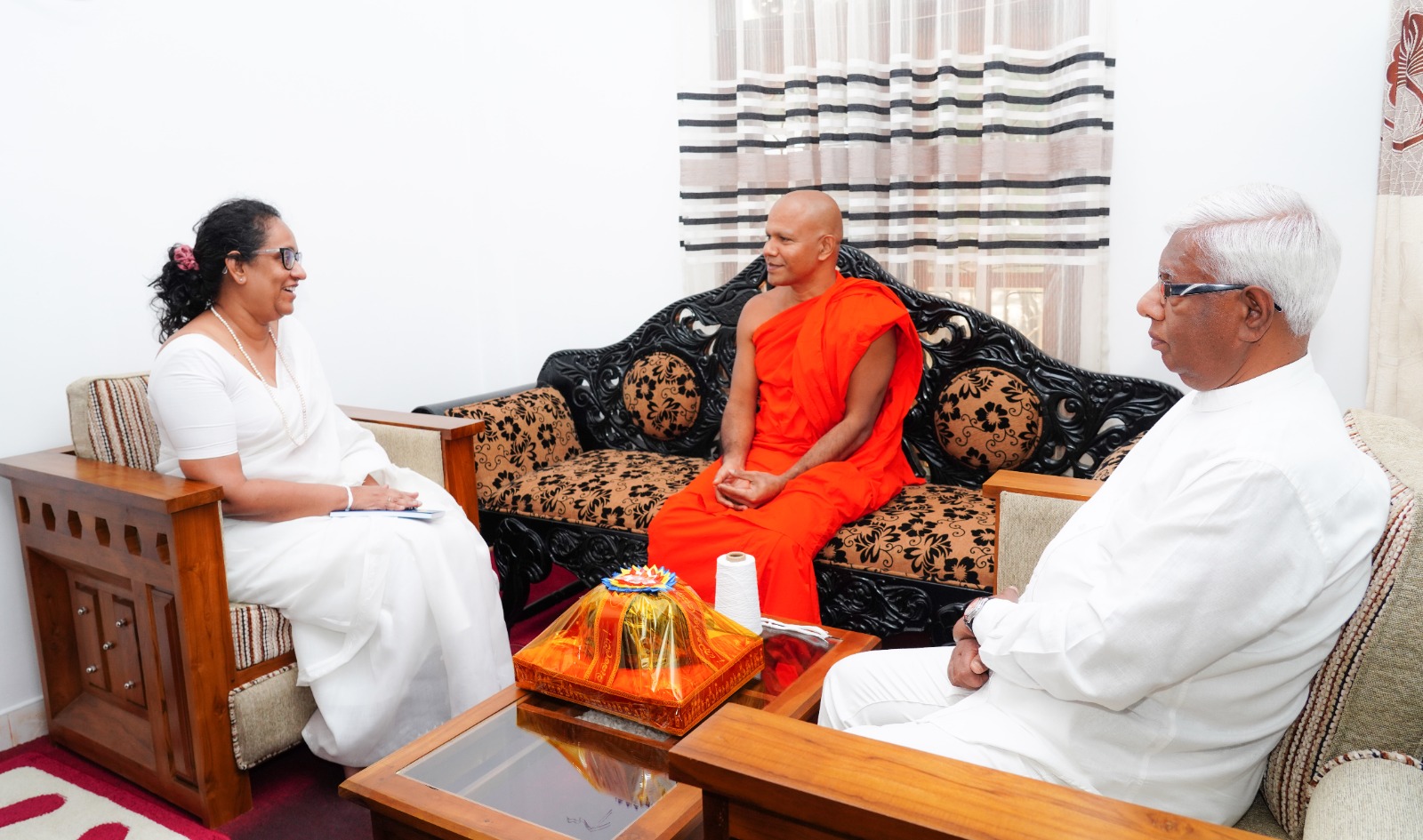
Prime Minister Dr Harini Amarasuriya stated that the necessary financial allocations for the development of infrastructure in provincial schools have been provided to all provinces. She emphasized that these funds must be utilized effectively for school development and requested that relevant authorities submit proposals to address existing shortcomings in school infrastructure.
The Prime Minister made these remarks during a cordial meeting with Muslim women in the Wellawaya area on 1st of March.
Subsequently, the Prime Minister met with the Chief Sanghanayake of the Uva Wellassa region and the Chief Incumbent of Yudaganawa Rajamaha Viharaya, Venerable Rajakeeya Panditha Most Venerable Galtemwatte Nandarathana Nayaka Thero, and briefed him on the current progress of the new education reforms.
She further stated that, while ensuring due recognition for vocational education, steps are being taken to develop 50 vocational training centers equipped with modern courses, covering all 25 districts of the country. She also noted that new education reforms will be introduced for Grade 6 starting in 2027, and that the printing of new textbooks will be entrusted to the Educational Publications Department of the Ministry of Education.
The occasion was attended by Uva Province Governor Attorney-at-Law Kapila Jayasekara, Deputy Minister of Trade, Commerce and Food Security R.M. Jayawardhana, Member of Parliament Ruwan Wijewardene, local government representatives, the Buttala Divisional Secretary and the District Secretary.
[Prime Minister’s Media Division]

The Department of Immigration and Emmigration has decided effective from 28th February 2026, to grant a free fourteen (14) day visa extension to all tourists who are unable to leave Sri Lanka due to flight cancellations. 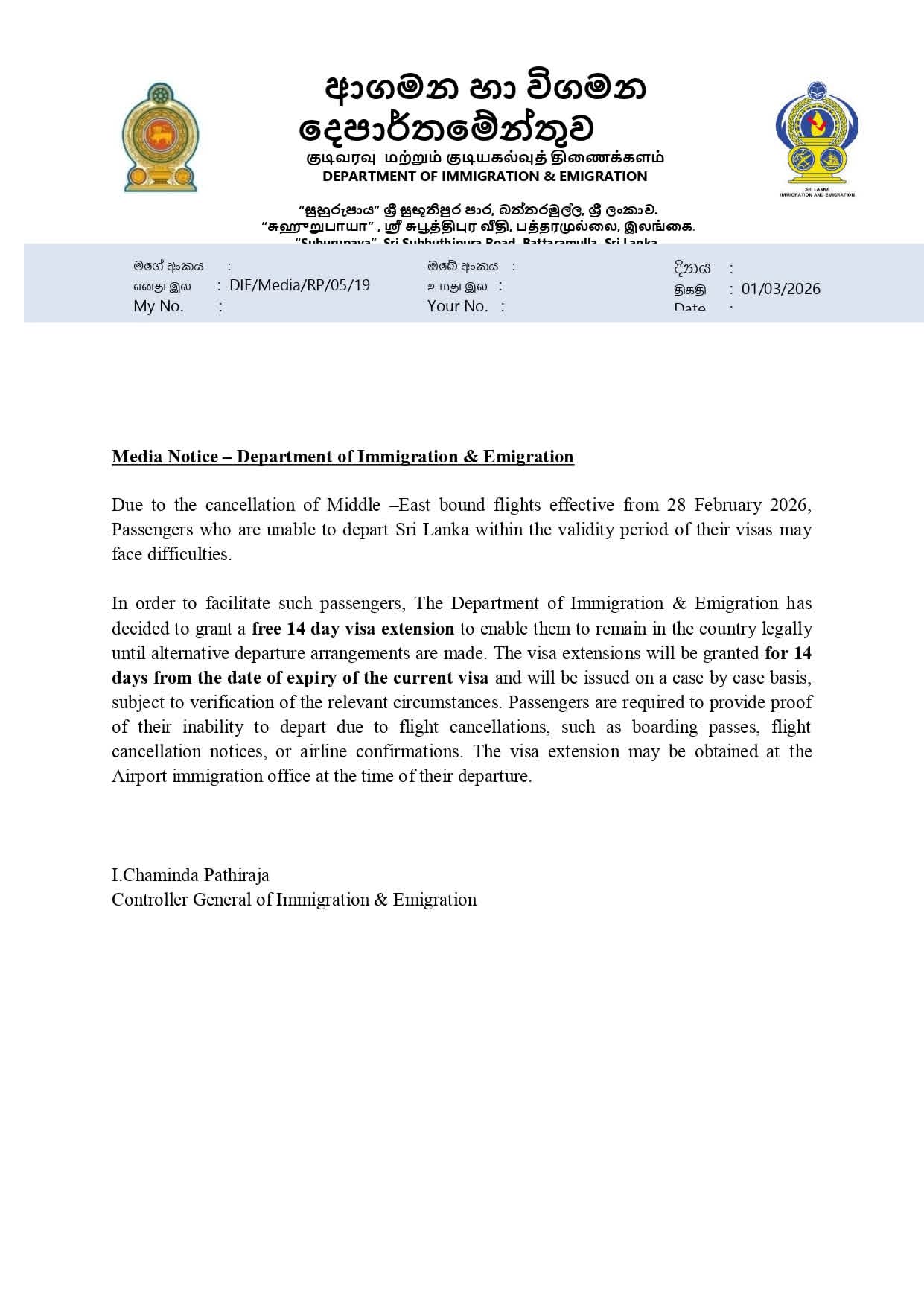
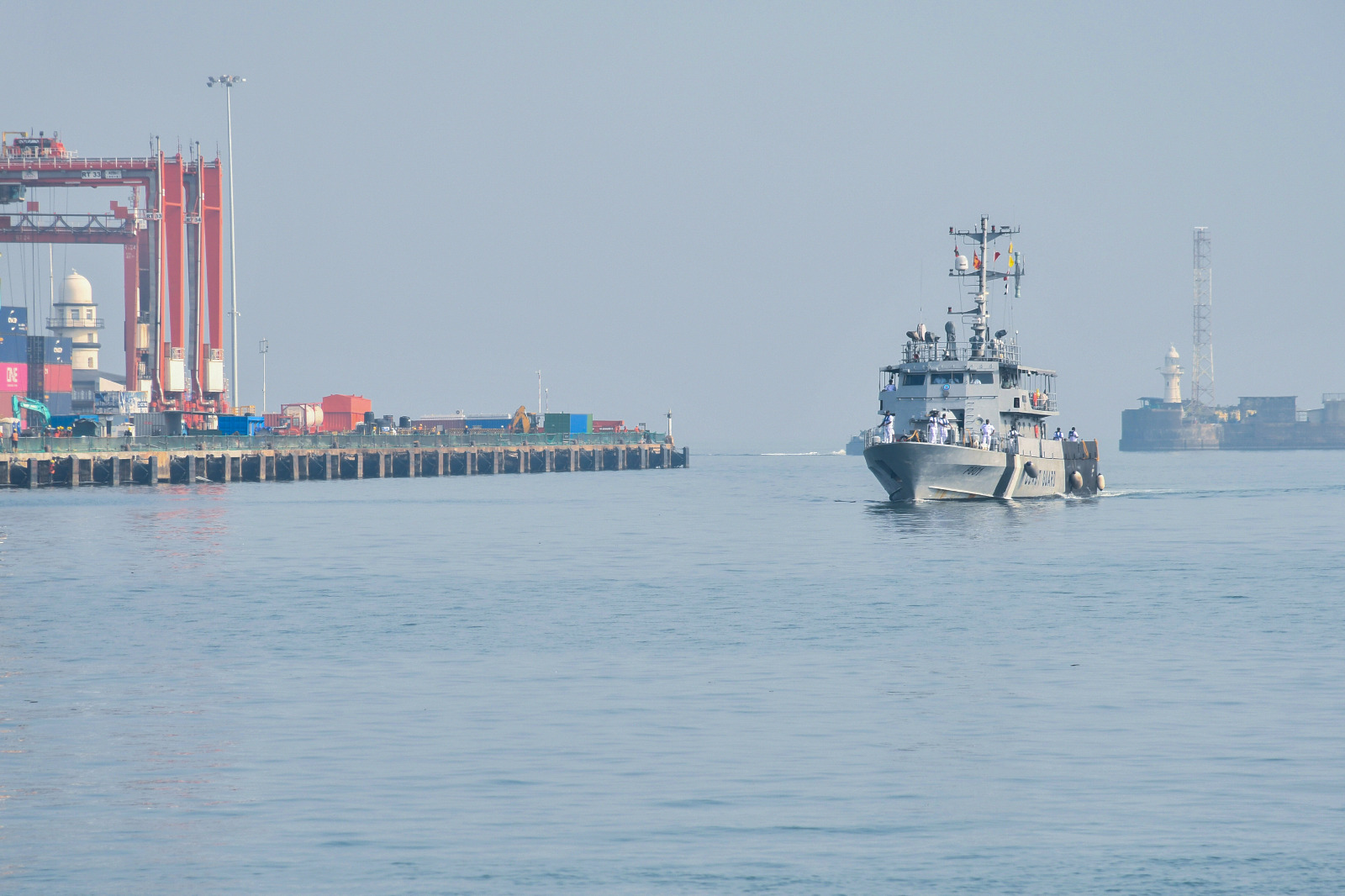
The Maldives Coast Guard Ship Huravee arrived at the Port of Colombo for replenishment purposes on 02 Mar 26. The visiting ship was welcomed by the Sri Lanka Navy (SLN) in compliance with time-honoured naval traditions.
The ship is a 48.9m long Offshore Patrol Vessel which is commanded by Lieutenant Colonel Ahmed Nafiu Mohamed.
Meanwhile, the ship’s crew is scheduled to visit several tourist attractions in the city of Colombo, during their stay in the island.

Australian girl, 8, killed in snowmobile accident in Japan

Russia, China raise diplomatic voices against US-Israeli attacks on Iran

Financial allocations for the development of infrastructure in provincial schools have been provided to all provinces – PM

Free 14 day visa extension for visitors unable to depart Sri Lanka

US embassy in Dubai hit; Israel pounds Tehran, Beirut

Perera, Sugandika, Ranaweera take Sri Lanka to T20I series win over West Indies

‘Dates have the highest sugar content to fight Coronavirus’

Sunday Island 27 December – Headlines

#SundayIsland 17th December – Headlines

Sunday Island – 28th March

Sunday Island Headlines – 21 March

Sunday Island – 21st February – Headlines
-

 Opinion6 days ago
Jamming and re-setting the world: What is the role of Donald Trump?
-
 Features2 days ago
Brilliant Navy officer no more
-
 Features5 days ago
An innocent bystander or a passive onlooker?
-
 Features6 days ago
Ratmalana Airport: The Truth, The Whole Truth, And Nothing But The Truth
-
 Opinion2 days ago
Sri Lanka – world’s worst facilities for cricket fans
-
 Business6 days ago
IRCSL transforms Sri Lanka’s insurance industry with first-ever Centralized Insurance Data Repository
-

 Business6 days ago
An efficacious strategy to boost exports of Sri Lanka in medium term
-
 Features4 days ago
Overseas visits to drum up foreign assistance for Sri Lanka