
Latest News
Green, Head and Marsh flay centuries as Australia put on a show

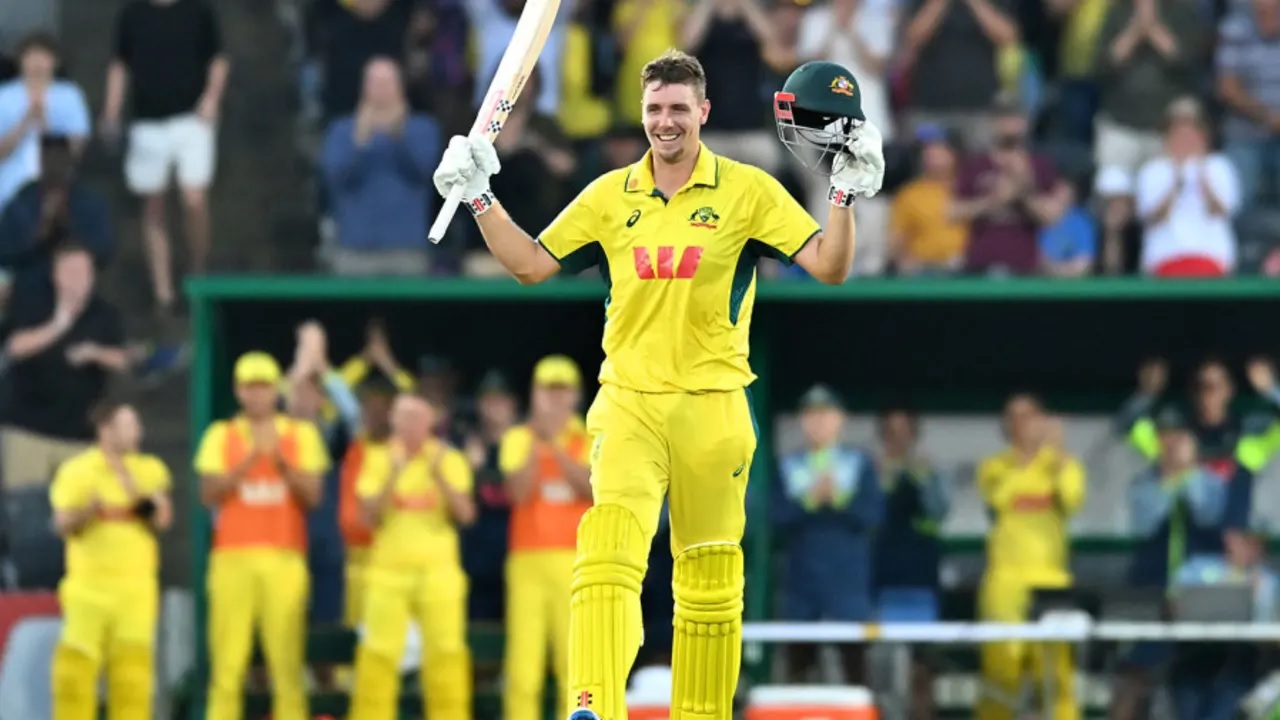
Centuries from Travis Head, Mitchell Marsh and a maiden ODI hundred from Cameron Green, off just 47 balls, took Australia to their second highest ODI total, behind their 434 for 4 against South Africa 19 years ago.
But there was no repeat of that match, as South Africa were bowled out for 155 and slumped to their heaviest defeat by runs by 276 runs to finish the series 2-1 winners. The consolation win meant that Australia’s record of never being whitewashed in an ODI series at home intact and completed their second biggest ODI victory.
While Australia’s seamers found movement under lights to blunt South Africa, the second innings belonged to Cooper Connolly. At 22 years and two days old, he became the youngest Australia to take a five-for in ODIs and the first Australian to do so since March 2023. He also finished with the best figures by an Australian spinner in the format.
All three matches in the series have been won by the team batting first, and all by big margins. In Mackay, it was noticeable how much more the ball did under lights and that difference in conditions prompted Marsh to bat first for the first time in 22 tosses. He would have been even happier with the way Australia responded to his call.
After being bowled out for under 200 in the first two matches of the series, Australia showed they meant business when Marsh and Head shared in Australia’s fourth-highest opening stand of 250. They batted together for 34.1 overs which still left plenty of time for Green to score the second-fastest ODI hundred for Australia after Glenn Maxwell. In the process, Australia also became only the second side in which the top three all scored centuries in an ODI innings.
The other team to have achieved that feat was South Africa against West Indies, a decade ago at altitude in Johannesburg. Australia’s trio of hundreds came on the Queensland coast, on a used but flat pitch, and against a weakened South African attack.
With Kagiso Rabada out of the series with an ankle injury and Lungi Ngidi rested, South Africa lacked discipline upfront and struggled to rein Australia in at any stage. Kwena Maphaka, playing in just his third ODI, gave away 73 runs in six overs, Wiaan Mulder was at his most expensive with 93 runs scored off his seven overs and only Keshav Maharaj conceded at under six runs an over.
Maphaka and Mulder took the new balls against an Australian pair who showed no mercy. When they raced to 41 without loss after four overs, returning captain Temba Bavuma had to introduce spin early. While Maharaj and Aiden Markram’s first overs were boundary-less, the pause in power hitting was only temporary.
Head brought up fifty off 32 balls and at that point had scored twice as many runs as Marsh, and only faced 10 more balls. It looked as though Head would race to a hundred before Marsh reached fifty but the Australian captain got there when he drove Corbin Bosch square off his 50th delivery.
Head’s hundred came off 80 balls, with a single from Muthusamy and his signature helmet-on-bat celebration, fitting of the significance of the moment. Head last scored an international century 25 innings ago in all formats.
The Head-Marsh partnership grew to 200 by the 28th over, and was Australia’s first double-century stand since the 2023 World Cup, when Maxwell went wild in their victory over Afghanistan. Six overs later, their stand reached 250 as Head took 19 runs off Markram. With 150 and beyond in his sights, it seemed Head could do no wrong but he couldn’t clear long-off against Maharaj.
In the over after his dismissal, Marsh reached his hundred, from 105 balls. He was also set for more but top-edged a slog-sweep off Muthusamy and Ryan Rickelton ran from behind the stumps to square leg to take the catch.
Australia promoted Green ahead of Marnus Labuschagne and gave him a licence to thrill. By the time Maphaka was brought back in the 43rd over, Green had his eye in. He brought up fifty off 28 deliveries when he hit Maphaka over midwicket for six, in an over that cost 20. Maphaka’s day got worse when he dropped Carey on 29.
Green then launched a magnificent assault on Muthusamy and sent him for a hat-trick of sixes to enter the 80s having declined a single to retain the strike. Twin sixes off Mulder put him on the brink and then Green reached his hundred with two off Bosch. He finished unbeaten on 118.
Carey iced the cake by reaching his 13th ODI half-century off 37 balls. The third-wicket stand between Green and Carey was worth 164 off 13.3 overs, at a scoring rate of 12.14 and Australia added 126 runs off the last 10 overs.
Faced with a daunting target, South Africa’s start was always going to determine how things went and it was badly. Markram’s struggles outside the off stump remain and he nicked Sean Abbott to second slip in the second over. Rickelton has also had a difficult tour and handed Connolly a catch at midwicket to depart for 11.
In the next over, Bavuma, whose approach was aggressive as he reached 19 off 10 balls, advanced on Abbott, swung and chopped on. By the nine over, Tristan Stubbs was also dismissed, caught at cover off Xavier Bartlett. From 50 for 4, 431 was a world away.
Tony de Zorzi and Dewald Brevis shared in South Africa’s best partnership but de Zorzi played a poor shot and was caught at midwicket when he tried to pull Connolly over the inner ring. Brevis looked the best of the South Africans, especially with his two sixes off Adam Zampa, but holed out to long-off on 49 to give Connolly a second wicket.
His next two came courtesy of spectacular catching by Labuschagne at long-on. He caught Wiaan Mulder low off the turf running in, and Bosch when he dived full length and avoided the boundary rope.
While Connolly had the fielders to thank for his earlier wickets, his fifth came through a clever piece of bowling. He drew Maharaj forward with a flighted ball, beat him as he slogged across the line and Josh Inglis did the rest. Zampa took the final wicket in the 25th over, as South Africa were bowled out with more than half their overs remaining.
Brief scores:
Australia 431 for 2 in 50 overs (Travis Head 142, Cameron Green 118*, Mitchell Marsh 100, Alex Carey 50*; Keshav Maharaj 1-57,Senuran Muthusamy 1-75) beat South Africa 155 in 24.5 overs (Tony de Zorzi 33, Dewald Brevis 49; Xavier Bartlett 2-45, Sean Abott 2-27, Cooper Connolly 5-22) by 276 runs
[Cricinfo]


Iranian Foreign Minister Abbas Araghchi has arrived in Russia for talks with President Vladimir Putin, as Teheran intensifies diplomatic efforts to end the United States-Israel war on Iran.
Upon his arrival on Monday, Araghchi told Iranian media that he had travelled to Russia “with the aim of continuing close consultations between Tehran and Moscow on regional and international issues”.
The diplomat said his meeting with Putin “will be a good opportunity to discuss developments in the war and review the latest situation”.
“I am confident that these consultations and coordination between the two countries in this regard will be of particular importance,” he added.
The visit follows an earlier meeting in Muscat with Omani officials, as Iran seeks to rally regional and international support for renewed negotiations.
Washington and Tehran agreed to a temporary ceasefire on April 8 following more than a month of fighting that began with US and Israeli attacks on Iran.
The truce, mediated by Pakistan, has since been strained by disputes over shipping through the Strait of Hormuz and a US blockade on Iranian ports; meanwhile, a parallel conflict involving Israel and Lebanon also threatens to complicate negotiations.
Reporting from Tehran, Al Jazeera’s Tohid Asadi said Russia was likely to play a central role in any next phase of the conflict. “We have a scenario for diplomatic settlement and another for confrontation,” Asadi said.
“Russia is going to play a key role when it comes to both, so Iran’s FM is there for consultations over most probably both. We know that Iran has several demands and is trying to prioritise them based on the situation. One is obviously the situation at the Strait of Hormuz, the possibility of the extension of the ceasefire, or another confrontation.”
The diplomatic push comes as US President Donald Trump scrapped plans to send Special Envoy Steve Witkoff and adviser Jared Kushner to Pakistan’s capital Islamabad for talks with Iran on Saturday, citing “tremendous infighting and confusion” within Tehran’s leadership.
Meanwhile, Iranian President Masoud Pezeshkian has reiterated that Tehran will not enter negotiations while the blockade remains in place.
It comes as the US Central Command (CENTCOM) said forces were continuing to implement the blockade, preventing vessels from entering or leaving Iranian waters.
“American forces have directed 38 ships to turn around or return to port,” CENTCOM said on X.
Trump said Iran had “offered a lot, but not enough”, while adding on Sunday that Iranian leaders “can come to us, or they can call us” if they wanted to resume talks.
Araghchi earlier described discussions in Islamabad as “very productive” and said they included a review of “the specific conditions under which negotiations between Iran and the US could continue”.
Reporting from Islamabad, Al Jazeera’s Osama Bin Javaid said Pakistani officials remained hopeful that diplomacy could still succeed.
“According to one diplomatic source, recent events have served as a catalyst, [reinforcing the view] that there needs to be a permanent end to hostilities,” he said.
“We are being told here in Islamabad that we are inching towards a framework of sorts, which will provide a background to which all of these sides can come to an agreement – and not just the Iranians and the Americans, but essentially the Gulf countries as well.”
[Aljazeera]
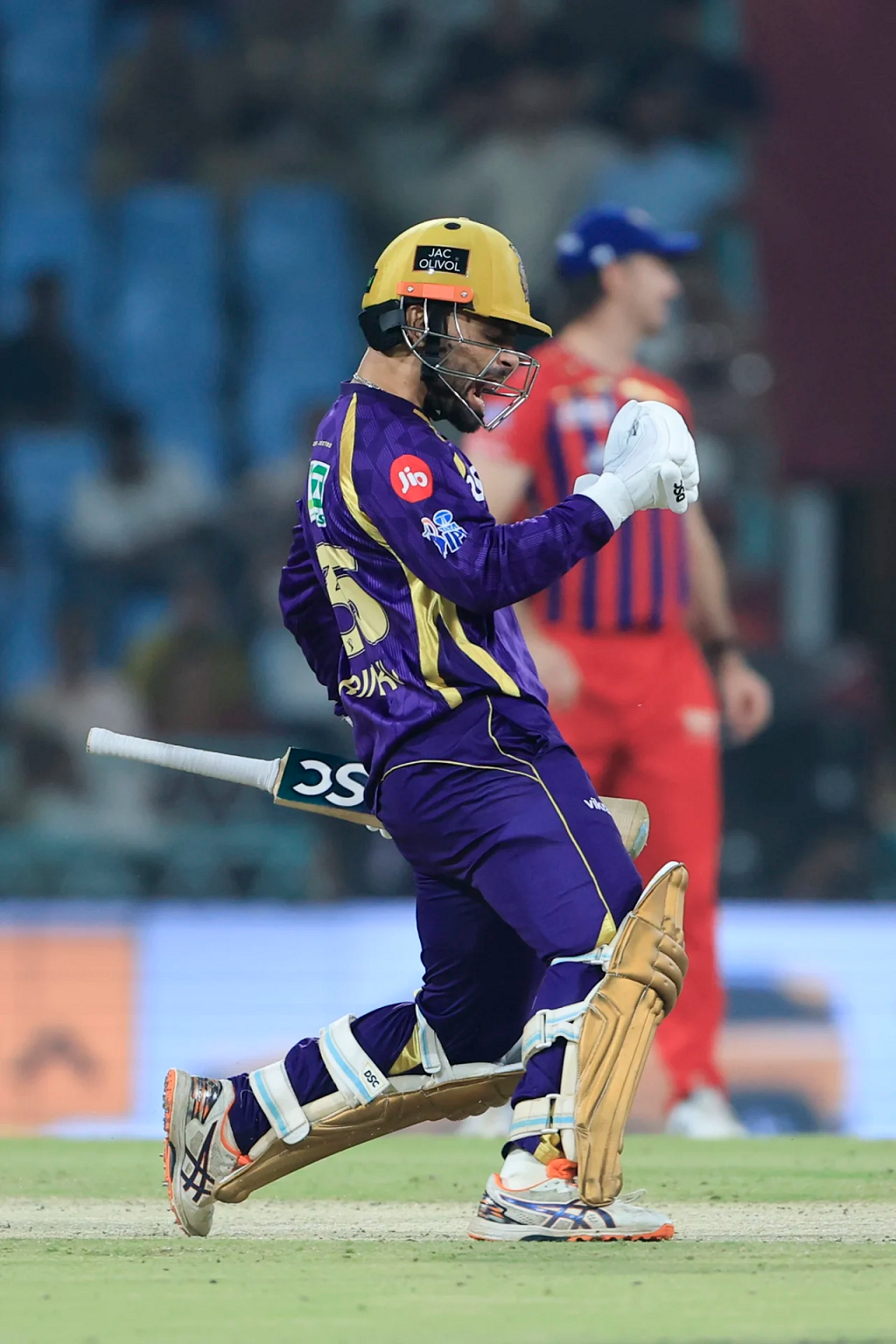
In a battle between the bottom-placed teams, momentum shifted hands multiple times before Kolkata Knight Riders (KKR) beat Lucknow Super Giants (LSG) in the Super Over, with Rinku Singh playing a pivotal role throughout the game.
Before the Super Over (effectively four balls across both innings), the 20th over of each innings in regulation time had the biggest say in an error-strewn game. After 19 overs, KKR were 129 for 7. Rinku smashed Digvesh Rathi for four successive sixes in a 26-run over to take them to 155 for 7. Rinku finished on 83 not out off 51 balls, his highest score in T20s
In the chase, LSG needed 17 from six balls with Himmat Singh and Mohammed Shami at the crease. Kartik Tyagi conceded successive no-balls off beamers before dismissing Himmat, but served up a half-volley with seven needed from one ball, and Shami launched it over long-off to tie the game.
The Super Over was an anti-climax. Sunil Narine bowled Nicholas Pooran first ball and had Aiden Markram caught off the third, with Rishabh Pant managing a single in between. Here, too, Rinku had a hand to play. When Markram launched Narine towards long-on, Rovman Powell sprinted round to his left, caught the ball at the boundary, and flicked the ball towards long-off, where Rinku completed the catch. This was in addition to his four catches earlier in the match.
Then, taking strike in KKR’s Super Over, he drove Prince Yadav’s first ball through cover point for four to seal the win.
Before all that, Mohsin Khan’s maiden five-for in T20 cricket had KKR reeling. In the second over of the innings, he had Tim Seifert caught at extra cover with a 142.4kph delivery. It was the second successive duck for Seifert, and a third wicket-maiden for Mohsin in this IPL.
In his next over, Mohsin slipped in a slower ball at 124.6kph. Ajinkya Rahane charged down the pitch but ended up miscuing the ball to Aiden Markram, who back-pedalled from mid-off to take the catch.
Angkrish Raghuvanshi pushed the last ball of the fifth over towards mid-on and set off for a single. Cameron Green sent him back while Shami went for a direct hit at the striker’s end. Raghuvanshi made a big U-turn and ended up taking the throw on his body as he dived to make ground. The LSG players appealed for obstructing the field, and the TV umpire gave it out, saying the batter “clearly changed his direction”.
Raghuvanshi wasn’t happy. He first argued with the on-field umpires, and then flung his helmet in anger as he neared the boundary line.
Mohsin returned to bowl the seventh over of the innings and straightaway had Rovman Powell gloving a pull to Pant. Cameron Green tried to counterattack. He hit two sixes off George Linde and one off Mohsin, but when he attempted another pull off Mohsin, he ended up skying it behind the stumps. Pant ran towards the boundary and completed the catch. Anukul Roy chipped the very next ball to short midwicket, giving Mohsin his five-for. Immediately after that, Mohsin was replaced by Impact Player Himmat, meaning he was not available to bowl the Super Over later.
KKR were 73 for 6 after 11 overs, and it became 93 for 7 when Ramandeep Singh fell. Manish Pandey was padded up in the dugout, ready to come in as Impact Player. But he was not required as Rinku kept fighting. He reached 43 off 40 balls by the end of the 18th over and then opened up. He started the 19th by hitting Shami for 6, 4, 4 before taking Digvesh Rathi apart in the 20th. It also meant KKR could use Varun Chakravarthy as their Impact Player.
LSG reunited their tried-and-tested opening pair of Mitchell Marsh and Markram, but their union lasted only seven balls; Vaibhav Arora had Marsh caught at mid-on for 2. Arora bowled three overs in the powerplay and gave away only 13 runs. LSG finished the powerplay at 37 for 1, and by the end of the eighth over, the required rate had touched nine.
Both Markram and Pant perished in trying to keep up with the asking rate. Pooran’s poor run continued; Varun had him caught at short third for 9 off 12 balls. Mukul Choudhary had burst onto the scene with a whirlwind half-century in a similar chase against KKR earlier in the season but on Sunday, he lasted just two balls.
At 93 for 5, needing another 63 from 28 balls, LSG seemed to be down and out. But Himmat and Linde took them closer, and Shami levelled the scores with his last-ball six. But KKR made no mistake in the Super Over.
Brief scores:
Kolkata Knight Riders 155 for 7 in 20 overs (Ajinkya Rahane 10, Cameron Green 34, Rinku Singh 83*; Mohsin Khan 5-23, George Linde 1-18) beat Lucknow Super Giants 155 for 8 in 20 overs (Aiden Markram 31, Rishabh Pant 42, Ayush Badoni 24, Himmat Singh 19, Mohammed Shami 11*; Anukul Roy 1-19, Vaibhav Arora 2-24,Cameron Green 1-12, Sunil Narine 1-23, Varun Chakravarthy 2-33, Kartik Tyhagi 1-41) via Super Over
[Cricinfo]
Latest News
Heat Index at Caution Level in the Northern, North-central, North-western, Western, Sabaragamuwa, Southern, and Eastern provinces and in Monaragala district during the day time
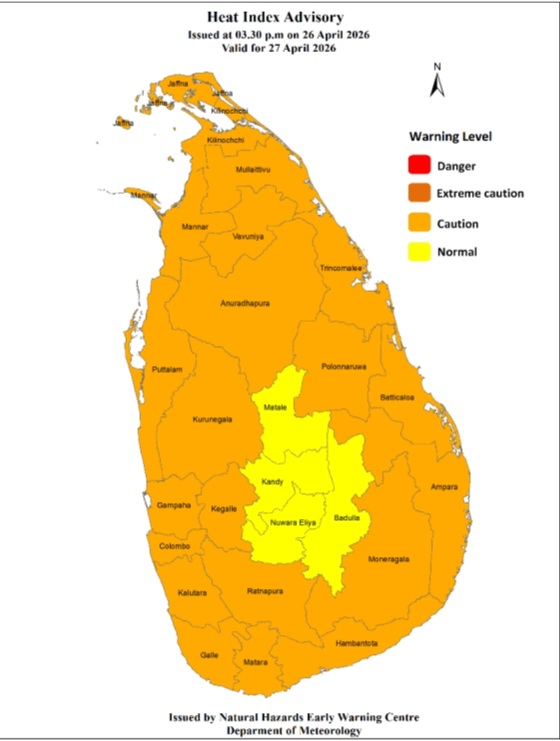
Warm Weather Advisory
Issued by the Natural Hazards Early Warning Centre
Issued at 3.30 p.m. on 26 April 2026, valid for 27 April 2026.
The Heat index, the temperature felt on human body is likely to increase up to ‘Caution level’ at some places in the Northern, North-central, North-western, Western, Sabaragamuwa, Southern, and Eastern provinces and in Monaragala district during the day time.
The Heat Index Forecast is calculated by using relative humidity and maximum temperature and this is the condition that is felt on your body. This is not the forecast of maximum temperature. It is generated by the Department of Meteorology for the next day period and prepared by using global numerical weather prediction model data.

Effect of the heat index on human body is mentioned in the above table and it is prepared on the advice of the Ministry of Health and Indigenous Medical Services.
ACTION REQUIRED
Job sites: Stay hydrated and takes breaks in the shade as often as possible.
Indoors: Check up on the elderly and the sick.
Vehicles: Never leave children unattended.
Outdoors: Limit strenuous outdoor activities, find shade and stay hydrated.
Dress: Wear lightweight and white or light-colored clothing.
Note:
In addition, please refer to advisories issued by the Disaster Preparedness & Response Division, Ministry
of Health in this regard as well. For further clarifications please contact 011-7446491.

Police officers donate LKR 9,687,462 from day’s salary to ‘Rebuilding Sri Lanka’ Fund

Iran’s top diplomat in Russia as Tehran intensifies efforts to end the war

Rinku, Narine win Kolkata Knight Riders error-strewn Super Over game

Rabada and Sudharsan crush Chennai Super Kings

Showers or thundershowers will occur at several places in most parts of the island after 1.00 pm

Heat Index at Caution Level in the Northern, North-central, North-western, Western, Sabaragamuwa, Southern, and Eastern provinces and in Monaragala district during the day time

‘Dates have the highest sugar content to fight Coronavirus’

Sunday Island 27 December – Headlines

#SundayIsland 17th December – Headlines

Sunday Island – 28th March

Sunday Island Headlines – 21 March

Sunday Island – 21st February – Headlines
-
 News7 days ago
Rs 13 bn NDB fraud: Int’l forensic audit ordered
-

 News5 days ago
Lanka faces crisis of conscience over fate of animals: Call for compassion, law reform, and ethical responsibility
-
 News4 days ago
Whistleblowers ask Treasury Chief to resign over theft of USD 2.5 mn
-

 News4 days ago
No cyber hack: Fintech expert exposes shocking legacy flaws that led to $2.5 million theft
-

 News5 days ago
USD 2 mn bribe: CID ordered to arrest Shasheendra R, warrant issued against ex-SriLankan CEO’s wife
-

 Business2 days ago
Nestlé Lanka Announces Change in Leadership
-

 News14 hours ago
BIA drug bust: 25 monks including three masterminds arrested
-
 News2 days ago
Hackers steal $3.2 Mn from Finance Ministry