
News
Green agriculture: Prez admits shortcomings, reiterates commitment

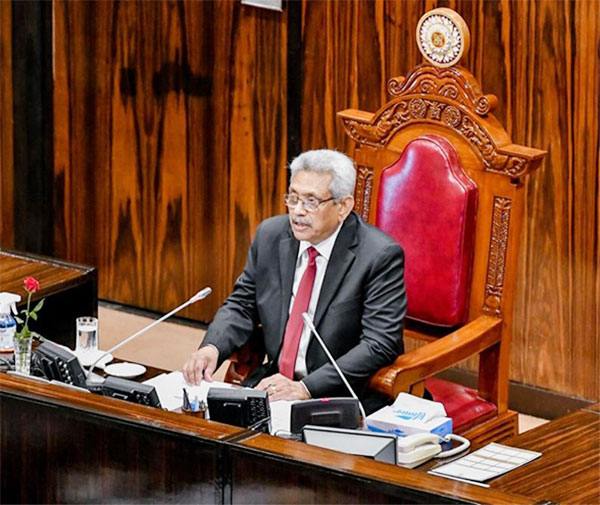
* Will not support any form of human rights violations
* Foreign currency issue most serious challenge
* Non-state universities needed
* PTA to be amended
* N&E members asked to review strategy
* Laws delays stressed
President Gotabaya Rajapaksa yesterday (18) reiterated his government’s commitment to green agriculture regardless of recent setbacks.
Delivering his third presidential policy statement at the re-opening of Parliament, following prorogation, the President said that his government had to face some problems in implementing their nontoxic green agriculture policy. The one time frontline commander said that due to some misunderstanding, their objectives and plans were not properly communicated, and some practical issues were politicised.
The President said: “The broad concept of green agriculture which was sometimes narrowed down to organic fertilisers even by responsible authorities led to the spread of misconceptions. As some decisions led to public hardships we had to make some changes to them.
However, there has been no change in our government’s policy towards green agriculture. Therefore, we hope to rectify the shortcomings and take forward these policies in a more productive manner. Our ultimate goal is to introduce modern technology to achieve higher productivity in agriculture, and to promote the use of bio-fertilisers in order to create an international market for non-toxic agricultural produce,” he said.
President Rajapaksa addressed a spate of issues at hand, including food security, the need to counter accountability allegations, responsibilities of parliamentarians, readiness to amend the Prevention of Terrorism Act (PTA), foreign debt servicing crisis, inordinate delays in the law administration, setting up of high quality non-state universities and the duty of lawmakers representing Northern and Eastern Provinces to review their political strategies, at least temporarily, and the hardships caused by the Covid-19 epidemic. The President also emphasised the restoration of national security.
Declaring that he was ready to provide the leadership, President Rajapaksa assured Parliament that Sri Lanka as a nation had the ability to overcome the challenges the country faced even at the very moment.
Explaining the tremendous hardships caused by the global epidemic and measures taken by the government to provide relief to the people and successful vaccination campaign, President Rajapaksa said: “The representatives belonging to various political parties in this august assembly have various political views, policy differences. However, we all ultimately wish for the good of the country. During this difficult time of a global catastrophe, we all have a national responsibility as people’s representatives to work together and build this country. I invite all of you to join us in fulfilling this responsibility.
While successfully encountering short-term problems, our primary responsibility is to continue to implement the long-term development programme presented by us to the people of the country, and endorsed by a majority. The sustainable future of the country is built on it. Therefore, we must not forget our priorities at any time.
“We are a nation that respects international laws and conventions. We need to correct the misconceptions that have been taken to the international community in the past regarding our human rights. I say with responsibility that during my tenure, the government did not support any form of human rights violations. We will also not leave room for any such act in the future. We do not condone such actions in any manner.
For almost three decades, nearly all sections of the community in this country suffered due to terrorism. In 2009, we were able to end this situation by defeating terrorism and bringing peace back to the country. What we need now, however, is to set aside the dark memories of the past and build a secure country where all sections of the community can co-exist in peace. We must all unite for this purpose, irrespective of ethnic, religious or political differences.
We have made a major investment to bring normalcy to community life in the war torn northern and eastern areas. It was during my time as Defence Secretary that more than 90% of the land in northern and eastern areas used for military activities during the war was liberated. Since we are able to ensure security and maintain peace in these areas, this will enable us to liberate remaining lands in the future.
The issue of missing persons in war is not something unique to a particular group. We will do maximum justice on behalf of all such persons.
We reject racism. The present government wants to safeguard the dignity and rights of every citizen in this country in a uniform manner. Therefore I urge those politicians who continue to incite people against each other for narrow political gains to stop doing so.
I took action recently to pardon and release a group of LTTE members who have been in detention over a long period of time. We are also preparing to make relevant amendments to the Prevention of Terrorism Act that had been in force since 1978.
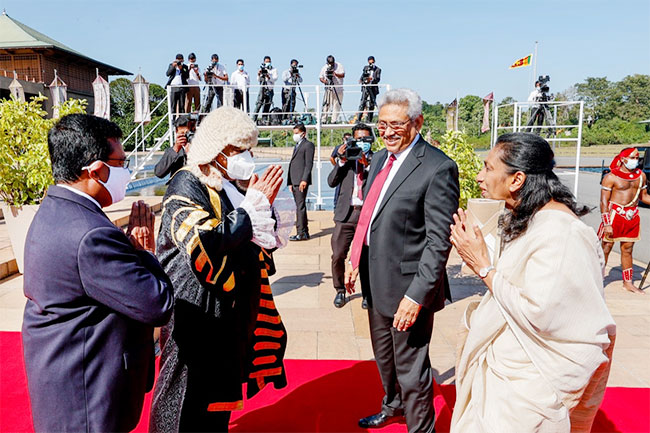 Speaker Mahinda Yapa Abeywardena receiving first lady Ioma Rajapaksa at the entrance to the Parliament. A smiling President looks on(pic courtesy PMD)
We are always ready to respond positively to observations made by the international community while giving priority to the country’s sovereignty and national security.
We are a free sovereign nation. We have no need to intervene in conflicts among powerful nations. While we respect our neighbours, we wish to pursue a policy of friendship with all States.
The people in the North and East who had been battered by the war for a long time wanted economic security above all else. They wanted a good education for children, job opportunities for young men and women, market access for self-employed and entrepreneurs, as well as water for drinking and agricultural purposes, housing facilities, hospitals, roads, and other infrastructure facilities. We regard the government’s prime responsibility towards reconciliation as providing such facilities to these people without discrimination.
Therefore, I urge the Members of Parliament representing the people of the North and East in this House to set aside various political ideologies, at least temporarily, and support the government’s efforts to improve the living conditions of the people in your areas.
I firmly believe that ensuring the rule of law and transparency is essential to strengthen democracy. Strengthening the independence of the judiciary is crucial to ensure the rule of law. Since I became President, appointments to the judiciary and the Attorney General’s Department were never politicized. Appointments were made on the basis of merit and seniority of officers in the judicial service, thereby demonstrating the commitment by my government towards an independent judiciary.
The country needs an efficient judicial system that is fair to all and not a burden to the public. However the present judicial system has many shortcomings. Even fundamental rights petitions, which the Constitution decrees must be addressed in two months, are not completed sometimes even during ten years. It takes years to punish persons who have committed crimes against minors. Often, it takes more than a lifetime to resolve land cases. In this context, it is no surprise that public confidence has eroded in the manner that the law operates.
Governments since 1994 have, on various occasions, attempted to introduce a new Constitution but to no avail. Therefore, I appointed an Experts Committee, with the approval of the Cabinet, to study this subject in depth, broadly consult public opinion and prepare a preliminary draft for a people-friendly constitution.
I hope to submit the recommendations of this Committee to the Cabinet and the Parliament for broad discussion.
We are well aware of the need to develop infrastructure facilities for rapid and sustainable development. Therefore infrastructure development activities continued even under pandemic conditions.
The 100,000 Roads Project, urban development projects, rural housing and urban apartment projects, 5,000-Bridge project, Rehabilitation of 14,000 Tanks Project, Irrigation development projects, programmes to provide electricity and drinking water to all households in the country, provision of high speed internet facilities throughout the country, flood control projects, technological villages and industrial township projects are all being implemented as planned.
Year after year, when these projects get completed, people will be able to see the results of the promises we made to them. Last week we commenced the construction of the Eastern Terminal of the Port of Colombo as promised in the Vistas of Prosperity and Splendour Policy Statement. Construction of the Western Terminal will begin shortly. By the time these projects end in 2024 and 2025, the Port of Colombo would have doubled its capacity and will be among the 15 busiest ports in the world.
Now the economic process in the country is gradually returning to normalcy. Tourists are returning. There is a clear growth in export sectors. However a number of challenges remain before us. Both short-term and long-term solutions are essential to overcome them.
The present budget has allocated a large amount of money for rural livelihood development as such short-term solution. The government hopes to assist a large number of self-employed people throughout the country through this. We fully understand the economic difficulties facing the people today.
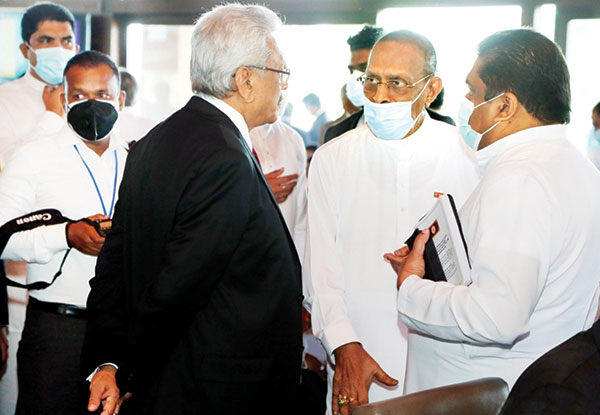 President Gotabaya Rajapaksa speaking with former Speaker Karu Jayasuriya yesterday (18)
Therefore, the government decided at the beginning of 2022 to introduce a Rs 229 billion relief package to the people. Even in the midst of major economic challenges, these reliefs are being provided because the government is sensitive to the problems of the people.
Our government provided free fertilizer to farmers for the past two years. We set a guaranteed price of Rs 50 for paddy. When the government paid 50 rupees, the private sector paid an even higher price to the farmers. Perhaps it was because of that decision taken by the government that a kilo could be sold for 60 to 70 rupees. It is unfortunate that a section of the farming community today has forgotten this.
The most serious challenge we face today in economic management is the current foreign exchange problem. Today we are encountering the climax of a problem for which a number of governments have failed to provide a lasting solution.
When I took over the country in 2019, the country’s foreign exchange reserves were only US $ 7.2 billion. Part of it was short-term loans. By then, more than US $ 6 billion a year in foreign debt had to be repaid over the next two years. It is the loans taken by all previous governments from time to time that we had to repay in this manner.
We had realized that under these circumstances if we fail to control our spending, there will be a foreign exchange problem in the near future. That is why we had to take unpopular decisions such as suspending the import of vehicles and restricting the import of various non-essential imported goods. In this manner, we have been able to control the total import expenditure for the last two years.
Over the years, the country’s average annual trade deficit has been around $ 8 billion. This shortfall was offset by revenues from tourism industry and remittances from Lankan expatriate workers and foreign exchange earned through foreign investment. Of these, we had the highest hopes for the tourism industry. We had planned to increase the revenue from tourism to US $ 10 billion over a few years.
But due to the Covid-19 pandemic, which began in December 2019, the global tourism industry suffered a setback. Thus we lost about $ 4.5 billion in annual revenue flowing into the country through tourism in 2020 and 2021.
We also lost a large amount of monthly remittances sent by about 200,000 Lankan expatriate workers who left their jobs and returned to Sri Lanka due to the Covid pandemic. Due to the continuous closure of the country, we were not able to attract new foreign investments.
Our reserves plummeted and imports were severely hampered by this unavoidable situations beyond our control.
It is not possible to meet our import requirements without increasing our reserves. In order to surmount this problem in the long run, we need to make great strides in our export industry through innovations, export diversification and value adding mechanisms. At the same time, there should be a major development in the areas of foreign currency attracting tourists, employment of skilled workers abroad, and information and communication technology.
All this had been clearly stated in our policy statement. Their implementation should be expedited now.
As a small country, our country has very limited natural resources to earn foreign exchange. We do not have resources like oil, gas and coal.
Today, all countries in the world that developed without natural resources have chosen foreign investment as the solution. They used foreign investment to boost the export industry, create new jobs and support local businesses.
If one acts for purely political reasons to misinterpret and create a wrong opinion among the people about foreign investments, then such a person is not doing any good to the country.
At this time we have a strong need for investment for the development of our country. Therefore, we need to make more efforts in the future to attract new investments to carefully chosen sectors. What matters is not whether they are domestic or foreign investment, but whether they are for the good of the country.
The solution to unemployment lies in job creation. At present most of the employment needs of the country are met by small and medium scale local businesses. Therefore, we must always prioritize the protection and empowerment of local entrepreneurs in various businesses. We understand the needs of the business community and will do our utmost to encourage them.
About 20% of our annual import expenditure is allocated for oil imports. When the total export earnings are less than $ 1,000 million a month, we have to spend about $ 350 million a month on oil alone. About 70% of the imported fuel is used as fuel for vehicles. It costs about 21% to generate electricity. Only 4% is used for industry.
When we allow the import of vehicles in the future, we hope to give priority to electric vehicles. Accordingly, we should plan to use renewable energy sources as much as possible when supplying electricity to vehicles.
The main problem facing industries in Sri Lanka is the high energy costs. Our country does not have fuel resources such as oil or coal. All of them should be imported. But we have rivers, seas surrounding the country, plenty of wind, and sunshine all year round. This is why renewable energy sources were prioritized under our Vistas of Prosperity and Splendour Policy Statement. We have agreed to the target of generating 70% of the country’s energy needs through renewable energy sources by 2030.
We have already made a number of plans to meet future power requirements. In the last two years alone we have been able to add significant renewable energy capacity to the local power grid using wind and solar power. The capacity of the Thambapanni Wind Power Plant, which was commissioned last year and is now successfully operating at 100 MW, will be increased by another 50 MW this year. In addition, under the ‘Gamata Balagarayak’ programme, work has commenced on the construction of 7,000 small solar power plants with a capacity of 100 kilowatts through local investors, of which 560 megawatts will be added to the power grid within the next two years. Also, the installation of Rooftop Solar panels on the roofs of government offices has commenced with a loan facility of Rs 20 billion signed with India last year. Construction of 120 MW Uma Oya and 35 MW Broadlands Hydro Power Plant is nearing completion. Moragolla Hydro Power Plant is expected to be completed by 2023.
Our goal is to achieve the carbon neutral target by 2050. Sri Lanka is already a co-leader in the Global Compact for No New Coal Energy. We will not approve the construction of coal power plants in the future for any reason.
I have always stated that education should play a very important role in the formulation of national policies. We need an education system that matches with the modern world. To this end, we have paid special attention to educational reforms as well as infrastructure development. We are working to increase the number of 379 national schools by a further 1,000. We have allocated a large amount of funds for school development in this budget as well. In the next few years, we will provide basic facilities to every school in the country to reduce the gap between schools.
We recognize the importance of technology education in creating employment and business opportunities for young people in the modern world. Therefore, in the last two years, allocations have been made to all universities to increase the number of students studying Science, Technology, Engineering and Mathematics (STEM) streams.
In addition, reforms have already been introduced to introduce courses in IT, English and Entrepreneurship for all university students, regardless of their subject stream.
We had emphasized the entitlement of every student who passes the Advanced Level to enter a university. Accordingly, steps have been taken to increase the capacity of all universities. All plans have been finalized to start 10 new City Universities covering 10 less privileged districts.
Through these reforms we have already increased the number of students admitted to universities annually by 35%. Accordingly, last year we were able to enroll 10,000 new students in addition to the 30,000 previously enrolled. We also increased the number of university staff by about 500 and allocated funds to improve their educational and welfare facilities. In addition, steps were taken to enroll 10,000 new students for technical degrees at the Open University. The courses are designed to enable these students to pursue their education while on the job from the first year.
However, less than 25% of students who qualify for university annually are still able to enroll in the state university system. Under these circumstances, and in relation to the growing population, we must realize that it is no longer a reality for the government alone to provide a high quality university education to all students who pass the Advanced Level.
Although eligible to enter a university, many young people are frustrated by the lack of space in the state university system and the lack of opportunity to even pay and pursue higher education in Sri Lanka. People with some means will even sell their parents’ properties and go abroad to study. Others become helpless.
Instead of sending money abroad for our own children’s education, we have lost the opportunity to attract foreign students to Sri Lanka through a high quality university system. Many of the world’s top universities are non-profit, non-governmental universities. All those universities offer scholarships to talented students for free education. This model, common to many countries in the world, is not adopted in our country.
If we create a more conducive environment for university education in our country, we will have the opportunity to attract world-renowned higher education institutions of international standard to Sri Lanka.
Through this, the capacity of the university system in Sri Lanka can be increased and higher education opportunities can be provided to more people.
There is no reason, other than the traditional political ideologies, not to give this opportunity to the children of the country. If the country’s legal framework needs to be changed to do this, it can only be done by this Parliament.
Therefore, I propose to this august assembly to discuss at length whether, while increasing the capacity of state universities, then establishment of high quality non-state universities in the country can be permitted.”





Latest News
Heat Index at Caution level’ in the Northern, North-central, North-western, Western and Southern provinces and in Trincomalee district.


Warm Weather Advisory
Issued by the Natural Hazards Early Warning Centre
Issued at 3.30 p.m. on 12 April 2026, valid for 13 April 2026.
Heat index, the temperature felt on human body is likely to increase up to ‘Caution level’ at some places in the Northern, North-central, North-western, Western and Southern provinces and in Trincomalee district.
The Heat Index Forecast is calculated by using relative humidity and maximum temperature and this is the condition that is felt on your body. This is not the forecast of maximum temperature. It is generated by the Department of Meteorology for the next day period and prepared by using global numerical weather prediction model data.

Effect of the heat index on human body is mentioned in the above table and it is prepared on the advice of the Ministry of Health and Indigenous Medical Services.
ACTION REQUIRED
Job sites: Stay hydrated and takes breaks in the shade as often as possible.
Indoors: Check up on the elderly and the sick.
Vehicles: Never leave children unattended.
Outdoors: Limit strenuous outdoor activities, find shade and stay hydrated.
Dress: Wear lightweight and white or light-colored clothing.
Note:
In addition, please refer to advisories issued by the Disaster Preparedness & Response Division, Ministry of Health in this regard as well. For further clarifications please contact 011-7446491.

On the apparent northward relative motion of the sun, it is going to be directly over the latitudes of Sri Lanka from 05th to 15th of April in this year.
The nearest areas of Sri Lanka over which the sun is overhead today (13th) are Pesalai, Mankulam and Nedunkerny about 12:11 noon.
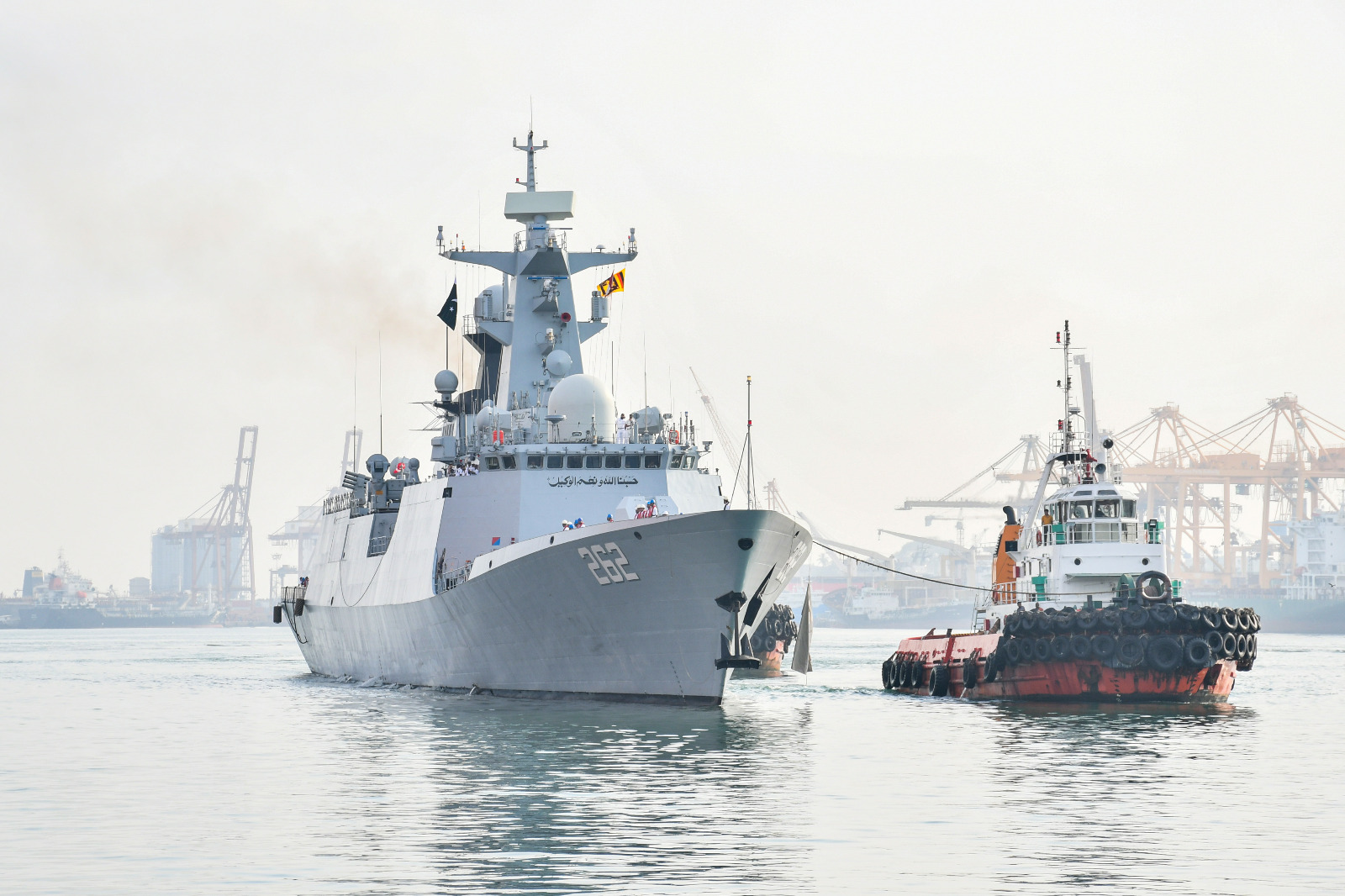
The Pakistan Navy Ship (PNS) TAIMUR and ASLAT arrived at the Port of Colombo on a goodwill visit on 12 Apr 26.
The visiting ships were welcomed by the Sri Lanka Navy in
compliance with naval traditions.
The duo of ships is commanded by Captain NIAMAT SAEED KHAN (PNS TAIMUR) and Captain NADIR MATEEN AFRIDI (PNS ASLAT).
Meanwhile, the ships are expected to conduct a Bilateral Naval Exercise LION STAR V with the Sri Lanka Navy in Colombo seas.

Salt and Patidar power RCB past Mumbai Indians

Prasidh, Buttler set up comfortable win for Gujarat Titans

Heat Index at Caution level’ in the Northern, North-central, North-western, Western and Southern provinces and in Trincomalee district.

Showers above 75 mm are likely at some places in the Western, Sabaragamuwa, Central, Southern and North-western provinces.

Sun directly overhead Pesalai, Mankulam and Nedunkerny about 12:11 noon

PNS TAIMUR & ASLAT arrive in Colombo

‘Dates have the highest sugar content to fight Coronavirus’

Sunday Island 27 December – Headlines

#SundayIsland 17th December – Headlines

Sunday Island – 28th March

Sunday Island Headlines – 21 March

Sunday Island – 21st February – Headlines
-

 News2 days ago
CEB orders temporary shutdown of large rooftop solar systems
-

 News7 days ago
Lankan-origin actress Subashini found dead in India
-

 News5 days ago
AG: Coal procurement full of irregularities
-

 Business4 days ago
Israeli attack on Lebanon triggers local stock market volatility
-

 Business5 days ago
Hayleys Mobility introduces Premium OMODA C9 PHEV
-

 News7 days ago
UN Regional Director launches SL’s first Country Gender Equality Profile during official visit
-

 News7 days ago
Dialog Launches ‘GanuDenu QR’, Making Cashless Transfers Free for All with eZ Cash and Dialog Finance
-

 Business4 days ago
HNB Assurance marks 25 years with strategic transformation to ‘HNB Life’