
News
Govt. urged to increase nursing cadre to tackle national health crisis

By Shamindra Ferdinando
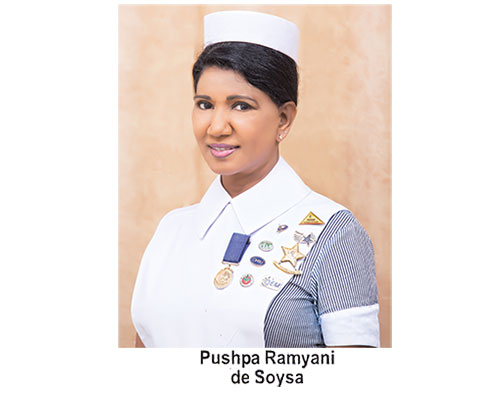
National Coordinator, Training (Nursing) Pushpa Ramyani de Soysa says that against the backdrop of alarming increase in the number of positive Covid-19 cases, the government needs to act swiftly and decisively to strengthen the nursing staff or face the consequences.
The top nurse insists a moment cannot be wasted as the ongoing epidemic threatens to overwhelm the entire country. The nurses’ spokesperson attached to the Accident Ward of the National Hospital, Colombo, delivered the dire warning in a live interview with Dasun Wasantha on the state-run ITN yesterday (14)
The outspoken official said that at the time Covid-19 erupted in 2020, the nursing staff consisted of approximately 38,000 representing all grades. At that time, the country experienced a staggering 50 per cent dearth of trained nursing staff, de Soysa said, urging those responsible as well as the public of the urgent need to strengthen the nursing staff.
She explained how the nursing staff worked under unbearable pressure as the entire medical staff backed by the military and the police struggled to cope up with the relentless Covid-19 onslaught.
Responding to the interviewer on live ‘Hathweni Paya’ , de Soysa said that as an immediate interim measure, those who had retired in the past few years could be brought back to lessen the pressure on the staff. When The Island sought further clarification from the National
Coordinator, the nursing veteran emphasized the Covid-19 challenge had to be tackled, in addition to the regular workload. A further deterioration of the situation could cause a catastrophe, she told The Island.
The National Coordinator told the ITN as nurses couldn’t be trained overnight the way required beds and other equipment could be supplied to hospitals, hence the urgent need to bring back the retired without further delay. She repeatedly stressed the responsibility on the part of the administration whoever in power to increase the nursing staff to meet the country’s growing requirement. Acknowledging the services rendered by the health services at an extremely difficult period, nurse de Soysa underscored the critical role played by the nursing staff in the overall effort against the epidemic.
Soysa highlighted what she called a coordinating role played by the nursing staff in the treatment of persons afflicted by Covid-19 or some other illness. In the absence of sufficient number of nurses, personnel had been re-allocated, de Soysa said, pointing out that due to Covid-19 explosion patients were being accommodated at hospitals.
Commenting on challenges faced by the nursing profession, de Soysa recalled the sacrifices made during the 30-year-war that was brought to a successful conclusion in May 2009. “Regardless of d immense difficulties, the nursing staff fulfilled their responsibilities during the conflict. We’ll do the same now,” de Soysa said, pointing out as many as 270 nurses had been tested Covid-19 positive, in addition to thousands quarantined.
The National Coordinator complained about the dearth of some critically important data relevant to the Covid-19 situation needed for evaluation purposes. Timely decisions couldn’t be taken for want of updated data at global and local level, she said.
She also discussed difficulties caused by some of those seeking treatment at hospitals not being aware of their condition, hence the need to be vigilant. However, sometimes, nursing staff served without taking into consideration the grave risks them faced. A grave looking de Soysa told the ITN interviewer they couldn’t follow health guidelines. “We cannot keep one meter distance in hospitals,” de Soysa said.
Nurse de Soysa said that she received both doses of covishields vaccine as key part of overall measures in place for the protection of the medical staff.
Without referring to any political party, de Soysa explained how the political administration over the years treated the nursing staff as slaves. Government treated nursing staff as dirt, de Soysa said, recalling with gratitude how Ven Muruththettuwe Ananda thera spearheaded a campaign that paved the way for significant improvement in the nursing service. The National Coordinator said that before the Ven. Thera’s intervention, they were assigned intolerable tasks regardless of their complains.
Responding to another ITN query, de Soysa said that successive governments hadn’t responded to their call for enhancement of the nursing service with the introduction of a system to produce qualified nurses who specializes in selected fields. Although action had been taken , the entire process was proceeding at snail pace, she alleged.
The National Instructor made reference to President Gotabaya Rajapaksa’s 2019 presidential election manifesto that also dealt with the issue at hand. The top nurse didn’t mince her words when she pointed out that the required improvements weren’t introduced as expected, hence the need to move now.









Former first lady Shiranthi Rajapaksa, wife of former President Mahinda Rajapaksa was produced before the Hulftsdorp court, after being arrested by officers of the Commission to Investigate Allegations of Bribery or Corruption (CIABOC) and produce
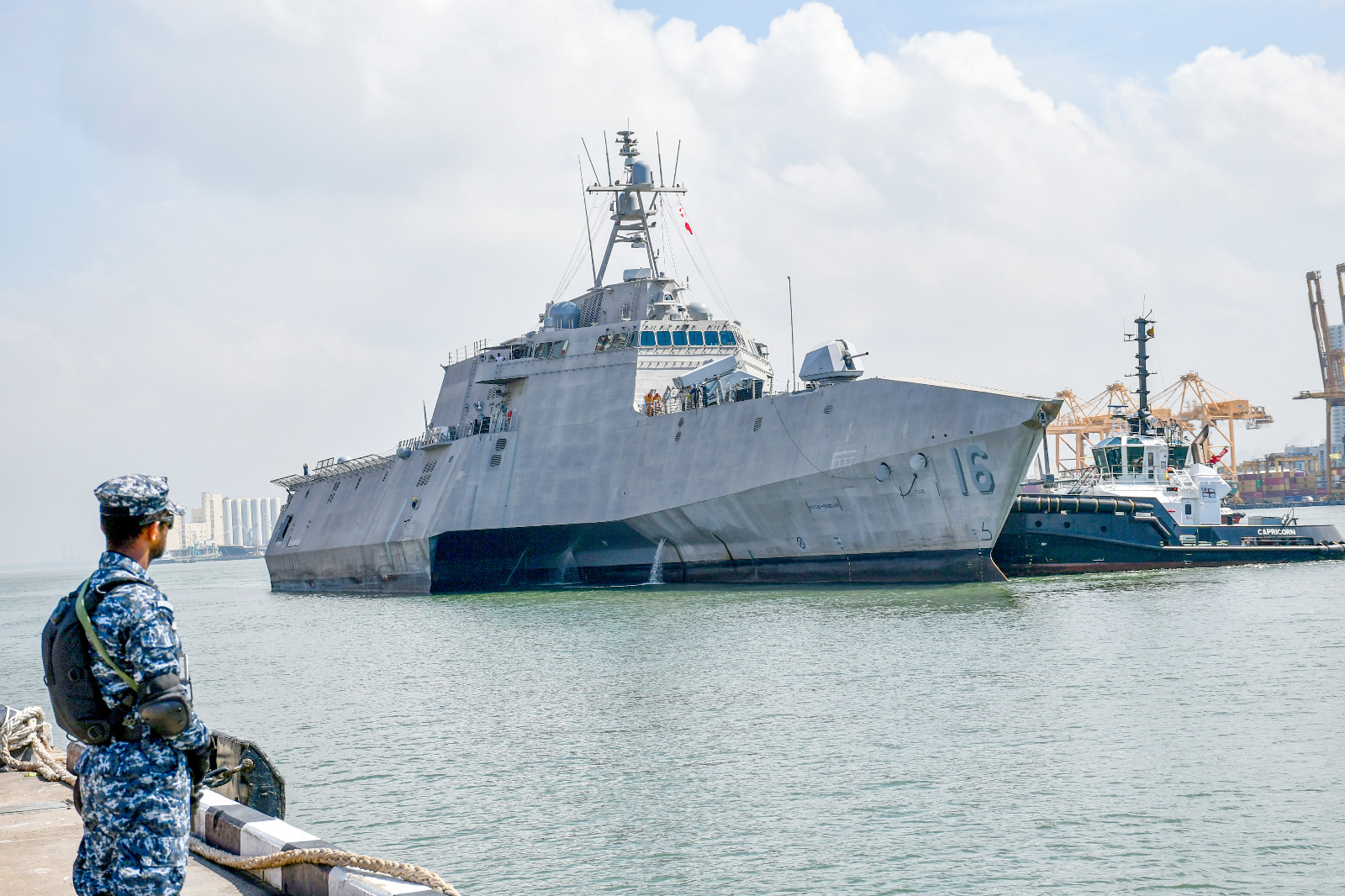
The U.S. Navy ship USS Tulsa (LCS 16) arrived at the Port of Colombo this morning, 7 October 2026 for replenishment purposes.
The visiting ship was welcomed by the Sri Lanka Navy in accordance with naval traditions.
The 127.7-metre-long platform is a Littoral Combat Ship commanded by Commander BM Wanier. Commissioned on 16 February 2019, USS Tulsa has since been in service with the US Navy.
The ship previously made a port call in Sri Lanka on 27 August 2025.
Govt. tells fuel distributors to maintain stocks to ensure uninterrupted supplies
by Saman Indrajith and Norman Palihawadane
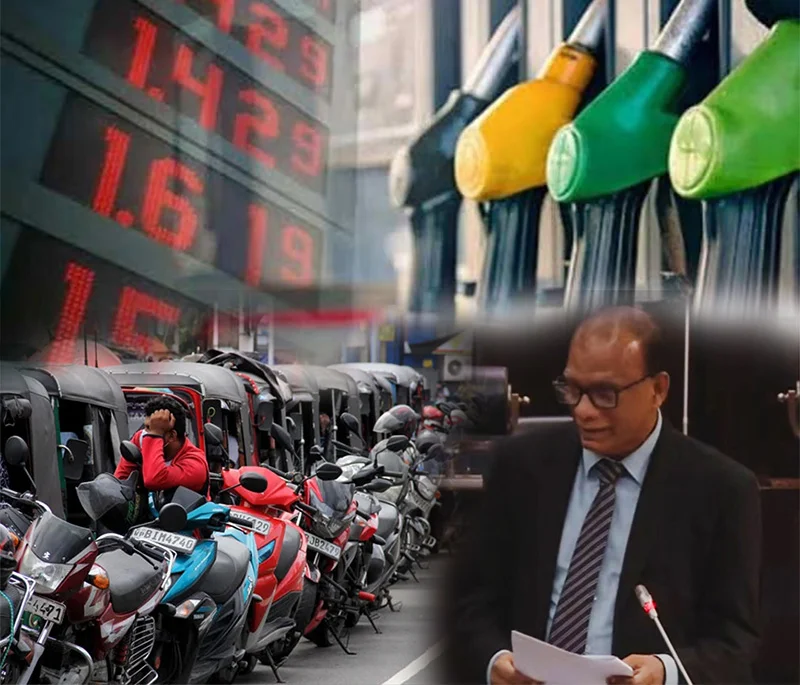
The government had instructed private fuel distributors to maintain minimum stocks and ensure uninterrupted supplies to the market, Energy Minister Anura Karunathilaka told Parliament yesterday (06).
Karunathilaka said the Ministry of Energy Secretary had notified the relevant companies of the requirement, following a reduction in supplies by some private distributors, amid higher international fuel prices.
The Minister said private companies had informed the government that they were facing losses because international prices had risen while fuel was being sold, locally, at prevailing prices. As a result, some companies had reduced the volumes released to the market.
The reduced supplies had increased the burden on the Ceylon Petroleum Corporation (CPC), whose share of the diesel market had risen from about 54% to 82%, the Minister said.
“The CPC currently holds an 82% share of the market,” he said, adding that it had increased its supplies, compared with February, to compensate for the reduction by private distributors.
Karunathilaka said the government could not, under the existing agreements with private companies, specify the quantities they should supply to individual filling stations. However, it could require them to maintain minimum stocks in the country.
The Minister said the Energy Ministry had already instructed companies that had failed to maintain the required stocks to take steps to prevent supply disruptions.
The Minister attributed the queues reported at some filling stations to reduced supplies from private distributors, as well as normal variations in fuel distribution. He also said demand for CPC fuel had increased because private companies generally did not provide fuel to dealers on credit, while the CPC offered a three-day credit facility.
“We expect that, as the Ceylon Petroleum Corporation takes on this additional burden, the problem will ease to some extent by Wednesday or Thursday,” Karunathilaka said.
He said instructions had also been issued to increase supplies to CPC filling stations. A special discussion on the issue is scheduled for today (07), with officials of the Energy Ministry and CPC expected to participate,
along with President Anura Kumara Dissanayake.
Meanwhile, Petroleum Dealers’ Association officials have called for an early solution to the supply issue. Association Chairman D.V. Shantha Silva said queues had been reported at many filling stations, mainly those operated by private distributors.
He said the situation was not due to an overall shortage of fuel, but was linked to reduced orders by Lanka IOC, Sinopec and R.M. Parks amid concerns over losses incurred on fuel sales.
The Ceylon Petroleum Private Tanker Owners Association has urged motorists to refrain from panic buying, saying there was no nationwide disruption to fuel supplies.
The government earlier increased fuel prices and introduced a per-litre diesel subsidy following concerns raised by distributors over rising international prices.

Showers above 100 mm are likely at some places in the Western, Sabaragamuwa, Central, Uva and Southern provinces and in Anuradhapura district

Remembering Juvenal, Coke, Acton and Machiavelli

West Asian conflict undergoing manifold complications

Nissanka absence opens door for Sri Lanka’s young guns

The prelate who walked the talk

Needs of populace hit by Cyclone Ditwah seen as waiting to be addressed

‘Dates have the highest sugar content to fight Coronavirus’

Sunday Island 27 December – Headlines

#SundayIsland 17th December – Headlines

Sunday Island – 28th March

Sunday Island Headlines – 21 March

Sunday Island – 21st February – Headlines
-

 Editorial6 days ago
Colombo Port drug bust: The plot thickens
-

 Features4 days ago
The first woman in the foreign service or Ceylon Overseas Service it was then called
-

 Editorial5 days ago
Fuelling discontent and protest
-

 News3 days ago
Geneva takes up Sallay’s case and govt. ignores opportunity to answer accusations
-

 Latest News5 days ago
Tharindu Rathnayake, bowlers secure Asian Games Bronze for Sri Lanka
-
 Foreign News5 days ago
Ten injured after car crashes into rugby supporters in Australia
-

 Features3 days ago
Sri Lanka Cricket Bill: Governance reform is not yet a cricket strategy
-

 News4 days ago
Nearly 20 Iranian tankers stranded off Lanka amid US sanctions