
News
Govt. insists no fraud in sugar imports

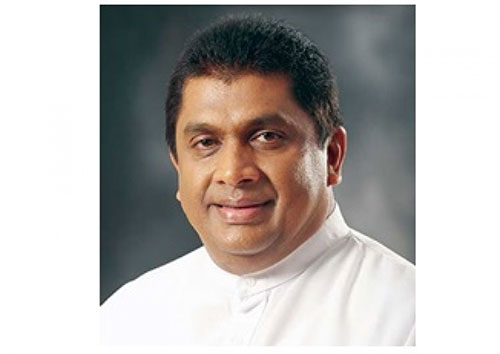
By Saman Indrajith
Cooperative Services, Marketing Development and Consumer Services State Minister Lasantha Alagiyawanna on Wednesday told Parliament that there was no truth in the Opposition’s allegations that the government had given undue duty concessions to a private sugar importer.
The Minister admitted that few companies made undue profits, making use of the gazettes issued by the government changing import duties on sugar. “But there was no fraud. If you insist that there was such untoward incidents then provide us with the details we may investigate it. We know that some companies made some profits but there is no proof of a fraud as alleged by the opposition.”
Minister Alagiyawanna said that during recent years the prices of essential food items had increased in November and December. “In October last year, our government made several policy decisions to give relief to people. On Oct 13 we released a gazette bringing down the 50 rupee import duty on a kilo of sugar to 25 cents. The price of a kilo of sugar was Rs 137 to 138 at that time. We thought that bringing down the tax would result in the lowering of the prices of sugar in the market. That did not happen. There had already been stocks of around 150,000 metric tons in warehouses belonging to the importers and they did not release their stocks. So, a private company came forward and imported sugar under the new price and released them to the market. That was what exactly happened. The decision to bring down the import tax was not taken by the President alone. The Ministry of Finance and Ministry of Trade too were party to it.
“Today, the prices of some essential food items are determined by supply and demand. Market forces determine the prices though we have issued regulations. Though we still have control on the prices of fuel, gas, cigarettes and liquor, the prices of essential food items are determined by market forces. That is the reality. We can change this by allowing certain imports but our decision is to strengthen the local production and industries. Although the people and the Opposition blame us, we are determined to stick to our policy until local production and industries get their hold in the market. We know that this is hard but we have to do so. For example, we can bring down the prices of rice within five days. All we have to do is to import rice at low prices from India but that will not help our farmers. Not a single grain of rice was imported in the year 2020. As a result now our farmers get between 50 to Rs. 55 a kilo of paddy. They used to get only Rs 38 per kilo.
“We know that a certain company made an undue profit but that is the nature of business. The permanent solution for this is to develop the Cooperative shops and Sathosa so that the government would have a network of establishments that have an effect on the market.
“The Opposition alleges that a businessman made Rs 10 billion profit by importing sugar due to the lowering of the import duty. It is not so. The cost of the stock of imported sugar was around Rs. 11 billion so practically there couldn’t have been a 10 billion rupee profit. Today a kilo of sugar is Rs 118. Otherwise, it would have been in the range of Rs 155- 160 a kilo.”

News
Construction of Jet A-1 Aviation fuel pipeline and new oil tank complex at Muthurajawela begins under President’s patronage

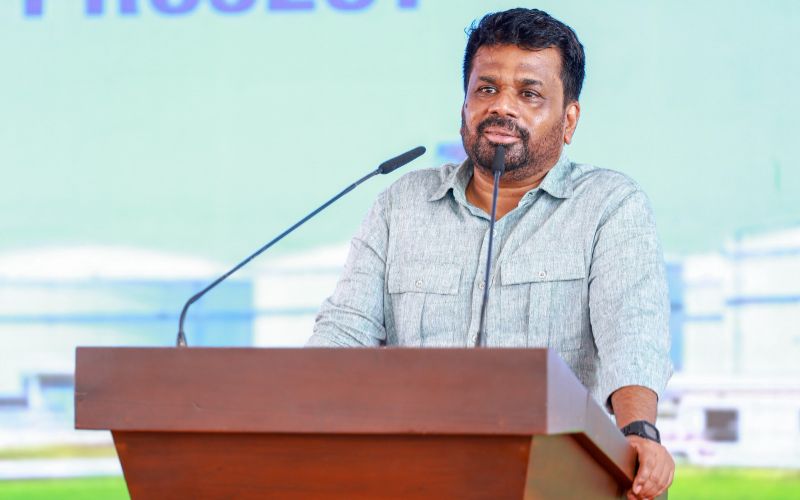
President Anura Kumara Dissanayake said that the Government’s objective is to maintain a strong state presence in the energy market while providing an efficient service to the people, adding that significant progress has been achieved towards this objective over the past two years and that a strong energy market that does not place a burden on the people is now being built in Sri Lanka.
The President made these remarks on Friday (02) morning while attending the commencement of construction of the Jet A-1 pipeline system of the Ceylon Petroleum Corporation (CPC) and two new oil storage tank systems belonging to the CPC and the Ceylon Petroleum Storage Terminal Limited (CPSTL).
The projects are being implemented in line with the Government’s national objective of developing infrastructure in the energy sector, with the aim of ensuring the security of aviation fuel supplies, reducing supply costs and providing the capacity required to meet future demand for aviation fuel.
A dedicated pipeline and associated tank complex are being constructed to connect Muthurajawela with the Bandaranaike International Airport in Katunayake, with the aim of meeting the future demand of the country’s aviation sector, ensuring the security of aviation fuel supplies and reducing transportation costs.
Construction has commenced on five new Jet A-1 fuel storage tanks with a total capacity of 92,000 cubic metres. These comprise two large Jet A-1 tanks, each with a capacity of 30,000 cubic metres; two medium-sized tanks, each with a capacity of 15,000 cubic metres; and an additional tank with a capacity of 2,000 cubic metres. The fuel supply pipeline system will be connected to the airport through a 21-kilometre-long underground pipeline with a diameter of 10 inches from the Muthurajawela tank complex. The project is scheduled for completion within 30 months.
Meanwhile, as part of ongoing efforts to strengthen and expand storage and infrastructure facilities in the petroleum industry, the Ceylon Petroleum Storage Terminal Limited (CPSTL) commenced construction today of three new storage tanks at the Muthurajawela Terminal.
Upon completion, the three-tank system, comprising two tanks with a capacity of 15,000 cubic metres each and one tank with a capacity of 10,000 cubic metres, will provide an additional total storage capacity of 40,000 cubic metres.
This will further enhance the petroleum storage capacity of the terminal and support the continued development of the country’s petroleum infrastructure. The project has a contractual period of 18 months and is scheduled for completion in April 2028.
The tanks are being constructed in compliance with relevant international standards and recognised industry best practices, ensuring enhanced safety, reliability and operational efficiency. The additional storage capacity will strengthen the country’s fuel reserves, improve operational flexibility and support the reliable and uninterrupted distribution of fuel products to meet the country’s growing energy requirements.
Minister of Ports and Civil Aviation and Minister of Energy Anura Karunathilaka said,
“We are now in an era of energy transition. The world is rapidly moving towards the use of clean energy. The use of electric vehicles is very important in this regard, and our country is also now moving in that direction.
The use of solar energy is also important. We expect to add 1,200 megawatts of solar power capacity to the national grid by 2029.
As a country, we must focus not only on controlling fuel prices but also on controlling fuel consumption. The public also has a major responsibility in this regard.
It is particularly important to change our patterns of energy consumption. Greater energy security can be achieved by avoiding periods of high energy demand, shifting towards electricity use and using fuel-efficient vehicles, particularly electric vehicles.”
Chairman of the Ceylon Petroleum Corporation D. J. Rajakaruna said,
“We faced a major challenge due to the war in the Middle East. However, with the intervention of the President, relief was provided to the people and the situation was managed very effectively.
As a result, while diesel prices in the global market increased by 91%, the increase in Sri Lanka was only around 39.5%. While petrol prices in the global market increased by 80%, the increase in Sri Lanka was only around 41%.
Despite providing fuel at lower prices in this manner, the Corporation has recorded a profit of Rs. 28 billion this year. We also recorded a profit of Rs. 36 billion last year.
This may raise the question of why fuel prices are not being reduced when there are such profits.
However, we have used those profits to commence a number of infrastructure development projects at the institution.
These include adding the capacity of 11 tanks, including the construction of six tanks that had previously been abandoned, to increase fuel storage capacity; modernising our oil-filling section, which is more than 90 years old, and establishing a gantry system similar to that at Muthurajawela; laying two new pipelines for unloading fuel from the port to Kolonnawa; constructing a new pipeline to transport Jet A-1 fuel to Katunayake; and upgrading the pipeline system and laying new pipelines, among many other projects.
We are implementing these projects using those profits. Therefore, we have returned the benefits to the people through these investments.”
The Minister of Science and Technology, Professor Chrishantha Abeysena; Deputy Minister of Energy, Arkam Ilyas; Member of Parliament Kumara Jayakody; Secretary to the Ministry of Energy and Senior Additional Secretary to the President, Russell Aponso; foreign ambassadors; government officials including officials of the Ministry of Energy and the Ceylon Petroleum Corporation; and representatives of Sinopec were among those present at the occasion.
President’s Media Division (PMD)


MONETABRIEF –The prosecution of high-profile individuals from the former Rajapaksa administrations is set to escalate this month with the clearing of legal hurdles and administrative bottlenecks, according to officials involved in the process.
Former president Gotabaya Rajapaksa’s attempt to secure an order preventing his arrest in connection with the Easter Sunday massacre was turned down by the Court of Appeal on Thursday.
An overseas travel ban has been in operation against Rajapaksa since June, but the Criminal Investigations Department made no move to question him. He instead filed a writ application seeking an order preventing his possible arrest.
President of the Court of Appeal Rohantha Abeysuriya noted that the court would not interfere with the investigative process. Any attempt by the court would amount to an obstruction of the investigation.
In an unrelated case, the same court rejected an application by opposition legislator Dilith Jayaweera seeking the quashing of a contempt charge filed against him by the Fort magistrate. The charges against Jayaweera and a few other opposition politicians are expected to be taken up in the coming week.
Jayaweera and other opposition politicians — Wimal Weerawansa, Udaya Gammanpila, Sugeeshwara Bandara, and Asanka Navaratne
— were hauled up over their remarks relating to the arrest of Suresh Sallay, the former head of the State Intelligence Service.
SLPP academic Mahinda Pathirana is also charged over his public comments about Sallay’s arrest in February under the draconian Prevention of Terrorism Act.
Former president Mahinda Rajapaksa’s son, legislator Namal Rajapaksa, is already in remand custody following his arrest in connection with three cases of bribery and money laundering relating to the 2013 Airbus deal and the Krrish property development in Colombo.
Although Namal has been granted bail in the Airbus money laundering charge, he is in custody until October 13 over the bribery charge relating to the same Airbus transaction. His arrest is under a provision of the Anti-Corruption Act that does not allow a magistrate to grant bail unless under exceptional circumstances.
Meanwhile, his mother Shiranthi Rajapaksa, who had been asked to report to the Financial Crimes Investigations Division on September 24, was a no-show and was yet to return from Singapore.
She had travelled overseas on September 16, and a family spokesman said she was handed the FCID summons at the departure lounge of Bandaranaike International Airport just before she boarded a flight to Singapore.
At the time, the family spokesman said she was due to return in three days.
“We will see greater momentum in the legacy cases in the coming weeks,” an official involved in the prosecutions said.
“We have cleared the legal hurdles to press ahead with more arrests,” he said.
“We are working on a few administrative issues which will be resolved very soon.”
The controversial prosecution of former President Ranil Wickremesinghe is dragging on without him being formally indicted since his arrest in August last year. The Fort magistrate has listed the case again for November 11, when the Attorney-General is expected to report on his decision regarding action against Wickremesinghe.

Police have reminded the public that courts have the power to take legal action against individuals who evade arrest or remain in hiding after warrants have been issued against them.
Police said that under Section 60 of the Code of Criminal Procedure Act No. 15 of 1979, a court could issue a written proclamation requiring a person evading arrest under a warrant to appear at a specified place and time.
The proclamation must allow the person at least 30 days to appear before court, Police said.
If the person fails to appear even after the proclamation has been issued, the court may take further action under Section 61 of the Act.
This includes issuing an order for the attachment of the movable or immovable property belonging to the person concerned.Police issued the reminder highlighting the legal measures available against persons who deliberately evade arrest and remain in hiding after warrants have been issued.

Debris found from plane that went missing off US coast

Construction of Jet A-1 Aviation fuel pipeline and new oil tank complex at Muthurajawela begins under President’s patronage

Landslide Early Warnings issued to the Districts of Kandy, Kegalle, Matale and Ratnapura

No handshakes and a delayed ceremony as India beat Pakistan at Asian Games

Showers or thundershowers will occur in most parts of the island after 1.00 p.m

Lanka enters new phase of prosecutions as hurdles clear

‘Dates have the highest sugar content to fight Coronavirus’

Sunday Island 27 December – Headlines

#SundayIsland 17th December – Headlines

Sunday Island – 28th March

Sunday Island Headlines – 21 March

Sunday Island – 21st February – Headlines
-

 News7 days ago
Police remove Thileepan statue in Jaffna
-

 Features7 days ago
The 22nd Amendment, constitutional recovery and illiberal slippage
-

 Features7 days ago
Of foreigners as CEOs of Lankan ventures
-

 Latest News5 days ago
Gold winner Tharanga gets brand-new Honda Vezel from SLAAJ
-

 News7 days ago
Sajith rejects Jt. Opp. protest sabotage claim; SJB TU chief demands remedial action
-

 Features5 days ago
Why Sri Lanka needs an Inclusive Civic Nationalism – urgently
-

 News4 days ago
US-assisted ‘Ice’ detection: NPC to examine IGP’s move to transfer drug-busting team
-

 Features6 days ago
Thailand’s biggest new global star …