
News
GL: Other nations must keep out of SL’s internal affairs as it does not meddle with theirs

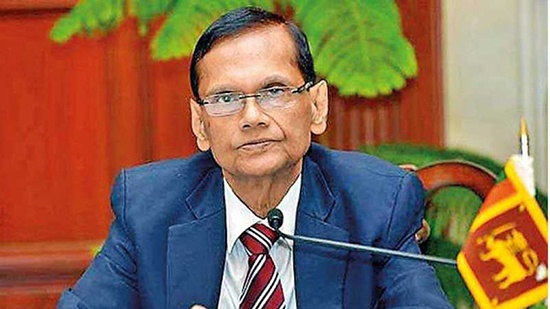
By Saman Indrajith
Education Minister Prof. G.L. Peiris says Sri Lanka has gone out of its way to refrain from interfering in the domestic affairs of other nations and expect non-interference by other nations in the country’s internal affairs.
Participating in the third reading debate on Budget 2021, the minister said on Wednesday (25) that Sri Lanka entertained expectations that other nations would respect without question the right of Parliament and the people of Sri Lanka to determine the country’s own destiny.
Prof Peiris said: “As we debate the foreign policy in this august assembly, circumstances in the world at large are certainly not propitious. COVID-19 has proven to be a calamity. There are many lessons to be learnt from this situation. One of the most important lessons is that no nation, no single country, no culture has a monopoly on wisdom. Nobody can claim to know all the right answers. The contemporary experience of the world demonstrates convincingly that there is no room whatsoever for arrogance, bigotry and self-righteousness. Today, more than at any other time in our history if we survive this crisis at all it can only happen on the basis of humility with spontaneous sharing of experiences and readiness to work hand in hand in a spirit of comradeship and solidarity.
“The cornerstones of the foreign policy of our country are crystal clear. They were set out with the exemplary clarity by President Gotabaya Rajapaksa at his inauguration in the hallowed precincts of the Ruwanweliseya in Anuradhapura. We seek friendship with all nations. We go out of our way to refrain from interfering in the domestic affairs of other nations. At the same time reciprocally we entertain expectations that others will respect without question the right of Parliament and the people of Sri Lanka to determine our own destiny. This is the rationale underpinning the statement made by Foreign Minister Dinesh Gunawardena at the Human Rights Council in Geneva barely three months after the assumption of office by President Gotabaya Rajapaksa. The government Minister Gunawardena unequivocally rejected the resolutions of the Human Rights Council 30/1, 34/1, and 40/1 respectively of 2015, 2017 and 2019. These resolutions were not only supported but also co-sponsored by the Yahapalana government of that time. This is scarcely believable when one considers the content and the impact of these resolutions. Undisputedly those resolutions dealt with matters which were within the purview of national institutions in Sri Lanka. They required the re-arrangement of Sri Lanka’s constitutional provisions, the restructuring of our armed forces and police, the repeal of major legislations such as the Prevention of Terrorism Act. These resolutions also empowered foreign and commonwealth judges to adjudicate on grave allegations relating to war crimes which were leveled against the armed forces of Sri Lanka. That is the effect of the operative paragraph six of the resolution of 2015. This was in blatant violation of the supreme law of this country – the constitution. This abdication of self-respect was further compounded by the acceptance by that government of the obligation to report from time to time to the human rights council and to abide by the judgment of that council in respect of the adequacy of the progress that had been made in respect of the implementation of these resolutions.
“The entire edifice of the UN system is based upon one sacred principle. That is the principle relating to sovereign equality of nations. That principle is illustrated amply by the seminal instruments of the UN system such as its Charter, the Declaration of Human Rights and jurisprudence of the International Court of Justice and its predecessor the permanent Court of International Justice. All countries that are members of the international community be they large or small, affluent or not so affluent, are equal in the eyes of the United Nations system – equal in intrinsic worth and equal in inherent value. There can be no discrimination whatsoever. This is why there can be no scope whatsoever for talking down or hectoring and for patronizing attitudes. This is not to be misunderstood. Counsel from friends and sharing of experiences, traditions that are made in a spirit of goodwill and friendship are always welcome. They are healthy. But what absolutely ruled out are judgmental postures in respect of the internal decision making processes of countries dealing with matters which are within their purview. The concept of equality is basic to the entire UN system.
“There is another principle that is equally important. That is the principle of fairness. This is an instinct that is embedded in human nature and it represents a component of all systems of law and justice and indeed of all civilizations since time immemorial. One must look at both sides of an issue. Evidence has to be weighed in the balance and conclusions must be arrived at objectively without bias or prejudgment. From that standpoint very sadly the people of Sri Lanka have good reasons to entertain grave misgivings. Evidence of the highest value has been deliberately disregarded if that evidence is favourable to the armed forces of Sri Lanka. A clear example of that consists of military dispatches by trusted members of foreign countries reporting confidentially to their own capitals. These have been totally ignored. These dispatches have been ferreted out with great difficulty. As pointed out by Minister Dinesh Gunawardena the persons of eminence such as Lord Michael Naseby both within the House of Lords and outside. There were also very critical findings by Queen’s Counsel of the eminence, Sri Desmond Silva, Sir Geoffrey Nice, Rodney Dickson. These findings completely exonerated the armed forces of Sri Lanka from any form of culpability of guilt with regard to war crimes under principles of international humanitarian law and international human rights law. This body of evidence was there and it was never taken into account. It was deliberately ignored. This was done in the lofty name of human rights. But it constituted a cynical violation of natural justice and the rules of fairness both in its substantive and its procedural dimensions.
“Sri Lanka is a country with proud history and a cherished heritage. Reconciliation, ethnic harmony, and transitional justice are not concepts by any means alien to us. We have been nurtured throughout the ages by a rich and vibrant cultural tradition by each of these areas. I want to stress that the mechanisms we have to evolve, if we aspire to any measure of success, must necessarily derive from the aspirations of our people. This is because of the importance of context with regard to these matters. The government of President Gotabaya Rajapaksa and Prime Minister Mahinda Rajapaksa, fortified by an unrivalled mandate obtained from the people of this country at both the presidential and parliamentary elections, has an unflinching resolve to address these issues at earliest. The government has both the moral and legal right and the space to do so. We ask for empathy and understanding as we move forward in partnership with international forces to assure our people a stable and a prosperous future.”

Latest News
Let us dispel the roots of greed, hatred, and delusion, and transform our lives into a nobel period that brings peace and serenity – PM

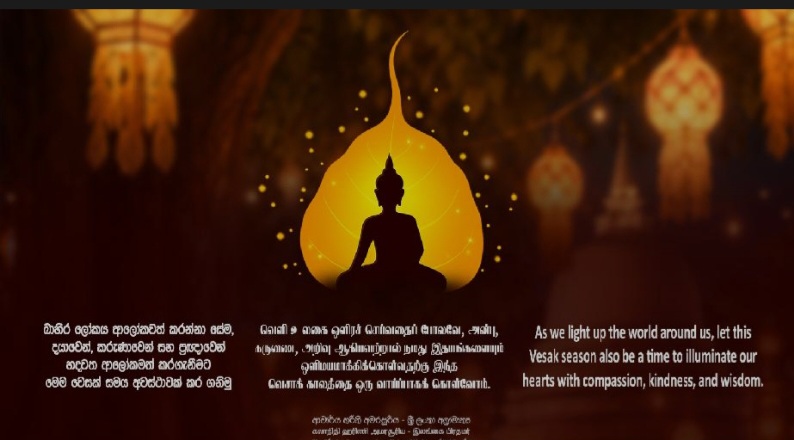
Prime Minister Dr Harini Amarasuriya in her Vesak day message called upon all Sri Lankans to dispel the roots of greed, hatred, and delusion, and transform their lives into a nobel period that brings peace and serenity
The Prime Ministers Vesak day message:
“It is an honor to extend Vesak day felicitations to all citizens of the nation during this sacred period in which lives are shaped in accordance with the noble teachings preached by Lord Buddha, and upholding the practice of Dhamma.
Just as the external world is illuminated by lanterns, this Vesak season should also be an opportunity to illuminate our own hearts with compassion, kindness, and wisdom. Let us dispel the roots of greed, hatred, and delusion, and transform our lives into a nobel period that brings peace and serenity.
“abhittharetha kalyāṇē” – Let us hasten towards the common good. The theme for this year’s State Vesak festival reflects the social needs of the present time. While eliminating narrow beliefs and mindsets, this Vesak festival should become a source of blessings and strength for us to build a nation dedicated to the common good and radiant with the values of the Dhamma.
Followed by the guidance of the Mahanayake Theros and the All Island Sasanarakshaka Mandalaya, I extend wishes for the State Vesak Festival, jointly organized by the Ministry of Buddhasasana, Religious and Cultural Affairs and the Ministry of Public Administration, Home Affairs, Provincial Councils and Local Government.
Through the deep bond that exists between the state and” Buddhism, the progress and prosperity of the country can be achieved through righteous governance. It is essential that we cultivate the patience needed to overcome the economic and social challenges we face as a nation, founded on the noble ideal of “May all beings be well, happy and at peace” where justice is ensured for all regardless of caste, race, or religion.
I respectfully invite all of you to join in celebrating an environmentally conscious and nature-friendly Vesak, walking the Middle Path. Let us move forward together towards a society grounded in principled conduct.
May everyone be blessed with a peaceful and meritorious Vesak!
News
Prime Minister and United Nations Resident Coordinator discuss post-Ditwah recovery and humanitarian cooperation
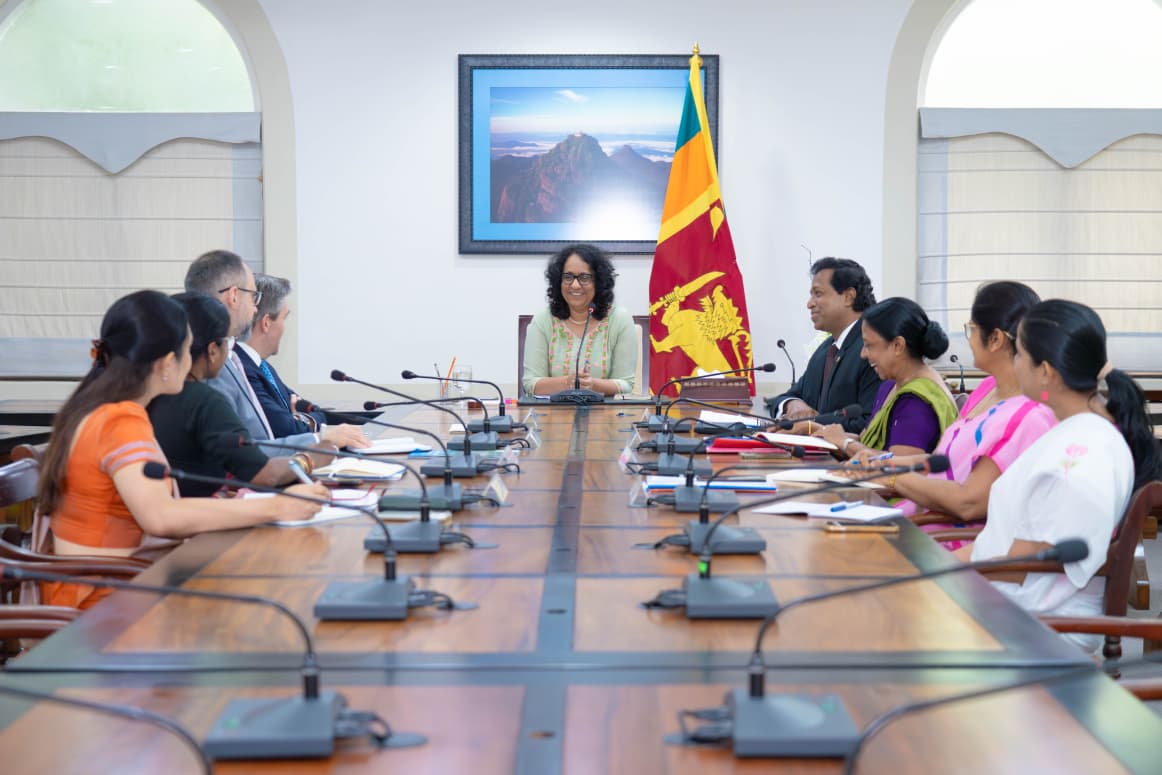
Prime Minister Dr. Harini Amarasuriya met with the United Nations Resident Coordinator in Sri Lanka, Marc-André Franche, at Temple Trees on Friday (29 May) to discuss post-Cyclone Ditwah recovery efforts and continued humanitarian cooperation between Sri Lanka and the United Nations.
Particular attention was drawn to the Humanitarian Priority Plan (HPP), launched in December 2025 to support communities affected by the cyclone. The initiative concluded on 30 April 2026 after providing humanitarian assistance to vulnerable populations across 25 districts through the collective efforts of 81 partner organizations.
The discussions highlighted the Government recognized the substantial international support mobilized through the HPP and noted the importance of sustained collaboration to ensure that recovery gains are maintained.
During the discussion the United Nations delegation formally presented the latest SRI LANKA Cyclone Ditwah Situation Report to the Prime Minister.
(Prime Minister’s Media Division)
Latest News
Further embrace the values of Buddhism founded upon non-violence, compassion and boundless loving-kindness towards all living beings – President
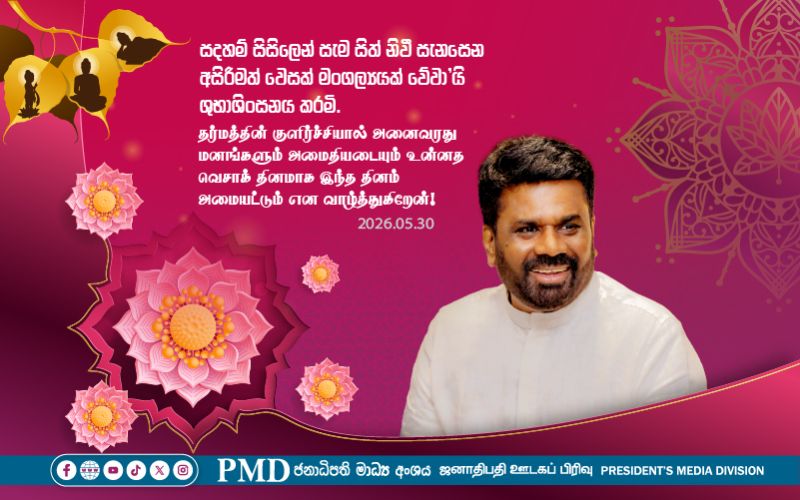
President Anura Kumara Dissanayake in his Vesak day message called upon all Sri Lankans to further embrace in their lives the values of Buddhism founded upon non-violence, compassion and boundless loving-kindness towards all living beings.
The full text of the Presidents message:
The Vesak festival, which commemorates the three pivotal milestones in the life of Lord Buddha: his birth, his attainment of enlightenment, and his passing (Nirvana), is the most sacred celebration for Buddhists across the world. The people of Sri Lanka, heirs to a proud culture enriched by Buddhist heritage, join Buddhists worldwide in devoutly observing this noble occasion.
Buddhism is the greatest philosophical teaching to have conveyed to the entire world a timeless and practical message of peace. The entirety of the Dhamma preached by the Gautama Buddha is founded upon the Four Sublime Virtues of loving-kindness, compassion, empathetic joy and equanimity.
Furthermore, peace, coexistence and reconciliation constitute the supreme teachings expounded not only by the Buddha but also by all enlightened teachers. Buddhism teaches that, in order to establish peace in the external world, inner spiritual peace within the individual must first be secured. We must recognise that this inward and peaceful approach, as advocated by Buddhism in guiding society towards collective noble objectives, is more relevant today than ever before. I believe that this was also the message brought to Sri Lanka recently by the Vietnamese monk Venerable Pannakara Thero, who undertook a pilgrimage on foot across the country.
Moreover, the celebration of Vesak is not merely a religious observance, but also a magnificent cultural festival that has, for thousands of years, reflected Sri Lankan identity, solidarity and artistic creativity. It is indisputable that the programmes organised alongside Vesak celebrations, giving prominence to acts of religious observance such as almsgiving, the observance of sil, meditation and Dhamma sermons, as well as the devotional offerings and festivities including dansals, Buddhist devotional songs, beautifully crafted lanterns and splendid pandals, greatly contribute towards fostering mutual understanding, reconciliation and coexistence among communities.
Inviting all people to further embrace in their lives the values of Buddhism founded upon non-violence, compassion and boundless loving-kindness towards all living beings, I extend my heartfelt wishes for a blessed Vesak festival in which all hearts may find peace, comfort and serenity through the soothing grace of the Dhamma.

Let us dispel the roots of greed, hatred, and delusion, and transform our lives into a nobel period that brings peace and serenity – PM

Prime Minister and United Nations Resident Coordinator discuss post-Ditwah recovery and humanitarian cooperation

Further embrace the values of Buddhism founded upon non-violence, compassion and boundless loving-kindness towards all living beings – President

Showers will occur at times in the Western, Sabaragamuwa and North-western provinces and in Galle, Matara, Kandy and Nuwara-Eliya districts

IMF urges Lanka not to meddle with exchange rate

Court orders arrest of Basil in Rs. 7.8m poll funds case

‘Dates have the highest sugar content to fight Coronavirus’

Sunday Island 27 December – Headlines

#SundayIsland 17th December – Headlines

Sunday Island – 28th March

Sunday Island Headlines – 21 March

Sunday Island – 21st February – Headlines
-

 News7 days ago
All-New GRAVITE launches at LKR 6.99 Mn
-
 Features7 days ago
The NPP’s pivot to the past
-
 News6 days ago
Police probe underway to ascertain links between criminals deported from UAE and local politicians
-
 News5 days ago
Easter Sunday carnage: Court told Maulana’s statement cannot be accepted without cross-examination
-
 Features7 days ago
End of Peacekeeping
-
 Opinion5 days ago
Undermining the democratic political framework
-
 News5 days ago
UK passport holder hiding here wants to have deportation order rescinded to leave without blemish
-
 Features2 days ago
The Division Bell Mystery