
Business
Gigalingua Lanka opens its doors to new opportunities for Sri Lankan nurses in Germany

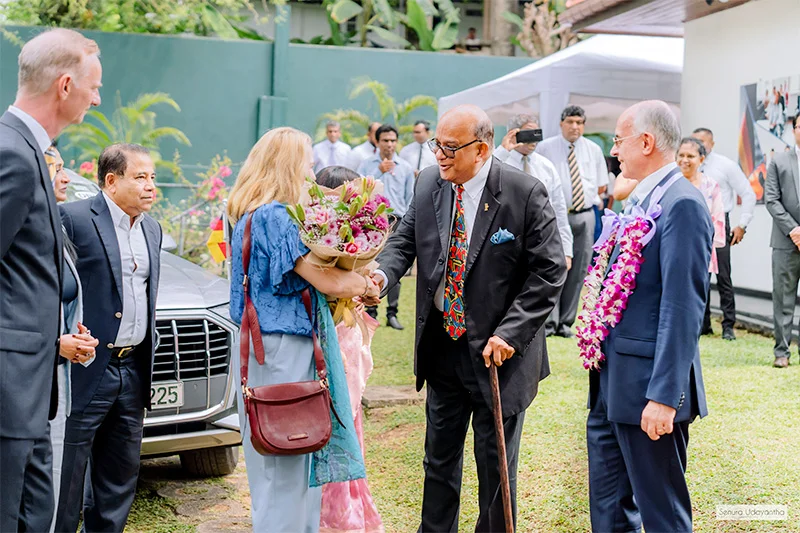
Gigalingua Lanka, a premier German language institute, officially launched in Colombo with a ribbon-cutting ceremony attended by distinguished guests, including Dr. Felix Neumann, German ambassador to Sri Lanka. This marks a significant milestone for Sri Lankan professionals, especially nurses, looking to expand their careers in Germany’s thriving healthcare sector.
In collaboration with its strategic partner Global Care Solutions (Pvt) Ltd – a renowned company in the foreign recruitment industry – Gigalingua Lanka offers a unique pathway for Sri Lankan nurses and apprentices to master the German language and pursue rewarding career opportunities in Germany.
Dr. Felix Neumann, the Chief Guest at the event, expressed his support for the initiative, emphasizing the importance of language education as a bridge to global career prospects. In his speech, Dr. Neumann noted, “German language is not only a means of communication, it is a gateway to global career opportunities.” He commended Gigalingua Lanka for providing valuable opportunities for Sri Lankans and addressing the critical demand for skilled workers, especially in the nursing sector in Germany.
Gigalingua Lanka is the first private institute in Sri Lanka to offer comprehensive German language training up to the B2 level, and conduct TELC exam. The institution also provides language training for apprentices, allowing them to undertake the Apprenticeship Program and contribute to the growing labor market in Germany. The collaboration between Gigalingua Lanka and Global Care Solutions is designed to meet Germany’s growing need for skilled workers, particularly in the healthcare sector.
The event was attended by a number of prominent figures, including Dr. Felix Neumann , Arthur Senanayake (chairman of IWS Holdings), Eran Wickramaratne – former MP, Chandra Schaffter – ( Founder of Janashakthi Insurance ), Dhammika Attygalle (Director Upali Group of Companies and President Automobile Association of Ceylon) Former Wing Commander Buwaneka Abeysuriya (Ex- chairman Janatha Estates Development Board).
Chairman of Global Care Solutions, Thomas Michael Kriwat, who is also chairman of the Mercmarine Group of Companies in Germany, highlighted the significance of the new training center. He said, “We are bringing world-class German occupational language training to Colombo, offering a structured, career-focused pathway for Sri Lankan professionals. By introducing TELC (The European Language Certificates) as an officially certified German language test authority, we are increasing accessibility for students seeking internationally recognized qualifications.”
At the thanksgiving speech, Dr. Rajan Sara, Managing Director of Global Care Solutions and Director of Gigalingua Lanka, outlined the critical need for foreign nurses in Germany. “Germany is facing a significant shortage of nurses, estimated to need an additional 150,000 by 2025. This is exacerbated by an aging population and increasing healthcare demands. Over 47,000 vacancies in the healthcare sector remain unfilled, making it an ideal time for Sri Lankan nurses to seize this opportunity,” Dr. Sara explained. (Gigalingua Lanka)

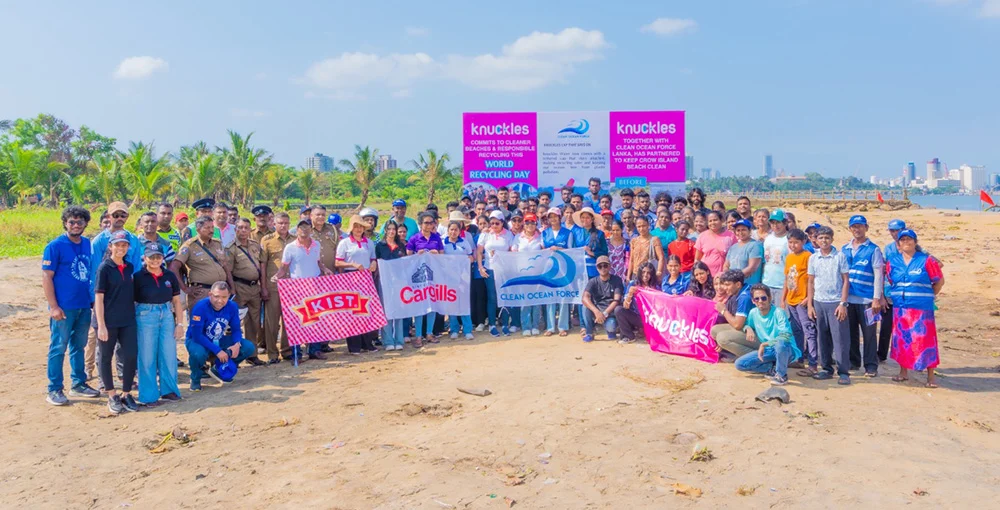
Cargills Food and Beverage Ltd. through its brands KIST and Knuckles, has signed a Memorandum of Understanding (MoU) with Clean Ocean Force Lanka (COF) to adopt Crow Island Beach for one year, reinforcing its commitment to long-term coastal conservation in Sri Lanka.
This pioneering initiative is designed to protect and preserve the coastal environment through several key measures, including the removal of plastic and other pollutants from the beach and surrounding coastal area. As part of the adoption programme, the beach will be maintained daily with the support of dedicated beach caretakers, while also supporting their livelihoods by providing meaningful income opportunities.
Marking the partnership and in celebration of World Recycling Day, a coastal clean-up programme was conducted at Crow Island Beach to remove plastic and other manmade pollutants. Volunteers from Cargills, Clean Ocean Force Lanka, the Interact Club of Colombo, the Colombo Municipal Council and the Women’s Force of COF Negombo (Sri Vimukthi Association) participated in the clean-up with support from the Marine Environment Protection Authority (MEPA), the Sri Lanka Police Environmental Division and the Ministry of Local Government and Environment as well as the Crow Island Beach Park Society.
Jerome Fernando, Chairman & Co-founder of Clean Ocean Force Lanka said that, “Marine & Coast Conservation demands a unified front. Our unique Public-Private-People Partnership model is the cornerstone of our mission, and today, we are thrilled to welcome Cargills (Ceylon) PLC as a vital partner in this journey adopting the Crow Island Beach for the next one year. This collaboration will not only amplify our efforts to eliminate plastic and manmade pollutants from our beaches, but also reinforce our commitment to empowering marginalized communities through sustainable livelihood opportunities. Cargills’ deep-rooted dedication to environmental sustainability and community wellbeing perfectly aligns with our vision.”
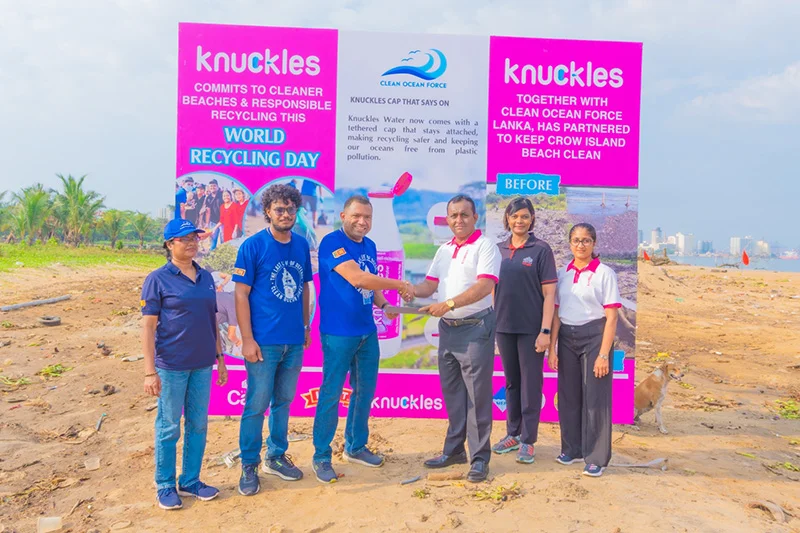
Jagath Gunasekara, General Manager of MEPA added, “The Marine Environment Protection Authority consistently promotes active private sector engagement in marine and coastal conservation, as well as pollution control initiatives. This approach aligns closely with our Beach Caretaker Programme. We are pleased to collaborate with Cargills (Ceylon) PLC in the adoption of Crow Island Beach through our long-standing partnership with Clean Ocean Force Lanka.”
During the event, Knuckles also launched Sri Lanka’s first tethered bottle cap, introducing a packaging innovation aimed at improving plastic waste management and supporting recycling efforts. The tethered cap is designed to remain attached to the bottle after opening, reducing the likelihood of caps being discarded separately. Bottle caps are among the most commonly littered plastic items globally and frequently enter landfills and waterways due to their small size and low collection rates.
Speaking on the initiative, Arjuna Kumarasinghe, Managing Director of Cargills Food & Beverage Ltd., said, “Cargills has always believed in taking responsibility for the communities and environments around us. By adopting Crow Island Beach, we’re able to work closely with our partners and local volunteers to protect this part of our coastline. Launching the tethered bottle cap is another way we’re addressing plastic waste and making recycling easier for everyone.”

The Central Bank is keeping its overnight policy rates unchanged, adopting a cautious stance amid uncertainty over the inflationary impact of energy prices due to the Middle East crisis.
‘We maintained the overnight policy rate at 7.75 percent, considering low inflation and a restrained approach on the fallout of the US-Israeli war on Iran, Central Bank Governor Dr Nandalal Weerasinghe said.
The Governor made these remarks yesterday at a press briefing held at the Central Bank head office in Colombo to announce the monthly monetary policy stance.
Dr Weerasinghe added: ‘Inflation is now expected to reach the Central Bank’s target of 5 percent in the second quarter of 2026, after Sri Lanka raised fuel prices by about 35 percent this month.
‘However, spillovers from the ongoing conflict could weigh on domestic economic activity in the period ahead should the conflict be prolonged.
‘The rates were steady since last May as the nation recovers from a 2022 financial crisis driven by a severe dollar shortage.
‘Supported by a US$ 2.9 billion programme with the IMF, Sri Lanka posted a strong economic recovery last year, growing by 5 percent and now targeting growth between 4 percent and 5 per cent in 2026.
‘What stands out is that they see space for inflation to rise because of energy prices but still stay contained.
‘From now to June, underlying economic momentum has the space to keep pace despite the disruption because domestic liquidity and credit has been quite substantial as well.
‘An IMF team will arrive in Colombo on Friday for the combined fifth and sixth reviews of the bailout.
‘Furthermore, Gross Official Reserves increased to US$ 7.3 billion at end February 2026 and the Central Bank purchased a substantial amount of foreign exchange from the market in the first two months of the year.
‘However, the ongoing conflict in the Middle East poses risks to Sri Lanka’s external sector outlook, particularly through energy, tourism, trade and remittance flows, although the overall magnitude of the impact remains uncertain.
‘While the Sri Lanka rupee remained relatively stable in early 2026, some depreciation pressures were observed following the onset of the Middle East conflict, similar to the exchange rates of regional peers.
‘Meanwhile, the Monetary Policy Board remains prepared to implement appropriate policy measures to ensure that inflation stabilizes around the target, while supporting the economy to reach its potential.’
By Hiran H Senewiratne

Dialog Television, Sri Lanka’s #1 Pay-TV service provider, has announced the latest upgrade to its smart entertainment lineup with the Dialog Play Mini, featuring seamless access to global streaming platforms including Netflix, Apple TV and YouTube, alongside the Dialog Play entertainment ecosystem for a unified viewing experience. Previously known as the ViU Mini, the device has now been reintroduced as the Dialog Play Mini, reflecting the evolution of Dialog’s digital entertainment platform under the Dialog Play brand.
The Dialog Play Mini transforms any television into a smart 4K entertainment hub by enabling hybrid multi-platform streaming across leading global and local content platforms, delivering a smoother, more intuitive viewing experience. Whether enjoying Netflix originals, Apple TV exclusives, or local favorites, households can now experience world-class entertainment in one compact device.
The Dialog Play Mini brings a streamlined, user-friendly experience to any home setup. Its single numeric-keypad remote controls both the TV and the device, offering simplicity and convenience for everyday viewing. With multiple connectivity options including Wi-Fi, hotspot, LAN, or wingle, the device ensures uninterrupted entertainment even in areas without smart TVs or advanced broadband setups.
Bridging the gap between entry-level set-top boxes and premium Android TV devices, the Dialog Play Mini offers a plug-and-play smart experience. Supported by Dialog’s nationwide service network, local warranty, and after-sales care, it delivers a reliable, feature-rich entertainment experience for Sri Lankan homes.
“With Dialog Play Mini, entertainment becomes more directly accessible for every Sri Lankan home – with or without a Smart TV,” said Lim Li San, Group Chief Operating Officer of Dialog Axiata PLC. “By bringing Netflix, Apple TV, YouTube, and Dialog Play together in one compact 4K-ready device, we’re redefining home entertainment through simplicity, innovation, and the power of connectivity.”
The Dialog Play Mini is now available at Dialog Experience Centers and authorized retailers islandwide. To purchase online, please visit
https://dialog.lk/dialog-play-mini

A strong Technical and Vocational Education and Training (TVET) system equips individuals with practical, relevant, and future-oriented skills helping to innovate responsibly towards a greener and sustainable future – PM

PM reviews progress of the committee appointed for the establishment of a National Nursing University

UN votes to recognise enslavement of Africans as ‘gravest crime against humanity’

Meta and YouTube found liable in landmark social media addiction trial

Showers expected in the Western and Sabaragamuwa provinces and in Galle and Matara districts after 2.00 pm.

Heat Index at ‘Caution level’ in the Western, Sabaragamuwa, Southern and North-western provinces and in Anuradhapura, Mannar, Vavuniya and Monaragala districts

‘Dates have the highest sugar content to fight Coronavirus’

Sunday Island 27 December – Headlines

#SundayIsland 17th December – Headlines

Sunday Island – 28th March

Sunday Island Headlines – 21 March

Sunday Island – 21st February – Headlines
-

 News2 days ago
Senior citizens above 70 years to receive March allowances on Thursday (26)
-

 Features4 days ago
Trincomalee oil tank farm: An engineering marvel
-

 News7 days ago
CIABOC tells court Kapila gave Rs 60 mn to MR and Rs. 20 mn to Priyankara
-

 Features4 days ago
The scientist who was finally heard
-
 Features7 days ago
Science and diplomacy in a changing world
-
 News2 days ago
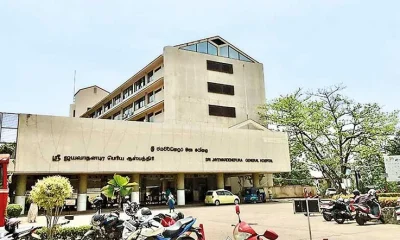
Japanese boost to Sri J’pura Hospital, an outright gift from Tokyo during JRJ rule
-

 News2 days ago
CEB Engineers warn public to be prepared for power cuts after New Year
-

 News6 days ago
Colombo, Oslo steps up efforts to strengthen bilateral cooperation in key environmental priority areas