
News
Gevindu underscores need for 20 A pending new Constitution

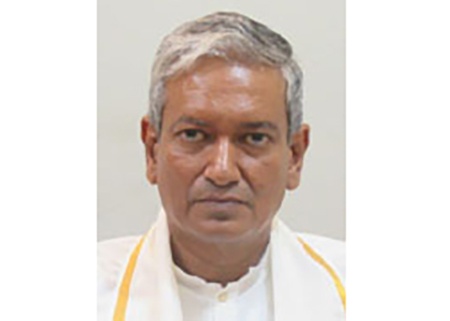
…discusses merits, demerits et al
By Shamindra Ferdinando
SLPP National List lawmaker Gevindu Cumaratunga says the 20th Amendment to the Constitution enacted last month is required to rectify weakening of the State by the 19th Amendment. Alleging that the 19th Amendment had been introduced in 2015 with an overwhelming majority primarily to achieve three objectives namely (I) remove the Rajapaksas from politics (II) provide executive powers to the then Prime Minister Ranil Wickremesinghe and (III) weaken the Sri Lankan State by depriving the executive of the previously enjoyed power.
In a brief interview with The Island, MP Cumaratunga, who is also the leader of the civil society organization Yuthukama, said that the despicable political project had been largely defeated. Those who had conspired to provide executive powers to the Premier at the expense of the President through the 19th Amendment were politically irrelevant today, the lawmaker pointed out.
Having reversed the UNP spearheaded strategy with the successful conclusion of 2019 presidential and 2020 parliamentary polls, the government had now done away with measures to weaken the State, the MP said.
Cumaratunga said that he discussed those issues on the second day of the debate on the 20th Amendment on Oct 22. The parliament provided the required 2/3 majority for the Amendment. Speaker Mahinda Yapa Abeywardena signed it into law on Oct 29.
Cumaratunga underscored the pivotal importance of correctly recognizing the objectives of the 19th Amendment and the challenges faced by the 20th Amendment.
“The 19th Amendment was brought into achieve sinister external objectives. The 20th Amendment was proposed to defeat that project jointly implemented by foreign powers and their local agents. If they succeeded in their high profile project to introduce a new constitution to their liking spearheaded by UNP leader Wickremesinghe, we would have ended up in total chaos with permanent foreign military presence and the country being a supply base for Western powers.”
The 19th Amendment was nothing but a dangerous constitutional tool that could have caused anarchy at every level, the newcomer to parliamentary politics alleged. In addition to NL member Cumaratunga, another key Yuthukama activist Anupa Pasquel was elected from the Kalutara district on the SLPP ticket at the August poll.
Cumaratunga explained how the conspirators included worthy sections to hide their real intentions. The MP alleged that their strategy had been quite efficient and useful from their point of view as the public were largely deceived. Cumaratunga said that nationalist groups, including Yuthukama wholeheartedly accepted many clauses which they sincerely believed were in the public interests.
Cumaratunga appreciated the restriction of the number of cabinet ministers and non-cabinet ministers to prevent political horse trading. This thwarted political parties from exploiting instability in parliament for their advantage, the MP said. “We also accepted the provision in the 19th Amendment to prevent the party in power to bring in emergency Bills, constitutional changes,” Cumaratunga said, recalling how the then President JRJ brought in the 13th Amendment to appease India and the 15 Amendment introduced by slain President Ranasinghe Premadasa to placate religious minorities. MP Cumaratunga alleged that the 19th Amendment included a clause prohibiting emergency amendments/Bills in a bid to hide their sinister intentions. The right of the public to challenge new laws in the Supreme Court should not be interfered with in any way, lawmaker Cumaratunga said.
Yuthukama
Chief alleged that additional measures were introduced by way of the 19th Amendment to strengthen the State auditing process in a cunning bid to divert the attention from selling vital state assets. While strengthening the hands of the Auditor General, the yahapalana administration perpetrated Treasury bond scams twice, the second in March 2016 far bigger than the first in late Feb 2015, MP Cumaratunga said. Responding to another query, Cumaratunga asserted that the handing over of Hambantota port on a 99-year-lease to China in 2017 exposed the previous government.
Cumaratunga appreciated President Gotabaya Rajapaksa and Premier Mahinda Rajapaksa effecting a spate of changes following representations made by the Maha Sangha and them once the 20 th Amendment was unveiled.
Cumaratunga said that the 20th Amendment faced the daunting challenge of reversing the 19th but the entire 78 Constitution as well as a series of amendments meant to protect the interests of political parties and their leaders.
Commenting on Manohara de Silva’s examination of strategies adopted by separatist elements, lawmaker Cumaratunga pointed out almost all amendments introduced after the 13th Amendment sought to pacify those promoting separatist ideology. The MP explained a campaign undertaken by Yuthukama soon after the enactment of the 19th Amendment in 2015 and the need to bring in 20th Amendment until consensus could be reached on a new Constitution.
A 9-member committee headed by Romesh de Silva, PC, is formulating a new Constitution.
Lawmaker Cumaratunga, in his speech delivered in parliament on Oct 22 pointed out the absurdity in following the Indian ‘system’ in introducing the 13th Amendment to the Constitution. Cumaratunga highlighted the introduction of a term (Railway Areas) in keeping with the Indian Constitution regardless of no such designated area in Sri Lanka.
Commending the government decision to expand the number of members of the Election Commission from present three to five, MP Cumaratunga said that their earnest wish is to bring in a new Constitution before President Gotabaya Rajapaksa begins his second year in Nov 2021. Cumaratunga said that Yuuthukama found seven sections in the original 20th Amendment wholly unacceptable. Among them was a bid to promote separatist ideology as well as to do away with the provision to subject the Office of the President and the Prime Minister to the State auditing process.
Yuthukama
leader acknowledged that all their proposals hadn’t been accepted including the one in respect of checks and balances among the President, the Prime Minister and the Parliament though the required was met to a certain extent by the President receiving the constitution right to dissolve parliament two and half years after the first sitting.
Appreciating the formulation of a Parliamentary Council in respect of the appointment of judges to higher courts, members of Commissions, including their chairmen, Attorney General and IGP instead of the previous Constitution Council that followed the NGO agenda, MP Cumaratunga said that the President’s prerogative regarding the appointment of the AG and the IGP was important. However, the MP acknowledged that the Parliamentary Council role in merely making observations needs to be resolved. Cumaratunga appealed to President Gotabaya Rajapaksa to make appointments taking into consideration recommendations/observations of the Parliamentary Council. The lawmaker also emphasized the importance of the Speaker’s role in the proposed mechanism for the President to receive recommendations/observations of the five-member Parliamentary Council. Cumaratunga said that the proposed mechanisms should be subjected to the Speaker’s approval; as such a decision should be made available to the parliament as it would ensure the intervention of the House in the matter.



Former first lady Shiranthi Rajapaksa, wife of former President Mahinda Rajapaksa was produced before the Hulftsdorp court, after being arrested by officers of the Commission to Investigate Allegations of Bribery or Corruption (CIABOC) and produce
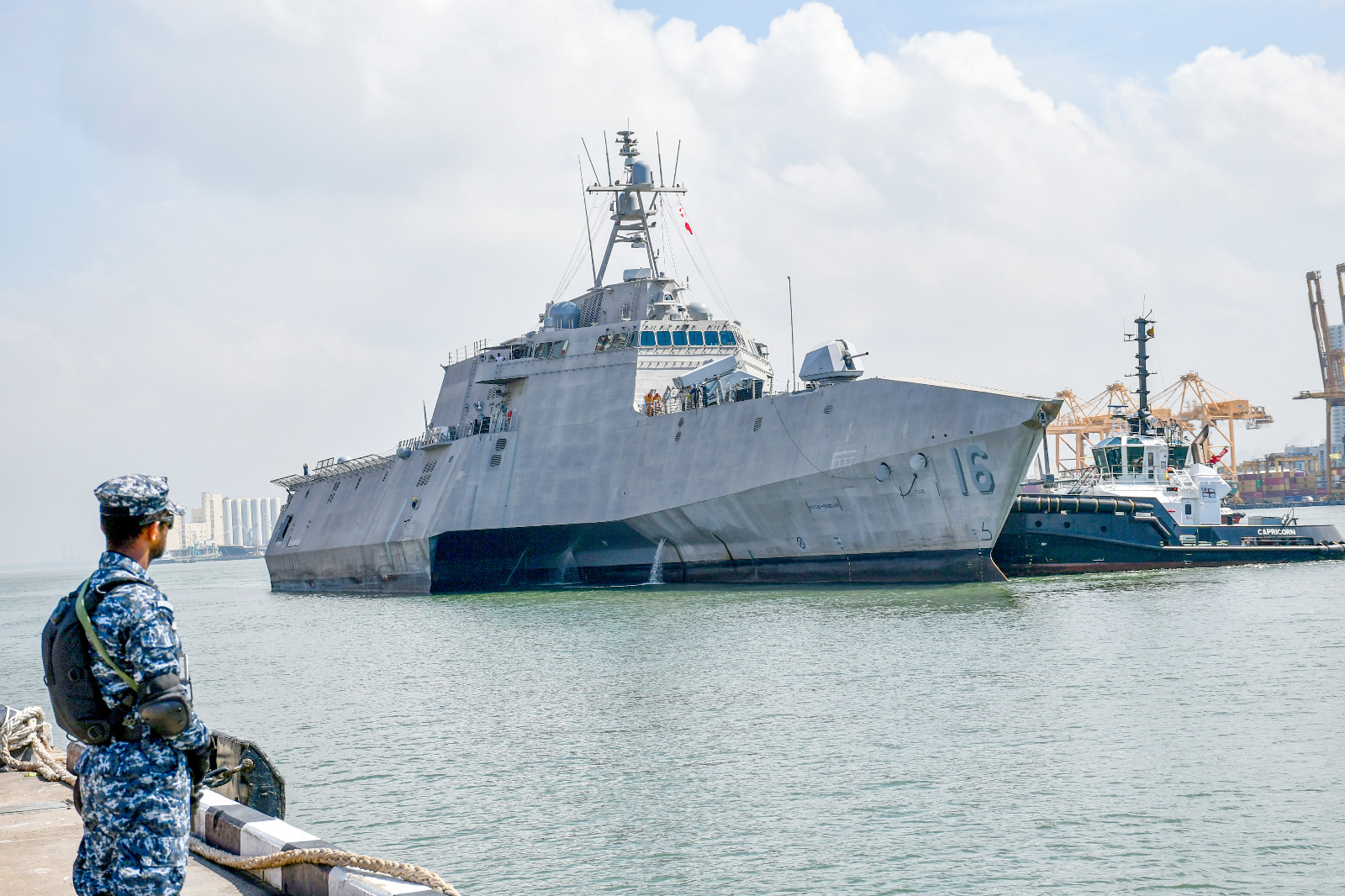
The U.S. Navy ship USS Tulsa (LCS 16) arrived at the Port of Colombo this morning, 7 October 2026 for replenishment purposes.
The visiting ship was welcomed by the Sri Lanka Navy in accordance with naval traditions.
The 127.7-metre-long platform is a Littoral Combat Ship commanded by Commander BM Wanier. Commissioned on 16 February 2019, USS Tulsa has since been in service with the US Navy.
The ship previously made a port call in Sri Lanka on 27 August 2025.
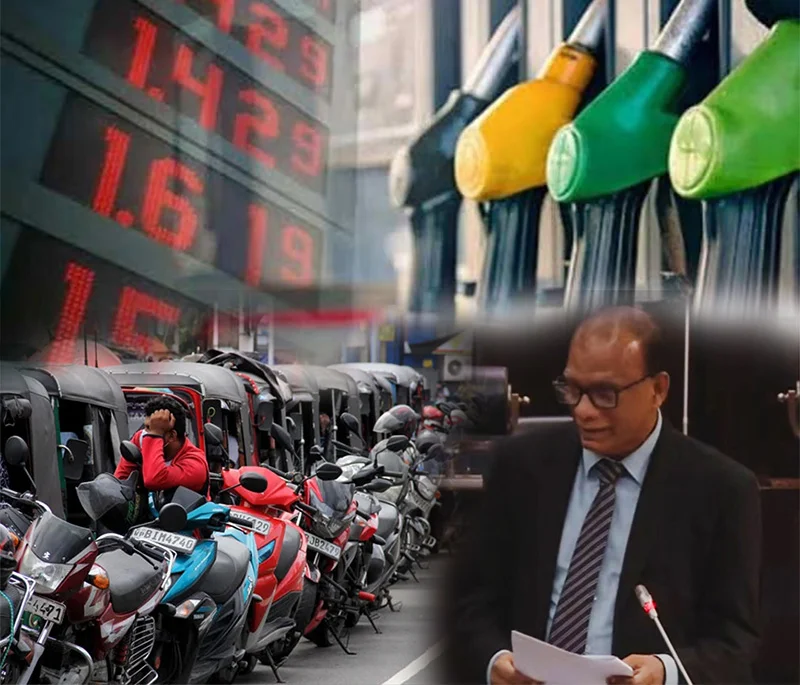
Govt. tells fuel distributors to maintain stocks to ensure uninterrupted supplies
by Saman Indrajith and Norman Palihawadane
The government had instructed private fuel distributors to maintain minimum stocks and ensure uninterrupted supplies to the market, Energy Minister Anura Karunathilaka told Parliament yesterday (06).
Karunathilaka said the Ministry of Energy Secretary had notified the relevant companies of the requirement, following a reduction in supplies by some private distributors, amid higher international fuel prices.
The Minister said private companies had informed the government that they were facing losses because international prices had risen while fuel was being sold, locally, at prevailing prices. As a result, some companies had reduced the volumes released to the market.
The reduced supplies had increased the burden on the Ceylon Petroleum Corporation (CPC), whose share of the diesel market had risen from about 54% to 82%, the Minister said.
“The CPC currently holds an 82% share of the market,” he said, adding that it had increased its supplies, compared with February, to compensate for the reduction by private distributors.
Karunathilaka said the government could not, under the existing agreements with private companies, specify the quantities they should supply to individual filling stations. However, it could require them to maintain minimum stocks in the country.
The Minister said the Energy Ministry had already instructed companies that had failed to maintain the required stocks to take steps to prevent supply disruptions.
The Minister attributed the queues reported at some filling stations to reduced supplies from private distributors, as well as normal variations in fuel distribution. He also said demand for CPC fuel had increased because private companies generally did not provide fuel to dealers on credit, while the CPC offered a three-day credit facility.
“We expect that, as the Ceylon Petroleum Corporation takes on this additional burden, the problem will ease to some extent by Wednesday or Thursday,” Karunathilaka said.
He said instructions had also been issued to increase supplies to CPC filling stations. A special discussion on the issue is scheduled for today (07), with officials of the Energy Ministry and CPC expected to participate,
along with President Anura Kumara Dissanayake.
Meanwhile, Petroleum Dealers’ Association officials have called for an early solution to the supply issue. Association Chairman D.V. Shantha Silva said queues had been reported at many filling stations, mainly those operated by private distributors.
He said the situation was not due to an overall shortage of fuel, but was linked to reduced orders by Lanka IOC, Sinopec and R.M. Parks amid concerns over losses incurred on fuel sales.
The Ceylon Petroleum Private Tanker Owners Association has urged motorists to refrain from panic buying, saying there was no nationwide disruption to fuel supplies.
The government earlier increased fuel prices and introduced a per-litre diesel subsidy following concerns raised by distributors over rising international prices.

Former first lady Shiranthi Rajapaksa arrested by CIABOC

U.S. Navy ship USS Tulsa arrives in Colombo for replenishment visit

Smriti Mandhana appointed India captain across formats

Ronaldo apologizes for Portugal walkout; says Jesus broke promise

Showers in the Western, Sabaragamuwa, Central, Uva, North-western and Southern provinces and in Anuradhapura and Mannar districts

Fuel crunch looms

‘Dates have the highest sugar content to fight Coronavirus’

Sunday Island 27 December – Headlines

#SundayIsland 17th December – Headlines

Sunday Island – 28th March

Sunday Island Headlines – 21 March

Sunday Island – 21st February – Headlines
-

 News7 days ago
US-assisted ‘Ice’ detection: NPC to examine IGP’s move to transfer drug-busting team
-

 Editorial6 days ago
Colombo Port drug bust: The plot thickens
-

 Editorial7 days ago
Drug busting, transfers and trust deficit
-

 Features4 days ago
The first woman in the foreign service or Ceylon Overseas Service it was then called
-
 News7 days ago
Sri Lankan facing death penalty in Saudi Arabia: Mano G appeals to Crown Prince
-

 Editorial5 days ago
Fuelling discontent and protest
-

 News3 days ago
Geneva takes up Sallay’s case and govt. ignores opportunity to answer accusations
-

 Latest News5 days ago
Tharindu Rathnayake, bowlers secure Asian Games Bronze for Sri Lanka