
News
Geneva urged not to accept GoSL excuses based on current economic difficulties

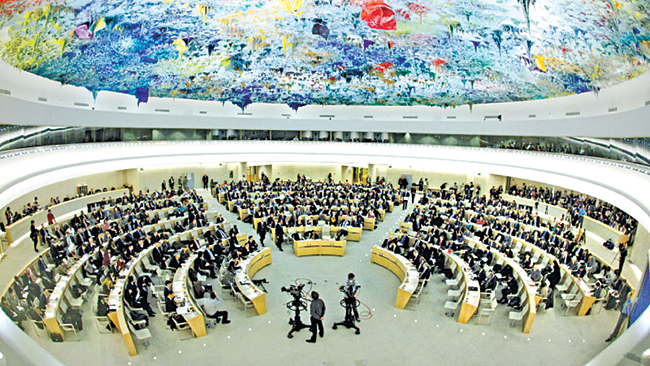
The UK based Global Tamil Forum (GTF) has called, for what it says is a well-targeted UNHRC resolution on Sri Lanka at the forthcoming Geneva sessions. The grouping stressed that the incumbent government shouldn’t be allowed to justify its failure to address the grievances of the Tamil-speaking community, on the basis of the current economic difficulties.
The following is the text of the statement issued by the GTF: ” The GTF welcomes the delisting of various Tamil diaspora organisations, and individuals, as an important step towards achieving improved ethnic relations and economic outcomes in Sri Lanka. However, it is disappointing that many Tamil and Muslim organisations, and individuals, are still on the updated list, gazetted on August 1, 2022. GTF calls on the Sri Lankan government to discontinue this shambolic process of listing and delisting entities to suit the political agenda of the time.
The entire process of publishing a list of designated entities and individuals, by the Sri Lankan government, is arbitrary, irrational, and an outright abuse of the United Nations Regulation (Regulation 4(7) of the UN Regulations No. 1 of 2012). From 2014, it was misused by the government to suppress freedom of speech and dissent and intimidate human rights defenders – not just within Sri Lanka but also overseas.
This is best illustrated with GTF – an organisation formed after the end of war, in 2009, to play a constructive role in promoting peace, justice, equality, and reconciliation in Sri Lanka. While promoting wartime accountability, including at the UNHRC, GTF has maintained high level engagement with all stakeholders in Sri Lanka, including politicians, civil society activists and media personnel, with the intention of working towards a durable political solution acceptable to all communities. GTF was also involved in targeted activities related to rehabilitation, medical emergencies and development initiatives in many regions and communities across Sri Lanka.
Despite its notable openness, transparency, and international recognition, and remaining unchanged in its philosophy and approach, GTF found itself in and out of the ‘list’ twice – listed in 2014, delisted in 2015, re-listed in 2021 and delisted in 2022.
GTF is grateful that the international community, and many Sri Lankan stakeholders (including the media), ignored this listing for what it truly is. In fact, our diplomatic engagements, including the crucial meetings in the US in November 2021 and March 2022, also meeting with the Minister of State for the Commonwealth and United Nations, and South Asia at the Foreign, Commonwealth and Development Office (FCDO) and various other important engagements, including the United Nations (UN), were not affected by the listing, but the ban’s impact on reconciliation, rehabilitation and economic progress in Sri Lanka was significant.
There is no doubt the timing of the recent delisting is to bolster Sri Lanka’s credentials as its human rights record is about to be reviewed at the UNHRC next month for the eighth time since the war ended in 2009. This action only confirms the time-tested pattern of Sri Lanka doing the bare minimum just in time for the next UNHRC session – and presents an eloquent argument for increased international scrutiny over Sri Lanka’s human rights and governance record.
The UNHRC session of September 2022 is hugely important for the Tamil people and indeed for the entire country to move forward. Sri Lanka’s record on implementing the key aspects of the UNHRC resolutions since 2012 (the last one passed in March 2021) is truly appalling. Despite few token initiatives, such as the establishment of the Office of the Missing Persons and the Office for Reparations, the country is yet to make any meaningful progress that would provide effective relief, justice, and closure for those directly impacted by the war. Further, some of the high-handed measures being taken against the protesters who agitated for progressive changes are deeply concerning. All of these call for increased international oversight of the human rights situation in Sri Lanka.
The nascent transformation Sri Lanka presently undergoing is significant. The successful protests that deposed Gotabaya Rajapaka’s is presidency has created an environment where an unaccountable government will be under increased scrutiny. In addition to wartime accountability, legal, financial, and other governance accountabilities are also under intense focus. This emerging trend needs to be conscientiously promoted by the international community, which is possible only with the adoption of a well-targeted UNHRC resolution. The new resolution needs to build on the key aspects of the March 2021 UNHRC resolution (A/HRC/RES/46/1) which empowered the High Commissioner’s Office to further advance wartime accountability.
Any argument Sri Lanka may put forward leveraging its economic difficulties for lowering the international scrutiny of its human rights record – as attempted by Sri Lanka during the UNHRC session in March 2022 – has no legal, moral, or political basis. The struggle for justice, rule of law, human rights and accountability could be strengthened by the UNHRC taking a principled stance at the Council’s upcoming 51st Session.”



President Anura Kumara Dissanayake called on the Atamasthanadhipathi, Chief Sanghanayake of Nuwara Kalaviya, Most Venerable Pallegama Hemarathana Nayake Thero, this morning (07) for a brief discussion.
During the meeting, the President apprised the Thero of the measures being implemented by the government to provide relief to the affected people and to restore normalcy in their daily lives.
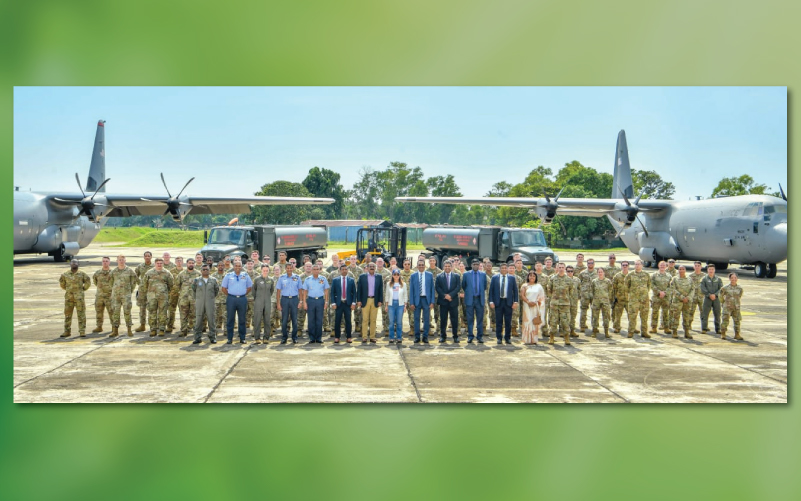
The United States has extended humanitarian assistance to Sri Lanka to support nationwide relief efforts in the aftermath of Cyclone Ditwah, which caused severe damage across multiple regions of Sri Lanka.
The latest round of assistance, included the deployment of two C-130J Super Hercules aircraft, equipment and US Air Force personnel. The US contingent will provide vital transportation and logistics support in areas identified by the Disaster Management Centre.
A formal handover took place this afternoon (07) at the Bandaranaike International Airport (BIA) with the support officially received on behalf of the Sri Lankan government by Minister of Science and Technology Prof. Chrishantha Abeysena, Deputy Minister of Ports and Civil Aviation, Janitha Ruwan Kodithuwakku and Deputy Minister of Defence Maj. Gen. Aruna Jayasekara (Rtd).
The assistance was presented by the United States through Julie Chung, Ambassador of the United States to Sri Lanka, and Lt. Col. Van Pinxteren of the United States Air Force.
As part of the support package, the United States contingent will provide logistics capacities needed to transport humanitarian supplies to affected communities in the Northern, Eastern and Central regions.
Sri Lankan officials expressed their gratitude for the timely support, which will bolster ongoing national efforts to reach displaced families and restore essential services in cyclone-affected areas.

President Anura Kumara Dissanayake instructed officials to prepare the farmers in the Anuradhapura District whose paddy cultivation was destroyed due to floods to re-cultivate during the upcoming Maha season.
Highlighting the need for all relevant institutions to work in proper coordination, treating this as a national necessity, the President instructed the authorities to provide compensation to farmers without delay and to ensure temporary irrigation water supply through provisional repairs.
The President further noted that the government is providing the highest amount of compensation in the country’s history for crop damages, with the expectation that cultivation activities will be commenced again promptly.
President Anura Kumara Dissanayake gave these instructions this morning (07) while attending a special coordination committee meeting at the Anuradhapura District Secretariat to review the programme being implemented to restore normalcy to the lives of people affected by the disaster situation and to rehabilitate damaged infrastructure in the district.
The President instructed officials to present, before this Friday, a report detailing the number of farmers who were completely affected, the extent of damaged farmland and the required financial allocations. He emphasised that compensation must be granted only to those who are genuinely entitled and that no one should receive it unjustly.
The President stated that the government is committed to providing compensation to the farming community and directed officials to foster confidence among farmers so that they will be encouraged to resume cultivation.
The President also inquired, separately, from the relevant institutions about the measures taken for the development of the district’s infrastructure including highways, irrigation and communication networks.
The President examined the programme for reopening obstructed roads and instructed that temporary repairs be expedited to meet the public’s transportation needs until permanent road development plans are implemented.
Officials of the Ceylon Electricity Board informed the meeting that 473 out of the 580 electricity transformers damaged due to the disaster have already been restored and that full electricity supply to the district could be achieved by tomorrow.
They further stated that 49,000 water connections had been affected, of which about 99% have now been restored, while water is being supplied by bowsers to the remaining areas. They noted that total restoration of water supply is expected within the next two days. Damaged community water projects are also being restored.
Well-cleaning activities are currently being carried out with the support of the Navy and the President instructed officials to complete these tasks swiftly through community participation coordinated by Divisional Secretariats.
Discussions were also held regarding the provision of compensation for crops such as Maize, restarting cultivation, restoring the livelihoods of those engaged in animal husbandry, normalising health services and rehabilitating religious sites including damaged temples.
The floods have caused total damage to 228 houses in the district. The President instructed officials to gather accurate information on whether affected families should be resettled on the same land or relocated elsewhere and to begin identifying suitable land for resettlement.
Officials reported that all schools in the district could reopen by 16 December. The President instructed that the Rs. 15,000 allowance promised by the Treasury for schoolchildren affected by the disaster be fully distributed before 31 December and that the list of beneficiaries be prepared without delay.
The President also expressed his gratitude to government officials, the Police and the Tri-Forces for their service in providing relief to the public and restoring infrastructure.
The meeting was attended by Co-Chair of the Anuradhapura District Development Committee, Minister of Trade, Commerce, Food Security and Cooperative Development Wasantha Samarasinghe, Minister of Housing, Construction and Water Supply Susil Ranasinghe , Anuradhapura District MPs Susantha Kumara Navaratna and Sena Nanayakkara, North Central Province Governor Wasantha Jinadasa, Chief Secretary J.M.R.P. Jayasinghe, representatives of local authorities; Secretary to the Treasury Dr Harshana Suriyapperuma, Anuradhapura District Secretary K.G.R. Wimalasuriya, ministry secretaries and other government officials.

President calls on Atamasthanadipathi Thero

US deploys two C-130J Super Hercules aircraft and personnel to assist in relief measures

Government prepares Anuradhapura farmers for Maha Season

Level III landslide warnings issued to the Districts of Kandy, Kegalle, Kurunegala and Matale extended till 1600 hrs on Monday [08]

A mechanism that goes beyond the normal state apparatus is needed to restore public life – President

President calls on the Mahanayake Thera of the Asgiri chapter

‘Dates have the highest sugar content to fight Coronavirus’

Sunday Island 27 December – Headlines

#SundayIsland 17th December – Headlines

Sunday Island – 28th March

Sunday Island Headlines – 21 March

Sunday Island – 21st February – Headlines
-
News5 days ago
Lunuwila tragedy not caused by those videoing Bell 212: SLAF
-
 News4 days ago
Level III landslide early warning continue to be in force in the districts of Kandy, Kegalle, Kurunegala and Matale
-
 Latest News6 days ago
Level III landslide early warnings issued to the districts of Badulla, Kandy, Kegalle, Kurunegala, Matale and Nuwara-Eliya
-
 Features6 days ago
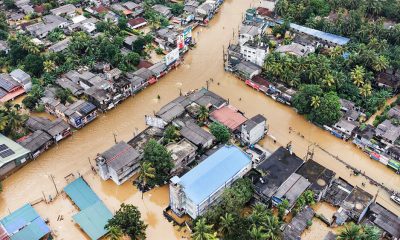
Ditwah: An unusual cyclone
-

 Latest News7 days ago
Updated Payment Instructions for Disaster Relief Contributions
-

 News2 days ago
CPC delegation meets JVP for talks on disaster response
-

 Business2 days ago
LOLC Finance Factoring powers business growth
-

 News2 days ago
A 6th Year Accolade: The Eternal Opulence of My Fair Lady