
News
General election: GTF discourages voters from backing major parties…

…warns of authoritarian rule
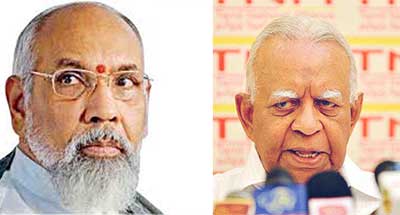
The UK headquartered Global Tamil Forum (GTF), which has been working closely with Tamil National Alliance (TNA), has urged the Tamils to vote for those only contesting the northern and eastern regions. In addition to the TNA, the Thamizhi Makkal Tesiya Kootani or the Tamil People’’s National Alliance led by former Northern Province CM C.V. Wigneswaran are in the fray in the former war zones.
The GTF, in a statement issued yesterday said: “First and foremost, ensure that people appreciate the significance of this election and the power of their vote – every vote matters. Second, no vote should be wasted on the multitude of independent groups and those representing countrywide parties, as these could only dilute the strength of the Tamil representation for future political engagements. Overly unrealistic agenda and an inward-looking insular political strategy is not the most suited in the present circumstances. The question for the Tamil voters is among the parties that represent Tamil national interest, which party and candidates are the best suited to navigate Tamil politics through the turbulent times ahead.”
The GTF urged all citizens of Sri Lanka, including those from Tamil and Muslim communities, to view the election with long-term perspective and exercise their franchise prudently and responsibly. Otherwise, the price of apathy could be too high.
The GTF alleged the election was being held amidst authoritarian presidential rule through decrees and task forces, key civilian functions entrusted to serving and retired military officers (some of whom credibly implicated in serious human rights violations), an atmosphere of intimidation and fear leading to media self-censorship and silencing of civil society activists, and insecurity among the minority communities.
The GTF said: “It is in this atmosphere that Rajapaksas are seeking 2/3rd majority to change the constitution, in particular, to abolish the 19th Amendment. It is not difficult to contemplate where this will lead to – executive power without checks and balances, marginalisation of Parliament and Judiciary, and key institutions made irrelevant. In such a quasi-democracy, rule of law and human rights will become expendable, and impunity will reign. The argument that a strong leader with unconstrained power is a must for development and prosperity is phony and self-serving.”
The GTF statement: “The last two attempts at constitution making (1972 and 1978), where the political parties that drove the process had 2/3rd majority, were disastrous, and their effects are still crippling the country. Democratic fundamentals and the multi-ethnic, multi-lingual, multi-religious character of the state were severely compromised to satisfy the power greed of the rulers. There is no indication that politics or statesmanship will be any different this time. In fact, if history is a guide, the outcome could be worse than what was achieved during the last two attempts. It is crucial, therefore, that all citizens should unite in denying the present rulers unfettered freedom for constitution making, rather ensure that only a widely consulted and compromised charter will be possible.
“While a functioning democracy with checks and balances are important for all citizens, it is so paramount for the minority communities. When the fangs of the majoritarian state unfairly target minority communities, even the theoretical possibility of legal recourse can be significant. So, it is vital that Tamil, Muslim and Christian communities study their electoral options and act wisely.
“Eleven years after the end of war, re-evaluating political circumstances and electoral possibilities is a must for the Tamil community. Gaining a respectable and secure status in the country is still a dream and there are many disappointments to contend with – no tangible outcomes on constitutional and accountability fronts, lack of momentum in returning to normalcy for the war-affected, and lingering concerns about protecting identity of the Tamil majority North-East. However, it is also undeniable that during the last five years there was notable relief for the Tamil people due to de-escalation of the military stranglehold in the North-East and people enjoyed some normalcy and freedom which included the right to memorialize the war-dead. How much of these could be lost due to the electoral outcomes is one important question to consider.
“The Tamil political leadership during the last decade has earned some positive marks on the national politics of the country – its role in the 2018 constitutional crisis being one notable example. A far-sighted political approach has somewhat weakened the apprehensions and animosities existed between the Tamil and other communities. Further, the Tamil nationalistic politics in Sri Lanka is viewed in the major capitals of the world as a far more progressive one than what it used to be. These fundamental building blocks are crucial for future political settlements, and need to be further strengthened, not weakened, as Tamil struggle moves on.
“Tamils in Sri Lanka is a significantly weakened community today – the population is relatively small with reduced electoral strength, and its educational and economic performances are among the worst in the country. Meeting political aspirations, though overwhelmingly the dominant issue for Tamils, is one of many objectives for the rest of the country. While the Tamil community should never take its eyes off from achieving political outcomes, it is no longer tenable that it be approached in a sequential manner, i.e. – ‘political resolution first, economic development later’. It is crucial that the Tamil political leadership become more cognizant of this reality and take necessary initiatives in this direction.
“The Sri Lankan political leadership’s intransigence in accommodating the legitimate aspirations of the Tamil community, made the Tamils look to the international community and India, with hope and expectation. While this is an integral part of the Tamil political struggle and need to be strengthened and leveraged to the maximum, this cannot substitute an effective political and civil society engagement with all communities in the country. This, too, needs to be a factor when Tamils consider their political choices.
“The Tamil community faces monumental challenges today. The Rajapaksas-led political ‘movement’ does not have many parallels in Sri Lanka’s history. It relies entirely on Sinhala-Buddhist vote and highly insensitive to the concerns and aspirations of the minority communities. No commitment to accountability and reconciliation (withdrew from co-sponsorship of UNHRC resolution), increased militarisation of civil functions (military officers for every village in the North-East), and the appointment of all-Sinhala task force to ‘preserve the historical heritage of Sri Lanka’ in the multi-ethnic Eastern Province are a few examples. More ominous is the possibility of losing some of the fundamental reforms such as power devolution under 13th Amendment and the parity status for Tamil language. A major economic contraction Sri Lanka is expected to undergo could lead to intensifying authoritarianism and militarisation, and in all likelihood the minority communities will be used as scapegoats for the wrong doings of the powerful.
“The period ahead will test the capability of the Tamil political leadership. Forming effective partnerships with the elected representatives from all minority communities and with those from the majority community with progressive views could be critical, so is fostering effective engagement strategies with the international community and India. If Rajapaksas are denied 2/3rd majority, such coalitions would be particularly powerful in preventing the constitution being amended on their own right. Perhaps the better strategy for the Tamil community could be protecting its hard-won gains, while exploring opportunities for furthering its community interests.
” Despite the fundamental weaknesses in Sri Lanka’s democracy, the country is often viewed favourably by the international community because it unfailingly conducts elections which are viewed largely as free and fair. In such circumstances, voting is fundamental and in fact the most powerful tool available to effect political, social and economic transformations in the country. The Global Tamil Forum (GTF) appeals to every citizen of Sri Lanka, and the Tamil people in particular, to cast their precious votes and cast it wisely, keeping the long-term interest of the country and their political, economic and democratic rights in mind.”

Latest News
Landslide RED warnings issued to the Divisional Secretaries Divisions of Ududumbara, Nildadndahinna and Walapane

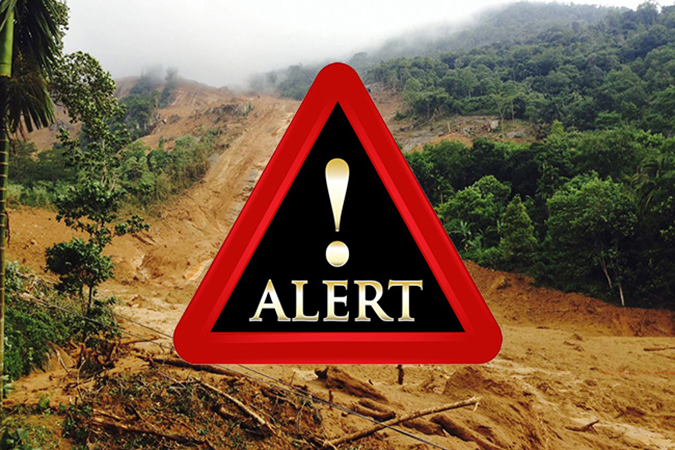
The landslide early warning center of the National Building Research Organisation [NBRO] has issued RED warnings to the districts of Kandy and Nuwara Eliya for the next 24 hours effective from 0900 hrs today [09th January].
Accordingly,
LEVEL III RED landslide early warnings have been issued to the Divisional Secretaries Divisions and surrounding areas of Ududumbara in the Kandy district, and Nildandahinna and Walapane in the Nuwara Eliya district.
LEVEL II AMBER landslide early warnings have been issued to the Divisional Secretaries Divisions and surrounding areas of Wilgamuwa in the Matale district, and Mathurata and Hanguranketha in the Nuwara Eliya district.
LEVEL I YELLOW landslide early warnings have been issued to the Divisional Secretaries Divisions and surrounding areas of Uva Paranagama, Welimada, Kandaketiya, Badulla, Meegahakiwula, Hali_Ela, Passara and Lunugala in the Badulla district, Minipe in the Kandy district, Ambanganga Korale, Ukuwela, Rattota, Naula and Laggala_Pallegama in the Matale district, and Nuwara Eliya in the Nuwara Eliya district.
Latest News
A Policy is being formulated to ensure Child Protection in the use of Technology — Prime Minister

Prime Minister Dr. Harini Amarasuriya stated that a policy is currently being formulated to ensure child protection in the use of technology.
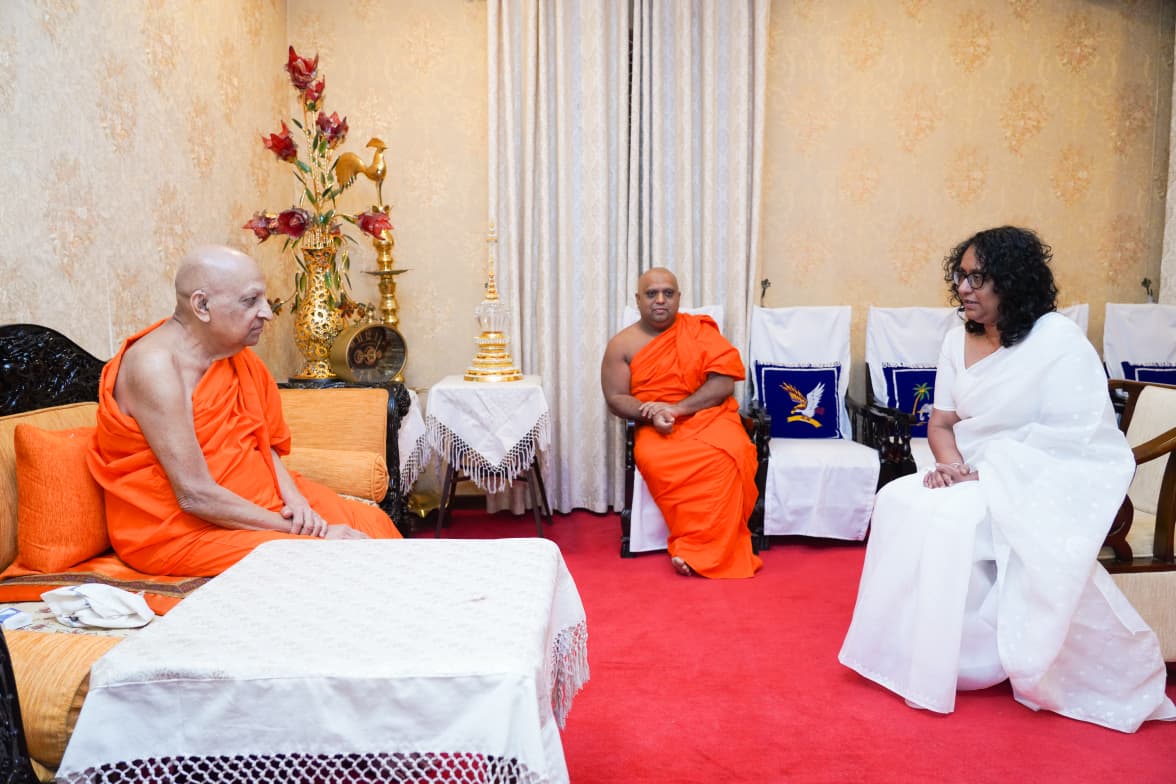
The Prime Minister made this statement on Thursday (08) in Kandy while briefing the Most Venerable Mahanayake Theros of the Asgiriya and Malwathu Chapters on the issue that has arisen regarding the Grade 6 English module. Thereafter, printed copies of all modules were presented to the Mahanayake Theros.
Earlier on Thursday (08), the Prime Minister visited the Malwathu Viharaya in Kandy and met the Most Venerable Thibbatuwawe Sri Siddhartha Sumangala Nayaka Thero, the Mahanayake of the Malwathu Chapter, where she explained the error that had occurred in the first print run of the English module for Grade 6 .
The Mahanayake Theros emphasized that education is a sensitive subject and that such matters should be handled with greater sensitivity and proper oversight. They further advised that a formal investigation should be conducted and that education reforms should be carried forward in a systematic manner.
Subsequently, the Prime Minister visited the Asgiriya Maha Viharaya and met the Most Venerable Warakagoda Sri Gnanarathana Mahanayaka Thero of the Asgiriya Chapter, where she clarified the error related to the English module.
The Mahanayake Thero noted that education reforms are a timely necessity and should be implemented with due oversight and careful review and also pointed out that there are broader issues in Sri Lanka regarding the use of technology, which are evident in the manner in which modern tools such as AI technologies are being used on social media.
Clarifying the issue Prime Minister Dr. Harini Amarasuriya further stated,
“We have appointed a committee to look into this issue, and based on the recommendations of the National Institute of Education (NIE), steps were taken to remove the relevant lesson. In addition, all printed copies of the relevant module have been stamped, and no module has been distributed to schoolchildren. A formal investigation into this matter has been initiated by the Ministry, and a complaint has also been lodged with the Criminal Investigation Department.
At the same time, we are in the process of formulating a policy on child protection in the use of technology”.
Thereafter, addressing the media and responding to the’ questions raised by journalists, the Prime Minister stated:
“The Opposition is attempting to use this national task for their own political advantage. However, many in society have expressed their views on the issues that have arisen in a positive manner, with the objective of identifying and correcting mistakes. The government has decided to move forward with education reforms by recognizing the error that have occurred and rectifying them. We will take the no-confidence motion brought by the Opposition as an opportunity to further advance dialogue on education reforms”
The occasion was graced by the Most Venerable Anunayaka Thero of the Asgiriya Chapter, Venerable Narampanawe Ananda Nayaka Thero; Deputy Registrar of the Asgiriya Chapter, Venerable Muruddeniye Dhammarakkhita Thero; Deputy Registrar of the Malwathu Chapter, Venerable Mahawela Rathanapala Thero; Members of Parliament Thushari Jayasinghe and Thanura Dissanayake; Mayor of Kandy Chandrasiri Wijenayake; Secretary to the Ministry of Education Nalaka Kaluwewa; and Secretary to the Ceylon Teachers’ Union in Central Province D. D. Wimalaweera.
[Prime Minister’s Media Division]
Latest News
The deep depression to the South-east of Sri Lanka is likely to intensify in to a cyclonic storm during the next 24 hours

A RED warning for a deep depression to the South-east of Sri Lanka has been issued at 01.00 a.m. on 09 January 2026 for the period until 01.00 a.m. 10 January 2026 by the Natural Hazards Early Warning Centre, of the Department of Meteorology.
The deep depression in the Bay of Bengal to the southeast of Sri Lanka (At 01:00 a.m. on Jan 9th, 2026 located about 200 km East of Pottuvil) is very likely to intensify further and move west-northwestwards towards the coast of Sri Lanka between Pottuvil and Trincomalee in the evening today (9th January 2026.) The system is likely to intensify in to a cyclonic storm
during the next 24 hours.
Hence, showery, and windy condition over the island, particularly in the Northern, North-Central, Eastern, Uva and Central provinces is expected to enhance.

Rain washes out 2nd T20I in Dambulla

Colombia sees ‘real threat’ of US military action, president tells BBC

Landslide RED warnings issued to the Divisional Secretaries Divisions of Ududumbara, Nildadndahinna and Walapane

Harmanpreet, Mandhana return to DY Patil, on opposite sides this time

Huge anti-government protests in Tehran and other Iranian cities, videos show

Clinical Pakistan look to keep momentum going and wrap up series

‘Dates have the highest sugar content to fight Coronavirus’

Sunday Island 27 December – Headlines

#SundayIsland 17th December – Headlines

Sunday Island – 28th March

Sunday Island Headlines – 21 March

Sunday Island – 21st February – Headlines
-

 News4 days ago
Interception of SL fishing craft by Seychelles: Trawler owners demand international investigation
-
 News4 days ago
Broad support emerges for Faiszer’s sweeping proposals on long- delayed divorce and personal law reforms
-

 Opinion21 hours ago
The minstrel monk and Rafiki, the old mandrill in The Lion King – II
-

 Features21 hours ago
The Venezuela Model:The new ugly and dangerous world order
-

 News3 days ago
Prez seeks Harsha’s help to address CC’s concerns over appointment of AG
-
 News5 days ago
Private airline crew member nabbed with contraband gold
-

 Latest News2 days ago
Warning for deep depression over South-east Bay of Bengal Sea area
-

 News3 days ago
Govt. exploring possibility of converting EPF benefits into private sector pensions