
News
Kenya too falls into Chinese debt trap


By S Venkat Narayan,
Our Special Correspondent
NEW DELHI. Kenya is one of China’s largest trade partners in Africa. It owes $6.5 billion to China, which is 22 percent of its total external debt. China’s interest payments represent 87 per cent of the cash used to service debt expenditure in 2019. Kenya is yet to work out an arrangement with China, but has been reluctant to seek debt relief amid reports that it was concerned it could hurt its ability to tap capital markets.
Kenya and neighbouring Ethiopia, according to the World Bank’s international debt statistics, are among the world’s most indebted countries. Kenya’s external debt rose four times over the last decade, only second to Ethiopia that saw its debt increase five-fold during the decade.
Analysts say the $3.2-billion contract with China in 2014 to build the standard gauge railways connecting Kenya’s capital Nairobi and the port city of Mombasa symbolised the problem. The railway line was expanded in 2015 to Naivasha town 75 miles northwest of Nairobi, raising the project cost by another $ 1.5 billion.
The railway line made a loss of $ 90 million in its first year. The government promised a profit in 2019. It ended up in the red again. The government has been forcing businesses to move their cargo on the railway to ensure it generates enough cash for operations but the project still recorded a loss of $200 million over three years. In September, a panel of lawmakers nudged the government to renegotiate the loan deal and cut operating expenses by half. Kenya hasn’t had its way yet.
The overpriced project, hugely criticised by independent observers right from the time it was first announced, has also been in the spotlight after Kenya’s appellate court ruled in June that the contract had been signed in violation of the rules and was illegal.
In the end, Kenya doesn’t have an option but to pay back the money.
Or Kenya could stand to lose the lucrative Mombasa port that was pledged as collateral when the huge loan was accepted.
Mombasa is counted as east Africa’s largest and most valuable port. It is not just the gateway into Kenya, but also its landlocked neighbours; Burundi, Congo, Rwanda, South Sudan and Uganda. Also, Kenyan media has reported, Nairobi could also have to give control of the Inland Container Depot that could bring thousands of port workers under Chinese lenders.
Zambia has finally received a six-month reprieve from China Development Bank on repayment of its debt due in October, the government in Lusaka announced last month after a desperate SOS that it was on the verge of a default.
Lusaka had already been attempting to restructure and refinance its Chinese debt when SARS-CoV-2, the virus that causes Covid-19, first reached Africa and rapidly spread across the world, infecting over 52 million and wreaking havoc on global economies. It has only gotten worse.
Kenya and Zambia’s story repeats itself across Africa, Asia and Latin America. According to the Financial Times (London), China has transferred nearly $150 billion to governments and state-owned firms in Africa alone to secure commodity supplies and fund its global network of infrastructure projects, President Xi Jinping’s signature Belt and Road Initiative (BRI).
Beijing is already the world’s largest non-commercial lender, more than the International Monetary Fund (IMF) and the World Bank. China’s share of bilateral debt owed by the world’s poorest countries to members of the G20 has risen from 45 percent five years ago to 63 percent last year. A recent World Bank report estimated China’s external loans and trade credits at $1.6 trillion, or close to 2 percent of global gross domestic product.
China watchers in New Delhi, quoted by the Hindustan Times, speak about how Beijing has expanded its footprint and influence in South Asia too by pouring billions of dollars in pricey infrastructure projects that mostly serve Beijing’s strategic interests and have to be executed by Chinese companies and Chinese workers.
Like the China Pakistan Economic Corridor (CPEC) that eventually will be paid for by Islamabad. Or the rail and deep-sea port projects along an economic corridor to Myanmar that will link China’s south-western interior to the Indian Ocean.
Because the loans are not based on the economic feasibility of the projects in the first place and are opaque, they are also seen to fuel allegations of corruption and autocratic behaviour.
Beijing has its grip on Sri Lanka to an extent that when US Secretary of State Mike Pompeo was in the country to campaign against China’s debt diplomacy. Colombo—-which is in the middle of negotiations with Beijing for another tranche of loans—-politely made it known that it is not going to change its approach to China.
In 2017, Sri Lanka had already handed over the strategic port of Hambantota on the country’s southern coast to China on a 99-year lease when it had trouble repaying its initial loan for the port.

Latest News
Let us all build a society valued with peace and harmony, guided by unity and solidarity beyond all differences – PM


Prime Minister Dr Harini Amarasuriya issuing a message on the occasion of the Hajj festival called upon all Sri Lankans to build a society valued with peace and harmony, guided by unity and solidarity beyond all differences
The Prime Minister’s message:
“On the occasion of “Eid-ul-Adha” or the Hajji Festival, celebrated with great reverence by Muslims across the world upholding the values of selflessness, unity, and compassion, I extend my felicitations to the Muslim community in Sri Lanka and around the world.
On this special Day, the festival of Hajji commemorates the boundless devotion to God and the noble spirit of generosity demonstrated by Prophet Ibrahim. This festival reflects the willingness of humanity to dedicate even its most precious possessions for the greater good of humankind and the devotion towards the God.
On this day, the most important lesson we must all understand is the value of rising above our differences and standing together in unity and solidarity. The message of Eid-ul-Adha, founded upon sharing and compassion, serves as a great example in our journey towards building a strong, peaceful, and prosperous Sri Lanka.
Therefore, setting aside narrow divisions, we must all resolve to act with respect and kindness towards one another and work together to create a society valued with peace and solidarity.
May this Hajji Festival bring happiness, peace, prosperity, and blessings to you all”.
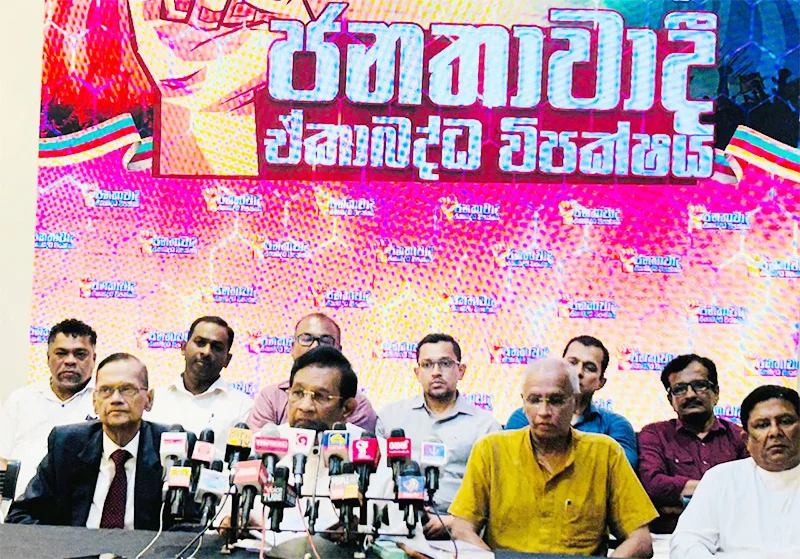
Ranil-led group asks govt. to hold PC polls
Former Cabinet Minister Dr. Rajitha Senaratne yesterday (27) claimed that there was no consensus between the JVP and the NPP regarding the long delayed Provincial Council (PC) polls.
Dr. Senaratne said that though JVP General Secretary Tilvin Silva had declared in Jaffna, over the last weekend, that it wouldn’t be possible to conduct PC polls this year, due to financial constraints and legal impediments, the position of NPP General Secretary Dr. Nihal Abeysinghe was different.
Addressing the media at Hotel Nippon, on behalf of the People’s United Opposition grouping, operating out of Ranil Wickremesinghe’s Flower Road Office, Dr. Senaratne, who represents the UNP, claimed that the JVP/NPP was all out to postpone the long delayed PC polls. The New Democratic Front (NDF) parliamentary group, elected to the current Parliament, received the backing of Wickremesinghe.
The ex-Minister explained how the NPP, with a 159-member parliamentary group, could comfortably secure the approval of the Parliament to conduct the PC polls under Proportional Representation system.
Declaring that they would submit combined candidate lists at the PC polls, Dr. Senaratne declared that those who declined to join them would be considered traitors.
Dr. Senaratne emphasised that there was no need for alliances and their objectives could be achieved through fielding combined candidate lists.
The Illankai Thamil Arasu Kadchi (ITAK) was represented by former lawmaker and acting Secretaray General of ITAK but the Sri Lanka Podujana Peramuna (SLPP) and the main Opposition Samagi Jana Balawegaya (SJB) weren’t represented.
Convenor of the People’s United Opposition Prof. G. L Peiris, at the beginning of the briefing, explained how the people were deprived of their democratic rights by the NPP, through the postponement of PC polls.
On Tuesday (26) MPs Shanakiyan Rasamanikkam, Mano Ganesan, and Nizam Kariapper attended a joint Opposition discussion with SJB and others, organised by PAFFREL. MP Rasamanikkam has criticised the delay in holding PC elections.
The Batticaloa District MP highlighted that he had already presented a private member’s bill to facilitate the conduct of elections, under the earlier system.
Rasamanikkam said:”The four Opposition members representing the Parliamentary Select Committee affirmed their stance to hold the Provincial Council elections under the preferential voting system.
“We noted, however, that the establishment of this committee appears to be a measure to further delay the process.
“Concurrently, an Additional Solicitor General of the Attorney General’s Department presented two proposals for conducting the elections.
“One of these recommendations involves introducing minor amendments concerning women and youth representation to the private member’s motion I tabled in Parliament, which seeks to hold the Provincial Council elections under the previous system.”
Meanwhile, PAFFREL said that altogether 42 political parties and civil society organisations were involved in that discussion.
PAFFREL said that of the 42 political parties and monitoring organisations that participated in the discussion, all but one political party consented to endorse the following joint statement. And it was decided to forward the joint statement to the Parliamentary Select Committee and the government.
“We, the secretaries of political parties and representatives of the other organisations, who attended the meeting organised by PAFFREL at the Hector Kobbekaduwa Agricultural Training and Research Institute, on 26 May, 2026, agreed to the proposal adopted to hold the Provincial Council elections as per the electoral system prevailed prior to the enactment of Act No. 17 of 2017, pending the final outcome of the Parliamentary Select Committee. We also agreed to ensure 25% representation of women and youth on a voluntary basis.”
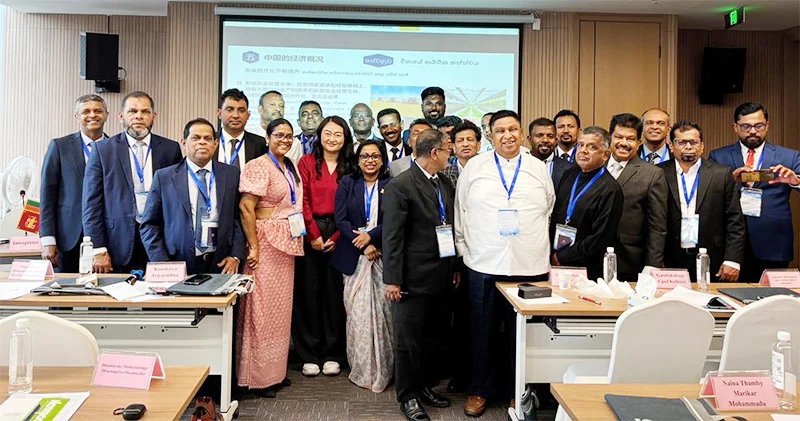
A Parliamentary delegation, comprising 20 Members of Parliament, and four officials, of the Parliament of Sri Lanka, led by Dr. Kaushalya Ariyarathna, Deputy Minister of Mass Media, is in China to participate in a workshop for Members of Parliament of Sri Lanka being held in Beijing and Guangdong.
The programme has been organised by the International Cooperation Centre of the National Development and Reform Commission (NDRC) of China, from 26th May to 5th June, 2026.
The delegation arrived in Beijing, on 25 May, and commenced official engagements on 26th May, with the Opening Ceremony of the Workshop held at the Fenghui Centre in Beijing, Parliament said.

Let us all build a society valued with peace and harmony, guided by unity and solidarity beyond all differences – PM

Showers will occur at times in the Western, Sabaragamuwa and North-western provinces and in Galle, Matara, Kandy and Nuwara-Eliya districts

Rajitha calls for combined lists, denounces those unwilling to join as traitors

20 lawmakers, four officials visiting China

More Japanese funds for demining operations in the north

Clingendael Institute delegation visits Pathfinder Foundation

‘Dates have the highest sugar content to fight Coronavirus’

Sunday Island 27 December – Headlines

#SundayIsland 17th December – Headlines

Sunday Island – 28th March

Sunday Island Headlines – 21 March

Sunday Island – 21st February – Headlines
-

 Business6 days ago
Historic launch of CCWE Fashion Week & International Summit 2026
-

 News4 days ago
All-New GRAVITE launches at LKR 6.99 Mn
-
 News3 days ago
Police probe underway to ascertain links between criminals deported from UAE and local politicians
-
 Features4 days ago
The NPP’s pivot to the past
-
 News2 days ago
Easter Sunday carnage: Court told Maulana’s statement cannot be accepted without cross-examination
-

 Opinion6 days ago
The need to reform Buddhist ecclesiastical order
-
 Features4 days ago
End of Peacekeeping
-
 News3 days ago
Dickoya double murder suspect arrested