
Features
Gamini D’s dilemma in returning to UNP and CBK’s entry via WPC

Of senior politicos obsession with ‘Godmen’, intrigues and spices
 The Central province is well known for its growing of spices like pepper, cardamom, cloves and nutmeg. They are grown in small household properties unlike tea, rubber, cocoa and coconut which are commercial crops grown in large estates in the district. After interacting with Kandyan villagers both as an official and a politician I became aware how important these crops are for the village economy.
The villagers are primary producers who sell off their produce to intermediary traders who in turn sell them to the bigger brokers in Colombo. This system is outdated and tends to give a bad deal to the primary producer-the villager. Often the intermediary dealer is a Muslim who has the ability to activate their commercial links with big time exporters in Colombo and earn large margins at the expense of villagers who are the actual producers.
With the expansion of the global middle class the demand for spices have gone up but we have not been able to exploit these assets due to a bureaucracy which is slow to act. On the other hand India – especially Tamil Nadu and Kerala are front runners in meeting global demand. This often leads to smuggling of spices like cloves and nutmeg to India because our products have a premium demand.
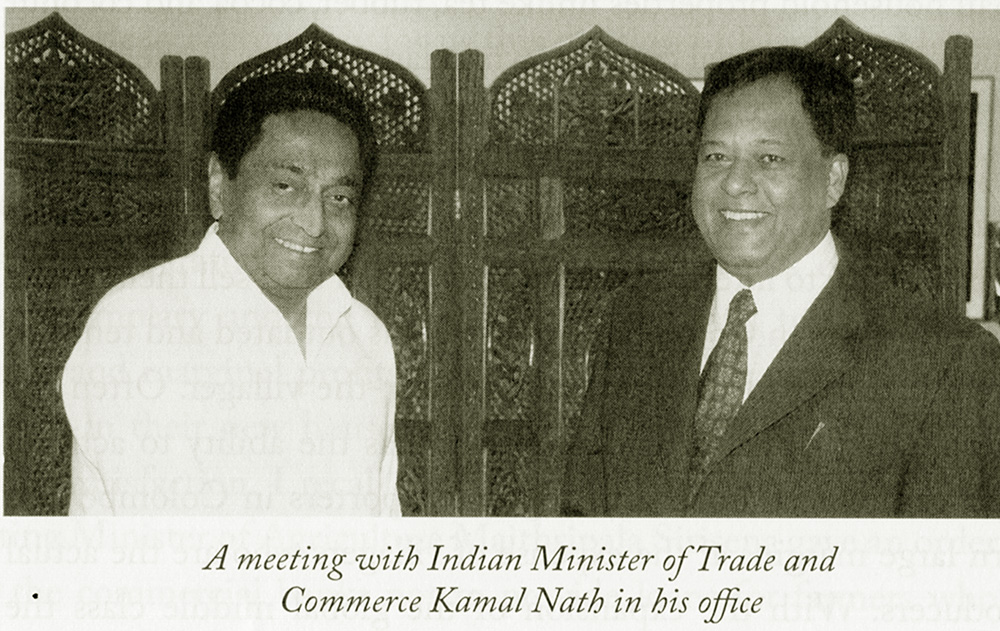
As Minister of Finance I often interacted with the Indian Minister of External trade, Kamal Nath with the idea of adjusting their duty structure to favour our spices on a preferential rate. He did so and it raised a furore in Kerala and Kamal Nath told me in lighter vein that he was blamed by the Indian Congress for their defeat in the local polls in Kerala because the local growers of spices and cashew had voted against them.
Since he was from Rajasthan, which was a state that did not grow spices, his voters did not object to the generous tariff concessions given to us. It was during this time that local spices recorded high sales and high incomes. Similarly during times of typhoons and heavy rains in Kerala when they cannot meet the demand for spices and cashew, our products are in great demand with the resulting increasing of prices. Traders tend to stockpile their holdings anticipating such a windfall.
Division of labour
The devolution of subjects to the Provincial Councils have been done in a haphazard manner. Many crucial areas which call for a high degree of coordination are badly affected by a division of responsibilities. Take for instance the crucial area of irrigation of which I was once the Minister in charge. Large scale irrigation works are a function of the center while minor irrigation works, which were earlier managed by a well funded Agrarian Services Department, have been handed over to the Provincial Minister.
Today there is a problem of both coordination and finance in this crucial sector. Rural irrigation has been neglected leading to a breakdown of agricultural facilities which in turn reduces output and pushes labour out of this sector. The ratio of agriculture’s contribution to GDP has declined continuously. So have the figures for employment in the agriculture sector which is now outstripped by the manufacturing and service sectors of our economy.
There are similar anomalies in the education and health sectors. While “national” schools and hospitals are better funded, their “provincial” counterparts are badly managed and underfunded. The public have a clear preference for “National” schools and hospitals. Why are the PCs institutions so underfunded?
It is because the Chief Ministers have diverted funds to duplicate their bureaucracy and promote popular but unproductive employment creation. The net result is that the PC system, at least in south Sri Lanka, has become a chaotic mess and another drain on national resources. New PC polls have not been held. But the public has shown no interest in resurrecting them.
Gamini’s dilemma
With the unexpected deaths of Premadasa and Lalith, and the disappearance of Upali Wijewardene, the only charismatic leader of the old UNP left standing was Gamini Dissanayake. The departure of Lalith cast a heavy burden regarding the DUNF on his shoulders. Earlier leadership jealousies with Lalith vanished with the new burden of organizational and financial responsibilities that Gamini had to now undertake alone. It was a formidable challenge.
Coupled with that was the demand for him to return to the “Mahagedera” from the rank and file of the party who saw their strength diminished due to the split between the UNP and DUNF at the recently concluded Provincial Council elections. For Gamini who was a UNP stalwart the only hurdle he had faced was Premadasa. Now that the single obstacle was providentially removed he saw no reason why his earlier labours for the UNP as a national leader should be wasted.
There was another reason which was perhaps not so well known. Like many of our political leaders Gamini was addicted to astrology and soothsayers. He was a believer in Satya Sai Baba who had assured him that he would reach the top and had even given him a charmed ring which would help him on his way. Most Sri Lankan politicians are believers in soothsaying and rituals because it gives them Dutch courage to soldier on in a field which is full of jealousy and uncertainty.
Unknown to most voters hosts of palm readers and soothsayers descend on Colombo from India during election time. They are sponsored by Tamil businessmen and they make sanguine predictions thereby answering the growing psychological anxieties of our politicians. Among them Premadasa and Gamini were foremost and ironically both were killed notwithstanding the predictions of “God men” who assured them of a long and fruitful life crowned with success.
Many evenings of our leaders are spent closeted in seances with these self appointed messengers from god. Many of our leaders have hastened to South India to participate in an expensive ritual known as “Thulabaram” in which our “friends of the oppressed and down trodden” are weighed in gold. Of late gold has been replaced by bundles of cash, usually provided by Tamil merchants with business interests in the island. All these “God men” advised Gamini that his future lay in rejoining the UNP and claiming his political inheritance.
While Gamini was veering towards a move to rejoin the UNP several major obstacles remained. One was the cordiality that had developed between the DUNF and the SLFP as shown in the appointment of Chief Ministers in the Western and North Central provinces. Mrs Bandaranaike was very supportive of Gamini and the DUNF. I remember that we worked very closely with her during the “Fransisco” debacle. The Southern Provincial Council was captured with the cooperation of the SLFP and DUNF and Amarasiri Dodangoda-a veteran SLFP nominee was to be elected the Chairman. However as a newcomer to the UNP Anura Bandaranaike, in order to show his loyalty to his new found party, pulled out one of his acolytes named Fransisco who was a PC member of the SLFP thereby depriving Dodangoda of a majority.
This impasse ended up in the courts and joint affidavits had to be furnished by the SLFP and the DUNF to the judiciary. During this time Gamini and I consulted Mrs. B several times. She was assisted by Attorney Nimal Siripala de Silva. In the end the courts held with Dodangoda marking a sea change in judicial verdicts which were earlier often in Premadasa’s favour. It was an early sign that the monolithic UNP will have trouble under the Wijetunga – Ranil administration. CBK’s new found leadership was giving hope to the debilitated SLFP. As a result the majority of UNPers needed Gamini more than ever and many party officials would come “incognito” to persuade Gamini to make a comeback.
Ranil-Wijetunga resistance
The incumbent President and Prime Minister, Wijetunga and Ranil, however were against the return of Gamini to the UNP. They were supported by Cooray and Choksy who felt that Anura Bandaranaike was enough of a crowd puller to need supplementing with an ambitious veteran who was currently in the doghouse. But the chief opponent was Ranil who felt rightly that Gamin’s arrival would mark the decline of his hold on the party. Many legal, technical and political objections were brought forward by the Ranil camp, particularly by Gamini Athukorale who had an axe to grind with Gamini the reasons for which were described in Volume One of my autobiography. They were not even on talking terms. As mentioned above, this conflict came into the open when we in the Central Provincial Council attempted to remove the Chief Minister.
The anti Gamini UNP leaders used all their powers to defeat this move and humiliate Gamini. Wijetunga was reported to have said in pithy Sinhala that “it was better to put a snake under your sarong than get close to the DUNF leader”. This was a trying time for us as both the UNP and the SLFP began to be suspicious of a major political shift engineered by Gamini. At the same time the SLFPers who had joined the DUNF like Monty Gopallawa were facing the prospect of being marooned as they had no wish to join the UNP since they were dedicated anti-UNPers right through their political careers. They argued for the continuation of the DUNF but they were in a minority who proved to be dispensable in Gamini’s quest for a power base.
Entry of Chandrika Kumaratunga (CBK)
The Provincial council elections brought CBK into the contemporary political contest with a bang. Her entry as the Chief Minister of the Western Province was like a breath of fresh air which helped the SLFP to settle their internecine conflicts and give them hope of winning an election after 17 years of UNP rule. Hers was not an easy path to the top. The Maithripala Senanayake and Anura clique, assisted by Mahinda Rajapaksa, challenged her all the way. At first she had to be assisted by comparatively junior party members like Mangala Samaraweera and SB Dissanayake who realized that a “new face” was needed to galvanize their grass roots supporters.
The old leaders like Maithripala Senanayake. Kalugalla and Sooriyaratchi who were behind Anura, had no hesitation in conspiring with UNP leaders in their attempts to block CBK. Their main obstacle was Mrs. B who stoutly backed Chandrika and thereby even alienated her favourite child Anura. It was a trying time for her which led to a stroke which later made her an invalid. But Chandrika brought a new “grass roots” approach with her own uninhibited style of politicking.
Her record victory in the Provincial Council election and the setting up of an administration with an alliance with the left and the DUNF highlighted the possibility of a new configuration in the anti UNP struggle. She also managed to win the confidence of the minorities and the support of India who looked upon Premadasa and Wijetunga with suspicion as being “anti-Indian”. She was crafting a new coalition of the left of which the UNP was now beginning to sit up and take notice.
This was confirmed when CBK led the anti UNP group to victory in the Provincial Council elections for the southern province in spite of the desperate efforts of the UNP which resorted to strong arm tactics like abducting Francisco. For the first time the UNP, and President Wijetunga, appeared to be nervous about their electoral prospects and there was a demand among the rank and file for Gamini which Ranil and Athukorala and their small coterie attempted to suppress.
But the wild card was Wijetunga who was being persuaded to think again about Gamini’s role in the changed circumstances. The UNP membership was not satisfied with Ranil’s leadership style which depended on a small group of admirers and was a far cry from the mass politics that JRJ and Premadasa had introduced into the party organization.
(Excerpted from vol. 3 of the Sarath Amunugama autbiography) ✍️


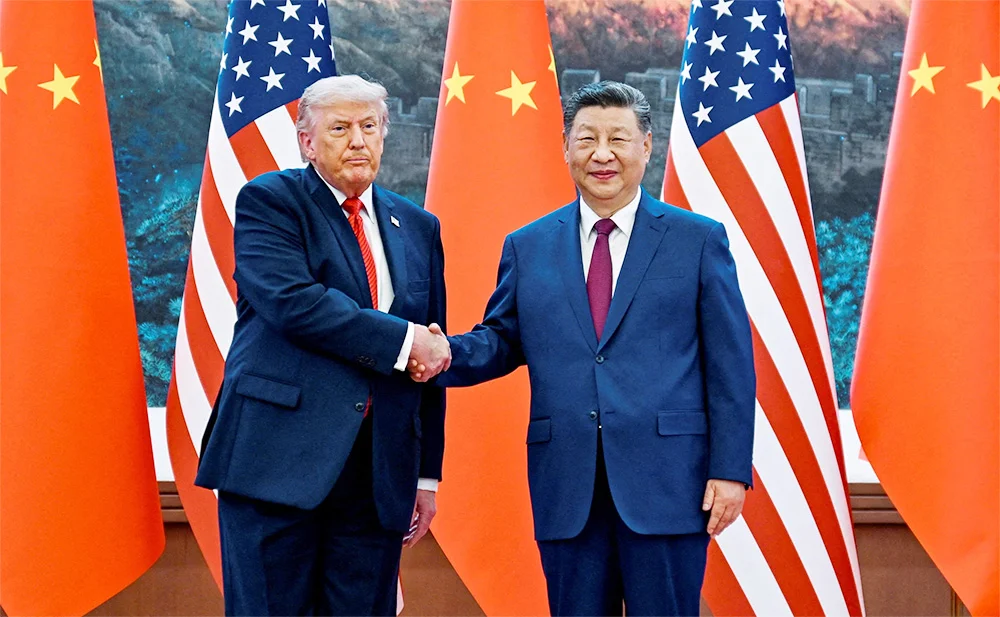
 The fact that some of the US’ topmost figures in business, such as Tesla chief Elon Musk and major US chipmaker Jensen Huang of NVIDIA fame, occupied as nearly a prominent a position as President Donald Trump at the recent ‘historic and landmark’ visit by the latter to China underscores the continuing vital importance of business in US-China ties. Business seemed to outweigh politics to a considerable degree in importance during the visit although the political dimension in US-China ties appeared to be more ‘headline grabbing’.
To be sure, the political dimension cannot be downplayed. For very good reason China could be seen as holding the power balance somewhat evenly between East and West. The international politics commentator couldn’t be seen as overstating the case if he takes the position that China could exercise substantial influence over the East currently; that is Russia and Iran, in the main. The latter powers hold the key in the Eastern hemisphere to shaping international politics in the direction of further war or of influencing it towards a measure of peace.
For example, time and again China has prevented the West from ‘having its own way’, so to speak, in the UN Security Council, for instance, in respect of the ongoing conflicts involving Russia and Iran, by way of abstaining from voting or by vetoing declarations that it sees as deleterious. That is, China has been what could be seen as a ‘moderating influence’ in international politics thus far. It has helped to keep the power balance somewhat intact between East and West.
At present a meet is ongoing between Chinese President Xi Jinping and Russian President Vladimir Putin in Beijing. This happened almost immediately after the Trump visit. Apparently, Beijing is in an effort to project itself as treating the US and Russia even-handedly while underscoring that it is no ‘special friend’ of the US or the West.
This effort at adopting a non-partisan stance on contentious questions in international politics is also seen in Beijing’s policy position on the Hormuz tangle and issues growing out of it. The Chinese authorities are quoted as saying in this regard, for instance, that China is for ‘a comprehensive and lasting ceasefire in the Middle East’.
Such a position has the effect of enhancing the perception that China is even-handed in its handling of divisive foreign policy posers. It is not openly anti-West nor is it weighing in with Iran and other Eastern actors that are opposed to the West in the West Asian theatre. A ‘comprehensive and lasting ceasefire’ implies that a solution needs to be arrived at that would be seen as fair by all quarters concerned.
On the highly sensitive Taiwan issue, President Xi was comparatively forthright during the Trump visit, but here too it was plain to see that Beijing was not intent on introducing a jarring, discordant note into the ongoing, largely cordial discussions with Washington. On the Taiwan question President Xi was quoted saying: ‘If mishandled, the two nations could collide even come into conflict.’ In other words, the US was cautioned that China’s interests need to be always borne in mind in its handling of the Taiwan issue.
The cautioning had the desired result because Trump in turn had reportedly conveyed to Taiwan that the latter’s concerns on the matter of independence had to be handled discreetly. He had told Taiwan plainly not to declare ‘independence.’
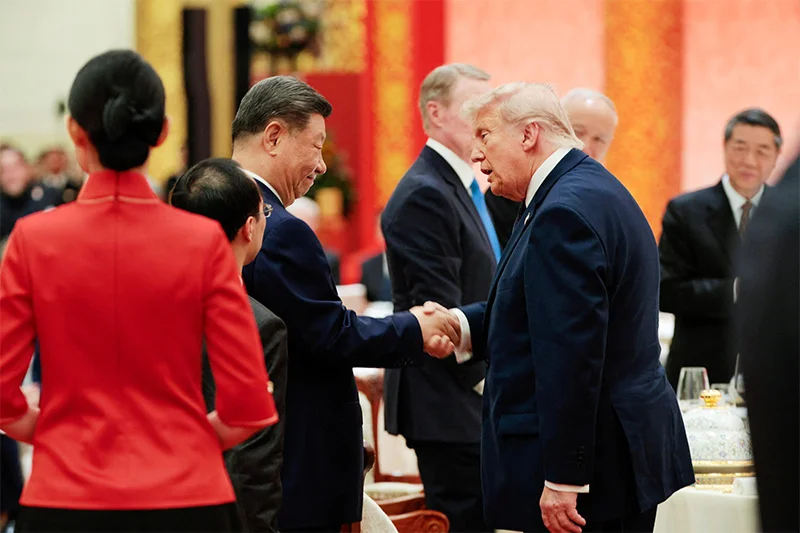
Accordingly, neither the US nor China had said or done anything that would have made either party lose face during their interaction. Apparently, both sides were sensitive to each others’ larger or national interests. And the economic interests of both powers were foremost among the latter considerations.
There is no glossing over or ignoring economic interests in the furtherance of ties between states. They are primal shaping forces of foreign policies and the fact that ‘economics drives politics’ is most apparent in US-China ties. That is, economic survival is fundamental.
Among the more memorable quotes from President Xi during the interaction, which also included US business leaders, was the following: ‘China’s doors will be open wider’ and US firms would have ‘broader prospects in the Chinese market.’
Xi went on to say that the sides had agreed to a ‘new positioning for ties’ based on ‘constructive strategic stability’. The implication here is that both sides would do well not to undermine existing, mutually beneficial economic relations in view of the wider national interests of both powers that are served by a continuation of these economic ties. That is, the way forward, in the words of the Chinese authorities, is ‘win-win cooperation.’
It is the above pronouncements by the Chinese authorities that probably led President Trump to gush that the talks were ‘very successful’ and of ‘historic and landmark’ importance. Such sentiments should only be expected of a billionaire US President, bent on economic empire-building.
One of the most important deals that were put through reportedly during the interaction was a Chinese agreement to buy some 200 Boeing jets and a ‘potential commitment to buy an additional 750 planes.’ However, details were not forthcoming on other business deals that may have been hatched.
Accordingly, from the viewpoint of the protagonists the talks went off well and the chances are that the sides would stand to gain substantially from unruffled future economic ties. However, there was no mention of whether the health of the world economy or the ongoing conflicts in West Asia were taken up for discussion.
Such neglect is regretful. Although the veritable economic power houses of the world, the US and China, are likely to thrive in the short and medium terms and their ruling strata could be expected to benefit enormously from these ongoing economic interactions the same could not be said of most of the rest of the world and its populations.
Needless to say, the ongoing oil and gas crisis, for instance, resulting from the conflict situation in West Asia, is taking a heavy toll on the majority of the world’s economies and the relevant publics. While no urgent intervention to ease the lot of the latter could be expected from the Trump administration there is much that China could do on this score.
China could use its good offices with the US to address the negative fallout on the poorer sections of the world from the present global economic crunch and urge the West to help in introducing systemic changes that could facilitate these positive outcomes. After all, China remains a socialist power.
“Everything ever said to me by any Chinese of any station during any visit was part of an intricate design”
— Henry Kissinger
That design may already be complete before this week’s , a meeting that could shape the future balance of global power.
The wind arrives quietly. By the time it is heard, history has already begun to turn. Across Asia, that wind is no longer distant. It carries with it the exhaustion of an old order and the uncertain birth of another. The question now is not whether the world will change. It is whether those who hold power possess the wisdom to guide that change toward something less violent than the century behind us.
Since 1945, the United States has carried the burden of a global order built with its Western allies. To its credit, the world avoided another direct world war between great powers. The conflicts remained contained in distant lands—proxy wars fought in the shadows of ideology, oil, and influence. From Latin America to Asia, the American century expanded not only through prosperity, but through intervention. Yet empires, even democratic ones, grow tired. Fatigue settles slowly into institutions, alliances, and public memory. The role of global policeman no longer inspires certainty in Washington as it once did.
The “rules-based order” now confronts its own contradiction: it was built to be universal, yet it often appeared selective. During my recent visit to , a young researcher asked me quietly, “Does the West itself still believe in the rules-based order?” The question lingered long after the conversation ended. The rising century demands a more inclusive architecture—one that recognises the reality of Asian power, especially China.
My three years of field research across South and Southeast Asia, documented in , revealed a transformation too significant to dismiss as temporary. China has moved beyond being merely a competitor to the United States. In trade, infrastructure, technology, cultural diplomacy, and economic influence, Beijing has established itself as what may be called the world’s “US +1.”
Great powers often search for such a partner. History shows this tendency clearly. When an empire becomes overextended—burdened by wars, alliances, sanctions, tariffs, and crises—it seeks another center of gravity to stabilize the system it can no longer manage alone. The United States today faces disorder stretching from Venezuela to Iran, from Ukraine to the unsettled Middle East. In this landscape, China emerges not simply as a rival, but as a state powerful enough to broker peace where Washington alone no longer can.
Drawing from the lessons of the Nixon–Mao era, warned that “” The United States and China are now engaged in a long-term economic, technological, political, and strategic competition. Managing that competition wisely may become the defining challenge of this century. In such a deeply polarized and unstable world, recognising China as a “US +1” partner is not surrender, but strategic realism.
Donald Trump understood this reality before boarding his flight to meet Xi Jinping. Their meeting inside Zhongnanhai—the guarded compound where China’s leadership governs—was never merely ceremonial. It symbolized a deeper recognition already acknowledged quietly within the itself: China is the nearest peer competitor the United States has ever confronted. Before departing Washington, Trump seemed to reassess not only China’s strength, but its unavoidable position as a “” shaping the future global balance.
Yet the significance of a Trump–Xi meeting extends beyond trade wars, tariffs, or diplomatic spectacle. It presents an opportunity to confront two crises shaping the century ahead: global energy insecurity and regional instability. Washington increasingly understands the limits of direct engagement with Tehran. Decades of pressure, sanctions, and confrontation have produced exhaustion rather than resolution. In that vacuum, Beijing now possesses leverage that Washington does not.
For China, this is an opportunity to evolve from a development partner into a security actor. Xi Jinping’s (GSI) was never designed merely as rhetoric. It was intended as the next phase of Chinese influence—transforming economic dependence into strategic trust. The geopolitical spillover from the Iranian conflict now offers Beijing a historic opening to project itself as a stabilising force in the region, not against the United States, but alongside it as a “US +1” partner.
If China succeeds in helping stabilise the Gulf and secure energy corridors vital to Asia, it will reshape perceptions of Chinese power globally. Beijing would no longer be seen only as the builder of ports, railways, and industrial zones, but as a guarantor of regional balance. This transition—from infrastructure diplomacy to security diplomacy—may become one of the defining geopolitical shifts of the coming decade.
Xi Jinping does not seek open confrontation. His strategy is older, more patient, and perhaps more formidable because of its restraint. Beijing speaks not of domination, but of a “,” advanced through three instruments of influence: the Global Development Initiative (GDI), the Global Security Initiative (GSI), and the Global Civilization Initiative (GCI). These are not slogans alone. Across Asia, many governments increasingly trust China as a development partner more than any other power.
India, despite its ambitions, has not matched this scale of regional penetration. In both ASEAN and South Asia, China’s economic gravity is felt more deeply. Ports, railways, technology networks, and financial dependency have altered the geopolitical map quietly, without the spectacle of war.
In , I compared three inward-looking national strategies shaping Asia today: Trump’s MAGA, Modi’s emerging economic nationalism , and Xi’s strategy. Among them, China has demonstrated the greatest structural resilience. Faced with American tariffs and decoupling pressures, Beijing diversified its supply chains across Central Asia, Europe, and Southeast Asia. Rail corridors now connect Chinese industry to European markets through Eurasia. ASEAN has surpassed the United States as China’s largest trading partner, while the European Union follows closely behind. Exports to America have declined sharply, yet China continues to expand. Trump, once defined by confrontation, now arrives seeking a new “” with China—an acknowledgment that economic rivalry alone can no longer define the relationship between the world’s two largest powers.
Unlike Washington, which increasingly retreats from multilateral institutions, Beijing presents itself as the defender of multilateralism. Whether genuine or strategic matters less than perception. In geopolitics, perception often becomes reality.
What emerges, then, is not surrender between rivals, but interdependence between powers too large to isolate one another. The future may not belong to a bipolar Cold War, but to a reluctant coexistence. The United States now recognises that China possesses diversified markets and partnerships capable of reducing dependence on America. China, in turn, understands that its long march toward global primacy still requires strategic engagement with the United States.
This is where the true geopolitical shift begins.
Many analysts continue to frame China solely as a threat. Yet history rarely moves through absolutes. The next world order may not be built through confrontation alone, but through uneasy partnership. Artificial intelligence, technological supremacy, economic stability, and global governance now demand cooperation between Washington and Beijing, whether either side admits it publicly or not.
Trump will likely celebrate his personal relationship with Xi, presenting himself as the American leader capable of negotiating a “better deal” with China than his predecessors. But beneath the rhetoric lies something larger: the gradual acceptance of China’s indispensable role in shaping the future international order.
Even the question of war increasingly returns to Beijing. If Washington seeks an understanding with Tehran, China’s influence becomes unavoidable. Iran listens to Beijing in ways it no longer listens to the West. This alone signals how profoundly the balance of power has shifted. And Xi, careful as always, refuses to openly inherit the mantle of global leadership. He delays, softens, and obscures intention. It is part of a longer strategy: to rise without provoking the final resistance of a declining hegemon too early.
History rarely announces its turning point. Empires fade slowly, while new powers rise quietly beneath the noise of the old order. Washington still holds immense power, but Beijing increasingly holds the patience, reach, and strategic depth to shape what comes after.
The century ahead may not belong to one power alone, but to the uneasy balance between Washington and Beijing. And in that silence, a new world order is already taking shape.
By Asanga Abeyagoonasekera

Chit-Chat Nethali Withanage
 Three months ago, 19-year-old Nethali Withanage, with Brian Kerkoven as her mentor, walked the ramp at Colombo Fashion Week. On 06 June, she’ll walk for Sri Lanka in Hurghada, Egypt, as the country’s delegate to Top Model of the World 2026._
I caught up with Nethali as she prepares to fly out, this weekend, and here’s how our chit-chat went:
1. Tell me something about yourself?
I’m someone who blends creativity with ambition. I’ve always loved expressing myself, whether it’s through fashion, styling, or the way I present myself to the world. At the same time, I’m very driven and disciplined, especially when I was working, as a student counsellor, at Campus One, at a young age, where I’ve learned how to connect with people, understand them, and communicate with confidence. I believe I’m still evolving, and that’s what excites me the most … becoming better every single day.
2. What made you decide to be a model?
Modelling felt natural to me because it combines everything I love – fashion, confidence, and storytelling without words. I realised that modelling isn’t just about appearance, it’s about presence and how you carry your energy. I wanted to be part of an industry where I could express different sides of myself, while inspiring others to feel confident in their own skin.
3. What sets you apart from other models?
I would say my ability to connect. Whether it’s with the camera, a brand, or an audience, I bring authenticity. I also have a strong background in communication and sales, which gives me an edge in understanding how to represent a brand, not just wear it. I don’t want to just model clothes, I want to bring them to life.
4. What clothing do you prefer to model?
I enjoy modelling versatile styles, but I’m especially drawn to elegant and expressive fashion pieces that tells a story. I love looks that allow me to embody confidence and femininity, whether it’s a structured outfit or something soft and flowing.
5. What is the most important aspect of modelling?
Confidence combined with professionalism. Confidence allows you to own the moment, but professionalism ensures that you respect the work, the team, and the brand you represent. Both are equally important.
6. If you could change one thing about yourself, what would it be?
I would say I’m learning to trust myself more and not overthink. I’ve realised that growth comes from embracing who you are, not constantly trying to change it. So instead of changing something, I’m focused on becoming more confident in my own voice.
7. School?
I did my O/Ls at Seventh Day Adventist High School Kandana, and, while at school, I was actively involved in creative activities. I enjoyed participating in English Day events that allowed me to express myself and interact with others. Those experiences helped me build confidence, teamwork, and communication skills, which continue to shape who I am today.
8. Happiest moment?
One of my happiest moments is realising how far I’ve come from being unsure of myself to stepping into opportunities, like modelling, and representing myself with confidence. That feeling of growth is something I truly value, and also a dream come true!
9. Your idea of perfect happiness?
Perfect happiness for me is peace of mind, being surrounded by people I love, doing what I’m passionate about, and feeling proud of who I am becoming.
10. Your ideal guy?
My ideal partner is someone who is respectful, supportive, and confident in himself. Someone who values growth, understands my ambitions, and encourages me to be the best version of myself.
11. Which living person do you most admire?
I admire strong, self-made individuals who have built their identity through hard work and resilience. People who stay true to themselves, despite challenges, inspire me, because they show that success is not just about talent, but also about strength and consistency.
12. Your most treasured possession?
My most treasured possession is my confidence. It’s something I’ve built over time, and it allows me to face challenges, take opportunities, and believe in myself, even when things are uncertain.
13. If you were marooned on a desert island, who would you like as your companion?
I would choose someone who is calm, positive, and resourceful, someone who can turn a difficult situation into an adventure. The right mindset matters more than anything.
14. Your most embarrassing moment?
I’m 19 and still haven’t faced any most embarrassing moment. But I would say I’ve had small moments where things didn’t go as planned, but I’ve learned to laugh at myself. Those moments remind me that perfection isn’t necessary; confidence is about how you recover, not how you avoid mistakes.
15. Done anything daring?
Pursuing modelling and stepping into competitions is something I consider daring. It pushed me out of my comfort zone and challenged me to grow, both personally and professionally.
16. Your ideal vacation?
My ideal vacation would be somewhere peaceful, yet beautiful, like a beach destination where I can relax, reflect, and reconnect with myself, while enjoying nature.
17. What kind of music are you into?
I choose music that matches my mood at that time, whether it’s calm and relaxing or energetic and uplifting. Music is something that helps me express emotions and stay inspired.
18. Favourite radio station?
Usually I don’t listen to radio stations but whenever I get into a car I would search for Yes FM because it has a refined balance of contemporary hits and timeless music. I appreciate how it maintains a vibrant yet sophisticated energy, keeping listeners engaged while creating a consistently uplifting atmosphere. It’s something I enjoy because it adds a sense of positivity and elegance to my day.
19. Favourite TV station?
At the moment, I don’t have a television at home, but growing up, my favourite TV station was ‘Nickelodeon’. I genuinely loved the shows and series it aired; they were fun, creative, and full of personality. It was something I always looked forward to, and those memories still bring a sense of joy and nostalgia, whenever I think about it.
20. Any major plans for the future?
My future plans are to grow in the modelling industry, work with international brands, build a strong personal brand and finish completing a Bachelor’s Degree in Business Studies. At the same time, I want to explore my creative side further, especially in fashion and business, so I can create something of my own one day.

Prime Minister Dr Harini Amarasuriya meets Foreign Secretary of the United Kingdom

Alice Capsey 74 not out blazes trail in seven-wicket England win

Kolkata Knight Riders keep their IPL campaign alive with low-scoring win

Showers will occur at times in the Western, Sabaragamuwa Northern and North-western provinces and in Anuradhapura, Galle, Matara, Kandy and Nuwara-Eliya districts

Suspects involved in sureties controversy granted bail

Steps underway to safeguard Sri Lanka’s maritime heritage

‘Dates have the highest sugar content to fight Coronavirus’

Sunday Island 27 December – Headlines

#SundayIsland 17th December – Headlines

Sunday Island – 28th March

Sunday Island Headlines – 21 March

Sunday Island – 21st February – Headlines
-

 Features4 days ago
Sri Lankan Airlines Airbus Scandal and the Death of Kapila Chandrasena and my Brother Rajeewa
-
 News5 days ago
Lanka’s eligibility to draw next IMF tranche of USD 700 mn hinges on ‘restoration of cost-recovery pricing for electricity and fuel’
-
 News4 days ago
Kapila Chandrasena case: GN phone records under court scrutiny
-
 News4 days ago
Rupee slide rekindles 2022 crisis fears as inflation risks mount
-
 Features1 day ago
Octopus, Leech, and Snake: How Sri Lanka’s banks feast while the nation starves
-
 Business4 days ago
Expansion of PayPal services in Sri Lanka officially announced
-
 Features6 days ago
Mysterious Death of United Nations Secretary General Hammarskjöld
-

 News4 days ago
Court orders further arrests in alleged USD 42 Mn NDB fraud case