
Sports
Gamini de Silva on life as Bangladesh’s curator

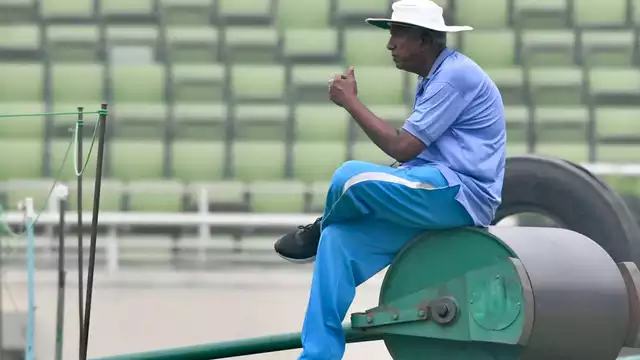
Curator Gamini de Silva is a familiar name in Bangladesh’s cricket fraternity, best known for preparing the low and slow wickets at the Sher-e-Bangla National Cricket Stadium. Many believe he was one of the key architects behind Bangladesh’s Test wins over England and Australia, working alongside then head coach Chandika Hathurusingha, whose plans proved too difficult for the visitors to handle. After 16 years of service, Gamini has now left Bangladesh, and before his departure he sat down with Cricbuzz to share his side of the story.
Here are the excerpts:
How was the chemistry between you and Hathurusingha? It was a major talking point because both of you made important contributions to Bangladesh cricket, including the England win, the Australia win and several others. How do you look back on that period?
Hathurusingha is a good friend of mine. We played together when we were around 14 or 15. After I retired, I started umpiring in Sri Lanka while he was still playing. Later, when I became a curator in Sri Lanka, he was coaching clubs and the Sri Lanka A team. After I came here, he came here as the Head Coach. So it was very easy to work with him because we understood each other’s needs. I followed what he said because I knew he was not saying it for his own benefit. He wanted to develop cricket and the main aim was to win matches. Once we started winning, the whole world realised that Bangladesh cricket was improving. We won at home and we won abroad as well. That was the change. Working with him was very easy.
You are often criticised for many things. I want to clear up one point. The wicket or the pitch, you prepare it based on what the team management wants. Is that correct?
The correct words are home board advantage. When I studied the curator course in England, the manual also clearly said that home board advantage is always there when you play cricket at home.
So the captain wants it, the coaches want it, and you prepare the pitch accordingly?
I have to. As you said, it is not my personal property. The advantage should be with the home team.
There has also been criticism that by preparing these kinds of wickets, you have damaged Bangladesh’s batting. Do you agree?
When we played and practiced, and when we worked on different scenarios, I prepared the practice pitches exactly the way the players wanted. Whatever they needed for match preparation was specifically for the match. If they wanted a practice surface with extra bounce or a grassy track, I arranged that. When they were about to tour other countries, I prepared practice wickets similar to what they would face abroad. So the practice conditions were always created according to their needs before they travelled.
Another major criticism during your tenure was that some players complained you did not allow them to practice. How do you respond to that?
The players have contracts with the BCB. The board pays their salaries every month, and my job is to fully look after them. Whatever they asked for in terms of practice, I arranged it. But if someone is not under contract, what can I do? I cannot give them a contract myself. When a player is under contract, I am fully with them.
How do you see the facilities in Bangladesh cricket?
The facilities are okay, but the grounds need to be developed. The number of tournaments is increasing, but the number of grounds is not.
And is that why the Mirpur wicket suffers, because it is overused?
If you visit the academy ground on any day, you will find a team playing. One team finishes, another starts. The ground stays busy throughout the year, and the national team often uses it as well. Earlier, we had only red-ball cricket, but now there is white-ball cricket too. In the past, there was just one team. Now we have three: one each for Tests, ODIs and T20s. Earlier, the same players played all formats, but now it is divided, which means the game has expanded. Before, we needed only one pitch. Now we need three. So the only solution is to increase the number of grounds and pitches.
How many days in a year is the Mirpur ground used for matches?
Let me give you an example. Melbourne was built 148 years ago, and in all that time it has hosted only around 160 matches. In comparison, Mirpur has hosted 218 international matches in just 19 years. Can you believe that? This is the number one ground in the world in terms of international matches played in such a short period. I managed all of that. If I had said no, what would have happened? Where would Bangladesh cricket be? The ICC might have questioned whether we had enough grounds or whether we could even prepare pitches suitable for international cricket. But I did everything on behalf of the Bangladesh Cricket Board. I did not look for anything else, I just did my job. That is why I am happy. I think most people in Bangladesh will also be proud that, in such a short time, we have hosted more international matches here than anywhere else. That is how it was made possible.
There is a belief that you used dead grass on wickets. Is that correct?
Yes. We studied this. If your pitch has no grass, it becomes only clay. If you play a match on pure clay from the very first ball, the pitch is finished immediately.
Why could grass not be grown here?
When you play a Test match, a single pitch endures around 90 overs a day for five days. By the end of that, the surface and the grass lose all their strength and need at least two months to recover. During that period, we use the other pitches for matches while keeping some covered to protect them. That makes daily preparation extremely difficult, especially for the pitch that has just been used.
The grass roots also need to grow at least three to four inches deep to hold the clay together. If the roots are not deep enough, the surface breaks apart. It is not an easy job. As curators, we always monitor the weather forecast to decide how much water to apply. Sometimes the forecast says only a 20 percent chance of rain and then it rains the whole day, and that completely changes how the pitch behaves.
At times we plan for a pitch to start turning after three and a half days, so we keep some moisture in it for the first few days. But when the sun is too strong, the moisture disappears quickly and the ball starts turning from day two. These things are beyond our control. Sunlight and weather can completely alter our plans. No curator in the world can claim to be 100 percent successful. Anyone who says that is lying, because conditions change everywhere.
Do you talk to Litton, Miraz or Shanto before a game?
They are happy. They come and look at the pitch and say, “Oh Gamini, this one is for me. Thank you.” And then they get the results. That is why I am happy. They are performing, and they are world-class now.
Around the world, certain grounds naturally suit certain types of bowlers. In India some venues favour spin, while in England and Australia some are known for pace. Do you think the same logic should apply to Mirpur, that it is naturally a spin-friendly venue and should be left that way instead of constantly trying to change it? And if Bangladesh need to prepare for conditions like South Africa, should those matches simply be scheduled in Chittagong or Sylhet instead of trying to make Mirpur something it is not?
That should be the way, yes. As I have said before, the first thing we need to do is increase the number of grounds. If we have more venues, we can manage everything properly. For example, if we want to prepare a high-bounce track, we can do it here. That is not the issue. The real issue is the lack of grounds.
If Purbachal becomes fully operational, it will help a lot. Unfortunately, Fatullah went under water and we lost two venues there. Right now, almost all our domestic tournaments depend on Mirpur. During the BPL, all eight teams practise here. We have 20 to 30 matches every year, and the ground is used for nearly a month just for that tournament. On top of that, there are four-day games, the National League, international matches, high-performance camps and now women’s cricket as well. We have to accommodate everyone. I cannot simply say no, because where will they play?
As a curator, you have to understand the facilities available. When I came here in 2009, I studied what facilities existed and how much cricket was being played. Over the years, the number of teams and tournaments has grown. We now have three formats, and each one requires its own preparation. All three teams often have to train at the same venue, which creates challenges. If we had more wickets and more grounds, it would be manageable. That is how other countries do it. They have enough facilities to spread the load.
But do you think the overall environment also plays a big role in preparing a wicket? Would bringing clay or materials from far outside the country really produce the desired results?
Our locally available black clay in Bangladesh contains a bit more sand. So during the hot season, it becomes very difficult to maintain the pitch without grass.
Will it help bringing clay thing clay from outside?
I proposed this in 2011. All the paperwork was completed, but the government did not grant permission due to environmental and other issues. Bringing clay from outside would be a good solution. Pakistan has very good clay, and Dubai also uses Pakistan clay, which many countries import. That clay is better than what we have here. Another problem is that in Bangladesh, there is only one supplier of black clay, and sometimes he says it won’t be available that year.
[Cricbuzz]



Sri Lanka’s share of the T20 World Cup will go ahead without disruption despite a recent cyclone and severe flooding that left large parts of the country battered and bruised.
Tournament organisers confirmed that matches scheduled in the island nation will proceed as planned, with Sri Lanka co-hosting the sport’s showpiece event alongside India. Three venues in Sri Lanka will stage games during the competition.
Sri Lanka is set to host 20 of the 55 matches in the tournament. Should Pakistan advance deep into the competition, the island will also stage a semi-final and the final, as Pakistan are unable to travel to India due to long-standing political tensions between the neighbours.
On November 27, cyclonic storm Ditwah swept across Sri Lanka and several other South-East Asian countries, bringing daily life to a grinding halt. Flooding and landslides claimed at least 634 lives, with more than 200 deaths reported in the central city of Kandy.
A recent inspection of facilities in Kandy, however, allayed fears, with authorities giving the ground the all-clear after confirming that damage was minimal.
“We are happy with the progress we have made and it is going to be a superb event,” an official involved in inspecting the Pallekele Stadium told Telecom Asia Sport. “Sri Lanka has hosted ICC events before with great success and we have no doubt this tournament will be another feather in our cap. Kandy has been cleared, as have the other two venues.”
Work is also nearing completion at Colombo’s Sinhalese Sports Club ground, where floodlights are being installed ahead of five scheduled matches. The capital’s R. Premadasa Stadium will host the bulk of the fixtures, including the blockbuster India–Pakistan clash on February 15.
“There has been huge demand for tickets for the India–Pakistan game,” the official said. “We expect a surge of tourists into Colombo around that fixture, which will provide a significant boost to the economy. Travel companies have already rolled out special packages and we anticipate full houses for several marquee games. India–Pakistan is the main attraction, no doubt, but matches like Sri Lanka versus Australia are also keenly awaited.”
Sri Lanka recently staged several Women’s World Cup matches, some of which were affected by rain. Organisers, however, are confident the weather will stay out of the contest this time, with February and March traditionally dry months in both Colombo and Kandy. (www.telecomasia.net)

Maliban Biscuits has announced a partnership with rising motorsport talent Yevan David, as he prepares to compete on the international stage in the 2026 FIA Formula 3 Championship.
At just 18, Yevan has emerged as one of Asia’s fastest-rising drivers, competing across some of Europe’s toughest circuits and creating history as the first Sri Lankan to race in the FIA Formula 3 Championship. This partnership brings together a young athlete redefining what’s possible for Sri Lanka in global motorsport and a homegrown brand that has consistently backed Sri Lankan ambition on the field, on the track, and beyond.
Yevan’s racing story began in go-karts, starting with early laps at the Sri Lanka Karting Circuit before moving into competitive karting in Singapore, where he quickly started stacking international results, including winning the IAME Asia Series (X30 Cadet) and the X30 Asia Cup. After graduating from karts, he stepped into single-seaters in 2024 across UAE F4, Spanish F4 and Eurocup-3, then announced himself in Europe by winning twice on his Euroformula Open debut weekend at Monza. In 2025, he underlined that momentum by taking the Euroformula Open Rookie title and finishing second overall, cementing his status as one of the most compelling young talents to emerge from Sri Lanka onto the global grid.
Commenting on the partnership, Yevan David said:
“Partnering with Maliban means a lot to me. They’ve supported Sri Lankan sport for generations, so having them beside me as I take this next step feels special. I’m proud to carry our flag forward with a brand that believes in our country’s potential as much as I do.”
Over the years, the brand has stood firmly behind Sri Lanka’s sporting journey across every level of competition, supporting the New Zealand U85kg Rugby Tour of Sri Lanka on the international stage, strengthening hockey at school level, backing the Sri Lanka U19 Women’s Cricket Team, supporting the U20 Men’s and Women’s rugby teams, championing Sri Lanka Rugby at the Asia Rugby Qualifiers and powering the Inter Club Rugby League and Clifford Cup Knockout Championship 2025/2026. This continued investment reflects a long-term commitment to building opportunity, confidence, and national pride through sport.
With Maliban’s support, Yevan’s journey to the FIA Formula 3 grid becomes more than an individual milestone, it becomes a national statement of belief and progress. Together, Maliban and Yevan will carry Sri Lanka’s flag into every corner, every lap, and every finish line he chases in 2026.

Lumbini were strongly placed after Nikil Abilash and Kisandu Dulneth put on a first wicket stand of 128 runs in reply to Isipatana’s 190, but a sudden collapse saw them end day one at 144 for five wickets in the Under 19 traditional encounter at Colts ground.
At Campbell Park, spinner Chaniru Senarathne produced figures 22-3-55-5 for Trinity in the traditional encounter against Wesley.
In an Under 19 Division I Tier ‘A’ cricket enountet at Bambalapitiya Savi Fernando and Asadisa de Silva put on an unbeaten 90 runs stand for the second wicket to help St. Peter’s reach 93 for one wicket at stumps in reply to DS Senanayake’s 241 on day one.
Asadisa was unbeaten on 53 after having faced 98 balls for his knock which included five fours and a six.
Match Scores
DSS 241, St. Peter’s 93/1 at Bambalapitiya
Scores
DSS
241 all out in 58.5 overs (Bihan Gamage 40, Shevan Welgama 66, Randisha Bandaranaike 29, Chithum Baddage 27; Sadeesha Silva 2/62, Janith Panditharathna 3/77)
St. Peter’s
93 for 1 in 33 overs (Savi Fernando 32n.o., Asadisa de Silva 53n.o.)
Wesley 200/9 decl., Trinity 40/1 at Campbell Park
Scores
Wesley 200 for 9 decl. in 78 overs (Rasheed Nahyan 43, Rashmika Amararathne 36, Methnula Mayadunna 37n.o.; Chaniru Senarathne 5/55)
Trinity
40 for 1 in 15 overs
Isipatana 190, Lumbini 144/5 at Colts
Scores
Isipatana 190 all out in 57 overs (Navidu Umeth 33, Yuveen Keshan 48, Janith Selaka 54; Yashod Kavindu 4/57, Dinal Sewmina 2/10)
Lumbini
144 for 5 in 38 Overs (Nikil Abilash 62, Kisandu Dulneth 57; Menula Dambakumbura 3/15, Thithira Sansira 2/30)
by Reemus Fernando

PM meets UN Resident Coordinator

Showers may occur in the Uva and Eastern provinces and in Matale, Nuwara-Eliya, Polonnaruwa and Hambantota districts.

Suspension of Indian drug part of cover-up by NMRA: Academy of Health Professionals

Dr. Jayatissa visits India amidst Ondansetron controversy

Inquiry launched into burnt elephant death at Seeppukulama as toll mounts

Members of Lankan Community in Washington D.C. donates to ‘Rebuilding Sri Lanka’ Flood Relief Fund

‘Dates have the highest sugar content to fight Coronavirus’

Sunday Island 27 December – Headlines

#SundayIsland 17th December – Headlines

Sunday Island – 28th March

Sunday Island Headlines – 21 March

Sunday Island – 21st February – Headlines
-

 Midweek Review6 days ago
How massive Akuregoda defence complex was built with proceeds from sale of Galle Face land to Shangri-La
-

 News5 days ago
Pope fires broadside: ‘The Holy See won’t be a silent bystander to the grave disparities, injustices, and fundamental human rights violations’
-

 News5 days ago
Pakistan hands over 200 tonnes of humanitarian aid to Lanka
-

 Business4 days ago
Unlocking Sri Lanka’s hidden wealth: A $2 billion mineral opportunity awaits
-

 News6 days ago
Burnt elephant dies after delayed rescue; activists demand arrests
-

 Editorial6 days ago
Colombo Port facing strategic neglect
-

 News4 days ago
Army engineers set up new Nayaru emergency bridge
-

 News6 days ago
Sri Lanka, Romania discuss illegal recruitment, etc.