
News
FSP picks holes in Trinco Tank Farm deal

By Rathindra Kuruwita
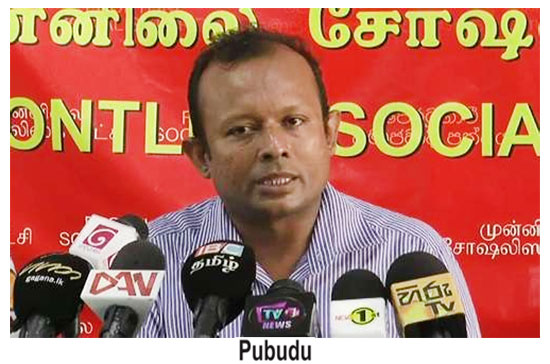
An agreements signed on Thursday night to develop the Trincomalee Oil Tank Farm as a joint venture between Ceylon Petroleum Corporation (CPC) and Lanka IOC was illegal and Sri Lankans should not accept them, Education Secretary of the Frontline Socialist Party (FSP), Pubudu Jayagoda said yesterday.
Jayagoda said that usually such agreements had three parts, – lease agreement, a modalities agreement and an agreement on the joint venture company, i.e. Trinco Petroleum Terminal Ltd. However, only the modalities agreement had been presented to the Cabinet in late December and it was that agreement the Cabinet approved on 03 January 2022, he said
“Did the government sign the lease agreement too? From what we hear, a lease agreement was signed on Thursday night. However, the Governor of the Eastern Province needs to sign the agreement for this lease agreement to be valid and legitimate. Since the Governor had not signed the agreement, the lease agreement is not legitimate and the entire agreement is null and void without a lease agreement. So we would like to tell Sri Lankans that there is no reason for us to accept or respect this agreement,” he said.
On Thursday night the lease agreement was signed and the signatories were Treasury Secretary, Land Commissioner General, Ceylon Petroleum Corporation (CPC), LIOC and Trinco Petroleum Terminal Ltd., the Minister of Energy Udaya Gammanpila said in a Tweet.
The Education Secretary of the Frontline Socialist Party said that the government had started to sign important agreements in the middle of the night. Earlier an agreement was signed, in the middle of the night, with US based, New Fortress Energy to transfer 40% of Yugadanavi shares and to handover the monopoly over the supply of LNG, he said.
“These strategically important agreements that have significant impact on our lives are not even presented to the Cabinet, let alone the people. These agreements are against our constitution and the law,” he said.
Jayagoda said given that the people had no access to the full agreement, they had to depend on the statements made by Minister Gammanpila. However, most of the statements the Minister made were false, he said.
“The Minister claims that agreements in 1987, 2003 and 2017 had already granted India the access to the old tanks in Trincomalee. These claims are contradictory. If the 1987 agreement had given the tanks to India, why sign another one in 2003 or 2017. Despite the Minister’s claims, there was no formal agreement to hand over 14 tanks to India in 2003, he said. A MoU was signed, but a formal agreement was never executed. The 2017 agreement between India’s Sushma Swaraj and then Minister Malik Samarawickrama too was only a MoU. So, IOC was holding these tanks illegally. However, when this agreement is signed it will formally have these tanks. The Minister also claims that the 1987 Indo-Sri Lanka accord earmarked these tanks for Indian use. However, the agreement only states that if we develop these tanks with a foreign partner that partner will have to be India. So Gammanpila is bending facts,” he said.
Jayagoda pointed out that it was now widely acknowledged that Sri Lanka didn’t sign the Indo-Lanka agreement voluntarily. India twisted the arm of then President J.R. Jayewardene to make him agree. The agreement did not even have clauses on what steps to take if one party violated the agreement, he said.
“The agreement had been violated so many times and it is a joke to say that we are adhering to a non-existent clause of this agreement. There really is no reason why we should accept the accord at all,” he said.
The current agreement signed on Thursday allows LIOC to make changes to the structures in the tank farm, Jayagoda said. The 2003 agreement only allowed IOC the use of the tanks.
“This is why this is a more dangerous agreement than anything signed in 1987, 2003 or 2017. Moreover, the agreement states that Sri Lanka can’t enter into agreements with other companies to operate in the tank farm for another decade. The worst part is that under the 2003, any issue that arises between the two parties could be solved by Sri Lankan law but the 2022 agreement says that we have to go before arbitration courts in Singapore to settle any dispute. Our previous performances before arbitration courts have been less than stellar,” he said.

News
Establishment of an Institutional Framework to Inagurate Upper Hydro Catchment Areas Management Authority

Policy approval of the Cabinet of Ministers was granted at their meeting held on 08.06.2026 to establish the Upper Hydro Catchment Areas Management Authority for identification and
execution of a formal and long – lasting remedy to secure the central hills including the upper hydro catchment areas enabling them to sustain amidst extreme weather conditions
due to natural calamities and human activities as well as to be used for the sustainable development of the country.
Accordingly, a concept paper has been prepared including
institutional structure, activities, powers, active subject area as well as administrative and coordination mechanism for the proposed authority by an expert technical committee appointed by the Secretary to the President.
Based on the said concept paper, the Cabinet of Ministers granted approval to the resolution furnished by the President to instruct the Legal Draftsman to prepare a draft bill including legal provisions required for the establishment of Upper Hydro Catchment Areas Management Authority.
News
Introduction of Flora and Fauna (Regulation of actions of the Indigenous Community within the nominated areas) Regulations
With the objective of securing the traditional livelihood and the eco system of the indigenous community, it has been recognized the necessity of introducing a formal regulation methodology to secure their engagement in livelihood activities by being more sensitive to the existing laws.
Thereby, the Fauna and Flora (regularizing) regulations under the Fauna and Flora Protection Ordinance (Authority 469) have been prepared so that nominated activities within the prescribed area to a member of the indigenous community
who has been registered for securing the rights acquired from law or custom or usage or traditional stance to execute an act within a certain state land that is fundamental to the survival of the indigenous community permission can be granted
Accordingly, the Cabinet of Ministers granted approval to the resolution furnished by the Minister of Environment to publish the said regulations in the government gazette notification and thereby submit to the Parliament for its concurrence.
Latest News
M. M. D. J. Senarathne, appointed Director General of the Department of National Botanical Gardens
The Cabinet of Ministers approved the resolution furnished by the Minister of Environment to appoint M. M. D. J. Senarathne, who is the senior most officer in Grade I of Sri Lanka Scientific Service se

Establishment of an Institutional Framework to Inagurate Upper Hydro Catchment Areas Management Authority
Introduction of Flora and Fauna (Regulation of actions of the Indigenous Community within the nominated areas) Regulations
M. M. D. J. Senarathne, appointed Director General of the Department of National Botanical Gardens

Harmanpreet Kaur steps down as India captain

Turkiye, Pakistan agree Saudi Arabia military deployment under Mecca pact

Rumesh Tharanga among nominees announced for World Athlete of the Year 2026

‘Dates have the highest sugar content to fight Coronavirus’

Sunday Island 27 December – Headlines

#SundayIsland 17th December – Headlines

Sunday Island – 28th March

Sunday Island Headlines – 21 March

Sunday Island – 21st February – Headlines
-

 Latest News7 days ago
Gold winner Tharanga gets brand-new Honda Vezel from SLAAJ
-

 News6 days ago
US-assisted ‘Ice’ detection: NPC to examine IGP’s move to transfer drug-busting team
-

 Features7 days ago
Why Sri Lanka needs an Inclusive Civic Nationalism – urgently
-

 Editorial5 days ago
Colombo Port drug bust: The plot thickens
-

 News7 days ago
Civil society activist accuses govt. of favouring Ven. Gnanasara
-
 Midweek Review7 days ago
Dappula’s Easter Sunday ‘grand conspiracy’ claim demolished
-

 Editorial7 days ago
When crime bosses rise above law and shrines
-
Editorial6 days ago
Drug busting, transfers and trust deficit