
News
FSP calls on people to oust govt.


By Saman Indrajith
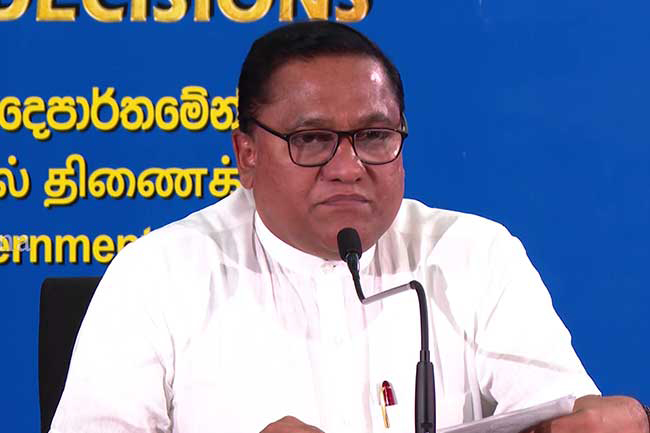
The Frontline Socialist Party, on Tuesday, said that people had no option but to take to the streets to chase out the incumbent government. “The government has not learnt that people engage in protests because they no longer can put up with hardships. We have no other option but to beat off this government. Ranil Wickremesinghe says that he has no home to go. He should not go home, he should be sent to a prison for the crimes he had committed,” FSP Education Secretary, Pubudu Jayagoda, told a press conference held in Colombo.
Jayagoda said that farmers, fishers, workers, students, women and peasants are rising up against taxes and suppression by the government and his party would support their struggle to drive out this government. Those engaged in the fisheries industry find it hard to survive because of the fuel price hike. Crisis in the fishing industry started with the price increase on a litre of kerosene from Rs 87 to Rs 340. During the time of Mahinda Rajapaksa kerosene price was increased by Rs 140 and the fishers took to the street, protesting, and Anthony Fernando, of Chilaw, was shot during such a protest and the government had to bring down the price.
“A boat with a 50 litre capacity has to spend around Rs 29,000 before it is put to sea. The kerosene cost comes around Rs 17,000, lubricants Rs 5,000, baits and lures Rs 5,000 and food for at least three fishermen at Rs 2,000. A boat with 20 litre capacity has to spend around Rs 10,000 a day. This is without the cost for ice. The price of ice that had been at Rs 250 now went up to Rs 600. There are boats with 9.9 to 15 horsepower that need at least 15 litres of kerosene and such boats do not go to deep sea. The ones that go far have 25 horsepower and they need 30 liters while only the vessels of 30-40 horsepower can go into deep seas and they need 50 to 60 litres of fuel.
Fisheries industry is on its death throes. “The situation is worse when it comes to multiday fishing trawlers. There are around 6,000 such vessels. They use diesel. A vessel that spends around 45 days in the deep sea cannot be put to sea without spending around Rs 10 million. People can no longer afford to eat fish. The government has to take immediate action to allocate fuel to the fishing industry, immediately save the jobs of 100,000 engaged in the industry and to fight against malnutrition. In that context, the government has increased the fuel quota of MPs from Rs 100,000 to Rs 200,000 and added many ministers. Every minister gets six vehicles. Each gets 750 litres of petrol. If he has three petrol vehicles he gets 2,250 petrol liters a month. More than Rs one million government money is spent for that. Each minister gets 600 litres of diesel per one vehicle and with three vehicles he gets 1,800 litres per month and the government pays around Rs 700,000 per month. Instead of saving the dying fishing industry this is what the incumbent government does,” Jayagoda said.
Jude Namal from the Fisher Organisations Collective, M Wijendran of the Independent Fisher Activists Committee and W Maximan for the Fisher Workers Association also addressed the press conference.



A group of Tamil Progressive Alliance (TPA) members, including its Leader Mano Ganesan, met President Anura Kumara Dissanayake on Thursday (02) morning at the Presidential Secretariat.
Extensive discussions were held on the issues faced by the Malayagam communities, particularly in relation to education, housing and land, as well as on the urgent measures required to address these concerns. The President paid special attention to all these matters.
Attention was also drawn to the recruitment of qualified Tamil-medium teachers to address the teacher shortage in estate sector schools and this too was discussed at length.
Members of Parliament P. Digambaram and V. Radhakrishnan, along with several other party members, were present at the meeting.
Minister of Foreign Affairs, Vijitha Herath, held talks with Deputy Foreign Minister of Russia Andrey Rudenko at the Foreign Ministry, in Colombo, on Thursday (02), with both sides reaffirming their commitment to strengthening bilateral relations.
The Sri Lanka Ministry of Foreign Affairs said the visiting Russian Deputy Minister noted that Russia regarded Sri Lanka as a long-standing friend.
Rudenko assured that Russia stood ready to support Sri Lanka when required, including in the swift supply of Russian oil to help address the current energy challenges, encouraging Russian investors to explore new opportunities in the country and promoting increased tourist arrivals.
He also expressed Russia’s readiness to provide compensation for Sri Lankan war veterans who had lost their lives in the ongoing conflict between Russia and Ukraine.
Minister Herath welcomed Russia’s willingness to assist, emphasising that Sri Lanka valued the support extended by its “old friend”, particularly at a time when the country was facing pressing energy needs.
He noted that the two countries shared nearly seven decades of diplomatic relations and said the present moment provided an opportunity to further strengthen ties, including through long-term trade agreements.
The discussions focused on enhancing cooperation in the fields of energy, investment, tourism and diplomacy, with both sides reiterating their commitment to further deepen the longstanding friendship between Sri Lanka and Russia.

Police yesterday arrested 157 foreign nationals in connection with an alleged organised online financial scam, conducted from a hotel in the Iranawila area in Chilaw.
The suspects were taken into custody during a raid carried out by the Police while they were staying at the hotel in Iranawila.
Police said the arrested group included 143 nationals from China, 13 from Bangladesh and one from Vietnam.
Investigators suspect the group had been involved in a coordinated online financial scam, targeting victims through digital platforms.
The suspects are being detained for further questioning while investigations are continuing to determine the full extent of the operation and whether additional individuals were involved.Police said further inquiries are underway.
By Norman Palihawadane

Iran executes two convicted members of banned opposition group

Afghanistan earthquake kills eight members of same family

Breakdown of the teams and groups of the FIFA World Cup in Canada, Mexico and the US after the final playoffs

365 US service members injured since start of Iran war – Pentagon

World Cup 2026: Italy’s football chief resigns after qualifying failure

Iran says it downed two US jets as search for one pilot continues

‘Dates have the highest sugar content to fight Coronavirus’

Sunday Island 27 December – Headlines

#SundayIsland 17th December – Headlines

Sunday Island – 28th March

Sunday Island Headlines – 21 March

Sunday Island – 21st February – Headlines
-

 News2 days ago
2025 GCE AL: 62% qualify for Uni entrance; results of 111 suspended
-

 News4 days ago
Tariff shock from 01 April as power costs climb across the board
-
 News5 days ago
Inquiry into female employee’s complaint: Retired HC Judge’s recommendations ignored
-
 Features6 days ago
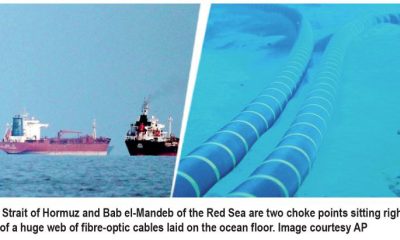
When seabed goes dark: The Persian Gulf, cable sabotage, and race for space-based monopoly
-

 Features5 days ago
New arithmetic of conflict: How the drone revolution is inverting economics of war
-

 Business3 days ago
Hour of reckoning comes for SL’s power sector
-

 Editorial2 days ago
Search for Easter Sunday terror mastermind
-

 Sports5 days ago
Sri Lanka’s 1996 World Cup heroes to play exhibition match in Kuala Lumpur