
News
FM says there was no outright sale of Colombo Port East Terminal to Indian company


“We should have acted more prudently on SLMC issue’
by Saman Indrajith
Responding to criticism on moves to hand over the East Terminal of the Colombo Port to India’s Adani Group, Foreign Relations Minister Dinesh Gunawardena, said that the government has not opted for the outright sale of national assets, but it should be borne in mind that many types of companies have to be considered when it comes to foreign investment.
“There are companies which provide management services and also firms that come as partner companies. We have not gone for outright sale of assets. We try to protect what we have and maintain our existing market, but we have to look 20-30 years ahead to remain globally competitive”, the Minister said in an interview with The Sunday Island.
Deals such as signing of the Hambantota port agreement by the previous regime would not happen under this government, he assured.
Asked about the controversial sacking of the president and four members of the Sri Lanka Medical Council (SLMC), the Minister said: “I think we should have acted more prudently. It is one of those institutions manned by leading members of the medical profession in the country. We, as a party, had disagreements with the SLMC, but we never approved the way the members were removed”.
Q: However, the government stands accused in some quarters of doing exactly what it vehemently opposed when in the opposition.
There are ways to look at these issues. Take the withdrawal from the UNHRC resolutions, as an example. If we had given into pressure, it could have resulted in losing almost everything, but we stood up against it. Then it was said that our stand against it would distance Sri Lanka from the international community.
Nothing of the sort happened. Take the Millennium Challenge Corporation (MCC) agreement issue as another example. We opposed it. Now, the US has announced that it would not proceed with it. Even the leader of the opposition now says he’s against it. These things will take their own time but at the end nothing detrimental will happen to our national interests. We are reviewing some projects that are stuck in the state sector. We have also suspended some projects.
There are some limitations to progress. The President has made a decision that we must end the sin of producing thermal power. The losses incurred have been a huge burden on the treasury. We have options now to move from hydro power to other renewable options to generate electricity.
Q: What is your assessment of the current political situation?
The people gave an unprecedented mandate to President Gotabaya Rajapaksa and our government because they have trust and confidence in our ability to deliver and our unwavering commitment when it comes to national security.
The composition of the opposition also changed because never in history have the people voted the UNP out of parliament. There were times when they voted out UNP governments but not the entire party. Some of those who had been in the UNP having realized the cardinal mistakes their party made left it to join other parties or to form new parties. The opposition missed the opportunity of working with the government for the sake of the country even after the President expressed his readiness to work with them.
When the new government came to power following the presidential election victory in November 2019, there were a lot of arrears to be settled and loan commitments of the former government to be honored. So we submitted to parliament a supplementary estimate for the purpose of cleaning up the mess they had created. Instead of supporting us, they plotted till the last moment to put the government in difficulty.
The President understood their intentions and decided to call for a general election as soon as he could. In that election, we received an overwhelming mandate from the people. The electoral results of the North also changed this time. The TNA campaigned as the ‘one and only representative of the Tamil people’, but the people of the North this time sent some elected members from new parties.
An entirely new situation has been created in the polity and we have a clear and strong mandate to solve any issue democratically under Prime Minister Mahinda Rajapaksa’s government. We, as a government have identified our responsibilities and obligations, to develop the country in the next five years.
Q: The confidence of the people you once commanded seems to be eroding fast in the context of surging Covid-19 pandemic situation.
The masses have reposed tremendous confidence on us. That public confidence got a boost following both local and international accolades we won by successfully managing the pandemic. Coronavirus is a problem affecting the whole world. The world will never return to the pre-Covid-19 economy again. The post-Covid situation will be different from country to country and region to region on the basis of economic survival factors.
We faced the general election under the corona threat. At that time too, the opposition said we had lost the popularity we commanded. But, at the presidential polls, the government won impressively with a two-thirds majority. Once again, there is criticism against the government. While accepting the fact that there is criticism, we must also assess from what quarter such criticisms emerge.
The Gotabaya Rajapaksa government does not have wavering policies. Our policies on foreign relations and national security are not shaky, but are on firm ground. The criticism comes from those who did not have such policies. So it is reasonable for them to make statements that the confidence of the people in us is eroding, but the truth is far from it.
Q: The MEP is one of the very old parties in the ruling coalition. What is the role of the MEP in the present context?
The MEP in its long existence as a political force has always fought for upholding national interests. We gave priority to sovereignty and territorial integrity of the country and to protect national interests. There is no change in that standpoint. Some parties now in the opposition did not accept the value of giving priority to national interests in the past but they too have been compelled to change their standpoints. We are a democratic party. We never took to arms. We, as a party, worked for the protection of all, including those who took up arms at one time and later abandoned it. We continue to stand for the promotion of an indigenous and local economy and local entrepreneurs.
Since its inception, our party we fought for the rights of the local entrepreneurs as we believe they should have a share in the national economy and that share should be increased. We also advocate the strengthening the public sector.
Q: It is claimed that cracks are appearing in the SLPP coalition as some of its partners are divided in opinion and unhappy particularly over the SLMC and the PUSCL issues.
We have a common program and a common objective. We have agreed on issues such as safeguarding national security, economic development, working for the betterment of the common man etc. For example, we will not let the national economy end up in the hands of a few. We have seen in the world how the economies of many countries similar to ours have been taken over by a few companies. Ours is a coalition government with many parties represented. They have freedom to make statements and express their opinions on various issues. It is a natural phenomenon the worldover. Many countries in the world today are governed by coalition governments. Member parties have the independence to maintain their diversity. It is democratic to maintain that diversity.
There is no issue big enough to break up this coalition. If you remember there were many disagreements when the 20th amendment was introduced, but everybody united in the end to see it through.
Q: There are concerns being raised about the provincial council election.
For any election, the existing electoral system has to be changed first. It has been accepted that the existing electoral system is a waste of public funds. There is consensus among all parties to do away with the existing electoral system. Apart from that, those in the government and the opposition mentioned in their manifestos that a new electoral system will be introduced.
When the time was up to conduct fresh provincial councils elections, the then (UNP) government brought a new bill against it. It also got the JVP and TNA to vote against holding elections. Following our opposition, the then speaker suspended parliament sittings to seek the advice of the then Attorney General, who is the incumbent Chief Justice. The Attorney General was of the view that if the government wanted to push ahead with some sections of the bill, then it would require two-thirds majority in parliament. The government of the day did not have two-thirds majority.
They waited till some MPs returned from abroad and rushed them to Parliament. The government also got the TNA and the JVP to vote with them. That was how they got the bill passed. Some of our new MPs do not know how this chaos was created. It was their creation. Now we cannot hold the elections as per the provisions of that bill. Scrapping that law does not activate the previous law. There is a need to bring about new laws which may take months.
Q: How do you see the UNHRC resolution against Sri Lanka, which was co-sponsored by then government?
While we were in the opposition, we said the resolution was detrimental to our national interests. The Yahapalana government used its vote against the country. It was against the constitution of the country. It also had an idea of contributing to the agenda to convert the country into a federal structure of governance. There are many inquiries from various countries and asking us what we have done after withdrawing from the resolution and results it produced. We have presented facts to support our decision.
Lord Naseby, the Honorary President of The All Party Parliamentary British Sri Lanka Group, said in the British House of Lords that the way the UK had acted with regard to Sri Lanka was wrong and if it continues to do so, that is also wrong. We have friendly countries; I think all countries are our friends.
Q: On foreign relations, where do we stand now?
The President, the Prime Minister and I visited India prior to the worsening of the coronavirus pandemic. The situation with regard to foreign relations is not what many have perceived to be. The Chinese Foreign Minister visited Sri Lanka followed by the Foreign Ministers of Russia. Japan and Pakistan. The US State Secretary also came here. The UK Foreign Minister spoke to us several times. All of them pledged their support to develop the country. The propaganda spread by the opposition is not the real story.
Q: There is speculation of a cabinet reshuffle in the offing.
I never worked for positions or to protect positions. We never engaged in politics with a power hungry motive. It is those who crave for power that somersault.



Latest News
Landslide Early Warnings issued to the Districts of Badulla, Kalutara, Kandy, Kegalle, Kurunegala, Matale and Monaragala


The National Building Research Organisation (NBRO) has issued landslide early warnings to the districts of Badulla, Kalutara, Kandy, Kegalle, Kurunegala, Matale and Monaragala effective untill 2100hrs on 12th May 2026.
Accordingly,
Level II landslide early warnings have been issued to the divisional secretaries division and surrounding areas of Passara in the Badulla district.
Level I landslide early warnings have been issued to the divisional secretaries divisions and surrounding areas of Bandarawela in the Badulla district, Walallawita in the Kalutara district, Pasbage Korale, Akurana, Gangawata Korale, Panvila, Yatinuwara, Ganga Ihala Korale, Doluwa and Udapalatha in the Kandy district, Mawanella, Bulathkohupitiya, Yatiyanthota, Aranayaka, Kegalle and Rambukkana in the Kegalle district, Rideegama in the Kurunegala district, Rattota, Naula and Ambanganga Korale in the Matale district and Badalkumbura and Wellawaya in the Monaragala district.
News
Showers about 100 mm are likely at some places in the Western, Sabaragamuwa, Central, Uva, Southern, North-western, Northern and North-central provinces and in Trincomalee district.

WEATHER FORECAST FOR 11 MAY 2026
Issued at 05.30 a.m. on 11 May 2026 by the Department of Meteorology
The low-level atmospheric disturbance in the vicinity of Sri Lanka is likely to develop into a low-pressure area around the next 36 hours. Therefore, the prevailing showery conditions over the island are expected to continue during the next few days.
Showers or thundershowers will occur at times in most parts of the island and Cloudy skies are expected, under the influence of the aforementioned system. Heavy showers about 100 mm are likely at some places in the Western, Sabaragamuwa, Central, Uva, Southern, North-western, Northern and North-central provinces and in Trincomalee district.
The general public is kindly requested to take adequate precautions to minimize damage caused by temporary localized strong winds and lightning during thundershowers.

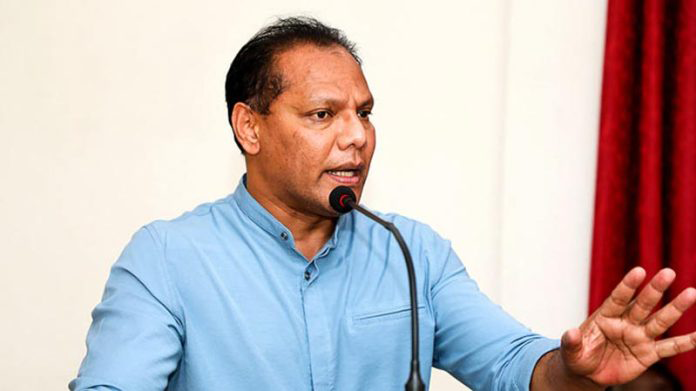
SJB MP Dayasiri Jayasekera has sought the intervention of the Inter-Parliamentary Union (IPU) to pressure the JVP-NPP government to respect the rights of the Opposition.
MP Jayasekera told The Island that they wouldn’t allow the NPP to suppress the truth regarding the theft of Treasury funds amounting to USD 2.5 million. He accused Speaker Dr. Jagath Wickremaratne of depriving the Opposition of its legitimate rights, at the behest of the government.
Jayasekera said that the Speaker’s conduct regarding the action taken against Deputy Secretary General of Parliament Chaminda Kularatne, too, had been brought to the notice of IPU and other international associations.
The text of MP Jayasekera’s letter to the Secretary general of IPU: “I respectfully submit this petition seeking the attention and intervention of the Inter-Parliamentary Union concerning a matter affecting parliamentary accountability, the rights of elected representatives, and the proper functioning of constitutional oversight within the Parliament of Sri Lanka.
On 06 May 2026, I Dayasiri Jayasekara MP submitted a formal request to the Hon. Speaker of Parliament seeking permission, under the Parliament (Powers and Privileges) Act No. 21 of 1953 and Standing Order 29(1), to raise a question of privilege regarding alleged constitutional and parliamentary violations by Mr. Harshana Suriyapperuma, Secretary to the Treasury of Sri Lanka.
The proposed privilege motion raised matters including:
1. Alleged violations of Articles 148, 149, and 150 of the Constitution of Sri Lanka concerning parliamentary control over public finance;
2. Alleged failure to report to Parliament concerning a controversial and unlawful transfer of approximately USD 2.5 million from the Treasury;
3. Alleged non-compliance with parliamentary committee procedures under the Standing Orders of Parliament;
4. Questions relating to constitutional eligibility under Article 91(1)(d)(xiii) of the Constitution concerning dual citizenship and qualification to sit and vote in Parliament;
5. A request that the matter be referred to the Parliamentary Ethics and Privileges Committee established under Standing Order 118.
Despite the seriousness of the constitutional and parliamentary issues raised, the Hon. Speaker declined permission for the privilege issue to be raised in Parliament.
It is respectfully submitted that this refusal has the effect of:
• Preventing an elected Member of Parliament from exercising his parliamentary oversight function;
• Restricting parliamentary scrutiny over matters involving public finance and constitutional accountability;
• Undermining the privileges of Members of Parliament to raise matters of urgent public importance;
• Limiting institutional transparency concerning allegations involving senior state officials.
The right of parliamentarians to raise questions of privilege and matters relating to constitutional governance is an essential component of parliamentary democracy and legislative independence. The refusal to permit even the presentation or preliminary consideration of such a matter raises serious concerns regarding parliamentary accountability mechanisms in Sri Lanka.
Accordingly, I respectfully request that the Inter-Parliamentary Union:
1.Take cognizance of this matter as one affecting the rights and functions of Members of Parliament;
2.Seek clarification from the relevant parliamentary authorities in Sri Lanka regarding the grounds upon which the privilege motion was disallowed;
3.Consider whether the refusal is compatible with internationally recognised principles of parliamentary democracy, accountability, and freedom of parliamentary speech;
4. Encourage the Parliament of Sri Lanka to ensure fair and transparent procedures governing parliamentary privilege motions and constitutional oversight.
I further request that this communication be placed before the appropriate committee or mechanism within the IPU dealing with the rights and duties of parliamentarians.”

Landslide Early Warnings issued to the Districts of Badulla, Kalutara, Kandy, Kegalle, Kurunegala, Matale and Monaragala

Philippine VP Sara Duterte impeached for a second time

US and French nationals test positive for hantavirus after leaving ship

Thailand’s divisive ex-PM is out of jail, but is the Thaksin era over?

Andy Flower fined for ‘use of an audible obscenity’ during Mumbai Indians clash

Royal Challengers Bengaluru eliminate Mumbai Indians and go top after tense finish

‘Dates have the highest sugar content to fight Coronavirus’

Sunday Island 27 December – Headlines

#SundayIsland 17th December – Headlines

Sunday Island – 28th March

Sunday Island Headlines – 21 March

Sunday Island – 21st February – Headlines
-
 News5 days ago
MIT expert warns of catastrophic consequences of USD 2.5 mn Treasury heist
-
 News7 days ago
CJ urged to inquire into AKD’s remarks on May 25 court verdict
-
 News2 days ago
Lanka Port City officials to meet investors in Dubai
-

 Editorial5 days ago
Clean Sri Lanka and dirty politics
-
 Opinion7 days ago
Security, perception, and trust: Sri Lanka’s delicate balancing act
-

 Editorial4 days ago
The Vijay factor
-
 News3 days ago
SLPP expresses concern over death of former SriLankan CEO
-

 News6 days ago
Development Officer bids Rs. 48 mn for CPC’s V8 at auction