
Editorial
Fish or cut bait!

Saturday 3rd June, 2023
Long lines of vehicles were seen near filling stations yesterday as well, and it may be a couple of days before the situation is brought under control. Minister of Power and Energy Kanchana Wijesekera has threatened tough action against the fuel stations that did not maintain adequate stocks due to speculation about fuel price reductions. But the government’s bark is worse than its bite.
Worryingly, the country is experiencing a crippling fuel shortage while the GCE O/L examination is on. About 472,500 candidates are sitting it at 3,568 centres. More than 35,000 persons, mostly teachers, are reportedly on examination duty. The government apparently has no concern for these students.
Ruling party politicians bellow rhetoric, but fuel station owners always have the last laugh, for most of them have political connections. They do not place orders for fuel if they get wind of possible downward price revisions in a bid to avoid losses but make a killing when fuel prices are increased. Thus, they have the best of both worlds at the expense of their customers, who have to grin and bear it.
The Ceylon Petroleum Corporation and the Ceylon Petroleum Storage Terminals Ltd., would continue fuel distribution over the weekend as well, Minister Wijesekera said on Friday. The need for such measures would not have arisen if the government had acted wisely. An increase in the petroleum sector overtime bill will cost the state coffers dear, and its losses will be passed on to the public.
The government should have known better than to increase the fuel quota on the eve of price revisions, without taking steps to ensure that fuel would be freely available for a steep increase in the demand to be met. It couldn’t have been unaware that the easing of fuel rationing, and price reductions would lead to a huge increase in the demand for petrol and diesel and there would be a shortage thereof unless action was taken to meet the shortfall in the fuel supply. One can only hope that it will learn from its mistakes in dealing with the filling station owners, who are manically focussed on furthering their interests and maximising profits with no heed for the public or the economy.
It is a mistake for the government to effect fuel price revisions on a specific day every month since it cannot ensure that all filling stations maintain adequate stocks in case of price reductions. At present, fuel station owners do not have supplies replenished for days on end if they fear price decreases, and there is no one to regulate them. They are apparently guided by Rafferty’s rules or no rules at all. The cantankerous government politicians should be asked to exercise control over their restless tongues, and refrain from announcing fuel price reduction in advance.
The government ought to do everything in its power to ensure that all filling stations maintain sufficient stocks regularly, price revisions or no price revisions. It has to get tough with those who fail to do so and muster the courage to revoke their licences. It should fish or cut bait.










Monday 23rd March, 2026
The fuel price revision on the eve of the reintroduction of the QR-based fuel quota system the other day was only a feint, and the killer hook followed on Saturday, when massive fuel price hikes sent the public reeling. Curiously, Cabinet Spokesman and Minister Dr. Nalinda Jayatissa has said that despite the latest fuel price increases, “the Treasury is still bearing a cost of Rs. 100 per litre of diesel and Rs. 20 per litre of petrol, resulting in an estimated monthly subsidy expenditure of approximately Rs. 20 billion”. This claim lacks clarity. If it is true that fuel is still subsidised, the government ought to present a cost analysis based on landed costs of imported fuel, refining or processing costs, if any, administrative and distribution costs, dealer margins, and government taxes and levies. Mere words won’t do.
A statement made by President Anura Kumara Dissanayake on fuel pricing, in Parliament last Friday, runs counter to the Cabinet Spokesman’s aforesaid claim. What one gathered from the President’s speech was that the government would increase fuel prices in such a way as to make them cost-reflective. The President said the Ceylon Petroleum Corporation (CPC) accounted for 57% of the country’s fuel supply, and if it had been the sole supplier, world market price fluctuations could have been managed by offsetting current losses with future profits.
He said the private sector now controlled 43% of the market, and its position was that if retail prices did not reflect the current landed costs of fuel, it would stop imports. Emphasising that the contribution of the private sector was essential to maintaining the national fuel supply, the President noted that the private companies would participate only if they could sell fuel at cost-reflective prices. In other words, his position was that it was not possible to subsidise fuel. So, if the fuel prices determined by the CPC are not cost-reflective, due to subsidies, they will compel the private companies in the fuel trade to vote with their feet. It will be interesting to see whether they will do so. They have already matched the CPC prices.
Meanwhile, there are some measures that the government can adopt immediately to grant relief to the public. As we argued in last Saturday’s comment, the government should seriously consider suspending the loss-recovery levy of Rs. 50 per litre embedded in fuel prices, and imposing it again, if at all, when oil prices stabilise in the world market. This levy must also be replaced with a special commodity tax, which can be imposed on the private companies engaged in the fuel trade; at present they do not transfer the proceeds from loss-recovery levy to the Treasury, unlike the CPC, according to some former Petroleum ministers. Expanding the base of the loss-recovery levy in the form of a cess will help reduce its quantum. Surprisingly, this issue has not been taken up in Parliament.
There is also a pressing need for a car-pooling system to address the issue of soaring fuel prices and low-occupancy vehicles on the road. There are some car-pooling platforms in Sri Lanka, but they are not widely used. Car-pooling apps and similar services operate across Europe, Asia and Latin America in countries, such as France, Germany, Spain, Italy, Belgium, Poland, the UK, Turkey, India, Russia, Brazil and Mexico.
Successive governments have not cared to increase the country’s strategic petroleum reserves. The incumbent dispensation has failed to be different. In April 2020, world oil prices turned negative for the first time in history, with the oil producers paying buyers to remove the commodity owing to a fear that they would run out of storage facilities. Sri Lanka could not benefit from that windfall. The SLPP was in power at the time. If the Trinco oil tank farm had been repaired and made operational by then, the CPC would have been able to make huge profits and even turn itself around.
Speaking in Parliament, President Dissanayake recently lamented the limited oil storage facilities in Sri Lanka. No country can absorb oil price shocks unless it maintains strategic petroleum reserves. Only a few of the 99 oil tanks in Trincomalee have been developed. The Indian Oil Company (IOC) has been given 14 tanks, and the CPC 24 tanks, which remain unused; 61 tanks are to be developed under a joint venture between the CPC and the IOC. Each tank has a capacity of about 10,000 MT. There are no signs of the CPC-owned tanks in Trinco being made operational any time soon despite the JVP-led NPP’s election pledge to rehabilitate them fast as a national priority. Rhetoric is no substitute for strategic planning.

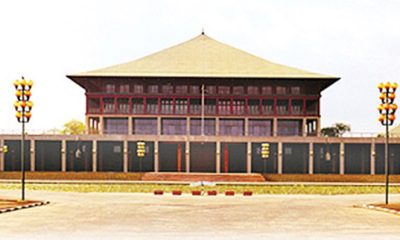
President Anura Kumara Dissanayake is often seen in Parliament, making special statements and long speeches in defence of his government. It is being argued in some quarters that no other President attended Parliament so frequently. This, however, is a moot point. We once commented on President Mahinda Rajapaksa’s regular presence in Parliament, asking whether he was trying to remind the Legislature that he was the boss. Why should the Presidents attend and address Parliament regularly?
President Dissanayake is apparently labouring under the misconception that he can shore up the government’s image single-handedly by attending Parliament and displaying his oratorical skills. Whenever he is sighted in Parliament, everybody knows that the government has blotted its copybook again and is badly in need of his help to distract the public from its blunders and misdeeds. President Dissanayake spoke in Parliament yesterday as well, stressing his government’s ‘neutral foreign policy’, among other things, for the umpteenth time.
Sri Lanka’s Constitution works the way it should only when the Executive is in a position to control the Legislature. When the President and the Prime Minister happen to represent two different political parties, the latter undermines the former, as was the case between 2001 and 2004, with President Chandrika Kumaratunga and Prime Minister Ranil Wickremesinghe leading the SLFP-led People’s Alliance and the UNP-led UNF, respectively. They were at loggerheads, and President Kumaratunga finally went so far as to sack the UNF government and hold a snap general election, which her party won, helping her consolidate her power by regaining control of Parliament. President Maithripala Sirisena faced a similar situation after breaking ranks with the UNP-led UNF in 2018. Thus, the Presidents do everything in their power to keep the Legislature under their thumb lest alternative power centres should form around the Prime Ministers in Parliament even when their own parties are in power.
The President is constitutionally required to attend Parliament once every three months. Article 32 (3) of the Constitution says: “The President shall, by virtue of his office, attend Parliament once in every three months ….” Article 32 (4) says: “The President shall by virtue of his office also have the right to address and send messages to Parliament. The President also has the power to make the Statement of Government Policy in Parliament at the commencement of each session of Parliament and preside over ceremonial sittings of Parliament, according to Article 33.
These constitutional provisions are widely thought to be aimed at ensuring periodic engagement between the Executive and the Legislature, thereby promoting accountability, communication, and constitutional balance in a presidential system. The Executive President’s regular presence in Parliament theoretically signals his or her respect for the legislature and helps reinforce the notions of accountability and constitutionalism, but it can also be interpreted as a form of ‘soft power projection’ when it is intended to shape political narratives in favour of the ruling party.
The Executive should be mindful of the time constraints faced by the Legislature. An oft-heard complaint in Parliament is that the members of both the government and the Opposition are denied sufficient time to speak. Their anger is directed at the Speaker. Not all of them come out with anything sensible in their speeches and during debates, which more often than not descend into slanging matches and even fisticuffs; they are known to say very little in so many words and often go off on a tangent. However, their right to express their views in Parliament as elected people’s representatives cannot be questioned. It is their time that the Executive uses to make speeches and statements in the House to further the interests of his or her party. The Executive ought to render unto the legislators what is theirs and refrain from trying to overshadow the Legislature.
Saturday 21st March, 2026
Trouble is said to come in threes. For Sri Lankans, it seems to come in multiples of three. Close on the heels of crippling fuel price hikes, speculation is rife that electricity tariff increases are on the cards. The government is said to be contemplating another round of fuel price hikes as well.
The JVP/NPP talked the talk in the run-up to the 2024 elections, but it is now unable to walk the walk. In fact, the sobering economic reality has compelled it to do the very antithesis of what it promised during its Opposition days. It made a solemn pledge to bring down the cost of living immediately after forming a government and even tackle the country’s debt crisis expeditiously, without aggravating the people’s lot. There seems to be no end in sight to its about-turns, which are legion.
There is reason to believe that many people voted for the JVP/NPP, expecting it to fulfil its promise to lower taxes and tariffs among other things. Now that the government has reneged on that pledge and increased taxes and electricity and fuel prices substantially, they must be feeling that they were taken for a ride. Winning elections by making all the promises in the world is one thing, but fulfilling them to live up to the people’s expectations is quite another. There was no way the NPP government could slash taxes and tariffs, given the perilous state of the economy and the IMF bailout conditions, which are aimed at increasing state revenue severalfold and bring about debt sustainability. President Gotabaya Rajapaksa’s government blundered by slashing taxes and fuel prices. Interim President Ranil Wickremesinghe had to rectify those colossal policy blunders that ruined the economy. However, the public naturally becomes livid when governments do not make good on their promises and they are left without the promised relief and benefits.
The Opposition has said President Anura Kumara Dissanayake yesterday made a case for another round of fuel price hikes while addressing Parliament. A spokesman for fuel distributors has gone on record as saying that more fuel prices are in the pipeline. Such statements only cause panic among consumers and drive filling stations operators to hide their stocks with a view to profiteering. Yesterday, many of them claimed they had run out of fuel. There is no one the public can turn to. Unsurprisingly, when many filling stations claim to have no fuel, queues of vehicles near the others where stocks are available grow longer. It behoves the President, other government politicians and fuel distributors to refrain from predicting fuel prices hikes. It is also a mistake for them to predict price reductions, for the filling station owners do not place orders until the fuel prices are lowered. What the politicians and others should do is to guard their tongues and allow fuel prices to be lowered or increased.
Further fuel price increases will make the cost of living even more unbearable for the ordinary people. The government, which came to power, promising to do away with the taxes on fuel and halve the petroleum prices, ought to consider lowering the loss-recovery levy on fuel, amounting to Rs. 50 a litre, until the global oil market stabilises with prices returning to the pre-Middle East conflict levels. Thereafter, that levy may be re-imposed but in the form of a special commodity tax so that the Indian Oil Company, Sinopec, etc., which are said to control 43% of the local fuel market, will have to pay it, and the Treasury will gain. At present, the loss-recovery levy helps increase the profits of the private companies, ironic as it may sound.
It is hoped that government politicians and their officials will talk less and work more to increase the country’s oil storage capacity. The need to increase oil buffer stocks as a national priority cannot be overstated. Allowing the government’s private sector cronies to import oil cannot be considered a solution to the current energy crisis.

Asia stocks slide as US and Iran threaten to escalate war

Heat Index at Caution Level in the Western, Sabaragamuwa, Southern and North-western provinces and in Anuradhapura, Mannar and Vavuniya districts

Showers may occur at several places in the Western and Sabaragamuwa provinces and in Galle, Matara and Nuwara-Eliya districts after 2.00 pm.

Fuel price hikes trigger transport disruptions and calls for fare increases

Prof. Peiris honoured by International Institute of Rehabilitation

CMC resumes parking fees

‘Dates have the highest sugar content to fight Coronavirus’

Sunday Island 27 December – Headlines

#SundayIsland 17th December – Headlines

Sunday Island – 28th March

Sunday Island Headlines – 21 March

Sunday Island – 21st February – Headlines
-

 News6 days ago
CIABOC questions Ex-President GR on house for CJ’s maid
-

 News7 days ago
Sri Lankan marine scientist Asha de Vos honoured at UNGA opening
-

 News7 days ago
Australian HC debunks misleading travel risk claims for Sri Lanka
-

 News5 days ago
Bailey Bridge inaugurated at Chilaw
-

 Latest News7 days ago
Wednesdays declared a government holiday with effect from 18th March
-

 News5 days ago
Pay hike demand: CEB workers climb down from 40 % to 15–20%
-

 News4 days ago
CIABOC tells court Kapila gave Rs 60 mn to MR and Rs. 20 mn to Priyankara
-

 Editorial6 days ago
Couple QR-based quota with odd-even rationing