
Opinion
First reign of terror by the JVP

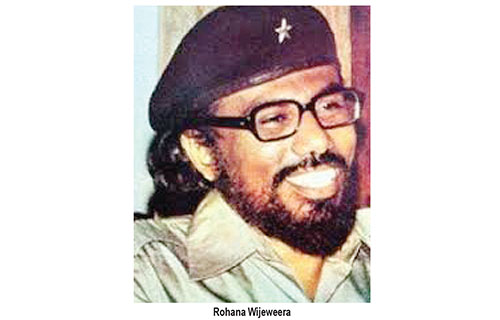
By MANO RATWATTE
I have been reading your articles on the 1971 JVP insurrection, quite avidly. A lot has been narrated about the fateful night of April 5th and the events that followed.
It was fascinating to read the accounts by the retired DIG. Thank you for all the articles. It brought back some vivid memories from my childhood.
My personal story from
that fateful period
I was a young boy, just past my 11th birthday and attending Royal College at the time. I was oblivious to the fact that, my father was the Private Secretary to the Prime Minister, and my maternal grandfather was the Governor General (Ceylon had not become a republic yet – that would happen later), our family would be under attack. I remember the very tense period, and how my parent’s home had been marked for attack. The markings were faint, a crude “X” made with red brick. This was repeated at the homes of some other relatives of the Prime Minister, as well. We were oblivious, never noticing the ominous markings.
I have no doubt if the JVP had succeeded they would have executed Mrs. Bandaranaike and probably my father, who was her brother, as well. The PM’s Private Secretary is a position equivalent to a White House Chief of Staff. My grandfather, as the GG and nominally Head of State, would probably have been a victim, too. It is more than likely that the JVP would have massacred my entire family, emulating what their heroes, the Bolsheviks did to the Czar’s family in Yekaterinburg, after the Russian Revolution.
When the severity of the threat became apparent, we were whisked away on the night of April 4th to the GG’s residence, Queen’s House, because the Army Commander felt it wasn’t safe for us to remain in our home. My grandfather had been the Governor General, since 1962, so luckily, we had a safe haven that was familiar to us. As a kid I thought it was “cool” to be escorted by armed soldiers. But, looking back, I realise I may not be alive today, if the JVP revolt had succeeded.
The timing of the JVP’s 1971 rebellion was very poor. The United Front government, which had won a massive landslide electoral victory, in 1970, hadn’t been in power for even an year and had not been able to implement many changes. The economic hardships, food queues and rationing, which were to come in the aftermath of the global energy crisis of 1973, weren’t on the horizon yet. Ceylon was a pleasant place with a vibrant democracy; the exception being the notorious coup attempt of 1962. A violent overthrow of the recently elected government wasn’t something likely to gain much support with the populace.
However, it is likely that, not for the serendipitous incidents in March, reported in this newspaper previously, with the JVP’s bombs exploding prematurely, the security forces would have been far less prepared and the rebellion may well have succeeded.
The situation in the early days of the revolt was very tense. My father was very active in the discussions, and was part of the National Security Council at Temple Trees. It seemed ‘touch and go’ for a while, but my father said that the Prime Minister never panicked. I know my father definitely didn’t, remaining calm despite the initial flood of bad news.
My father never panicked, no matter what the threat was. He had previously faced down the Air Force guard that threatened to open fire on my aunt, in January 1966, along with the late Dr. Baduiddin Muhammed, at a political rally. Before that, in September 1959, he had helped prevent the domestic staff at Tintagel, the PM’s private residence, hack, murderer Somarama to death, after SWRD’s assassination on the front lawn of the property. If the assassin had been killed that day, the right wing conspiracy behind it would have never been uncovered.
Reminiscing o 1971, he told us much later, with a chuckle about the ashen-faced (his words) Army Commander who was at the NSC meetings held at the Temple Trees annexe. The General wanted the PM to ask Yugoslavian leader Marshal Tito for military help. I’m not sure if the request was ever made or whether Mrs. B refused as she had faith in country’s military.
Lanka’s innocence was lost forever that day. Suddenly security and protection of VIPs became a thing in Ceylon. Prior to April 1971, the Prime Minister would have just a token escort, with a pilot-car containing a couple of armed guards and one personal bodyguard, typically a Police officer. The Governor General hardly had any security. A sleepy police Sergeant would be posted at Queen’s House. No bulletproof cars or decoy convoys like today. All that began during the war against the LTTE terrorists and suicide bombers.
I didn’t realize the gravity of the situation, until I saw guard points manned by armed sailors from the Navy, between Temple Trees and Queen’s House, during the curfew.
I remember riding in the GG’s vehicle to Temple Trees, and seeing Navy sailors in their blue uniforms and helmets with rifles and lights pointed towards the car, shouting “Halt” at the vehicle. They were mostly armed with obsolete WW1 vintage Lee Enfield Rifles, or the small Sterling ‘Sten’ submachine guns. I still remember their smart blue uniforms and the white garters (boot covers) around their boots. I also remember seeing a fleet of Indian Navy ships in Colombo, anchored facing Galle Face Green.
I remember my father, and the late Anuruddha Ratwatte (his cousin, then a Colonel), flying on Indian Air Force helicopters from the Royal Ceylon Air Force ground, that the retired DIG referenced. I tagged along in the vehicle that was used to drop them off there. They were overseeing the airdropping of surrender leaflets; an idea my father is believed to have thought of and proposed to the NSC. It offered amnesty and rehabilitation to JVP cadres who surrendered. The leaflets were dropped over the thick jungles where the remnants of the JVP were hiding. It may have been later in April or much later in May. I hope the DIG throws some light. The idea was a success with many fugitive JVP-ers surrendering to the security forces as a result of the campaign.
I have a lot more memories of those scary and sad days. The JVP has never apologized for the disruption of Ceylon’s society. Their actions were far worse in their second incarnation, but by then we were inured to violence. In 1971 we were still a peaceful and innocent country.
What if the 1971 rebellion had succeeded?
What if the JVP had seized power that April, 50 years ago? What would a Ceylon look like? A beautiful socialist utopia with complete state control of the economy? Thousands of grey Mao-suited robots with a little red book goose-stepping to herald a strongman similar to North Korea, who were supporters of the JVP? Would Wijeweera have been a Dear Leader and great benefactor? Or an Oliver Cromwell, a Gandhi, or a Pol Pot?
Act 2: Policy mistakes
Harping back to the 1971 insurgency; it shocked the leftist coalition government, headed by my aunt. As a result, some of the radical policy reforms, such as the Land Reform Act, were rushed through to assuage the anger demonstrated by the insurgents.
Land Reform, as my father later used to say, was one of the “most iniquitous” acts of policy. Think about it. Landholdings were restricted to 50 acres per adult. So if a family had adult children they could have 50 acres each, but even if a family had four young children, they lost most of their lands and six people would all have 50 acres in total ! It defied common sense and economic logic.
Did they assume the kids wouldn’t grow up to become adults? Or perhaps it was deliberately written to favour some, with thousands of acres of land and adult children, over others with young families or no children. Either way it was an absurd policy, which destroyed many viable plantations, reducing them to economically unviable smallholder status.
Housing ownership policies also were also rushed as a result of the 1971 rebellion. The implementation of this, too was botched and much wealth was destroyed. If the JVP had been more patient, they could have had a much better chance of wreaking even greater mayhem, when people were angry and tired of the stagnant economy post-1974.
But, indeed, it was serendipitous that those two premature bomb explosions happened in March. The second one happened the day my family was spending time with our uncle to celebrate his birthday.
Act 3 – The next JVP
insurrection
Their reign of terror and counter terror by the Government, in 1987- 89 was far worse for the entire nation. I was by then out of the country and did not experience any of it. My father wrote to me and asked me to stay in the USA as long as possible. An uncle of mine (a first cousin of my father’s) was burnt alive in Matale, during the hell the JVP unleashed in the aftermath of the Indian “invasion by invitation” after J.R. Jayewardene erred in handling relationships with India. Another good friend’s relative was chased down and killed at his estate, because he had raised the national flag on Independence Day as the government had requested. A respected scholar was assassinated on the University of Colombo campus – Professor Stanley Wijesundere. His son and I were good friends and classmates.
And no one should forget nor forgive the brutal murder of a great humanist and charismatic leader Vijaya Kumaranatunge, the leader of the SLMP and most popular celebrity actor. Why did the cruel assassins shoot him in the face after he was already dead and fallen? Was it because of sheer envy and evil thoughts of their leader who could not stand a good-looking popular rival?
My issue with all these lame excuses and talk about a ‘people’s struggle’, is that the JVP never sincerely apologized for the violence they unleashed, and keep celebrating their leader as if he’s a local Lenin; when he and his then generation of combatants had more in common with the Khmer Rouge and Pol Pot, than Marx.
Recap 1971
Harping back to the successful victory over the JVP, in 1971, it must be mentioned how quickly almost every major nation in the world came to help Sri Lanka. Because of the excellent relationship between Ceylon and India, they were the first to rush in help. I remember they even supplied the Army with SLR 7.62 automatic weapons, much more capable weapons than the ancient rifles and inaccurate Sten guns which was all they had. The Ceylon military, which up to that point was a well-disciplined force but mainly a ‘parade-ground army’, was called upon to quell a domestic armed insurrection while armed with vintage bolt action rifles.
The tiny Armoured Corps, equipped with a few Daimler armoured cars, (the largest of which had a 2-pounder gun) was used to secure Kegalle and Mawanella, which had been seized by the JVP. A few vintage Ferret Scout cars armed with WW2 era Bren guns, were deployed at Temple Trees. Later one of the Saladin six-wheeled armoured cars, with a bigger 76mm gun was also deployed facing Galle Road.
Ceylon’s tiny military, led by professional leaders, acquitted themselves really well. While there were sad incidents like the Premawathi Manamperi incident, they deserve gratitude and thanks of the entire nation. Especially a then 11-year old boy’s sincere thanks for protecting him and his family.
Hope
All is not hopeless. The new younger and more educated leaders of the JVP have embraced democratic politics and their performances in Parliament exposing corruption of governments (whichever government is in power), and their well informed and educated analysis and criticisms, are a fresh positive contrast to the adi-pudi abuse laden politics of everyone else. But they will remain a less than 5% party if they keep celebrating a man who twice took our nation down a path that was disliked or hated by most. Clearly, the UNP could also apologize for the counter terror they unleashed.
Geo political friends
India was the most important ally in 1971. Indian-Lanka relations deteriorated because of President J. R. Jayewardene’s hostile views and his foolish attempts to align himself with the US and ASEAN, totally oblivious to who the regional power was. This is something to be cognizant of today, in post cold-war realignment of alliances. The USA, which was once hostile to India, is now totally aligned in the QUAD coalition against China. India has justifiable fears and concerns about China. It stems from having been humiliated by China in the1962 border war which led to a loss of territory.
Sri Lanka really needs to nurture its friendship with India so that they will be like the 1971 ‘Dhosthi India’ and not the ‘Dushman/badamaash India’ following the gory Black July of 1983. Same country – two different postures.
The paradigm shift about security, in 1971, was significant and permanent.


Keynote Address Delivered at the International Research Conference of the Faculty of Law, University of Colombo, on 12 December 2025.
(Continued from yesterday)
V. Usage Down the Ages
Empirical evidence during all epochs of history, and in a vast array of legal cultures, establishes without doubt the need for far-reaching executive powers during times of crisis.
The legal acumen of the Roman Republic did not recoil from conferment of even dictatorial powers on its principal executive officials—the two consuls—during periods of breakdown. They wielded life and death powers over Roman citizens, but the right balance was struck. Extraordinary authority was limited to the brief span of six months, and the appointing official could not select himself. Checks and balances assured success of the system: although 90 dictators were appointed under the Roman Republic during a period of 300 years, not one dictator attempted to perpetuate the system at the end of his tenure.
The English common law is certainly no exception to this tradition. The essence of the English doctrine is that the Executive has “an inherent constitutional authority to proclaim martial law when it deems there to be a public emergency, a proclamation that entitles the Executive to act as it sees fit to respond to the emergency” (Dyzenhaus).This power has been applied by the United Kingdom to her colonies, including Ceylon, where Governor Sir Robert Chalmers, for example, made ruthless use of it during the Sinhala-Muslim riots under the cloud of World War I.
In the United States, Congress has passed no fewer than 470 statutes granting authority to the President to use extraordinary powers during a declared state of national emergency. An egregious instance is Executive Order 9066 issued by President Roosevelt just two months after the Japanese attack on Pearl Harbour. This resulted in the mass incarceration of approximately 120,000 Japanese Americans from the western United States, over 70,000 of whom were American citizens(Amanda Tyler).
In the aftermath of 9/11, one of the gravest global emergencies in our time, American and British courts, for compelling reasons, showed marked solicitude for executive authority. A plurality of the Supreme Court of the United States held that the Congressional Resolution, Authorization for Use of Military Force, permitted the detention of enemy combatants, such power being recognized as “fundamental” and “a necessary and appropriate use of force” (Hamdi v. Rumsfeld). In the United Kingdom, in the first decision after 9/11, the House of Lords, grounding its decision in the separation of powers, held that it is for the Executive to decide what is in the interest of national security (The Belmarsh case).In doing so, the House of Lords had no hesitation in overruling the decision to the contrary by an administrative tribunal, the Special Immigration Appeals Commission.
VI. Imaginative Features of the Evolving Law
The limits of judicial review in this setting emerge clearly from impeccable precedents across the world. Legitimacy of the Proclamation of Emergency issued in Sri Lanka by the Acting President on 17 July 2022, assessed in light of these precedents, admits of no doubt.
The dominant test is that based on proportionality. The salient requirement is that the impugned measure should clearly realize or advance its underlying purpose, that “the use of such means would rationally lead to realization of the law’s purpose”(A. Barak). In terms of a comparative assessment of the harm inflicted on constitutional rights and the benefit accruing to the public interest, intervention by the Executive should come down heavily on the side of the latter, as opposed to the former(A.P. Brady).
The basis of justification is that the risk of harm sought to be averted should be very high, an overriding public interest being placed at stake in a situation where the outcome is perilously uncertain (J. Zander).Gravity of the risk and the extent of impending harm are the governing factors.
Evaluated against these criteria, the Sri Lankan Emergency Proclamation of 17 July 2022 passes the test with ease. In the backdrop of the nerve centres of the Executive Administration having fallen to the control of a violent mob, and the attempted extension of their initiative to the precincts of Parliament, where a crucial vote was scheduled within a matter of days for the election of the President of the Republic, in keeping with constitutional procedure, the Proclamation clearly served the purpose of ensuring unimpeded access to Parliament for legislators to perform their constitutional duty. Prevention of this by unlawful force would have presaged nothing less than the collapse of constitutionalism and the descent of the country into anarchy.
While recourse to the proportionality test would inevitably yield this result, it is worth noting a further refinement in the developing law. This has taken the form of modifying the criterion of proportionality by the application of a “precautionary principle” in suitable contexts.
The effect of this principle, now fortified by reliable antecedents, is “to favour the governmental objective (to mitigate or avert a crisis) over fundamental rights” (Ondrejek and Horak). This approach, militating against the postulate, in dubio pro libertate, has been described as “a rational and prudent response in the face of uncertainty”(Renn).
The precautionary principle, as a feature of contemporary jurisprudence, has its origin in international environmental law. Its substance is captured in the Rio Declaration on Environment and Development, 1992, which states: “In order to protect the environment, the precautionary approach shall be widely applied by States according to their capabilities. Where there are threats of serious or irreversible damage, lack of full scientific certainty shall not be used as a reason for postponing cost-effective measures to prevent environmental degradation”. Lack of epistemic certainty, then, must not forestall preventive action against grave damage. This principle has currently received acceptance outside the domain of environmental law as the anchor of a pragmatic mediating technique, of particular value in our time.
Applied to the Sri Lankan situation, it should conclusively govern the outcome, in that pre-emptive action in the face of impending disruption of a crucial meeting of Parliament is obviously a measure of prudence.
VII. A Realistic Assessment
The ratio decidendi of the majority decision of the Supreme Court is that, even after the President had reached a proper conclusion about the existence of a state of public emergency, he is still compulsorily required to consider whether other options are available to deal adequately with the crisis. This finding is demonstrably at variance with established authority.
The view has been persuasively taken that “There is usually more than one decision compatible with the complainant’s rights,
and it is for the public body rather than the court to choose between them”(T. R. S. Allen). Thus, “when there is scope for different answers or approaches, it is right that the court accept the solution favoured by the public authority”. Sir Thomas Bingham (as he then was) has referred in this context to “the range of options open to a reasonable decision maker”(R v. Ministry of Defence, ex parte Smith).Accordingly, there should not be “too narrow a space for the discretion of the primary decision maker”(Ondrejek and Horak).
The Supreme Court of the United States has declared: “It is no part of the function of a court to determine which one of two modes was likely to be the most effective for the protection of the public”(Jacobson v. Massachusetts). The Court spelt out the rationale for its ruling: the contrary decision could well lead to “disorder and anarchy”.
In a well-known ruling in 2018, in a case involving a travel ban imposed by President Trump, the Supreme Court observed: “Whether the President’s chosen method of addressing perceived risks is justified from a policy perspective, is irrelevant”(Trump v. Hawaii).The Court therefore refused the plaintiffs’ request for “a searching inquiry” on the ground of “the deference traditionally accorded to the President in the sphere of national security”.
This approach has cogency, for at least four compelling reasons.
First, the need for expeditious intervention is paramount. This is tied to the essential “reassurance function” of the Executive. “The government must act visibly and decisively to demonstrate to its terrorized citizens that the breach was only temporary, and that it is taking aggressive action to contain the crisis”(Ackerman).Speedy action on the spur of the moment, in an atmosphere far removed from one conducive to meticulous weighing of alternatives ex post facto, in a relaxed and unhurried setting, is the critical need.
Second, the consequences of delay should be evaluated against the prudence of prompt action. The reflection by Obeyesekere J. carries conviction: “In the event the Acting President did not take decisive steps, and further elected representatives were murdered, or Parliament was stormed, this Court may have had to consider whether there was a dereliction of duty in failing to act on the advice of pivotal officers responsible for maintaining law and order”. This was a situation in which the Minister of Public Security, the Secretary to the Ministry of Defence, and the Inspector General of Police had all recommended to the Acting President the declaration of a State of Emergency.
Third, in this instance, the effect of Presidential intervention was required only for a strikingly brief duration—until Parliament met within two days. Professor Bruce Ackerman of Yale University has offered the sapient comment: “The Executive should be given the power to act unilaterally only for the briefest period—long enough for the Legislature to convene and consider the matter, but no longer”.
Fourth, the rigidly circumscribed scope of judicial review in this setting is indicated by the narrow window for application of the Wednesbury test of reasonableness. In the evolving law, the impugned action is no longer required to be “suitable”, as a matter of judicial proof. All that is required is that it should “not be manifestly unsuitable”. This involves, from a practical standpoint, shifting of the burden of proof from the decision maker to those assailing the decision; and the threshold of proof is dauntingly exacting. The preferred principle in modern law is that “the courts should not quash or declare illegal any emergency measure or decision unless it is very likely(based on the already available data and evidence) that it cannot contribute to the legitimate aim in any way”(Ondrejek and Horak).
The Supreme Court of India has determined that there is no warrant for judicial intervention unless it is clear from the material on record that there is “absolutely no justification” for the Proclamation (Bhagvati J in Minerva Mills).Stringency of the test for availability of judicial review is laid bare by the example given by Bhagwati J—the Chief Minister of the state in question being below five feet in height(State of Rajasthan v. Union of India).This bears comparison with the famous illustration of the red-headed schoolteacher in the Wednesbury case. The trend, then, is unmistakably hostile to expansion of judicial review on this ground.
In our own country, this predisposition is reinforced by a firmly entrenched constitutional norm. A foundational principle of our public law is the vesting of judicial power, not in the courts but in Parliament, which exercises judicial power through the instrument of the courts. This is made explicit by Article 4(c) of the Constitution which provides: “The judicial power of the People shall be exercised by Parliament through courts, tribunals and institutions created and established, or recognized by the Constitution, or created and established by law, except in regard to matters relating to the privileges, immunities and powers of Parliament and of its members, wherein the judicial power of the People may be exercised directly by Parliament according to law”.
VIII. Conclusion
One of the most influential academic contributions to this subject in our time is the paper recently published in the University of Queensland Journal by Richard Ekins, Associate Professor of Law in the University of Oxford, and Graham Gee, Professor of Public Law in the University of Sheffield. The view is there articulated with exceptional force that there is reason to entertain deep suspicion regarding “a vague freewheeling judicial power”, which is seen at bottom as “antithetical to the rule of law”. This has been trenchantly denounced as “a lawless grab for power, unrooted in our constitutional tradition”.
The overarching problem is one of legitimacy. It should certainly give us pause that “this dangerous stretch of legal technique” carries with it the risk of displacing the proper exercise of political accountability and, in doing so, compromising basic constitutional principle.
This kind of judicial overreach has many undesirable consequences beyond the crisp question of the legality of the declaration of a state of emergency in 2022, including:
a) Traducing constitutional tradition;
b) Subverting the specific model of separation of powers reflected in our Constitution;
c) Undermining the established rule of interpretation that the courts construe the law from the face of the statutory and/or constitutional text, including due respect for ouster clauses;
d) Eroding established principles of public law in respect of the legality of executive or administrative actions; and
e) Inappropriately invoking doctrines such as those relating to ‘public trust’ and ‘just and equitable’ remedies to justify judicial overreach when those doctrines are there to ensure the common good and institutional role morality.
By Professor G. L. Peiris ✍️
D. Phil. (Oxford), Ph. D. (Sri Lanka);
Rhodes Scholar, Quondam Visiting Fellow of the Universities of Oxford, Cambridge and London;
Former Vice-Chancellor and Emeritus Professor of Law of the University of Colombo.
Opinion
The Maha Jana Handa at Nugegoda, cyclone destruction, and contenders positioning for power in post-NPP Sri Lanka – II


Continued from December 9, 2025
During his rousing speech, Harin Fernando anticipated SLPP national organiser Namal Rajapaksa’s straightforward declaration of his resolve to end the JVP/NPP regime as soon as possible. The latter’s battle cry might have sounded premature even to some of his less attentive fellow members of the SLPP who failed to catch his meaning. It is possible that Harin delivered a preemptive strike at what he felt was Namal’s overweening presidential ambition (by making a facial gesture, before leaving the speaker stand, that suggested contempt at the latter’s goal). What Namal expressed was his desire and determination to bring down a poor-performing government that, he believed, was causing great harm to the country through ignorance, inexperience, and arrogance of the men and women who were running it.
Harin was criticised in Parliament by Wimal Weerawansa MP, in February 2024 during Ranil Wickremesinghe’s presidency, for having casually stated during an interview with an Indian TV channel, as newly appointed Tourism minister then, that Sri Lanka was a part of India! Indian High Commissioner Santosh Jha’s recent remark at the Colombo YMBA’s ‘Light of Asia’ Centenary Celebrations (December 6, 2025) that “… India and Sri Lanka are connected not only by geography but by deeper bonds of culture ….” could be read as a matter of fact allusion to a sinister assumption that Harin’s ‘casual’ statement probably purposefully expressed. It is also significant that Harin was appointed by the UNP as its Deputy Secretary General of Political Mobilisation with immediate effect on October 21, 2025. His new responsibilities include uniting all political parties in the country and engaging them in a common programme, in addition to which he will be coordinating the many meetings that are to be organised by the UNP. Harin’s new post seems to match Namal’s position as the national organiser of the SLPP.
Actually, the very idea of holding a series of such massive protest rallies across the country is Wickremesinghe’s brainchild. If he and Mahinda Rajapaksa have masterminded the Maha Jana Handa protest rally campaign initiated on November 21, 2025, they have all the reason and the moral right as well as the inherent obligation to do so. They ought to get involved in actively mentoring the next generation of rulers at this crucial moment of unprecedented national emergency caused by the recent cyclonic disaster of apocalyptic proportions. They both share between them a significant amount of responsibility for the current situation due to their own past strengths and weaknesses of leadership as senior politicians, in their characteristic egoistic ways, though.
Mahinda Rajapaksa, a follower of the watersheds of 1956 and 1972 in the political history of post-Independence Sri Lanka, inadvertently turned the 2009 victory over terrorism, which he was largely instrumental in creating through his own brave political leadership, into a sort of pyrrhic victory. That is, he let his success become the cause of his own downfall and the country’s regress; this was basically as a consequence of his shameless indulgence in ‘family bandyism’ or nepotism. As for Wickremasinghe, an admirer of the 1978 introduction of the open market economic system and the institution of the executive presidency (by his uncle, UNP leader J.R. Jayewardene), acts as if he wants to erase from national memory the two previous epochal events (of 1956 and 1972) that his rival is guided by; this makes him look least sensitive towards Sinhalese Buddhist majority’s legitimate aspirations.
Wickremesinghe and Mahinda Rajapaksa, each tried and tested in the rough and tumble of parliamentary politics for over half a century, have always been political rivals, but both have also been robust defenders of parliamentary democracy. Those who are old enough or adult enough may remember how, not long ago, the Parliament chamber reverberated with their raised voices denouncing each other with shouts of “kauda hora? Mahinda hora …. Ranil hora benku hora”, etc. Despite this mutual hostility in politics, they have together profoundly influenced the most tumultuous course of the island’s political history of the last two decades (2005-25). At the Maha Jana Handa, Harin expressed his views on the complementary roles the two senior leaders played during that period in the service of the Sri Lankan people. While praising Wickremesinghe for saving Sri Lanka from total economic collapse in 2022, and for having made similar contributions in the past for the uplift of the country and its people. Harin paid unqualified encomiums to Mahinda Rajapaksa for having eliminated the scourge of separatist terrorism through his unique abilities of political direction and diplomacy.
Harin’s explicit acknowledgement of the historic achievement of the leader (Mahinda Rajapaksa) of the SLFP (the major partner of the UPFA, now the SLPP) signifies a sea change in the UNP’s traditional attitude towards that victorious nationalist triumph over the LTTE.
So, Wickremesinghe and Rajapaksa represent respectively the UNP and the SLFP, which, though now almost defunct, are still alive and well in their new manifestations. The UNP is probably on the verge of being made whole with the return of its breakaway group the Samagi Jana Balavegaya (SJB) led by Sajith Premadasa, with or without his consent; it should not be forgotten that the SJB, with its 40 MPs, forms the main Opposition. There will most likely be a similar reunion between the SLFP and the SLPP. The cooperation between the two oldest national parties at this crucial juncture is imperative for the survival of the sovereign unitary state of Sri Lanka. If Sri Lanka’s unitary status must be ended for some untoward reason beyond the country’s capacity to deal with such as global or regional geostrategic pressure (which is, of course, unlikely, because the Eastern bloc countries Russia and China, with comparable military and economic power also have stakes in the region), it should be done through Parliament, not otherwise.
The rescue of parliamentary democracy after the ouster of the 7th Executive President of the Democratic Socialist Republic of Sri Lanka Gotabaya Rajapaksa in 2022 amidst the so-called Aragalaya (Struggle) protest, which was turning violent, was the joint achievement of Wickremesinghe and Mahinda Rajapaksa (though it was cynically bruited about the social media that Wickremasinghe played an opportunistic ‘run with the hares and hunt with the hounds’ strategy exploiting Aragalaya, begun peacefully, but later hijacked by violent extremist elements including members of the JVP/NPP. Representatives of certain regional communal parties, and coercive religious extremists hiding among them, were there too. These elements seem to be lying low now in sinister silence.
On December 5, 2025 President Anura Kumara Dissanayake made a special statement in Parliament which took almost one hour and forty minutes. He dwelt on the devastation being caused by Cyclone Ditwah that had by then raged for about a week already and what his government was doing and was planning to do in the future to bring relief to the hapless thousands affected. Two things out of the many matters that he touched on, I feel like mentioning here:
1) He made some commendatory remarks about the triforces members and the police, while paying tribute to Wing Commander Nirmal Siyambalapitiya of the Air Force, who died in a helicopter accident during a rescue operation in the flood-hit Wennappuwa area, and to the five Navy personnel who went missing while being engaged in widening a waterway in the Chundikulam lagoon in Chalai in order to control the flood situation there. This is something that suggests an implicit acknowledgement made (belatedly, though) by the President of the vital importance of the defense forces whose selfless dedication to the service of the nation should never be underestimated. That is a salutary attitudinal change on his part, comparable to the aforementioned volt-face of the UNP regarding Mahinda Rajapaksa-led victory over separatist terrorism.
President Dissanayake had stopped calling the security forces members ‘ranaviruwo’ or ‘war heroes’, perhaps under pressure from the small section of the Tamil diaspora enjoying the patronage of the meddling powers. This year President Dissanayake marked the May 2009 victory over terrorism a day later than the due date, that too grudgingly. The vociferous Archuna Ramanathan, independent MP from Jaffna, who calls the dead Prabhakaran his ‘god’, and claims that he receives funds from the Tamil diaspora (which may be true), taunts the President and his Sinhalese MPs for failing to call the members of the Sri Lanka Army ‘war heroes’! While President Dissanayake denounces ‘Nationalism’ consciously misconceiving (a la Americans) it as ‘jativadaya’ (Racism) or ‘warga vadaya’ (Communalism), he allows the rump of the banned LTTE to commemorate the dead terrorist leader as a national hero. Illegal Mahaveerar Naal celebrations were held in the north in the last week of November. MP Archuna Ramanadan, it was reported, thanked the Sri Lanka Navy personnel for saving him from the flood waters while returning from one of those celebrations!
2) While paying a passionate tribute to the security forces members President Dissanayake made a gratingly incongruent gratuitous reference to the submerged Gampola area as ‘a place largely populated by Muslims’: “No room should be left for them to feel isolated or discriminated against”. What an ill-conceived remark! Clearly, he meant to curry favour with the Muslim community of the place. He is probably already trying to promote himself among the Muslim community in preparation for re-election in 2029!
During the “Derana 360” programme hosted by Kalindu Karunaratne about a month ago, Minister of Justice and National Integration Harshana Nanayakkara, NPP MP, probably inadvertently, revealed that they had to give in to certain Tamil demands in the North (which might seem unreasonable and extremist to the majority community) in order not to spoil their chances of winning support at the next election.
SJB leader Sajith Premadasa, in his capacity as the Leader of the Opposition, was on an official visit to New Delhi in early November, 2025, which focused on strengthening India-Sri Lanka bonds. (But his egotistic utterances degraded his Indian visit into a private one.) He had meetings with senior Indian leaders including External Affairs minister Subramanyam Jaishankar and Corporate Affairs minister Nirmala Sitharaman. He was given the honour to address the Indian Council of World Affairs (ICWA). Sajith Premadasa talked about Sri Lanka’s commitment to its special strategic relationship with India, stressing “the need for implementing the 13th Amendment for Sri Lanka’s stability”. It is impossible that he is unaware of the fact that the 13th Amendment was externally imposed on Sri Lanka in 1987 by India and has not been fully implemented by any president to date for good reasons.
The National Joint Committee (NJC), a leading civil society organization committed to the defence of Sri Lanka’s unitary state status and sovereignty, has strongly condemned Sajith Premadasa’s ‘recent declaration in New Delhi that he would fully implement the 13th Amendment to the Constitution’ (The Island/November 14, 2025)
The NJC has issued a statement condemning SJB and Opposition Leader Sajith Premadasa’s recent declaration in New Delhi that he would fully implement the controversial 13th Amendment to the Constitution when elected to power. Co-Presidents of the NJC, Lt. Gen. Jagath Dias (Rtd) and Dr Anula Wijesundara expressed shock, dismay, disappointment and disgust over it. They have described Premadasa’s uncalled-for undertaking given to India as unbecoming of him as the leader of the main opposition; it is a disdainful betrayal of the nation. The NJC views the 13th Amendment, introduced under duress, as obsolete because India did not fulfil its part of the contract to disarm the LTTE, leading to a disastrous three decade military conflict.
What I have delineated above is a hexagonal simulacrum of the chaotic political situation of the country as I perceive it, for what it is worth, with Mahinda Rajapaksa and Wickremesinghe poised at opposite points equidistant from the square formed in the middle by President Dissanayake and Premadasa facing each other and Harin confronting Namal. Concluded
By Rohana R. Wasala ✍️

 On the occasion of the ninetieth anniversary of the Lanka Sama Samaja Party (LSSP), this article highlights the party’s positions on constitutional matters. When the LSSP was founded, it had two primary objectives: obtaining complete political independence for Sri Lanka and building a socialist society. The first of these was achieved in two stages. The LSSP directly contributed to achieving semi-independence in 1948 through its anti-imperialist struggle and full political independence in 1972. The second objective remains a distant goal.
Citizenship Act
In the very second year after independence, the D. S. Senanayake government acted to deny citizenship to the Hill-Country Tamil community and, consequently, deprived them of voting rights. In the 1947 election, many Hill-Country Tamils—who voted as British subjects—were inclined toward the Left, and especially toward the Sama Samaja Party. In that election, the Ceylon Indian Congress won seven seats, and with the support of plantation workers in areas where they were numerous, several left-wing candidates were also elected.
Seeing the long-term danger in this alliance, the Sri Lankan capitalist class ensured that the Citizenship Act defined the term “citizen” in a way that denied citizenship to hundreds of thousands of Hill-Country Tamil people. As a result, they also lost their voting rights. At that time, it was the Left, led by the Sama Samaja Party, that opposed this.
While the Tamil Congress, a coalition partner of the government at the time, voted in favour of the legislation, S.J.V. Chelvanayakam stated that the inability of Tamil leaders to protect their cousins—the Hill-Country Tamil community—showed that being a partner in a Colombo-based government brought no benefit to minority groups. He argued that the lesson to be learned was the need for self-government in the regions where they lived. Chelvanayakam’s founding of the Federal Party was one consequence of this process.
Although section 29 of the 1947 Constitution purported protection by providing that no law shall make persons of any community or religion liable to disabilities or restrictions to which persons of other communities or religions are not made liable, neither the Supreme Court of Ceylon nor the Privy Council in England, which was then the country’s highest appellate court, afforded any relief to the Hill-Country Tamil community.
Parity of Status for Sinhala and Tamil and the Ethnic Issue
When the UNP and the SLFP, both of which had previously agreed to grant equal status to the Sinhala and Tamil languages, reversed their positions in 1955 and supported making Sinhala the sole official language, the LSSP stood firmly by its policy of parity. Earlier, when a group of Buddhist monks met N. M. Perera and told him they were prepared to make him Prime Minister if he agreed to make Sinhala the only official language, he rejected the proposal. Had the country heeded Colvin R. de Silva’s famous warning— “One language, two countries; two languages, one country”—the separatist war might have been averted. Because the Left refused to be opportunistic, it lost public support.
During the 1956 debate on the Official Language Bill, Panadura LSSP MP Leslie Goonewardene warned: “The possibility of communal riots is not the only danger I am referring to. There is the graver danger of the division of the country; we must remember that the Northern and Eastern provinces of Ceylon are inhabited principally by Tamil-speaking people, and if those people feel that a grave, irreparable injustice is done to them, there is a possibility of their deciding even to break away from the rest of the country. In fact, there is already a section of political opinion among the Tamil-speaking people which is openly advocating the course of action.” It is an irony of history that Sinhala was designated the sole official language in 1956, yet in 1987, both languages were formally recognised as official.
1972 Republican Constitution
Colvin’s contribution to the making of the 1972 Republican Constitution, which severed Sri Lanka’s political ties with Britain, was immense. Preserving the parliamentary system, recognising fundamental rights, and incorporating directive principles of state policy that supported social justice were further achievements of that Constitution. It also had its weaknesses, and any effort to assign full responsibility for them to Colvin must also be addressed.
In the booklet that he wrote on the 1972 Constitution, he said the following regarding the place given to Buddhism: “I believe in a secular state. But you know, when Constitutions are made by Constituent Assemblies, they are not made by the Minister of Constitutional Affairs.” What he meant was that the final outcome reflected the balance of power within the Constituent Assembly. As a contributor to constitution drafting, this writer’s experience confirms that while drafters do have a role, the final outcome on controversial issues depends on the political forces involved and mirrors the resultant of those forces.
In fact, the original proposal approved by the Constituent Assembly was that Buddhism should be given its “rightful place” as the religion of the majority. However, the subcommittee on religion, chaired by Prime Minister Sirimavo Bandaranaike, changed this to “foremost place.” It is believed that her view was influenced by the fact that one of her ancestors had signed the 1815 Kandyan Convention, in which Buddhism was declared inviolable, and the British undertook to maintain and protect its rites, ministers, and places of worship.
As Dr Nihal Jayawickrama, a member of the committee that drafted the 1972 Constitution, has written, the original draft prepared by Colvin did not describe Sri Lanka as a unitary state. However, Minister Felix Dias Bandaranaike proposed that the country be declared a “unitary state”. Colvin’s view was that, while the proposed constitution would have a unitary structure, unitary constitutions could vary substantially in form and, therefore, flexibility should be allowed. Nevertheless, the proposed phrase found its way to the final draft. “In the course of time, this impetuous, ill-considered, wholly unnecessary embellishment has reached the proportions of a battle cry of individuals and groups who seek to achieve a homogenous Sinhalese state on this island”, Dr Jayawickrama observed.
Indeed, the failure of the 1972 Constitution to make both Sinhala and Tamil official languages was a defeat for the Left. Allowing the use of Tamil in the courts of the Northern and Eastern Provinces and granting the right to obtain Tamil translations in any court in the country were only small achievements.
Devolution
The original Tamil demand was for constitutionally guaranteed representation in the legislature. Given that, in the early stages, they showed greater willingness to share power at the centre than to pursue regional self-government, it is not surprising that the Left believed that ethnic harmony could be ensured through equality. After the conflict escalated, N. M. Perera, now convinced that regional autonomy was the answer to the conflict, wrote in a collection of essays published a few months before his death: “Unfortunately, by the time the pro-Sinhala leaders hobbled along, the young extremists had taken the lead in demanding a separate State. (…) What might have satisfied the Tamil community twenty years back cannot be adequate twenty years later. Other concessions along the lines of regional autonomy will have to be in the offing if healthy and harmonious relations are to be regained.”
After N. M.’s death, his followers continued to advance the proposal for regional self-government. At the All-Party Conference convened after the painful experiences of July 1983, Colvin declared that the ethnic question was “a problem of the Sri Lanka nation and state and not a problem of just this community or that community.” While reaffirming the LSSP’s position that Sri Lanka must remain a single country with a single state, he emphasised that with Tamils living in considerable numbers in a contiguous territory, the state as presently organised does not serve the purposes it should serve, especially in the field of equality of status in relation to the state, the nation and the government. The Left supported the Thirteenth Amendment in principle. More than 200 leftists, including Vijaya Kumaratunga, paid the price with their lives for doing so, 25 of whom were Samasamajists. The All-Party Representatives Committee appointed by President Mahinda Rajapaksa and chaired by LSSP Minister Tissa Vitharana, proposed extensive devolution of power within an undivided country.
Abolishing the Executive Presidency
It is unsurprising that N. M. Perera, who possessed exceptional knowledge of parliamentary procedure worldwide and was one of the finest parliamentarians, was a staunch defender of the parliamentary system. In his collection of essays on the 1978 Constitution, N. M. noted that the parliamentary form of government had worked for thirty years in Sri Lanka with a degree of success that had surprised many Western observers. Today, that book has become a handbook for advocates of abolishing the executive presidency. The Left has consistently and unwaveringly supported the abolition of the executive presidential system, and the Lanka Sama Samaja Party has contributed significantly to this effort.
The National People’s Power, in its presidential election manifesto, promised a new constitution that would abolish the executive presidency, devolve power to provinces, districts, and local authorities, and grant all communities a share in governance. However, there appears to be no preparation underway to fulfil these promises. It is the duty of the Left to press for their implementation.
In an article published in The Island on June 6 this year, to commemorate N. M. Perera’s 120th birth anniversary, the writer wrote: “The Left may be weaker and fragmented; nevertheless, the relevance and need for a Left alternative persist. If the LSSP can celebrate its 90th anniversary as a reunited party, that could pave the way for a stronger and united Left as well. Such a development would be the best way to honour NM and other pioneering leaders of the Left.” It is encouraging that some discussion on this matter has now emerged. Merely discussing the history of the LSSP and the Left is insufficient; action is required. It is the duty of leftists to disprove Bernard Soysa’s sarcastic remark, “left activists are good at fighting for the crown that does not exist.”
by (Dr) Jayampathy Wickramaratne,
President’s Counsel

US to host Qatari, Turkish and Egyptian officials for Gaza ceasefire talks

Noritake Company Limited donates Rs. 20 million to the Government’s disaster relief programme

Subhan, Minhas star as Pakistan set up U-19 final with India

Malhotra, George fifties set up India vs Pakistan final

Sri Lanka replace Asalanka with Shanaka as captain ahead of T20 World Cup

GovPay Concludes 2025 with Rs. 2 Billion in digital transactions, marking a major milestone in Sri Lanka’s digital transformation

‘Dates have the highest sugar content to fight Coronavirus’

Sunday Island 27 December – Headlines

#SundayIsland 17th December – Headlines

Sunday Island – 28th March

Sunday Island Headlines – 21 March

Sunday Island – 21st February – Headlines
-

 Features6 days ago
Why Sri Lanka Still Has No Doppler Radar – and Who Should Be Held Accountable
-

 Midweek Review3 days ago
How massive Akuregoda defence complex was built with proceeds from sale of Galle Face land to Shangri-La
-

 News2 days ago
Pakistan hands over 200 tonnes of humanitarian aid to Lanka
-
 News2 days ago
Pope fires broadside: ‘The Holy See won’t be a silent bystander to the grave disparities, injustices, and fundamental human rights violations’
-

 Latest News6 days ago
Landslide early warnings in force in the Districts of Badulla, Kandy, Kegalle, Kurunegala, Matale, Nuwara Eliya and Ratnapura
-
 News3 days ago
Burnt elephant dies after delayed rescue; activists demand arrests
-
 Features6 days ago
Srima Dissanayake runs for president and I get sidelined in the UNP
-
 News7 days ago
Govt. okays postgraduate medical training for Maldivian medical officers and dental surgeons