
Sports
Fine margins decide classic as India march into final


Defending champions India produced a splendid show in the World Cup semi-final in Bombay, winning a high-scoring thriller where the margins were wafer thin. England are an equally formidable side and, in the end, it proved to be a contest decided by fine details. Or, as West Indian great Clive Lloyd famously put it, catches win matches.
England captain Harry Brook grassed a sitter at mid-off early in the innings of Sanju Samson and the Indian wicketkeeper-batter made the former champions pay dearly. On the other hand, Axar Patel plucked two blinders in the deep, moments that turned the tide and snatched the momentum away from England just when they were threatening to seize control.
The spectacle had all the ingredients of a classic and, unsurprisingly, the ground was packed to the rafters. Fans queued up hours before the toss, while India’s glitterati turned the venue into something of a red-carpet affair. Bollywood celebrities rubbed shoulders with former greats of the game and the Ambani family, India’s wealthiest, were present alongside the Chief Minister of Maharashtra and several leading politicians.
With the stands awash in blue, the crowd played their part as India delivered a performance worthy of the occasion. The remarkable thing about Indian cricket is how it keeps churning out talent from what seems an endless conveyor belt. Even with stalwarts like Rohit Sharma, Virat Kohli and Ravindra Jadeja having moved on, the cupboard is far from bare.
In fact, the world’s number one ranked batter and bowler are both Indians, a reflection of the depth of their resources. Even though Abhishek Sharma and Varun Chakravarthy endured relatively quiet tournaments, India’s bench strength ensures that there is never a shortage of match-winners waiting in the wings.
For Sri Lanka, there is a lesson somewhere in this story. Our corporate sector may not have the financial muscle of businesses that own Indian Premier League franchises, but there are certainly passionate cricket lovers running large companies who could lend their weight to the Lanka Premier League when it is relaunched. The problem in the past has been expecting profits before the product had time to grow, a flawed business model if ever there was one.
If Sri Lanka are serious about becoming a force to be reckoned with T20 cricket again, a proper relaunch and rebranding of the LPL is not just desirable but essential.
There was also a thought spared for Jacob Bethell after his magnificent hundred went in vain as England fell just short. The young man showed maturity beyond his years. Even after reaching three figures, his celebrations were muted, he knew the job was only half done.
That is something our players could learn from. Too often we see extravagant celebrations after milestones, with batters launching into choreographed routines and bowlers turning into Robin Hoods after a five-wicket haul.
Bethell, though, looks the real deal. Born in the Caribbean and tipped by many as the next big thing in world cricket, he has already offered a glimpse of what the future might hold. If this innings was anything to go by, the youngster is here to stay.
Rex Clementine
in Ahmedabad

Latest News
Heat Index likely to increase up to ‘Caution level’ at some places in the Western, Sabaragamuwa, Southern, Eastern, North-western, Northern and North-central provinces and in Monaragala district

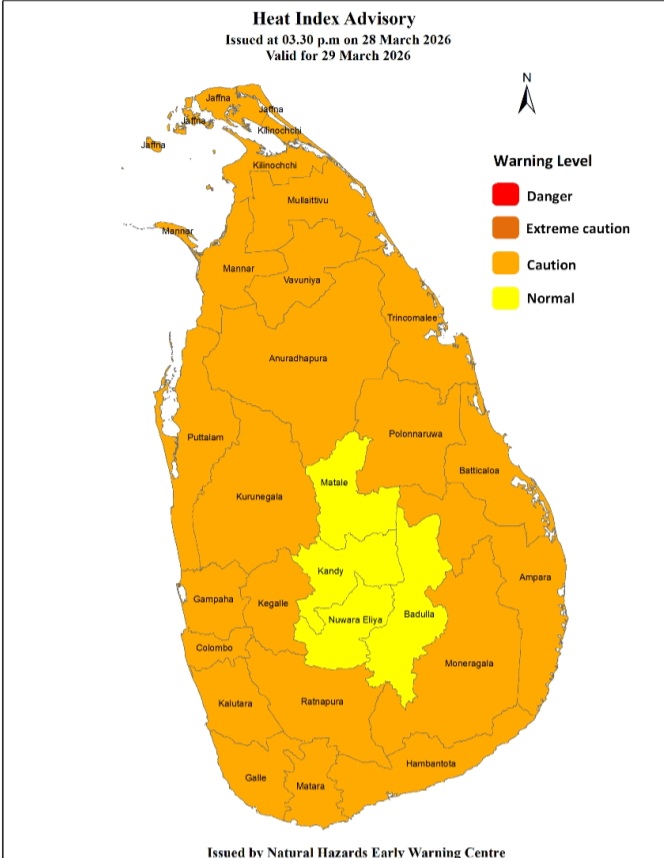
Warm Weather Advisory
Issued by the Natural Hazards Early Warning Centre of the Department of Meteorology
Issued at 3.30 p.m. on 28 March 2026, valid for 29March 2026.
Heat index, the temperature felt on the human body is likely to increase up to ‘Caution level’ at some places in the Western, Sabaragamuwa, Southern, Eastern, North-western, Northern and North-central provinces and in Monaragala district.
The Heat Index Forecast is calculated by using relative humidity and maximum temperature and this is the condition that is felt on your body. This is not the forecast of maximum temperature. It is generated by the Department of Meteorology for the next day period and prepared by using global numerical weather prediction model data.

Effect of the heat index on human body is mentioned in the above table and it is prepared on the advice of the Ministry of Health and Indigenous Medical Services.
ACTION REQUIRED
Job sites: Stay hydrated and takes breaks in the shade as often as possible.
Indoors: Check up on the elderly and the sick.
Vehicles: Never leave children unattended.
Outdoors: Limit strenuous outdoor activities, find shade and stay hydrated.
Dress: Wear lightweight and white or light-colored clothing.
Note:
In addition, please refer to advisories issued by the Disaster Preparedness & Response Division, Ministry of Health in this regard as well. For further clarifications please contact 011-7446491.
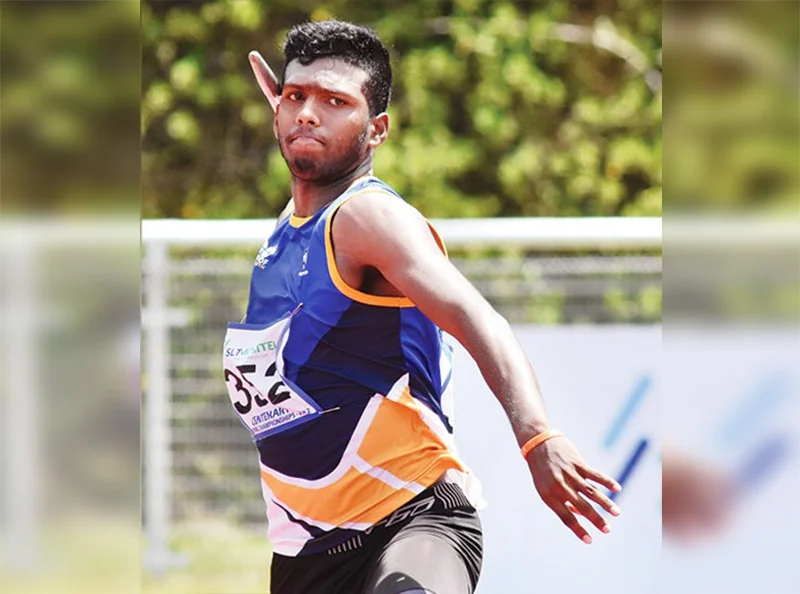
Rumesh Tharanga created history with yet another world leading throw that shattered his own national javelin record at the Champions Track and Field event at Diyagama on Saturday.
The massive 89.37 metres throw, when recognized by World Athletics is set to become the fourth furthest throw in the history of the Asian region.
Despite little competion from his rivals, Tharanga rose like a champion of an entirely different league when he delivered the record breaking feat in his final attempt.
Tharanga had a world leading mark of 83.07 metres for the year coming into this meet. His national record of 86.50 metres was from August 2025. (RF)
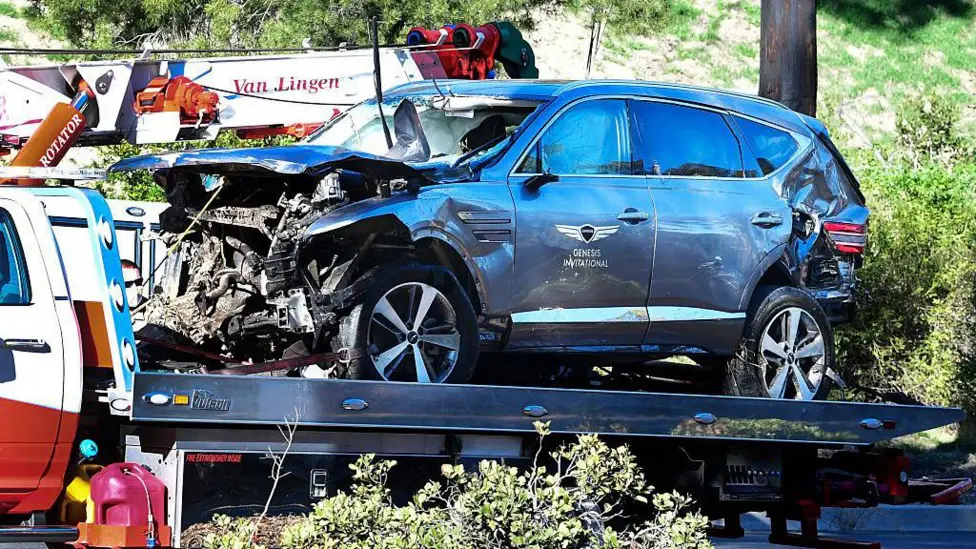
Tiger Woods has been charged with driving under the influence after rolling his car in a crash in Florida, police have confirmed.
The Martin County Sheriff’s Office said the 15-time major champion was also charged with property damage and refusal to submit to a lawful test.
Woods, 50, rolled his Land Rover after clipping a pressure cleaner truck while trying to overtake it at “a high rate of speed”, according to Sheriff John Budensiek.
The golfer, who had to crawl out of the passenger door of his vehicle, passed a breathalyser test after the crash but refused a urine test.
No-one sustained any injuries in the incident which took place on Beach Road in Jupiter Island just before 14:00 local time on Friday (about 19:00 GMT).
Sheriff Budensiek told a news conference: “The DUI investigators came to the scene and Mr Woods did exemplify signs of impairment.
“They did several tests on him. He did explain the injuries and surgeries that he’s had and we did take that into account, but they did some in-depth roadside tests.
“When it was determined, he was placed under arrest and taken to the Martin County jail.
“At the Martin County jail, and even on scene, we were really not suspicious of alcohol being involved in this case and that proved to be true.
“Mr Woods did a breathalyser test with triple zeros, but when it came time for us to ask for a urinary analysis test, he refused.”
Budensiek also said Woods had been “co-operative but was trying not to incriminate himself”.
“He has a right to refuse that test,” added the sheriff. “There is a statute which he will be charged with for refusing to take that test, but we will never get definitive results as to what he was impaired on at the time of the crash.”
US president Donald Trump was asked about the crash on Friday, saying: “I feel so badly. [Woods has] got some difficulty. There was an accident. That’s all I know.
“He’s a very close friend of mine, he’s an amazing person, an amazing man.”
Sheriff Budensiek said Woods would remain in jail for eight hours then be released on bond. The charges are misdemeanours, not felonies.
The BBC has contacted the golfer’s representatives for comment.
This is not the first time Woods has been involved in a car accident – he has played a limited schedule since the serious crash in 2021 that left him with extensive injuries and fortunate to be alive.
In 2017 police officers also found him slumped at the wheel of his parked Mercedes-Benz not far from his Florida home.
A toxicology report found Woods had several legal medications in his system and marijuana’s active ingredient, and he was sentenced to a year’s probation after pleading guilty to reckless driving.
In 2009 Woods hit a fire hydrant, a tree, and several hedges in a bizarre collision outside his home.
The incident sparked accusations of extramarital affairs which led to the end of his seven-year marriage and the loss of lucrative sponsorship deals.
[BBC]

Heat Index likely to increase up to ‘Caution level’ at some places in the Western, Sabaragamuwa, Southern, Eastern, North-western, Northern and North-central provinces and in Monaragala district

Tharanga shatters national javelin record again

Courtesy call by the Heads of Mission- Designate on Prime Minister

Three dead after helicopter crash in Hawaii

Woods charged with driving under influence after crash

Showers may occur at a few places in the Rathnapura, Kaluthara, Galle, and Matara districts during the evening or night

‘Dates have the highest sugar content to fight Coronavirus’

Sunday Island 27 December – Headlines

#SundayIsland 17th December – Headlines

Sunday Island – 28th March

Sunday Island Headlines – 21 March

Sunday Island – 21st February – Headlines
-

 News4 days ago
Senior citizens above 70 years to receive March allowances on Thursday (26)
-

 Features21 hours ago
A World Order in Crisis: War, Power, and Resistance
-

 Features6 days ago
Trincomalee oil tank farm: An engineering marvel
-

 News2 days ago
Energy Minister indicted on corruption charges ahead of no-faith motion against him
-

 News3 days ago
US dodges question on AKD’s claim SL denied permission for military aircraft to land
-

 Features6 days ago
The scientist who was finally heard
-

 Business3 days ago
Dialog Unveils Dialog Play Mini with Netflix and Apple TV
-

 Sports2 days ago
SLC to hold EGM in April