
Midweek Review
Field Marshal in penetrating post-Aragalaya move


By Shamindra Ferdinando
Field Marshal Sarath Fonseka has switched sides again. Fonseka, MP, threw his weight behind UNP leader Ranil Wickremesinghe’s Presidential Polls campaign as the latter strengthened his position, politically, with the finalisation of debt restructuring pacts with the Official Creditor Committee (OCC) and the Exim Bank of China for USD 5.8 bn and USD 4.2 bn, respectively.
Japan-led OCC includes France, India, the United States, Canada and several European nations. However, Sri Lanka is yet to reach an agreement with private creditors. That remains a challenge.
But, on the political front, President Wickremesinghe continued to make substantial progress with the gradual disintegration of the ruling Sri Lanka Podujana Peramuna (SLPP). Would Gampaha District lawmaker Fonseka’s betrayal of the main Opposition party the Samagi Jana Balawegaya (SJB) at a crucial stage of the Presidential Polls campaign undermine Sajith Premadasa drive, with more than a dozen others from the SJB also having behind the scene negotiations with the UNP Leader to back him at the crucial poll, foremost being Rajitha Senaratne?
To be fair by Rajitha he has gone on record telling interviewer Chamuditha Samarawickrema, without naming the co-conspirators, that his plan is to, at the same time, have Sajith Premadasa as the PM candidate in a definite future tie up with Ranil. It is a clear cut challenge to the JVP. According to the one-time Health Minister Dr. Senaratne the SJB rebels had their first meeting at the residence of Eran Wickramaratne, MP, and, according to him, other rebels are cozying up to Ranil more than him.
The launch of FM Fonseka’s memoir “The Army Commander’s Promise to the Nation – I will not leave this war to the next Army Commander,” at Nelum Pokuna, with the participation of President Wickremesinghe last Friday (28) marked the end of Fonseka’s relationship with the SJB, officially.
Fonseka’s move is unlikely to undermine the SJB’s campaign at any level, unless the current internal rebellion, urging Wickremesinghe and Premadasa getting together for the greater good of everyone, gain greater support. In fact, in spite of MP Fonseka being Chairman of the party, he never played a role in Sajith Premadasa’s campaign. But Sajith has to be cognizant of the fact that his MPs do not want to be at the mercy of the JVP knowing its bloody past during two unsuccessful uprisings against elected governments in 1971 and the 1987 to ’89 period. His own late father President Ranasinghe Premadasa and his supporters faced the brunt of the JVP violence in the second uprising. By Sajith Premadasa’s own admission he was the target of an attack when he went to visit the Aragalaya camp site at Galle Face in 2022. He escaped any bodily harm, or even death, thanks to his alert driver who managed to whisk him away to safety in the nick of time. A similar visit to the site by JVP Leader Anura Kumara Dissanayake went off without any incident!
Field Marshal Fonseka, the war-winning Army Commander (2005-2009), had been among those UNPers who joined the SJB at its inception. in 2020. close on the heels of the Grand Old Party’s heavy defeat at the 2019 presidential election. The formation of the SJB, at the expense of the UNP, led to the total annihilation of the latter at the 2020 Parliamentary Polls, if not for a single National List (NL) slot.
The SJB secured 54 seats, including seven National List slots, whereas the UNP was reduced to just one NL slot. Now, MP Fonseka has returned to the UNP. Of the 54-member parliamentary group, fiery Fonseka is actually the third SJBer to go back to the UNP since Wickremesinghe joined the Rajapaksas in April 2022. SJBers Manusha Nanayakkara and Harin Fernando switched their allegiance to Wickremesinghe immediately after the latter accepted the premiership from Gotabaya Rajapaksa. (Former SJB NL member and State Minister Diana Gamage’s ouster from Parliament should be dealt with separately).
The SJB also lost Patali Champika Ranawaka, who registered Eksath Janaraja Peramuna (EJP) and declared his intention to contest the 2024 Presidential Poll. Unfortunately, the former JHU stalwart lacked the required backing to join the fray. Would Ranawaka, too, join Wickremesinghe? If that happened, what would be MP Ranawaka’s terms as he recently declared that he wouldn’t accept ministerial portfolios.
What really prompted MP Fonseka to join Wickremesinghe? The former Sinha Regiment veteran desperately wanted to contest the 2024 presidential election though he lacked political platform. In fact, Fonseka felt he should have had the opportunity to take on Gotabaya Rajapaksa at the 2019 presidential election. Fonseka obviously had no option but to join Wickremesinghe as the SJB publicly rejected him.
The FM’s relationship with Wickremesinghe cannot be examined without taking into consideration the latter’s dependence on the ruling SLPP in Parliament. However, the SLPP has been fragmented, sharply, with a significant number of MPs declaring their support for Wickremesinghe’s candidature.
In late February this year, Fonseka, in an exclusive interview with the writer, declared that he wouldn’t leave the party, hence the decision to title that article ‘Field Marshal won’t quit SJB’. (https://island.lk/field-marshal-wont-quit-sjb/). But, he has done so. In fact, The Island, during that interview at his Thalahena, Malabe office, raised the possibility of him joining Wickremesinghe against the backdrop of meeting the President in Parliament. The FM claimed that he met Wickremesinghe not as the President but the Minister in charge of the Finance portfolio regarding some of his funds held by the government. According to Fonseka, his February meeting, on the day the President delivered his latest policy speech, was the third. “There were two other previous meetings regarding the same matter,” Fonseka said, adding that the other officials who dealt with the issue at hand were the Governor, CBSL, Treasury Secretary and the Attorney General.
Disclosing the February meeting lasted just 10 minutes, Fonseka appreciated the fact that the President didn’t discuss politics at all on all occasions. “Perhaps, regarding the same matter, I may have to meet the President again.”
The funds held by the government are widely believed to be received by Fonseka in the run-up to the 2010 Presidential Polls. Perhaps, the Wickremesinghe-Rajapaksa government must have released the funds that had been held for over a decade. The June 28 book launch proved switching allegiance is all part of the game.
But if Wickremesinghe opts out of the race, as some believe, in favour of Fonseka, as happened in 2010, 2015 and 2019, then most of the JVP bravado about the election being a cake walk as there is no real challenger may turn out to be plain bravado. The writer, however doesn’t think so.
A place in Yahapalana Cabinet
In February 2016, Yahapalana Premier Ranil Wickremesinghe threw a political lifeline to Fonseka who had been in a desperate situation in the wake of the massive 2015 General Election defeat. Having contested the 2015 General Election under the symbol of the Democratic Party (DP), Sri Lanka’s most successful Army Chief failed to secure a single seat. That defeat demoralised and disappointed him. Obviously, Fonseka had absolutely no opportunity to strike a deal with President Sirisena or Premier Wickremesinghe as DP’s showing at the parliamentary poll was so poor and he faced political oblivion.
But, the sudden death of UNP NL MP M.K.D. S. Gunawardena, a SLFPer who switched allegiance to Wickremesinghe, in February 2016, created a vacancy that gave an opportunity to Wickremesinghe. Fonseka was swiftly named Minister of Regional Development and, thereafter, as Minister of Wildlife and Sustainable Development until the Oct 2018 constitutional crisis.
If not for Wickremesinghe, Fonseka wouldn’t have received an opportunity to serve in the Cabinet of Ministers. In the wake of the constitutional crisis triggered by President Sirisena and the Easter Sunday attacks several months later, interested parties called for Fonseka’s appointment as the Minister in charge of police. President Sirisena, who had been at loggerheads with the then Minister Fonseka, declined to do so.
At the time of the National Thowheed Jamaat (NTJ) mounted Easter Sunday attacks Sirisena served as both Defence and Public Security minister.
Regardless of the opportunity granted by Wickremesinghe, in Feb 2016, Fonseka deserted him in 2020 when Sajith Premadasa formed the SJB. About five months after the General Election, MP Fonseka received the appointment as Chairman of the party. Now, after four years in political wilderness, lawmaker Fonseka had again received media attention by way of a book launch but could he sustain public interest?
When Fonseka’s relations deteriorated with the SJB at an early stage, as a member of Sajith Premadasa’s team, he got involved with a group of senior citizens who genuinely promoted him as an independent presidential candidate. They organized a mega event at a five-star hotel in Colombo several months ago to promote Fonseka’s candidature. But, when Fonseka made his latest move, that group simply abandoned him. One of them admitted quite candidly that they were duped.
Now FM is ready to follow SLPP dissidents who switched allegiance to Wickremesinghe at the expense of the party they were elected.
Having given up post of Chief of Defence Staff (CDS) in July 2009 to enter politics, Fonseka contested the 2010 presidential election but suffered heavy defeat at the hands of Mahinda Rajapaksa. The UNP-led coalition that included the JVP and the TNA, lost interest in Fonseka ahead of the parliamentary polls. The celebrated ex-Army Chief ended up with the Democratic National Alliance (DNA) and the grouping, led by the JVP, secured seven seats at the General Elections. Fonseka was among the group that included Arjuna Ranatunga, Titan Alles and Anura Kumara Dissanayake.
The arrest of Fonseka in early February 2010 in a despicable manner and subsequent legal action/ court martial and his release in May 2012 with a presidential pardon demonstrated a pathetic state of affairs.
Fonseka-TNA relations
Fonseka comfortably won all electorates in the Northern and Eastern Provinces at the 2010 presidential election. After having accused his Army of butchering Tamil civilians on the Vanni east front, the TNA (one-time-LTTE ally), backed his candidature, thanks to Washington’s machinations here to defeat Rajapaksas at any cost for defying the West and wiping out the Tigers militarily. The TNA backing for Fonseka had been in line with the overall US-led strategy to defeat Mahinda Rajapaksa at the 2010 Presidential Poll. The US strategy, however, failed that time till Sirisena’s betrayal five years later, again with the US backing. Fonseka ended-up losing by a staggering 1.8 mn votes though he handsomely won all the North and East electoral districts with mainly Tamil votes.
MP Fonseka, in May 2021, explained why the Tamil electorate voted for him at the January 26, 2010, presidential election. The explanation given in Parliament coincided with the low-key 12th anniversary of Sri Lanka’s triumph over the LTTE. Fonseka declared: THE PEOPLE OF THE NORTH AND EAST VOTED FOR HIM WITHOUT HATRED BECAUSE OF THE RESTORATION OF PEACE IN THE ENTIRE COUNTRY.
Why did MP Fonseka make such an assertion 12 years after the war? What prompted him to say so? Most importantly, was he telling the truth? Did the Tamil electorate really vote for him because of his role in the eradication of the LTTE? No one has responded to Fonseka so far. The civil society, too, has remained mum.
Actually, why did the UNP pick Fonseka as the common candidate? In the aftermath of the eradication of the LTTE, in 2009, the UNP had no option but to accept Fonseka as the common candidate, particularly against the backdrop of the war-winning General making covert moves in their direction. The UNP-led Opposition strategy was primarily meant to deprive President Mahinda Rajapaksa the advantage of the unbelievable (in the eyes of the powerful West that insisted on the invincibility of the Tigers in battle) war triumph. There couldn’t have been a better choice than Fonseka though the Opposition leadership quite correctly realised how the inclusion of the LTTE’s sidekick Tamil National Alliance (TNA) in the grouping distanced the Southern electorate.
Fonseka didn’t mince his words when the media, on July 15th 2009, raised the possibility of his entry into active politics. The writer was among those who had been present at the media briefing called by General Fonseka, in his new capacity as the Chief of Defence Staff (CDS) at the Joint Operations Headquarters (JOH) within the Army Headquarters premises.
Fonseka declared he would never seek a political career. The war veteran said that he wouldn’t want to lose his popularity within 24 hours by taking to politics. The former Army Chief recalled the fate of his senior colleagues, Major General Lakshman Algama and Major General Janaka Perera, both of whom perished in LTTE suicide attacks on election platforms.
The LTTE assassinated Gemunu Watch veteran Algama on Dec 18, 1999, at an election rally in Ja-Ela held in support of UNP Presidential candidate Ranil Wickremesinghe, whereas Commando veteran Perera perished on Oct 06, 2008 in Anuradhapura at an event related with PC polls in which he contested as the Chief Ministerial candidate of the North Central Province.
Nothing could be further from the truth than Fonseka’s declaration in Parliament that those living in the northern and eastern regions voted for him because of the restoration of peace therein? The Tamil electorate never accepted Fonseka’s role as the Commander of the Army and repeatedly accused him and his Army of genocide, especially after the crushing defeat of the LTTE.
Having recognized the LTTE as the sole representative of the Tamil speaking people, way back in 2001, the TNA wouldn’t have accepted Fonseka if the outfit hadn’t been convinced that only the former Army Commander could have challenged the immensely popular Mahinda Rajapaksa at the 2010 Presidential Poll.
The plan received the wholehearted backing of the West and especially the US, though the then US Ambassador in Colombo, Patricia Butenis, in a confidential dispatch from Colombo, subsequently exposed by Wikileaks, categorized Fonseka as a war criminal along with President Mahinda Rajapaksa, Defence Secretary Gotabaya Rajapaksa and lawmaker Basil Rajapaksa.
The diplomatic missive, dated January 15, 2009, held the above-mentioned leaders responsible for war crimes. In spite of that, the US threw its weight behind Fonseka, perhaps initiating the move itself as the only viable political strategy to defeat the hugely popular war-winning Mahinda Rajapaksa securing a second term.
Now Fonseka is back again with Wickremesinghe as the latter builds-up large alliance in preparation for the 2024 Presidential Poll.
Why Fonseka accepted the TNA’s backing against the backdrop of its close relationship with the LTTE is still a mystery. Having recalled the killing of Majors General Algama and Perera when he assumed duties as the CDS in July 2009, Fonseka quite conveniently forgot the TNA’s endorsement of the LTTE bid to assassinate Fonseka. If the LTTE succeeded in eliminating Fonseka in April 2006 and Defence Secretary Gotabaya Rajapaksa in Oct 2006, the war would have definitely taken a different turn as we have often been reminded.
Post-Aragalaya politics
Field Marshal Fonseka was one of the few lawmakers to publicly endorse Aragalaya that forced Gotabaya Rajapaksa out of office. Aragalaya accepted him. The war veteran was the only lawmaker to address the crowds near the Janadhipathi Mandiraya a couple of hours before they stormed the place. After the SLPP elected Wickremesinghe, in late July 2022, as the President, MP Fonseka called for fresh Aragalaya to oust the Wickremesinghe-Rajapaksa administration. Addressing Parliament, Fonseka urged people to gather in Colombo on Nov 09, 2022. The war veteran wanted to launch a continuous protest campaign until the government was forced out. The SJB quickly distanced itself from Fonseka’s plans. The August 09 project collapsed. Fonseka suffered an irreparable setback.
Perhaps, Fonseka’s latest move should be discussed in the context of the retired military being largely divided among the SJB and JJB/JVP. Fonseka is the only top level retired officer to throw his weight behind Wickremesinghe.
Among those who had been present at the book launch was retired General Mahesh Senanayake, who recently joined the SJB. But that hadn’t discouraged Fonseka from inviting Senanayake, who was recalled from retirement to serve as Yahapalana Army commander. That was due to Fonseka’s intervention. But, the SJB’s decision to accommodate retired General Daya Ratnayake angered Fonseka, who lashed out at Sajith Premadasa for doing so.
The leader and Chairman hadn’t agreed on many things. Actually, there hadn’t been consensus on key issues. They disagreed on the move to back Dullas Alahapperuma as the Opposition candidate against Ranil Wickremesinghe when Parliament voted to elect an MP to complete the remainder of Gotabaya Rajapaksa’s five-year term. Finally, having tried to utilise Aragalaya against Wickremesinghe, Fonseka ended up in the President’s camp.

In the run-up to the 2015 Presidential election, a Chinese submarine visit, in 2014, caused major media fury. Indian media alleged the vessel was nuclear powered. In spite of Sri Lanka repeatedly assuring that it was not and New Delhi was always informed in advance of Chinese submarine visits, the Modi government, however, resorted to action detrimental to the Rajapaksas ahead of the presidential poll.
By Shamindra Ferdinando
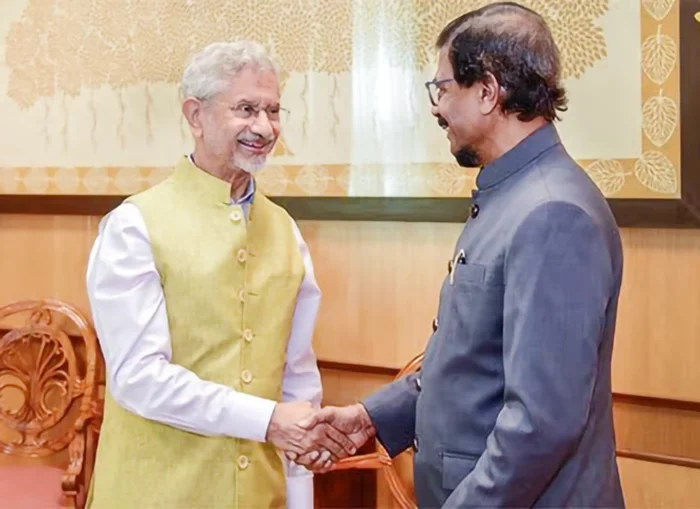
One of the busiest Indian politicians, Indian External Affairs Minister Dr. S. Jaishankar, recently received JVP General Secretary Tilvin Silva, in New Delhi. It was Jaishankar’s second meeting with Silva, in New Delhi, this year. They first met in February.
The ruling Bharatiya Janata Party (BJP) invited the JVP General Secretary as it sought to enhance direct relations with the once morbidly anti-Indian so-called Marxist party in line with the overall Indian strategy. The five-day visit (27 Sept. to 01 Oct.) perhaps underscores the deterioration of other political parties represented in Parliament and outside. The media reported the invitation was extended under the ‘KNOW BJP’ initiative intended to familiarise the international community with the history of the party.
Among those who met Silva were BJP National General Secretary (Organisation) B.L. Santhosh, National President of the BJP Mahila Morcha (Women’s Wing) Roopkumari Choudhary, BJP Youth Wing representatives Vineet Vats Tyagi and Bhakti Sharma. Chief Minister of Delhi, Ms. Rekha Gupta, as well as Delhi State Education Minister Ashish Sood. Silva also met Delhi BJP President Harsh Malhotra.
Welcoming the JVP delegation at the BJP’s Delhi Office, newly appointed Delhi BJP co-incharge and former Surat MP Darshana Jardosh, who took charge at the party office recently, said in a Facebook post: “India and Sri Lanka share a timeless bond rooted in civilisation, culture and faith. Under the visionary leadership and sustained efforts of Prime Minister Narendra Modi, India-Sri Lanka relations have gained renewed momentum, with stronger cooperation in development, healthcare, energy, connectivity and people-to-people ties. Such meaningful exchanges strengthen mutual understanding and reaffirm our shared commitment to democracy, development, public welfare and a stronger neighbourhood.”
The JVP delegation consisted of its General Secretary Tilvin Silva, Central Committee member Chandrika Adikari, lawmaker Aboobucker Athambawa, District Committee member Kabilan Suntharamoorthy and International Department member Kalpana Madhubhashini.
There hadn’t been any previous instance of a General Secretary of a Sri Lankan political party receiving an invitation from the BJP, leading to a meeting with the External Affairs Minister. The BJP/the Government of India wouldn’t have arranged the latest visit unless the powers that be felt the pivotal importance of consolidating ties with the JVP that once waged a bloody insurrection against the deployment of Indian armed forces in Northern and Eastern regions of Sri Lanka (1987 July to March 1990).
Vijay Chauthaiwale, in-charge of BJP’s Foreign Affairs Department, declared that the visit was meant to strengthen BJP–JVP engagement, facilitate the exchange of organisational experiences and further deepen ties between the two political parties.
In late January, 2024, in the run-up to the Presidential election, India made it clear its position regarding the crucial national election when it invited JVP leader Anura Kumara Dissanayake, MP, to New Delhi. Dissanayake’s delegation included MP and JVP propaganda secretary Vijitha Herath, NPP secretary Dr. Nihal Abeysinghe and Professor Anil Jayantha.
The five-day visit, in early Feb. 2024, signalled that New Delhi anticipated Dissanayake’s victory at the Presidential election and was confident of JVP triumph at the parliamentary election. Dissanayake received a mega boost, thanks to his unprecedented meeting with Dr. S. Jaishankar, National Security Advisor Ajit Doval and Foreign Secretary Vinay Mohan Kwatra. In a way, the high-level opportunities, granted by New Delhi, strengthened Dissanayake’s position and may have influenced the voters, living in predominantly Tamil speaking regions.
Having bagged the Presidency in Sept. 2024, the JVP swept the parliamentary polls. The New Delhi’s intervention may have undermined the main Tamil political party, namely the Illankai Thamil Arasu Kadchi (ITAK), one-time LTTE’s cat’s paw. The JVP scored an extraordinary victory in the Northern and Eastern provinces where it bagged 12 seats (Jaffna 3, Vanni 2, Trincomalee 2, Digamadulla 4 and Batticaloa 1). The ITAK was reduced to just eight seats, their worst performance since the eradication of the LTTE, in May, 2009.
Post Easter Sunday developments
Having failed to achieve its long standing political objectives, the JVP, in mid-2019, founded National People’s Power, aka Jathika Jana Balawegaya (JJB).
JVP leader Dissanayake received the leadership of the newly formed political alliance. Tilvin Silva remained the JVP General Secretary, whereas Dr. Abeysinghe, renowned epidemiologist was named the General Secretary of the NPP. While the JVP General Secretary remained outside the parliamentary group, Dr. Abeysinghe successfully contested the Nov. 2024 parliamentary polls. He represents the Kalutara district.
In spite of the JVP/NPP expressing confidence of sharp increase in public support for the candidature of Dissanayake at the Nov. 2019 presidential election, he couldn’t poll half a million votes. Dissanayake managed just 418,553 votes (3.16%) and ended up a distant third.
SLPP candidate Gotabaya Rajapaksa, who hadn’t at least bothered to take SLPP membership, comfortably won the election. The wartime Defence Secretary polled 6,924,255 votes (52.25%) while Sajith Premadasa, who contested under the ‘Swan’ symbol of the New Democratic Front (NDF) obtained 5,564,239 votes (41.99%).
The 2019 Easter Sunday suicide attacks, launched by the National Thowheeth Jamaath (NTJ), created an environment that facilitated Gotabaya Rajapaksa’s victory. Now, the crux of the matter is whether the NTJ, formed in Kattandudy by Mohamed Zahran Hashim, in 2014, carried out near simultaneous suicide attacks to help Gotabaya Rajapaksa, though well tarnished among average Muslims as being anti-Islam, to win the presidency.
The ongoing CID investigation focused on the British Channel 4 claim, aired in Sept. 2023, regarding Easter Sunday carnage, is all about that still unsubstantiated allegation. The CID arrested the former head of Directorate of Military Intelligence (DMI/2012-2016) and ex-State Intelligence Service (SIS/2019 to 2024) Maj. Gen (retd) Suresh Sallay in February, this year, in connection with this investigation. He is held under the Prevention of Terrorism Act (PTA) on allegations ironically levelled by a fugitive from Sri Lankan law.
The current status of JVP/NPP relations have to be examined, taking into consideration the declaration made by the then MP Nalinda Jayathissa, who served as a member of the Parliamentary Select Committee (PSC), that inquired into the Easter Sunday massacre. Jayathissa alleged that India was behind the Easter Sunday carnage. The uncorroborated allegation was made in February 2021, just two months short of two years, after the attacks. However, he denied saying so in August 2025, nearly a year after the Presidential election and in the wake of India and Sri Lanka entering into seven Memorandum of Understanding (MoUs), including one on defence.
The seven MoUs, signed in Colombo, in early April 2025, underscored the trajectory of the Indian strategy. Signing of an MoU on defence hadn’t been publicly mentioned, even during the presidency of Ranil Wickremesinghe (2022 July-2024 Sept.) though the UNP leader sought to further enhance relations with Premier Narendra Modi’s India. Therefore, the signing of the MoU on defence, in April 2025, and the rapid acquisition of the Colombo Dockyard Limited by India’s state-run Mazagon Dockyard Shipbuilders Ltd., couple of weeks later, jolted the country.
In fact, Premier Modi gave the first indication of the impending defence MoU when President Dissanayake visited New Delhi, in Dec. 2024. It was Dissanayake’s first official visit. Although the joint communiqué, issued from New Delhi at the conclusion of the visit, had been silent on the agreement on defence MoU, a translation of Premier Modi’s speech revealed the truth.
In early September, this year, India and Sri Lanka signed three more MoUs, including one that dealt with six L70 air defence systems, operated by the Air Force. Those guns had been acquired during the war against the LTTE to meet the threat posed by small fixed wing aircraft, then possessed by the once fledgling Tiger air force.
Transformation of JVP
The late Somawansa Amarasinghe, in late Nov. 2001, during Chandrika Bandaranaike Kumaratunga’s tenure as the President, disclosed notable change in its position, vis-a-vis India. Having returned from Europe, following a 12 -year self-imposed exile, Rohana Wijeweera’s successor had no qualms in declaring that India saved his life. That declaration was made at his first public rally in Kalutara.
Although the sole surviving member of the original JVP politburo, Amarasinghe, fled the country in Feb. 1990, there hadn’t been at least a reference to possible Indian involvement in the rescue operation. Did Amarasinghe, for some mysterious reason, understate the Indian involvement?
The writer sought an opportunity to seek clarification from Amarasinghe regarding his escape from government forces and death squads hunting for prominent JVPers, even after the execution of Rohana Wijeweera. Amarasinghe politely declined to discuss what he said at the Kalutara rally, in Nov. 2001.
During the second violent rebellion, from 1986 to 1989, Rohana Wijeweera, Upatissa Gamanayake, Sumith Athukorala, D.M. Ananda, Saman Piyasiri Fernando, Piyadasa Ranasinghe, H.B. Herath, Gunaratne Wanasinghe, R.B. Wimalaratne, Somawansa Amarasinghe, Shantha Bandara, Nandatilaka Galappaththi and Lalith Wijeratne, functioned as politburo members.
Some speculate that New Delhi may not have been directly involved in Amarasinghe’s rescue but allowed him to stay there until he found a way out of India. At the height of the insurgency, Somawansa got his wife Malani and son Isuru to leave the country and he later joined them.
What made India facilitate Amarasinghe’s escape or turn a blind eye to his presence there? Whatever happened back in the late 80s may have a significant impact on the developments today. Maybe not. But, the way the JVP transformed itself from a rabid anti-India position to establish partnership is not a mystery. The JVP opposed all projects initiated by previous governments and sabotaged each and every one of them. There cannot be a better example than the JVP-led protests against the 2019 tripartite agreement involving Sri Lanka, India and Japan. President Gotabaya Rajapakasa couldn’t go ahead with the Easter Container Terminal (ECT) project. Faced with non-stop protests, President Rajapaksa was compelled to rescind the agreement.
India protested the move. IHC in Colombo emphasised that “all sides should abide by the existing understandings and commitment” in timely implementation of the agreement, signed in 2019.
Sri Lanka offered India and Japan an opportunity to develop the port’s West Container terminal as a reconciliation move. But Japan pulled out of that partnership.
Sri Lanka (Sri Lanka Ports Authority) finalised the agreement with Adani Ports and SEZ, John Keells Holdings on Colombo West International Terminal (CWIT) in late Sept. 2021. Amidst an unprecedented economic crisis that led to President Gotabaya’s Rajapakasa’s ouster, in July 2022, blamed on a political campaign alleged to have been backed by the US and India, the work on CWIT made rapid progress. If anyone suspected the JVP-led NPP’s sudden about-face intentions as they always opposed anything and everything Indian in the past, the change of government in Sept. 2024 cleared the way for an all-out effort to bring CWIT work to a successful conclusion.
CWIT formally launched operations in the first week of April 2025 in the immediate aftermath of the two countries finalising seven MoUs, including one on defence.
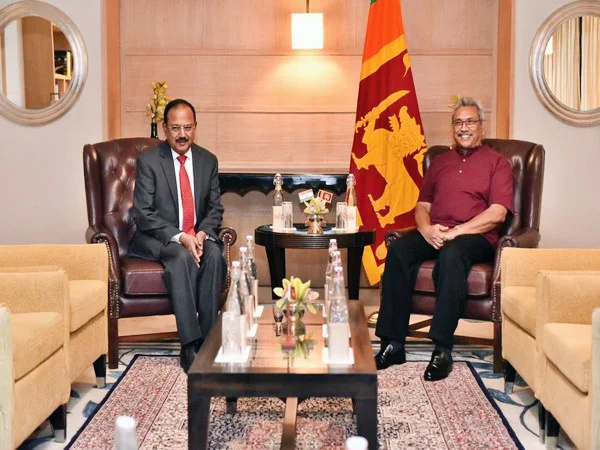
Gotabaya Rajapaksa meets Ajit Doval in late Nov. 2019, in New Delhi. It was Rajapaksa’s first meeting with Doval after Rajapaksa became the President .
New approach
Prime Minister Dr. Harirni Amarasuriya joined Indian High Commissioner Santosh Jha at the recent commissioning of Phase 2 of CWIT project. Declaring that the two million TEU mark has been crossed, in record time, Jha declared: “Let us remember what the Colombo West International Terminal is. A flagship deep-water container terminal. Built by a partnership of the Sri Lanka Ports Authority, John Keells Holdings, and Adani Ports and SEZ. An investment of approximately 750 million US dollars, it is one of the most significant infrastructure investments in Sri Lanka’s maritime sector in recent years.”
Much to the surprise of utterly disorganised and inept political parties in parliamentary opposition and outside, the Dissanayake’s government has indicated that the incumbent administration intends to go along with the US and India. Those who feared to finalise agreements with the US and India, in the past, and often succumbed to JVP inspired trade union pressure, respond with disbelief as the US and India advance their agenda, without the usual resistance from the JVP, with it turning into an ardent admirer of India.
The government has conveniently forgotten the moratorium on visits by foreign research vessels declared by President Ranil Wickremesinghe for the year 2024. That declaration made at the behest of India and US to prevent Chinese research vessels from entering Sri Lankan waters remain in force though the government promised to review Wickremesinghe’s decision. The moratorium on research vessels visits seems to be permanent and no political party, represented in Parliament, is likely to raise it.
The sinking of an unarmed Iranian frigate off the southern coast in the first week of March this year, just outside Sri Lankan territorial waters and in India’s backyard, and subsequent Indian accusations of Chinese military presence at Hambantota, highlighted the crisis hapless Sri Lanka is in. The ongoing controversy over the US warning Sri Lanka of dire consequences if supplies were made available to Iranian vessels stranded off the country’s south western coast.
The JVP/NPP administration appears to be in a dilemma as Sri Lanka cannot forget critical support provided by Iran, especially during Eelam War IV. Former Sri Lankan Ambassador in Tehran, M.M. Zuhair, recalled how the Iranian government swiftly and decisively provided assistance amidst western efforts to jeopardise the military campaign by undermining the national economy.
As the war entered a crucial stage, the government found itself in an extremely difficult situation. Following talks at the highest level, Iran provided Sri Lanka with an interest-free and concessionary oil credit facility worth $1.05 billion to help obtain crude oil requirements, President’s Counsel Zuhair said.
If not for the rolling credit line easing severe foreign exchange pressures, the Rajapakasa government could have faced an insurmountable challenge, the former diplomat said, adding that unfortunately those in decision-making positions now have forgotten the past.
The change in Sri Lanka’s trajectory began with the advent of the treacherous Yahapalana administration. Under the Sirisena-Wickremesinghe leadership, Sri Lanka betrayed the war-winning military at the United Nations Human Rights Council (UNHRC) in Geneva, in Oct. 2015. It would be pertinent to mention that the BJP came into power in the year before securing what the media called a historic absolute majority at the Indian parliamentary polls. Since then the BJP developed its strategy vis-a-vis Sri Lanka.
Sri Lanka is beneficiary of a spate of Indian funded projects implemented over a period of time. Having once launched an insurrection in the aftermath of the Indian Army deployment here, in 1987, and opposed what it called Indian expansionism here, the JVP is now the beneficiary of India funded projects, not only in the Northern and Eastern provinces, but other provinces as well. One of the most important projects of them all was the flagship housing programme meant to construct 60,000 units. Launched after the end of war, in 2009, the project covered the Central and Uva provinces. While continuing the housing project, etc., launched previously, the BJP advanced a comprehensive strategy meant to ensure Colombo remained within New Delhi’s sphere of influence.
Hope you haven’t forgotten how Doval, in 2014, demanded Sri Lanka halt major Chinese projects, including USD 1.4 bn Colombo Port City project and take back China managed Colombo International Container Terminal (CICT) that was in operation since July 2013. Sometime after Mahinda Rajapaksa lost the 2015 presidential election, Gotabaya Rajapaksa revealed how Dorval twice demanded the cancellation of Chinese projects and CICT take over. Sri Lanka’s refusal to heed Indian warnings resulted in them backing turncoat Maithripala Sirisena’s candidature at the 2015 presidential election. The rest is history.
Between the devil and the deep blue sea:
 by Sasanka Perera
(The writer is on X as @sasmester)
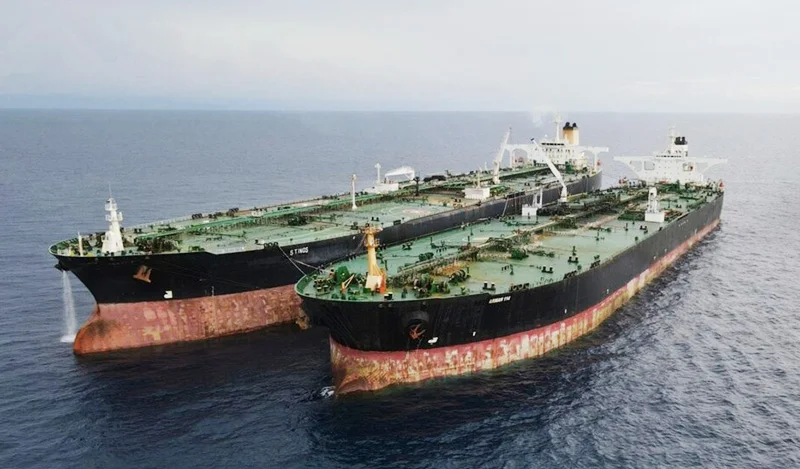
According to news reports, about 19 Iranian tankers are berthed approximately 15 nautical miles off Sri Lanka’s southwestern and western coasts since August 2026. They are void of their cargoes of crude oil, having offloaded them to other tankers destined mostly to Chinese refineries. Seas off Sri Lanka’s maritime boarders are not the only concentration of such inactive Iranian ships with their crews. Malaysian and Indonesian waters and just beyond also have concentrations of Iranian tankers. Sri Lankan authorities have maintained that these vessels are positioned just outside the country’s 12-nautical-mile territorial waters, indicating that local authorities have limited direct jurisdiction over them. While this is legally correct, the potential consequences of these ships being in such close proximity to our waters cannot be ignored.
The current situation has come about because of unilateral secondary sanctions imposed by the United States targeting Iranian shipping around the world. Effectively, secondary sanctions are punitive measures imposed by a powerful country, in this case, the United States, against foreign individuals and entities that do business with a primary target country already under a first-tier embargo or trade ban. In this case, this primary country is Iran. This means, the provision of supplies or services to Iranian vessels by Sri Lankan companies or the government would run afoul of the unilateral US sanctions. At present, these ships are said to be low on fuel, and sustenance such as water and food. So, the underlying question is, should Sri Lanka and the world let the Iranians starve just beyond our waters for fear of US sanctions which are immoral and unethical — if not illegal at least in terms of their own laws.
Since initial local reports suggested that the US had warned Sri Lanka that they would impose sanctions on our country if its authorities provided supplies or services to Iranian ships, the Sri Lankan Foreign Ministry issued a press clarification saying, that the US has issued secondary sanctions as part of ‘their own common policy perspective’ which applies ‘globally and do not target only SL or any specific country.’ This is correct and common sense. But what does it mean to our country, which is caught in the middle of the illegal war the US and Israel are waging against Iran? Being neutral is one matter. But do we allow our moral compass to be compromised and allow people to starve because of our fear of these sanctions. Let me remind, notwithstanding the burden of human rights violations on the part of the state, we are a country that showed mercy to LTTE leaders when they needed medical treatment in Colombo. We also sent shipments of food, medicine, and relief items to trapped civilians in LTTE-controlled areas knowing fully well that these were being intercepted and seized by the LTTE, which would sustain its campaign against the country. There is little doubt we will suffer greatly if we opt to help the stranded Iranian seamen. But Sri Lanka has been in this situation before when the US destroyed an Iranian ship close to our waters. The Sri Lankan government took the decision to provide humanitarian assistance to the crew of another Iranian ship at the same time in early March 2026, and rightly so. At the time, the government took recourse in international obligations operative in humanitarian conditions in general and the Law of the Sea (UNCLOS) in particular.
In many ways, the present situation indicates the obvious contradictions across public international law, UNCLOS, the law of neutrality, and the conflict between unilateral jurisdiction versus state sovereignty. It also exposes the moral and ethical obligation of a country in the midst of the immorality and evil exercised by far more powerful nations and many others who have lost their moral and ethical consciousness.
Most serious international legal scholars and multilateral bodies (including the UN) maintain that unilateral secondary sanctions such as those declared by the US — lacking UN Security Council authorisation — violate international law. Because secondary sanctions threaten nations’ access to the global U.S. financial system, and therefore work better than traditional military enforcement, third states like Sri Lanka face a state of economic coercion. This makes de facto compliance necessary even when de jure international law regards the sanctions as overreach.
Providing ship-to-ship transfers, provisions, or repairs to vessels stationed outside a country’s territorial waters falls under standard maritime commercial freedom. Threatening a state for permitting its private companies or state entities to render essential and life-saving services outside territorial waters interferes with high-seas freedoms (UNCLOS Article 87). This is the situation Sri Lanka currently finds itself in. The problem with U.S. secondary sanctions is that they attempt to dictate how Sri Lanka exercises or refrains from exercising this sovereign prerogative. Our government needs to resist this shameless bullying.
If these vessels run out of drinking water and food as is likely to happen soon, offering the ship crews Permissible Humanitarian Assistance is a matter of offering distress relief. Under Hague XIII and customary law, neutral states, like Sri Lanka in this case, are permitted, and more importantly, morally bound to render essential humanitarian assistance, such as food, medical aid, or emergency repairs necessary to ensure seaworthiness, to vessels in distress. For its own convenience and lack of moral values, the U.S. government’s secondary sanctions typically make little distinction between commercial logistics, fuel supply, and basic humanitarian assistance.
On 4 October 2026, the Minister of Foreign Affairs made clear in public that Sri Lanka will make ‘all our decisions while protecting our sovereignty and identity’ and ‘if there is a need arising from humanitarian considerations, we will make the necessary intervention.’ Theoretically, this is the correct position notwithstanding it is a difficult position for a small country like Sri Lanka to put into practice. But from a moral high ground, it is always possible. I assume this is why the minister referred to the earlier incident involving an Iranian ship when he noted that ‘Sri Lanka is providing the vessel’s 13 crew members with the necessary food, accommodation and security while ensuring that the vessel remains safely maintained’. More importantly, he also noted that ‘Sri Lanka always acts in accordance with international maritime law.’ This is a position we must maintain whatever the pressure.
Threatening secondary sanctions against services rendered to stranded or distressed ships directly clashes with a neutral state’s obligation to protect human life at sea under the SOLAS Convention (Safety of Life at Sea) and SAR Convention (Search and Rescue). As far as I understand, from an international law standpoint, U.S. threats of secondary sanctions over Sri Lankan services to Iranian vessels represent such violations and an extraterritorial assertion of domestic authority that lacks a multilateral mandate (such as a resolution in the almost dysfunctional UN Security Council).
From a foreign policy perspective, we should have already begun negotiations with counties like Malaysia and Indonesia (in whose extended backyards many of these ships transferred their oil to other tankers) and China (to whose refineries much of this oil went and which paid for these cargoes) to ascertain how the lives of these sailors can be saved. After all, the cargoes did not come to us, and its transshipment was not facilitated by us. This is not about the maintenance of these vessels themselves or helping in their reintegration into the so called ‘shadow fleet of Iran.’ Here, our neutrality must be underlined. This is simply about human life. Have we thought of approaching the above countries to ascertain if they would help in finances to feed the Iranian sailors if our country decides to bring them ashore for humanitarian assistance and to build a coalition for such contingencies within applicable international conventions?
While international law grants Sri Lanka the clear sovereign right to manage services in its territory and EEZ, and mandates distress relief under maritime safety conventions, the practical reality of financial enforcement mechanisms forces us to weigh legal rights under UNCLOS and public international law against the immediate economic costs of U.S. financial isolation. This is why our engagements with countries like Malaysia, Indonesia, Russia and China, to mention only four nations, are essential and should have already begun.

by Prof. N. A. de S. Amaratunga PhD, DSc, DLitt
Prof. Sasanka Perera’s important article dealing with the vital subject of discipline of Buddhist monks published in the Midweek Review of The Island on 23 Sept., 2026 needs a response with regard to its reference to faith, mythology and rituals. He says, “One must concede that it is mythology and rituals that hold any core set of philosophical ideas such as the dhamma together as a religion. It is through these practices that religion as a matter of faith emerges from abstract ideas. This is common to any religion. It is through these practices that Buddhism, Christianity, Hinduism or Islam become religion”. First, it may not be correct to say that it is mythology and rituals that hold together the core set of philosophical concepts of Buddhism. Second, it may not be correct to infer that Buddhism has emerged as a matter of faith through the practices of rituals. Further, it is not through practice of rituals that Buddhism becomes a religion.
First of all, we must determine what constitutes the core philosophy of Buddhism and find out to what extent it depends on mythology. We must also examine the origin of rituals in Buddhism to see whether or not the dhamma could exist without rituals. Then, we must look at the nature of faith and its role in Buddhism.
The core philosophy of Buddhism is empirical in nature, which means it is based on, or derived from, observation, experiment, or sensory experience and it has nothing to do with mythology. The word “Ehipassiko” that prominently appears in Prof. Perera’s article cannot have any relevance in Buddhism if it depends on mythology to be held together. “Ehipassiko” is not applicable to religions based on mythology. The Buddha requested everybody interested to “come and see for yourself” because it could be known by experience. Same could be said about the discourse to the Kalamas, which Prof. Sasanka Perera has quoted. Theistic religions that are based on mythology cannot be examined by such means.
Prince Siddharta, before he attained Nibbana, experienced “Dukha” or suffering and “Anicca” or impermanence in his surroundings and found that such an existence cannot have a permanent self, (“Anatta”). Thus, the three signs of existence “Anicca, Dukha, Anatta” are empirical in origin and they form the core philosophy of Buddhism on which the doctrine is based. The “Four Noble Truths” are developed on this basis, and these also have no mythology whatsoever.
Prince Siddharta realised the fallacy of the Vedic thesis and rejected it entirely when he composed the three signs. Therefore Prof. Perera’s theory that “it is through these practices that religion as a matter of faith emerge from abstract ideas” does not hold where Buddhism is concerned. Buddhism is neither a “matter of faith” nor did it emerge from abstract ideas.
The fourth Noble Truth has no myth basis and is not dependent on blind faith or rituals. It is the path to the final goal in Buddhism; that is freedom from suffering. It is entirely based on morals which is central to Buddhism. Three factors in the Arya Astanghika Marga, deal with morals that prepare the mind for the final stages, “Sati” and “Samadhi”. These three factors which are concerned with right speech, right action and right livelihood, do not involve the practice of rituals. Unlike in theistic religions Buddhism does not require rituals in the practice of morals. None of the other factors in the Arya Astanghika Marga prescribe rituals. Therefore, one wonders, if the path to the final goal does not need rituals, where else could they be required to be of any significance.
“Nowhere else” is the obvious answer. What Buddhists have to do instead, is to live by the five precepts, eight precepts or ten precepts, or practice the Arya Astanghika Marga as far as possible, none of which have rituals. In such practice even if one does not reach the ideal, one would be immensely benefitted including peace of mind and satisfactory existence without too much suffering. This could be attained without the practice of rituals.
The Buddha rejected the practice of rituals in Sámaññaphala Sutta of the Dìgha Nikáya, where he declares all blessing rites and rituals as animal sciences (tiraccháanavijjá). Such was the attitude of the Buddha towards rituals. Ven. Kekirawe Sudassana was abiding by the Buddha’s word when he made the bold and correct statement that rituals were unnecessary in the practice of Buddhism. Ven. Sudassana should not be penalised for attempting to reject rituals.
Early Buddhism there was no mention of rituals. The four major Nikayas, Digha, Majjima, Anguttara and Samyutta comprise Early Buddhism. These were the only Nikayas in the Sutra Pitaka that were assigned to the Bhanaka monks to be preserved by the oral tradition, at the First Buddhist Council held three months after the Parinirvana of the Buddha and therefore considered to be closest to Buddha’s preaching. At the Third Buddhist Council held under the auspices of King Asoka, Ven. Moggalliputtatissa cleansed the Dhamma of all impurities that had crept into it and this was the Dhamma that was brought to Sri Lanka in the 3rd Century BCE. This Dhamma did not advocate the practice of rituals to the Sri Lankan community and there was no rituals in the country until the 5th Century CE.
It was Ven. Buddhagosa in the 5th Century CE, who probably had come under the influence of Mahayana when he was in South India on his way to Sri Lanka, who in his translations of the commentaries introduced dividend carrying rituals.
Sri Lankan monks came to accept the practice of rituals as a necessary method to attain Nibbana. Eminent Buddhist scholar Prof M. M. J. Marasinghe says: “The hard work of Buddhagosa and the Mahavihara fraternity culminated in the formulation of a new ritual structure with attractive advantages to keep both the lay followers and the members of the Sanga happy and content As a result, when we pass from the canonical Pali texts to the Pali commentaries we come into a totally new teaching different from the original” (Beyond Ritualistic Realm, 2018).
In Buddhism, faith is quite different. There has to be faith in the path that will finally lead to the goal, for otherwise there may not be total commitment. However, love and devotion to the Buddha is not required. This is understandable as the final goal, Nibbana, is development of wisdom (“paññâ”) for which there is no need for the personal involvement of the Buddha.
Though not conclusively proved, there seems to be new evidence in neuroscience that points to the possibility of consciousness emitting out of the body. Further, recent advances in theoretical physics show that matter could be converted to energy and energy to matter. If stream of consciousness is a stream of energy, it being integrated into matter is not difficult to accept. Man is nothing but a conglomerate of energy. In such a system, continuity of consciousness in a samsaric cycle may not be implausible.
However, Ven. Sudassana may be correct in saying that belief in karma and rebirth may not be essential for the practice of Buddhist morals. One may practice five, eight or ten precepts or even Arya Astanghika Marga without feeling compelled to believe in karma and rebirth.
Without saying there is absolutely no presence of faith, mythology or rituals in Buddhism, which are in fact later intrusions, it could unequivocally be stated that neither mythology, faith nor rituals played a role in the origin of early Buddhism and nor are they needed to hold together the core philosophy of Buddhism as a religion. They are not necessary to practice Buddhism and be benefitted by it.

Ronaldo apologizes for Portugal walkout; says Jesus broke promise

Showers in the Western, Sabaragamuwa, Central, Uva, North-western and Southern provinces and in Anuradhapura and Mannar districts

Fuel crunch looms

Gnansara Thera to be assigned to prison printing section: Officials

Speaker rejects Ajith Perera’s privilege complaint

OIC of FCID summoned before Maligakanda Magistrate

‘Dates have the highest sugar content to fight Coronavirus’

Sunday Island 27 December – Headlines

#SundayIsland 17th December – Headlines

Sunday Island – 28th March

Sunday Island Headlines – 21 March

Sunday Island – 21st February – Headlines
-

 News6 days ago
US-assisted ‘Ice’ detection: NPC to examine IGP’s move to transfer drug-busting team
-

 Editorial5 days ago
Colombo Port drug bust: The plot thickens
-

 Editorial6 days ago
Drug busting, transfers and trust deficit
-

 Features3 days ago
The first woman in the foreign service or Ceylon Overseas Service it was then called
-

 Editorial4 days ago
Fuelling discontent and protest
-
 News6 days ago
Sri Lankan facing death penalty in Saudi Arabia: Mano G appeals to Crown Prince
-

 Latest News4 days ago
Tharindu Rathnayake, bowlers secure Asian Games Bronze for Sri Lanka
-
 News5 days ago
ADB-backed virtual net metering project faces policy contradiction