
Opinion
Ditwah wake-up call demands a national volunteer community service for rebuilding Sri Lanka

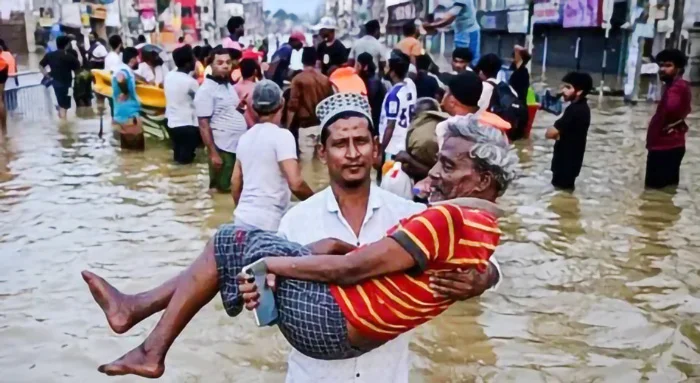
The Tsunami of 2004 struck our coasts, but the recent Cyclone Ditwah has delivered an unprecedented blow, devastating and traumatising the entire country. President Anura Kumara Dissanayake rightly called it the “largest and most challenging natural disaster” in Sri Lanka’s history.
The toll is staggering: Over 600 people were confirmed dead, with hundreds still missing. More than 2 million citizens – nearly one in ten people—have been affected. 41,000 to 86,000 houses are damaged or completely destroyed. The damage is widespread, with 22 of the island’s 25 districts declared disaster-affected areas. A provisional economic damage estimate reaching up to USD 7 billion—a figure that instantly consumes about 7% of our national GDP. This was not merely a natural disaster; it was a crisis amplified by systemic failure, culminating in a catastrophe that now demands a radical, long-term policy response.
Unlike the Tsunami, the destruction to our vital inland infrastructure—roads, bridges, railway lines, and power networks—has been colossal, crippling the nation’s ability to recover. Over 25,000 members of the tri-forces have been mobilised, and the nation rightly hails their courageous and relentless efforts in rescue and relief. They should now be graduated from ‘Rana Viruvo’ to RUN VIRUVO considering the efforts they are still putting into the relief operations in this unprecedented calamity. But the scale of the rebuilding effort requires a permanently sustained unified national mechanism, perhaps learning from their rich experiences.
Why did devastation reach this cataclysmic level?
Unlike a sudden earthquake/Tsunami, a cyclone’s path is largely traceable. Yet, the “post-mortem” on Ditwah reveals a horrifying truth: the storm’s devastation was amplified by our own institutional failures.
The India Meteorological Department (IMD) which runs the Regional Specialised Meteorological Centre (RMSC) monitors the oceans in this region and issues alerts for cyclones. It serves all the regional countries — Bangladesh, Maldives, Myanmar, Oman, Pakistan, Sri Lanka and Thailand. The RMSC first predicted the formation of a depression as early as November 13 and issued an alert over the possibility of a cyclone forming on November 20. From November 23 onwards, IMD/RMSC had been routinely sharing frequent weather updates with Sri Lanka.
Robust models from the India Meteorological Department and the RMSC provided ample warnings of the depression and subsequent cyclonic intensification. Some of these predictions by the RMC and even the BBC forecasted rainfall over 300- 400 mm which could go up to even half a meter per day. True to their forecasts, Matale tragically received unprecedented rainfall of around 520 mm, triggering fatal landslides. Ditwah’s impact was worsened by its unusually slow movement over the island which sustained heavy rainfall over several days.
The Governance Gap
The critical breakdown occurred between the scientific prediction and the state’s executive arm. Warnings, if not taken seriously or acted upon, become meaningless data points. The core issue is a fragmented disaster management system that lacks the “unified command structure” required for real-time data sharing and rapid deployment. As one analyst noted, the disaster delivered a hard lesson: we entered one of our worst natural disasters in decades without a functioning national strategy and with a severe deficit in “adaptive capacity.
Scientific forecasts were not translated into an appropriate, urgent disaster preparedness program by the Sri Lankan state apparatus. Public reports indicate that national preparedness was woefully short of what was needed. The warnings failed to translate into a coherent, proactive response into an appropriate disaster preparedness action program on the island. This failure points directly to long-standing institutional deficits.
The Strategic Imperative: Dedicated Workforce for a $7B Recovery
President Anura Kumara Dissanayake rightly emphasised that restoring public life requires a unified operational mechanism that goes beyond normal state administration. To tackle this immense task, the Government has established a ‘Rebuilding Sri Lanka Fund’ to finance the medium- and long-term recovery, including essential infrastructure and public health issues.
This newly established ‘Rebuilding Sri Lanka Fund’ addresses the financial cost, but it does not solve the fundamental manpower crisis which is a key bottleneck in retarding the progress of this formidable undertaking. Rebuilding 247 kilometers of impacted roads, restoring two-thirds of unusable railway lines, clearing hundreds of landslides, and repairing crucial irrigation systems demands a sustained, disciplined, and massive workforce that normal state administration simply cannot provide. Furthermore, with the changing climate, events of this nature and magnitude may be more frequent in the future.
As such, there is a moral call to a strategic imperative. The immediate, ad-hoc spontaneous public volunteerism is commendable, but the scale of the task ahead requires a permanent, non-partisan national investment in human resources. The time for piecemeal recovery programs is over. Ditwah has forced the issue of structural accountability and national capacity onto the policy agenda.
A Call for Mandatory National Service
One of the most responsible paths forward is to utilise this crisis to institutionalise a robust National Service System, transforming a generation of youth into a standing army for climate resilience and nation-building. To fail to do so would be to guarantee that the next storm will bring an even higher price.
Sri Lanka cannot afford to be unprepared again. The solution is to immediately mobilise and, for the long term, institutionalise the patriotic energy of our youth into a robust, structured National Service System. This service should be more than just disaster relief; it is a long-term investment that will:
i) Build the Nation: Provide a rapid-response labour force for future disasters, infrastructure projects, and conservation efforts.
ii) Forge Character: Instill essential skills like discipline, leadership, accountability, and responsibility in our youth, thereby contributing to lower rates of substance abuse and crime.
iii) Strengthen Unity: Promote social cohesion and reinforce national identity by having youth from all backgrounds work together for a common cause.
The legal framework for such a move already exists. The Mobilisation and Supplementary Forces Act, No. 40 of 1985, already gives the government the powers to issue a National Service Order to enlist people in a National Armed Reserve. This mechanism can be adapted to establish a non-military, civilian-focused service.
Sri Lanka already has a government supported National Volunteer Service affiliated to her Social Services Department. It coordinates volunteers, develops management systems, and works with partners like the UN volunteers. This service can be improved and upgraded to tackle challenges in natural and/or human induced disasters which are going to be more frequent with greater intensity, at times.
In the immediate term, the large number of existing volunteers dispersed all over the island need to be engaged as understudy groups, working directly alongside the armed forces and government departments in the recovery process which is already happening in a number of instances.
Ditwah is our wake-up call for longer-term strategic planning and policy reforms. Alongside reacting to catastrophes in a piecemeal manner in the short-term, we must systematically start building a resilient nation with a vision for the future. Investing in a structured, mandatory Civilian National Service is the only way to safeguard our future against the inevitable challenges of climate change and to truly rebuild Sri Lanka.
Globally over 60 countries have national service portfolios mostly of military nature. Both Germany and France have recently reintroduced their national services to meet their own specific needs. In the US, the National Community Service centers around the Corporation for National and Community Service (CNCS), a federal agency that runs programs like AmeriCorps and Senior Corps, mobilising millions of Americans in service to address needs in education, disaster relief, environment, and more, fostering civic duty and offering educational awards for service.
Incorporate National Service into Educational Reforms
We must mobilize our youthful energy into a national service portfolio unique to our own needs giving due recognition to our history, geography and culture. As a long-term investment, this should be initiated while children are still in school, preparing them mentally and physically to contribute to nation-building.
A well-designed National Volunteer Community Service would instill discipline and foster essential skills like leadership, responsibility, and mutual respect, while contributing at the same time to national development. We can tailor this service to tackle our unique challenges in public safety, disaster relief, and environment conservation.
Existing school programmes like scouting and cadeting can be innovatively transformed to lay a sound foundation for this life-changing National Service for all schoolchildren. According to the initial estimates of UNICEF, over 275,000 children are among the 1.4 million people affected both physically and mentally who need careful rehabilitation.
The current educational reforms are an ideal platform to impart crucial values in patriotism and introduce essential skills like time management, discipline, and accountability. This system could not only build successful individuals but also help decrease social issues like substance abuse and crime among youth.
In the immediate future, to meet the demands of the recovery effort now, currently available volunteers should be engaged as understudy groups, working alongside the armed forces and government departments involved in the rebuilding process. The long-term investment in a Mandatory National Service, on the other hand, will strengthen our national identity and contribute to the “unified operational mechanism” the President has called for.
The author can be contacted at nimsavg@gmail.com
by Emeritus Professor
Nimal Gunatilleke

Opinion
From the Lecture Hall to the Global Market: How Sri Lankan students are mastering the “Gig Economy”


Have you ever wondered how a university student, between heavy textbooks and late-night study sessions, manages to earn a professional income in US dollars? It sounds like a dream, but for thousands of Sri Lankans, it’s becoming a daily reality through online freelancing.
A recent study published in the Ianna Journal of Interdisciplinary Studies has pulled back the curtain on this digital revolution. By interviewing 21 successful student freelancers across Sri Lanka, researchers have mapped out exactly what it takes to turn a laptop and an internet connection into a thriving career.
The Rise of the “Earn-as-you-learn” Era
In Sri Lanka, the number of online freelancers has exploded from about 20,000 in 2016 to over 150,000 today. While our traditional education system often focuses on preparing students for 9-to-5 office jobs , these students are diving into the “Gig Economy” a digital marketplace where they sell specific skills, like graphic design or programming, to clients all over the world.
The Secret Sauce for Success
So, what makes some students succeed while others struggle? The research found that it isn’t just about being good at coding or design. Success comes down to six “Core Pillars”:
· A Growth Mindset: The digital world moves fast. Successful students don’t just learn one skill; they are constantly updating themselves to ensure they don’t become “outdated”
· The Balancing Act:
How do they handle exams and clients? They don’t use a magic wand; they use strict time management. Many work late into the night (from 6 p.m. to midnight) to accommodate international time zones.
· The Power of “Hello”:
Since most clients are in the USA or UK, strong English and clear communication are vital. It’s about more than just talking; it’s about negotiating prices and building trust.
· Proactive Problem Solving:
Successful freelancers don’t wait for things to go wrong. They update their clients regularly and fix issues before they become headaches.
Why This Matters for Sri Lanka
Right now, our universities don’t always teach “how to be a freelancer”. This study suggests that if we integrate freelancing modules and mentorship into our degree programs, we could significantly reduce graduate unemployment. It’s a way for students to gain financial independence and bring much-needed foreign currency into our economy while still in school.
You Can Do It Too
If you’re a student (or the parent of one), the message is clear: the global market is open for business. You don’t need to wait for graduation to start your career. With a bit of flexibility, a willingness to keep learning, and a proactive attitude, you can transition from a learner to an earner.
The Research Team Behind the Study
This groundbreaking research was conducted by a dedicated team from the Department of Business Management at the SLIIT Business School (Sri Lanka Institute of Information Technology). The authors of the study include:
· Lihini Niranjana Dasanayaka
· Thuvindu Bimsara Madanayake
· Kalana Gimantha Jayasekara
· Thilina Dinidu Illepperuma
· Ruwanthika Chandrasiri
· Gayan Bandara
by Ruwanthika Chandrasiri

In an article titled “India shaping-up as model ‘swing state” (The Island 29.01.2026) Lynn Ockersz says, “Besides, this columnist would go so far as to describe India as a principal ‘Swing State.’ To clarify the latter concept in its essentials, it could be stated that the typical ‘Swing State’ wields considerable influence and power regionally and globally. Besides they are thriving democracies and occupy a strategic geographical location which enhances their appeal for other states of the region and enables them to relate to the latter with a degree of equableness. Their strategic location makes it possible for ‘Swing States’ to even mediate in resolving conflicts among states”.
A ‘swing state’, as in elections, should be able to decisively influence the final outcome. In the context in which India is recognised as a ‘swing state’ the final outcome should first be regional and then, if possible, extend to the rest of the world. And the desirable outcome must entail regional peace, cordial relations and economic stability which would constitute the most vital needs for any part of today’s world. Military power should not feature in the equation, for more often than not, such power is used to brow beat into submission the weak and the poor.
India no doubt is growing fast to be a global economic power and militarily also it is way ahead of the region. Its democracy, in the sense that democracies are measured in today’s world, also may be as the columnist says “thriving”. However, periodical elections, however fair they could be, should not be the sole criterion to judge democracy. If democracy cannot solve the problem of inequality it may lose its credibility as a mode of good governance. As a means of finding who rules, the system may be satisfactory but the other vital components of democracy, such as equitable wealth distribution, if lacking, the system may not serve its purpose.
Inequality in India is among the highest globally, with the top 1% owning nearly 40% of national wealth and the top 10% holding roughly 65% of total wealth and 58% of income. While the economy grows, the bottom 50% receives only 15% of the income. This disparity, driven by wealth concentration and low female labour participation, persists across class, caste, and gender. The income gap between the top 10% and the bottom 50% remained stable, with no significant reduction in inequality over the last decade.
India ranks very low in gender parity (127 out of 146 countries in the Global Gender Gap Report 2023). Female labour force participation is very low, at 15.7% (though government data suggests 41.7% by including agriculture and unpaid work). Women earn significantly less than men, working 53 hours per week compared to 43 for men. Inequality is intensified by existing social divides based on caste, religion, region, and gender. Access to healthcare is limited for many, with 63 million people pushed into poverty annually due to costs. Approximately 74% of India’s population could not afford a healthy diet in 2023. Roughly 64% of the total Goods and Services Tax (GST) in India comes from the bottom 50% of the population, whereas only 4% comes from the top 10% (Global Inequality Report 2024).
This sad state may not be the fault of democracy but the economic system of all so called democratic countries. The other three countries, Indonesia, South Africa and South Korea, that the columnist has named as suitable to be ‘swing states’ are no better. Neoliberalism and democracy are increasingly viewed by critics as an “evil nexus” or a destructive pairing, where the logic of the free market—privatisation, deregulation, and austerity—subverts the principles of democratic self-governance and social equality.
However, my main argument concerns the more important qualities that a country must possess to qualify as a ‘swing state’; the capacity to lead from the front in campaigning for peace and cordiality in the region. In this regard India fails miserably. The past with regards to good neighbourliness, where mighty India is concerned, tells a sad story. How it tried to solve the ethnic problem in Sri Lanka may be etched in the minds of those who lived in that era. The “parippu-drop” followed by gun-boat diplomacy saved the LTTE enabling it to continue with its murderous terrorism aimed at dividing the country. It was India who provided the initial “infra-structure” for training of terrorists who waged a thirty year war in Sri Lanka, committing brutal genocide against the Sinhalese and Muslims and not sparing the Tamils as well. India did not lift a finger to stop the bloodletting. Then it rammed the 13th A down our throats as a solution to the problem but did not keep to its terms and conditions which required it to disarm the LTTE. 13th A hangs over our head like the Sword of Damocles and India doesn’t fail to remind us about it from time to time. And we are burdened with the white elephant of provincial councils. Moreover, evidently India continues to interfere in our internal affairs, apparently colluding with the US, it may have had a hand in the regime change in Sri Lanka in 2022 (Shamindra Ferdinando, The Island, 04.02.2026). Another matter that appears to be perniciously secretive is that the Indian government doesn’t want the Sri Lankan government to reveal to its people the contents of the defence agreement it has entered into with the latter, as if people didn’t matter !
Now that tiny Sri Lanka is weakened and pliable after suffering multiple crises, India comes to its aid at the slightest mishap, very much like the hero who comes to the rescue of the damsel in distress, seemingly competing with other suitors. It doesn’t want the damsel to fall into the arms of China, given its geopolitical beauty.
Take the case of the other neighbours of India, does it have the capacity to swing, for instance, Pakistan into at least a position of less animosity. And what about its eastern neighbour, Bangladesh? They can’t even play cricket. Relations between India and Bangladesh, are currently under severe strain as of early 2026, driven by the ousting of former Prime Minister Sheikh Hasina, who has been given asylum in India to the chagrin of Bangladesh. Tensions are high due to attacks on diplomats, stalled visa services, water disputes, and alleged interference. The unresolved sharing of the Teesta River and other transboundary rivers remains a major contention, with Bangladesh accusing India of managing these to its detriment. Concerns exist in New Delhi regarding Bangladesh strengthening ties with other nations like Pakistan, seen as a shift away from Indian influence (Altaf Moti, 2026).
Coming back to the conflict with its western neighbour Pakistan, since the 1947 partition, both countries have claimed Kashmir, a region inhabited by a majority Muslim population but initially ruled by a Hindu Maharaja, leading to wars in 1947, 1965, and 1999. India accuses Pakistan of supporting militant groups in Kashmir, a claim Pakistan denies, which has frequently led to military escalations, such as the 2019 Pulwama incident and 2025 strikes. The Indus Waters Treaty is under strain, with potential for conflict over control of water resources. Both nations are nuclear-armed, raising international concerns about regional stability. Recent tensions included increased cross-border firing, drone warfare, and suspected militant attacks in Kashmir, leading to retaliatory missile strikes. The conflict remains a major geopolitical issue, with tensions frequently escalating due to nationalist sentiment and a lack of diplomatic progress (Britanica, 2026).
Another matter of relevance is that India-Pakistan-Afghanistan relations are defined by a complex, triangular, and competitive dynamic. Following the 2021 Taliban takeover, India has adopted a pragmatic, security-focused approach, delivering humanitarian aid to Afghanistan via Iran to circumvent Pakistan. Meanwhile, Pakistan-Afghanistan ties have deteriorated over border disputes, prompting Kabul to seek warmer relations with India as a counterweight to Islamabad. Without formally recognising the Taliban, India has re-established a technical mission in Kabul to secure its interests, monitor anti-India groups, and maintain developmental influence, which directly challenges Pakistan’s historical influence in the region. Is such manoeuvring of regional relations a virtue of a ‘swing state’!
Paradoxically, India is developing a special friendship with the murderous regime of Netanyahu in Israel focussing on defence and anti-terrorism. Indian prime minister is planning to visit Israel towards the end of this month which would obviously boost the image and credibility of a ruler who has committed genocide of the Palestinians. The barb no doubt is intended to prick Pakistan. Could such a country bring peace to the region, which it must if it is to qualify as a ‘swing state’.
India seems to have good relations with its northern neighbour, little Nepal, though minor but persistent issues remain. Disputes, notably regarding the Kalapani-Limpiyadhura-Lipulekh area, have caused tensions. Nepal has, from time to time, requested, a revision of the 1950 Treaty, viewing it as unbalanced. Growing influence of other foreign powers (particularly China) in Nepal poses a strategic challenge for India.
The other northern neighbour, the giant, is a different kettle of fish. India has fought several wars with China and there are frequent border skirmishes. The rivalry between these two giants is second only to that between the US and China. The war for markets, influence and hegemony between these countries may one day tear the world apart.
India seems to be having border disputes with most of its neighbours. Fortunately, we have no common border with it but there is Katchatheevu, on which they have recently made a claim.
India being the big brother must take the initiative to resolve the disputes it has with its neighbours and work towards lasting peace in the region. The inability to do so reflects, more than the external factor, the internal depravity that plagues its politics. One has only to listen to its political leaders during election times to gauge the depth of racism they descend to in order to swing the votes. This phenomenon is more evident in their own ‘swing states’. This racism cannot be confined to its borders, it has to cross the borders and be projected to the neighbourhood, if the politicians are to appear to be truly patriotic. Thus, the border disputes and acrimony continue.
If peace, cordiality and economic stability are the desirable goals for the region – one cannot think of anything more important than these – India may not be the ‘swing state’ that could give leadership to the struggle that would finally bring these qualities to the region.
by N. A. de S. Amaratunga

Globalisation exposes weakness and failed governance; and invites intervention – A message to all inept governments everywhere
The government of Burkina Faso has shattered the illusion of party politics, dissolving every political party in the nation. Its justification is blunt: parties divide the people, fracture sovereignty, and allow corrupt elites to hijack the sacred powers that belong to the citizenry.
This is not an aberration. It is the recurring disease of fragile states. Haiti, Somalia, Sudan, Venezuela, Sri Lanka—their governments collapse under the weight of incompetence, leaving their people abandoned and their sovereignty hollow. These failed states do not merely fail themselves; they burden the world. Their chaos spills across borders, draining the strength of nations that still stand.
Globalisation does not forgive weakness. It exposes it. And as global opinion hardens, a new world order is taking shape—one that no longer tolerates decay. The moment of rupture came when US President Donald Trump seized Nicolás Maduro from his Venezuelan hideout and dragged him to face justice in America.
Predictably, the chorus of populists cried “oil!” They shouted about imperialism while ignoring the rot of Maduro’s failed government and his collapse in legitimacy. But the truth is unavoidable: if Venezuela had been competently governed, Trump would never have had the opening to topple its leadership. Weakness invited conquest. Failure opened the door.
Singapore offers the perfect counterexample. It is perhaps the best-governed nation on earth, and for that reason it is untouchable. Strong governance is the only true shield of sovereignty. Without it, sovereignty is a brittle shell, a flag waving over ruins.
Trump’s precedent will echo across continents. China, Russia, India—regional powers are watching, calculating, preparing. The message is unmistakable: Sovereignty is conditional. It is not guaranteed by history or by law. It is guaranteed only by strength, by competence, by the will to govern effectively.
This is the revolutionary truth: nations that fail to govern themselves will be governed by others. The age of excuses is over. The age of accountability has begun. Weak governments will fall. Strong governments will endure. And the people, sovereign and indivisible, will demand leaders who can protect their destiny—or see them replaced by those who can.
By Brigadier (Rtd) Ranjan de Silva
rpcdesilva@gmail.com

The SSC finally steps out of the sunshine and into the floodlights

SAARC journalists meet in New Delhi

Governor of Gujarat met with Sri Lanka PM to discuss exposition of Devnimori Relics

India chase sixth Under-19 World Cup title, England their first since 1998

Meet the women protecting India’s snow leopards

Louvre Museum crown left crushed but ‘intact’ after raid

‘Dates have the highest sugar content to fight Coronavirus’

Sunday Island 27 December – Headlines

#SundayIsland 17th December – Headlines

Sunday Island – 28th March

Sunday Island Headlines – 21 March

Sunday Island – 21st February – Headlines
-

 Business6 days ago
Hayleys Mobility ushering in a new era of premium sustainable mobility
-

 Business3 days ago
SLIM-Kantar People’s Awards 2026 to recognise Sri Lanka’s most trusted brands and personalities
-
 Business6 days ago
Advice Lab unveils new 13,000+ sqft office, marking major expansion in financial services BPO to Australia
-

 Business6 days ago
Arpico NextGen Mattress gains recognition for innovation
-

 Business5 days ago
Altair issues over 100+ title deeds post ownership change
-

 Editorial6 days ago
Govt. provoking TUs
-

 Business5 days ago
Sri Lanka opens first country pavilion at London exhibition
-

 Business4 days ago
All set for Global Synergy Awards 2026 at Waters Edge