
Features
Disaster Management and The Power of Science


The key to managing future disasters is through the smart utilisation of science
Living With Nature
As Sri Lanka has witnessed through the intense impact of Tropical Cyclone Ditwah, the power of nature is there for all to see, feel, hear, and grieve over. The hubris of humanity deludes us. We cannot control nature in its most powerful manifestation. The lesson we should learn is to live with nature, listen to nature, and learn from nature. The most effective method of managing disasters, mitigating disasters, or even avoiding disasters is to smartly apply the science that is readily available to all. Smart science utilisation educates all about the magnitude, scale, duration and likely outcomes of natural phenomena. This approach feeds into developing a culture of living with nature, planning our country with nature in mind, training the scientists we need, strengthening scientific and disaster management departments and institutions, joining up decision makers and scientists, and dramatically increasing the scientific awareness of the whole population. This is a sure-fire way of reducing the devastation of potential disasters. BUT: it’s a hard road, a difficult road, and one that requires the sustainability of a safe nation focus, decade after decade. This article focuses briefly on the science of cyclones/storms, rivers, and landslides: the three natural phenomena that bring the most frequent disasters to Sri Lanka.
Worldwide Cyclone Paths
Bay of Bengal Cyclone Paths
Cyclone Ditwah and Sri Lanka (Source https://zoom.earth/storms/ditwah-2025)
Tropical Cyclone
Tropical Cyclones originate between latitudes 10 degrees north and south of the equator. They form through heat interactions of warm surface ocean waters and the atmosphere. Cyclones move from the equator to the north and south, seeking the warmest parts of the ocean to sustain and build their formation. Cyclones are heat-seekers and can only survive while warm surface ocean waters continuously feed intense convection systems that create enormous spiral clouds rotating around a central column. Thankfully, most cyclones are born and die harmlessly within ocean space. But when they make landfall they release their pent-up energies in the form of winds, rain, and storm surges (oceans can be sucked up like tsunamis by intensely low-atmospheric pressures associated with cyclones). The most powerful cyclones generate winds of 300 to >400km/hour, air pressures as low as 870mb, total rainfalls of over 6m, and highest rainfall intensities of 1.14m/24 hours and >400mm/hour. Cyclones mainly affect countries located between latitudes 10 and 30 degrees north and south of the equator. Regions such as East Asia, the Caribbean/Gulf of Mexico and Indian/Pacific Ocean Islands are the most impacted cyclone areas. Sri Lanka is lucky, as relatively few cyclones make landfall, tending to move further north before they strike.
Cyclone Ditwah and Sri Lanka
Cyclone Ditwah was rapidly born SW of Sri Lanka, growing from a meteorological depression on the 26th of November 2025. It moved east and north crossing Sri Lanka over the next few days, retaining a low-pressure identity until December 3rd. It formed through the presence of warm ocean around Sri Lanka and concurrent atmospheric conditionalities.

Bay of Bengal Cyclone Paths (source Monas et al., Tropical Cyclone Research & Review, 2022)
Rainfall Over Sri Lanka 27-29 November 2025
The slow-moving nature of Cyclone Ditwah significantly increased its impacts. As cyclones go, wind speeds were on the low side (50-90km/hour) and the air pressure relatively high (1002 mb). Ditwah did, however, release large amounts of rainfall over 2-3 days of protracted rainfall, and over large areas of Sri Lanka. Total rainfalls of 150-500mm occurred alongside rainfall intensities of 300mm/24 hours. A similar slow-moving tropical depression hung around the mountains of Guadalcanal, Solomon Islands, for several days during April 2014, releasing over 700mm of rainfall, which created severe flooding in the national capital town of Honiara.
Storms and Monsoons
Cyclones are examples of extreme storms. Storms are a more frequent and regular weather phenomenon within Sri Lanka. Whatever label is given to weather systems the important data we need for managing rain hazards includes the timing and duration of storms, their predictability, the earliest warning signs we can detect, likely wind speeds and durations, rainfall amounts and distribution, and areas most likely to be affected by storms.
Sri Lankan Monsoons

Sri Lankan Monsoons (Source Ceylon Tour Guide Drivers)
Sri Lanka’s meteorological patterns are well known and documented by the SL Department of Meteorology and other sources. The drivers, durations, weather patterns, and areas affected by the two monsoons (from the southwest and northeast at different times of the year) are common knowledge. Furthermore, incidents of disasters caused by intense storms have produced a plethora of data that can be used to inform disaster management and planning. The science of meteorology has been revolutionized over the past decades through the advent of sophisticated satellite, airborne, and ground weather sensors, alongside big-data multiple-scenario mega-computer modelling capabilities, and an abundance of highly trained meteorological scientists. The recognition of climate change, particularly since the late 1990s, has led to a quantum leap in in research and financial investments, and hardware/software/ scientific advances. We now know our weather systems and the physics of the atmosphere with an enviable level of prediction/modelling when viewed through the eyes of the 1960/70s or 80s generations
Whither the Weather Data: what’s the Point?
There is no substantial reason or excuse why countries, regions, communities, scientists, and decision-makers cannot turn all the amazing weather data and capability into tools and practical applications to mitigate future disasters. The science is so smart and powerful that a failure to use its helpful essence is plain foolishness. The data, and approach suggested, as we will see below, with river and landslide science, can undoubtedly deliver a safer country and world. Bangladesh, a poor country with a population of 172 million is regularly hit by cyclones, storms. and high magnitude floods. Cyclone Bhola, in 1970, killed half a million people and wiped out 85% of the nations homes. And yet, this low-income nation has impressively adopted new smart disaster management ways, including integrating science, greatly reducing the impacts of disasters over time.
Allowing Rivers to Run Free
Sri Lanka River Basins
Sri Lanka has over 100 river basins, (or catchments), the largest of which (the Mahaweli) has an area of over 10,000km2. The Mahaweli River extends to over 335 km in length. Sri Lankan rivers are mostly aligned in a radial fashion, centred upon South-Central Highlands, flowing to all corners of the country. Rivers are the lifeblood of any country. They are like blood vessels in the human body. If we fail to look after rivers, environments degrade, human and animal life suffers, and disasters are heightened in magnitude.
Modern (and ancient) philosophers ask us to view rivers not as inanimate natural features, but as sentient living beings. The science of hydrology (study & understanding of water systems) enables humans to optimally manage rivers and related eco-landscape systems, and to live safely with rivers. The latest thinking is moving towards the idea of allowing rivers to run freely: for humans to adopt the principle living respectfully and safely with the vital lifeblood of any country or region.
Rivers form through rain (and snow) falling on land and organising themselves according to the physical laws of drainage. Just as we engineer drainage in our houses so that we stay dry, and channel the waters where we want them to go, nature drains our lands. Rivers will follow the easiest path they can from the highest areas of their river basins (or catchments) to the lowest point they can reach (usually the ocean, sometimes local lakes or inland seas). Rivers follow geology and topography, but also mould and shape landscapes themselves, over time.
-

- Landslide Prone areas in Sri Lanka (Source Geosciences Research 2018, Bandara & Jayasingha)
-
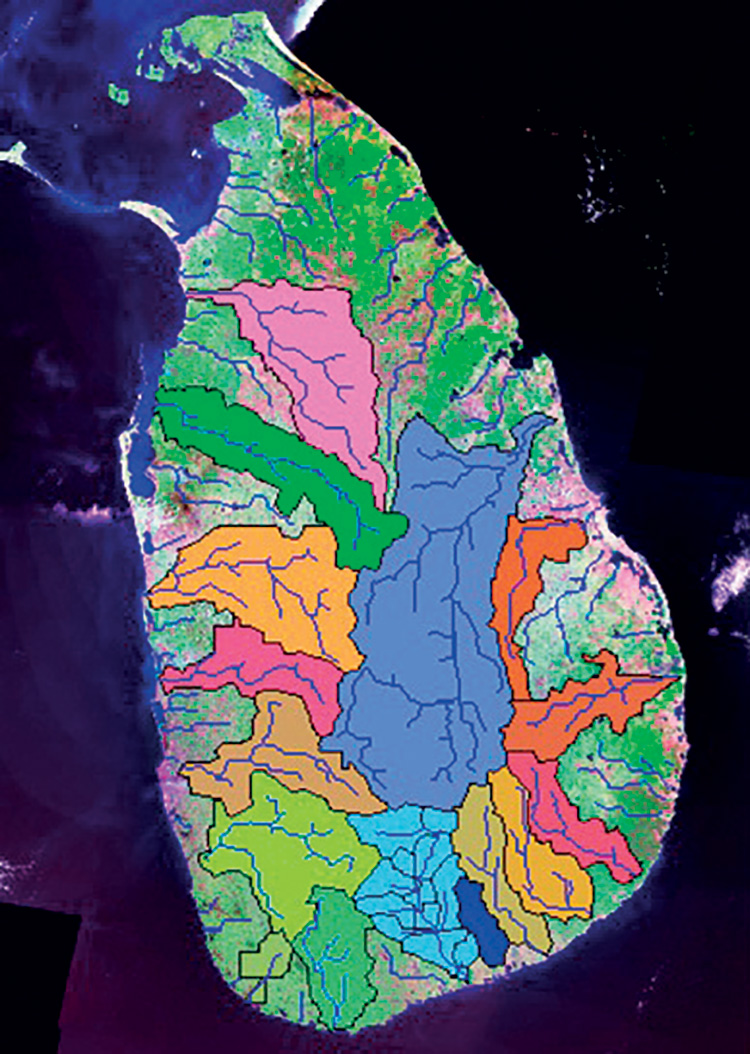
- Sri Lanka River Basins (Source https://island.lk/eco-friendly-regional- development-model)
They are fed from water reservoirs that come from the sky, from vegetation root systems, and from large underground reservoirs. Geological structures, geological bedrock and geological surface deposits all influence rivers. Gravity will dictate how water flows through any landscape.
The nature of rivers changes according to the quantity and rate of water they transport. During times of low rainfall and drought they will occupy only a small part of their channels. With heavy and intense rain, they rise and often break out of their channels flooding their hinterland (termed floodplains). The rise and fall of rivers are natural. When rivers are at their highest their sheer hydraulic power is thousands of times greater than during the quiet times. Floods have provided humans with fertile plains, regularly renewing land with fresh silt and mud, and the sapphires, garnets, and rubies Sri Lanka is famous for. Science allows us to deeply understand the nature and behaviour of rivers: why they occupy their courses, why they go dry, why they flood, how much they flood, how they erode, how they deposit, and how they can carry different sizes and volumes of material.
Modern scientific sensors can accurately map rivers, measure the rainfall within their catchments, their flow rates, and the shape and form of their river channels. Modern computer modelling can accurately predict the size, duration, time, magnitude, and likely impact of floods. Mapping of geological river deposits informs us of the extent of floods over time in any river system. Science can monitor rivers, inform us about groundwater reservoirs and health, pollution within rivers, and how human impacts are influencing river processes.

Worldwide Cyclone Paths (source Nature 2020, https://doi.org/10.1038/s41597-020-0381-2
Most rivers in the world have been engineered by humans in a wide variety of ways. Dams, canals, river re-routing, energy generation, water storage, water pumping schemes, irrigation, and industrial utilisation, are examples. Intelligent utilisation of river resources has been of great human benefit. However, as with any natural system, there is a threshold beyond which damage is caused to the arteries of the nation. River catchment (basin) development can occur with no mindfulness of river-health. Mountainsides are denuded of trees, houses and urban areas grow quickly with disregard to river-natures, the natural architecture of land and river drainage is altered so much that water run-off significantly increases, and the impact of floods increases dramatically.
Whilst humans must use river resources to sustain modern livelihoods, the wider utilisation of science to inform our activities, and the greater the adoption of the principle of allowing rivers to run free, the safer our world will be. Our rivers and ecosystems will smile widely. Simple science-informed guidance such as avoiding building houses in flood plains, caring for the slopes that feed our rivers, and limiting rapid water urban run-off can be adopted by all. The idea of ‘sponge’ cities where urban environments soak up and store water, rather than increasing run-off is catching on in Singapore, China, and Denmark.

Sri Lanka’s population growth 1871 – 2001 (https://commons.wikimedia.org/wiki/File:SL_population_ growth.png)
Carefully safeguarding, and maximising the anti-flood control potentials of the beautiful wetland network of Colombo, and the incredible intelligent irrigation systems built from over 2000 years ago in central-north Sri Lanka is essential for a future safe Sri Lanka.
The Science of Landslides
Landslides occur in different shapes and forms but essentially move material quickly downslope through the force of gravity. They can vary in size, style, and magnitude, from slow but persistent peripheral movement of surface layers, to rapid movement of large quantities of rock and surficial deposits over significant distances. One large recent earthquake in Enga province, Papua New Guinea (2024) formed from the collapse of a large part of a mountainside, burying villages and leading to the deaths of up to 2000 people. Some of the world’s largest landslides transport cubic kilometres of material, and have killed 20,000 – 200,000 in China, Venezuela, and Peru.
Landslide Prone areas in Sri Lanka
Sri Lankan landslides mostly occur within the central Highlands region and peripheral areas, particularly in the southwest.

Debris Flow Rotational Landslide (Source Utah Geological Survey)
Much of Sri Lankan geology is comprised of hard crystalline rocks called gneiss: this forms the bulk of the nation’s upstanding mountains. Whilst intrinsically a hard and strong rock, Sri Lankan gneisses are weathered deeply by a hot, humid, tropical climate. Chemical weathering breaks down bedrock, forming thick deposits of altered degraded, material, termed regolith. These deposits can be 10m-> 30m thick. They lack the intrinsic cohesive strength and structure of the gneissic bedrock from which they form. Regolith is often reddish in colour due to the presence of abundant iron hydroxides.
Debris Flow Rotational Landslide
Sri Lankan landslides are mostly termed debris flows, involving the rapid downslope movement of moderate to large volumes of surficial regolith material downslope.
The causes of landslides are well known, as are areas of landslide high-risk. Landslides occur on steep or moderate slopes, particularly within areas of high relief. Triggers for landslides include earthquakes, volcanic eruptions, and high intensity rainfall. For Sri Lanka heavy rainfall, persistent rainfall, or alternating protracted periods of heavy and/or persistent rain with contrasting drought seasons are the main landslide triggers. Persistent-protracted monsoonal rainfall can seep deeply within surface regolith material, particularly if the materials are porous and permeable (capable of soaking and transporting water within its mass, like a sponge).
When the regolith becomes sodden with water its weight increases many times, internal friction is reduced, and lubrication increased. The ever-present gravity pulls with greater force on this wet, heavy, lubricated regolith. When this gravitational force exceeds the ‘sticking’ force that binds the regolith to the mountainside, the material slips and forms a landslide. Ancient and recent landslide deposits can be geologically mapped, helping us understand where and why landslides have occurred in the past. This mapping helps us identify and locate high-risk zones. Slope strength can be monitored through slope-stress sensors. In Hong Kong, a city of millions built on steep tropical slopes, every high-risk slope is catalogued, drained of water, strengthened through engineering, and regularly monitored.
Human activities can significantly increase the risks of landslides. Any activity that reduces the stability of slopes increases the probability of landslides. Cutting down trees, steepening slopes through engineering, and retarding natural slope-drainage, will all increase the likelihood of landslides. Moving human settlement to high-risk zones increases the exposure of people to landslide risks. Human interventions can reduce landslide risks by planting trees with deep root systems on slopes, increasing the natural drainage of slopes, and monitoring slope stability through simple observations such as observing the onset or long-term occurrence of surface cracks, road and wall slippage, and cracks appearing in buildings on slopes.

Increasing urbanisation in Colombo 1995-2017 (Source https://archive.roar.media/english/life/in-the-know/urbanisation-sri-lanka-growing-pains)
Landslides are a natural phenomenon and are part of the beauty of landscape formation. They have occurred long before humans existed and will continue to do so long after humans. The science of landslides is well understood and can help us all live more safely, at lower levels of risk. It is up to us to take notice of nature and live wisely with the nature of landslides.
Demographics and Development
Whilst climate change has had numerous impacts on weather systems, particularly in increasing the capacity of clouds to hold water, and rain more intensely, along with increasing the power of winds, we cannot blame everything on climate change. In days gone by we used to blame gods, now we blame climate change. We need to adapt to climate change, full stop. There are many things we are in control of and can change. More importantly, we need to become increasingly aware of the link between demography, socio-economics, urban development, and increasing environmental risks. These phenomena are all in our hands.
For most of human history global populations numbered millions and tens of millions. By 1804 the global population reached 1 billion, 2 billion during the early twentieth century, almost 3 billion in 1950 and now over 8 billion. This rapid rise in population, together with unprecedented levels of consumerism, has stressed the earth far more than any living species has done so during the past 4 billion years.
Sri Lanka’s population growth 1871 – 2001
Sri Lanka’s population grew rapidly from 2 million in1871, 6 million in 1943, to 22 million today, although it now appears to be reaching a steady state. This rapid population growth has led to concomitant urban growth, particularly around Colombo and the southwest, together with road-ribbon development, virtually continuously for example, between Colombo and Kandy. Mass tourism adds another one or two million high- consuming visitors every year.
Increasing urbanisation in Colombo 1995-2017
Rapid, sub-optimally planned, urban development, not only leads to the rapid generation of less-attractive urban environments (that will deter visitors), but also increases the exposure of a greater number of people to environmental risks. Whilst the power and wisdom of science can produce informed plans for safety and planetary health, the competing power of the development rupee or dollar profit unfortunately wins out. Profit at the expense of nature and environmental safety.
Conclusions: the power of Science: it’s in our hands
This article clearly spells out the practical nature and the power of the science of cyclones, weather, rivers and landslides, and how it can reduce our risks and exposure to potential disasters. Cyclone Ditwah and the 2004 tsunami were clear demonstrations to Sri Lanka of the power of nature. Science informs us, educates us, helps us understand how nature works, devises early warning methods and systems, monitoring tools, and predictive advice. If we apply the science and combine this with decision-makers, government, communities, and industry, we can live with nature and develop towns cities and village sympathetically. This is our choice. It is in our hands. We can avoid placing high populations or vulnerable poor people in areas of high environmental risk. We don’t have to surface this beautiful country with unattractive, never-ending, concrete, plasterboard, and cement. We can, instead, work with natural science, with natural systems, and with nature to create a happier, safer country, in-tune with the non-human as well as the human world.
Honouring all humans and sentient beings who have suffered from Cyclone Ditwah
I express my deep condolences to all who have suffered as Cyclone Ditwah struck. Many died. Many lost their homes, possessions, and loved ones. Many suffered damage to their properties. So many birds animals, insects and sentient beings suffered. Disasters bring deep anguish. Thankfully, the Government, nation, institutions, society and the international community have recognised the level of emergency and are providing assistance in a myriad of forms. I hope that, in a small way, this article presents opportunities to reduce future suffering.
by Prof. Michael G. Petterson

Features
‘There are no private universities in Sri Lanka’ – some considerations for higher education reform
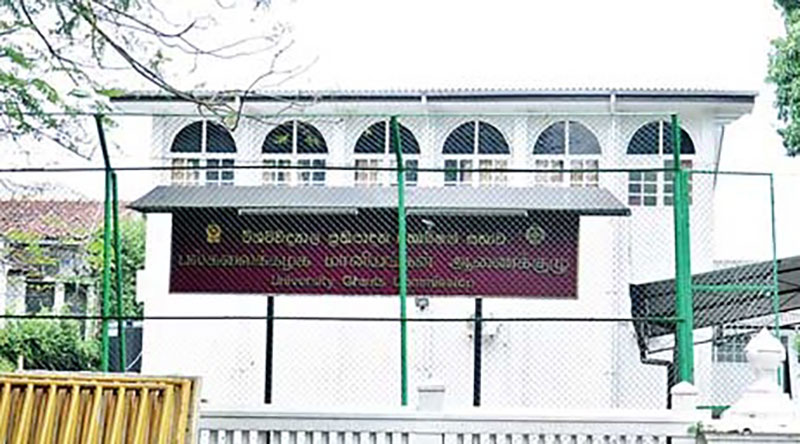
 Academics involved in education policy like to say that there is no such thing as a private university in Sri Lanka. The only ‘universities’ in the country are state universities; anything else offering degrees is a private higher education institution (HEI). This position is technically accurate. Yet, in the discourse and imagination of the public, private universities are very real – people teach in them, students register in them, families pay fees, and such degree holders enter job markets in Sri Lanka and outside.
For decades, activists concerned for public higher education have ignored or resisted looking at private HEIs, as if such scrutiny would taint them. Others have worked in both types of institutions, carrying practices from each to the other. The apex body governing state universities, the UGC, has, meanwhile, ignored the concept of conflict of interest and appointed individuals in private higher education in committees and leadership positions. It is unsurprising then that some of the ideologies informing private higher education appear in reform agendas in the state sector.
This is a good time then to consider the varying types of private HEIs around us, and to take a look at some of the issues within them in the hope that higher education reform agendas will include private, as well as state higher education.
What is a ‘private university’?
First, some clarifications. In the public imaginary, a ‘private university’ is typically an institution that provides a foreign or local degree for which the student makes a payment. But this broad classification encompasses a host of diverse institutions and types of degrees which I detail below.
The Non-State Higher Education Division (NSHE) of the Ministry of Education has recognised 295 degrees by 32 institutions. Most of these are private companies and include a handful of established, well-known private HEIs that are ‘university like’. The degrees are local degrees conferred by the institutions accredited by the NSHE Division. While private HEIs conferring local degrees must be accredited by the NSHE Division, there appears to be no legal consequence for not doing so. In addition, there are several permutations of the private degree that miss the net of this Division and the Standing Committee on Accreditation and Quality Assurance (SCAQA) that assists this Division.
For one, degrees conferred by foreign universities offered, via these same private HEIs, are not vetted by the NSHE Division. Secondly, there is a growing plethora of private HEIs which have either no physical presence locally or only a dubious presence. The University Grants Commission has notified the public, through their website, that foreign universities listed in the Commonwealth Universities Yearbook and the World Higher Education Database are recognised, but refrained from giving any other details – which degrees? Offered by what modes? These details are not known. Some of the foreign universities in the lists may be legitimate entities in their own land but the degrees conferred locally, in their name, may not adhere to curriculum or teaching specifications of the NSHE Division or the UGC.
Another troubling phenomenon is the ‘top up degree’, which appears to work on the same principle as that of a pre-paid mobile connection: if I have a Diploma or an HND of a sort, I am eligible to complete a course of study which provides me with a degree, usually from a foreign university. The idea that someone who does not initially qualify for a degree programme should be able to work their way towards one is a progressive notion. This is the concept that open and distance learning (ODL) was based on initially, but which is now sadly exploited. ODL models are expected to provide opportunity for learning for those who may be excluded from traditional learning institutions. In Sri Lanka, however, we have seen ODL become a marketplace offering easy to obtain, for-fee qualifications by institutions with little commitment to superior teaching and learning.
Finally, a perusal of the many types of private HEIs and their varied degrees bring to mind another question – how should the private degrees, provided by state institutions (that are not educational institutions), be regulated? Who should do so?
All of these create a host of problems for the public – for hopeful students and parents and trusting employers. For the higher education sector, recruitment of academic staff, too, has become difficult due to this plethora of ambiguous higher education qualifications, as I discussed in a previous Kuppi article (‘Recruiting academics to state universities’).
Some issues in private HEIs – a bellwether for change in state universities
In this second part of this article, I will discuss some aspects of work in private HEIs – albeit the more established institutions – given that such issues may appear in reform agendas in future.
Across state universities, all permanent staff of a specific category are paid according to the same criteria. The picture is not so clear when it comes to private HEIs since they are different entities legally, typically companies. Private HEIs have salary scales and financial incentives that are different to each other. The more established private HEIs reportedly have attractive renumeration packages, possibly a reason for academics of state universities migrating eagerly to such institutions during sabbatical years and on retirement. This may not of course be the case with other less established, or improperly registered HEIs of which we know little. Academic staff of these more accepted private HEIs seem to value the high financial remuneration they receive (in comparison to state universities) as something that makes their work rewarding.
Attractive remuneration is important to sustain the good life and is at times seen as the institution’s way of encouraging good work. Yet, this has implications for the future of the institution: to continue to deliver on promised financial packages, institutions must continue to have large profit margins. One strategy has been to enroll multiple cohorts of students per year, even up to three or four intakes per year. This can result in exploitative work conditions, since staff must cater to all these cohorts in that same year. If there is inadequate staff, employees are further burdened. On the other hand, if there is a sudden drop in enrolments (degrees can go out of fashion) unexpected layoffs occur. Similar to other sectors that employ short-term contract staff – including state universities – in private HEIs, too, individual teachers, who are on short term contracts that need regular renewal, can feel pressured to work under difficult or exploitative conditions.
At the same time, even in the more established private HEIs, work norms differ from those of state universities in that they include promotional work that keeps the institution’s name in the eye of the public. The Marketing (or similarly named) unit comes up in conversations as one of the most important departments. It appears to weigh in on decision-making related to the number of staff, the amount of re-sits per exams, and other pedagogically important matters. This is a worrying example of how financial rationales interfere with pedagogically or academically sound processes, resulting in problematic results in the classroom. On the plus side, junior colleagues, who had experience in both state and private HEIs, also felt that they faced less harassment in private HEIs – primarily due to the private HEIs ability to take swift action in reported cases of harassment. This is a real indictment on state institutions and their reluctance to address chronic issues of harassment in our universities.
Yet, while we hear much about problems in state universities, we hardly hear of problems that staff in private HEIs face. One rationale for a lack of public expressions by staff is that expressions of discontent might lead to trouble given the importance of reputation for private HEIs. The worry about reputational damage is a growing concern in state universities, too, as evidenced by social media policies and internal conversations on reputational damage, consequent to negative publicity. Institutional worries of reputational damage are harmful in the long run since these impact not only freedom of expression by student and staff, but also research that is possible in and about the education sector.
Some thoughts at the end…
A close look at the private higher education sector is important given its strong presence in the country. Impending reform needs to regulate this diverse array of higher education offerings in the private sector, as well as the state institutions that offer privately-funded options of higher education (a topic for a separate Kuppi on its own). It is time we carefully considered how to build a whole system of higher education out of this broken mess.
Kaushalya Perera is a senior lecturer at the University of Colombo.
Kuppi is a politics and pedagogy happening on the margins of the lecture hall that parodies, subverts, and simultaneously reaffirms social hierarchies.

Singer Nish Peiris is set to take the next big step in her music journey.
The talented vocalist, who has been seen and heard in the scene here for a short while, and was also featured with the now-defunct band, Inner Vision, has announced that she will be fully committing to her solo career, after completing her degree this year.
“I’m finishing my degree this year, and after that I’ll be fully committing to my solo music career,” Nish told The Island.
“I’ve already got a few tours lined up for next year, so I’m really excited for what’s ahead.”
Fans, no doubt, will remember Nish for her smooth voice and stage presence, and the good news is that she is now ready to chart her own path and bring new music to audiences at home and abroad.
With tours already planned for 2027, the year 2026 promises to be an exciting year for the young artiste as she steps into the spotlight on her own.
We wish Nish every success in this new chapter!

 While Sri Lankan music lovers, in Dubai, are eagerly looking forward to being a part of the action on Saturday, 25th July, with Rajiv Sebastian in the limelight, Sri Lankans, in Toronto, Canada, are equally excited and are anxiously awaiting the arrival of Sri Lanka’s famous singer/entertainer Sohan Weerasinghe.
Having done the needful with The X-Periments, the legendary performer has now embarked on an exciting new chapter – a solo career – and Toronto, Canada, will see him do the needful, on Friday, 31st July, 2026, from 8.00 pm to 12.00 am, at the Angus Glen Golf Club.

Sohan Weerasinghe: In Canada, and ready to do the needful on 31st July
Reports indicate that it’s a ‘sold out’ event – naturally with Sohan in the spotlight.

Gamini Hemalal: Creating all the excitement for Sri Lankans in Toronto
Having built his reputation through years of unforgettable performances, and hits that became part of our musical fabric, Sohan is ready to bring his own vision, sound, and stories directly to the audience, in Toronto, Canada, backed by the phenomenal Toronto Ceymphony Live Band.
Says Gamini Hemalal, who has been instrumental in reviving the Sri Lankan entertainment scene, in that part of the world:
“The countdown begins for the most exclusive musical event of the summer! Join us for a premium night of incredible music, elite hospitality, and a lavish buffet as the legendary Sohan Weerasinghe takes the stage live in Toronto!
“This is a high-end event, designed for those who appreciate exceptional entertainment and great food.”
Gamini, who is also a member of the Toronto Ceymphony Live Band, mentioned that it’s going to be an intimate musical evening with the celebrated Sohan Weerasinghe.
From packed auditoriums to intimate shows, Sohan continues to prove why he remains one of Sri Lanka’s most beloved entertainers.
For decades, Sohan Weerasinghe has been a household name in Sri Lankan entertainment.
Known for his captivating smooth voice and charismatic stage presence, Canada will experience it all on Friday, 31st July.
Next on the list of events, Gamini Hemal is working on, is Halloween night and he says “what we plan to do will be very interesting and unique … with a surprise guest star, as well!”

Charted Computer Institute of Sri Lanka to be established
Drug Dependent Persons (Treatment and Rehabilitation) Act No 54 of 2007 to be amendmend
Mrs. O. T. M. I. Thilakarathne appointed to the Post of Surveyor General
Purchase of 600 buses for intercity / long distance services of the Sri Lanka Transport Board
Protection of Historical, Cultural, and Traditional Intellectual Property related to the Kandy Esala Perahera
Development of roads which are not under the Road Development Authority

‘Dates have the highest sugar content to fight Coronavirus’

Sunday Island 27 December – Headlines

#SundayIsland 17th December – Headlines

Sunday Island – 28th March

Sunday Island Headlines – 21 March

Sunday Island – 21st February – Headlines
-
 Business3 days ago
‘Giving up was never an option’: The fisherman who fought back after losing millions in SL
-

 Features3 days ago
Two memorable excerpts from a former SLAF commander’s memoir
-

 Latest News3 days ago
Davis cup Asia/Oceania Group IV 2026 to be held in Colombo from 20th to 25th July
-

 Features3 days ago
Erdoğan’s New Republic
-

 Life style3 days ago
Taste of the Swiss Alps comes to Colombo
-
 Features7 days ago
Dirty Money
-
 News4 days ago
Dengue outbreak gallops ahead: Infections surpasses 73,455, leaving 50 dead
-
 News4 days ago
Evidence recorded in money laundering case against Yoshitha Rajapaksa