The declaration of the National Namal Uyana as a “National Heritage of Sri Lanka” with the aim of identifying, conserving and bequeathing the country’s national heritage to future generations under the Ministry of Buddhasasana, Religious and Cultural Affairs and the commemoration of the 35th anniversary of its establishment was held under the patronage of President Anura Kumara Dissanayake at the Presidential Secretariat, on Thursday (26).
The National Namal Uyana, spanning 602 hectares within the Palagala Divisional Secretariat Division of the Anuradhapura District, is a unique site of significant national, religious, environmental and geographical value. At the request of its founder, Venerable Wanawasi Rahula Thero and with the intervention of the Ministry of Buddhasasana, Religious and Cultural Affairs, the site was formally declared a National Heritage of Sri Lanka. To mark this occasion, the commemorative plaque was unveiled by the President via virtual technology.
Speaking on the occasion, President Anura Kumara Dissanayake stated that the responsibility of safeguarding this unique environmental heritage and bequeathing it to future generations rests with all.
The President also expressed his sincere appreciation for the dedication shown by Venerable Wanawasi Rahula Thero over the years in protecting and developing the National Namal Uyana.
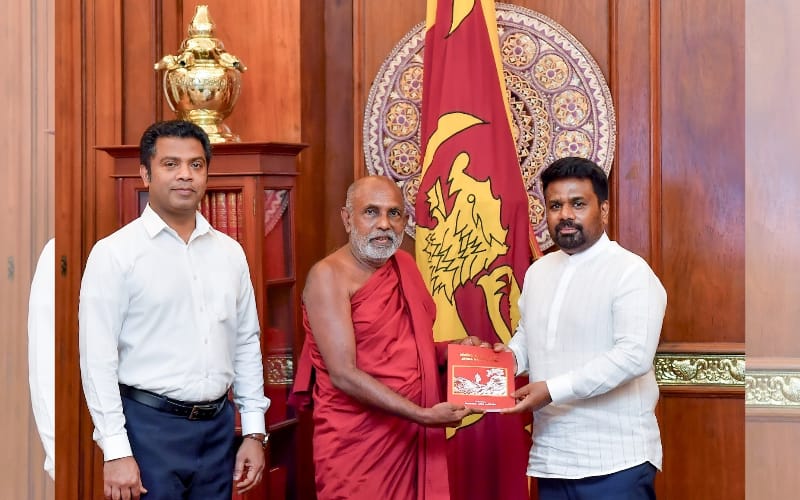
On the occasion of the 35th anniversary of the National Namal Uyana, the first-day cover issued by the Postal Department of Sri Lanka, along with the ‘National Namal Uyana Shashthreeya Sangrahaya’, was presented to the President by Venerable Wanawasi Rahula Thero.
Delivering a special address on the occasion, Venerable Wanawasi Rahula Thero, founder of the National Namal Uyana, stated that this event would go down in history as one of the most outstanding environmental services undertaken by the present Government.
The thero also expressed his deep appreciation for the President’s decision to hold the programme at the Presidential Secretariat, rather than at the National Namal Uyana premises as originally planned for tomorrow (27), in view of the prevailing situation in the country.
He further highlighted that the people of the country has been widely embraced President Anura Kumara Dissanayake’s vision and commitment for national development and emphasised the need for unity among all citizens in addressing the challenges currently facing the country and for collectively seeking effective solutions.
On this occasion, Venerable Wanawasi Rahula Thero, founder of the National Namal Uyana, also shared further remarks.
On 28 March 1991, I began my work at the National Namal Uyana, a beautiful forested area, dedicating myself with great commitment despite facing a very difficult life. During this time, local monks and members of the public levelled various accusations against me and subjected me to public criticism. Numerous articles were written against me in the press. Yet, I did not waver in my efforts.
However, during the tenure of President Chandrika Kumaratunga, I was fortunate to receive the assistance of Berty Premalal Dissanayake, through whose efforts electricity was made available. Subsequently, I have also received support from all Presidents who have held office after President Kumaratunga. I have not made any personal requests, yet opportunities have consistently been accessible to me, owing to my unwavering commitment to act with integrity.
During your tenure, the roads in the area surrounding the National Namal Uyana have been well developed and I extend my appreciation to all involved in this achievement. I also express my sincere gratitude to Minister Dr. Nalinda Jayathissa and Deputy Minister Gamagedara Dissanayake, who worked with dedication to ensure that the National Namal Uyana was formally declared a National Heritage of Sri Lanka. Similarly, I acknowledge the efforts of officials, including Roshan Gamage, who managed these activities efficiently. I also deeply appreciate the extensive support provided by both electronic and print media in promoting this initiative.
The National Namal Uyana is not my personal property; I have only acted as its guardian. For this reason, I planned for it to be entrusted to the Central Cultural Fund after my tenure and I am confident that this process is being managed effectively. I also envisaged connecting this site with Gangarama and having officials at the level of the Secretary to the President, the Secretary to the Ministry of Wildlife Conservation and the Secretary to the Ministry of Buddhasasana oversee its continued development. Without such measures, the site could have been at risk of deterioration during my absence.
I have done my part for this country. I owe nothing to the nation. My foremost responsibility is to ensure the protection and preservation of this site. As someone born in the nearby village of Anuradhapura District, I am deeply honoured and delighted that, today, this has been officially declared a National Heritage under your auspices.
Additionally, there are two schools and two hospitals in the Palagala Divisional Secretariat Division. On behalf of the local communities, I respectfully request that one of these schools and one of these hospitals be upgraded into fully equipped facilities to better serve the people.
This occasion was attended by a distinguished group of officials, including Minister of Health and Mass Media, Dr Nalinda Jayathissa, Deputy Minister of Buddhasasana, Religious and Cultural Affairs, Gamagedara Dissanayake, Secretary to the President Dr. Nandika Sanath Kumanayake, Secretary to the Ministry of Buddhasasana, Religious and Cultural Affairs, Prince Senadheera, Secretary to the Ministry of Environment, K.R. Uduwawala, Senior Additional Secretary to the President, Roshan Gamage, Director General of Archaeology, E.A. Senerath Wikramasinghe, Director General of the Central Cultural Fund, Dr. Nilan Cooray and Postmaster General S.R.W.M.R.P. Sathkumara among others