
Business
DFCC Bank among top 100 consumer brands in Sri Lanka for 2021

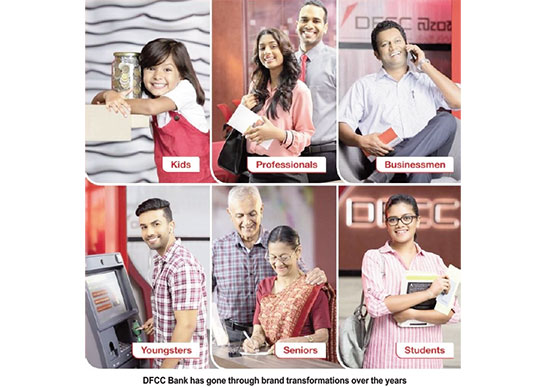
DFCC Bank has been rated among the top 100 most valuable consumer brands in Sri Lanka for the year 2021. Ranking 27th in the analysis conducted by Brand Finance Sri Lanka, DFCC Bank was able to climb up a notch to the 27th position, following last year’s position as the 28th most valuable consumer brand in the country.
This is an indication of DFCC Bank’s stellar performance, despite the raging pandemic which upset the progress of numerous businesses both locally and globally. DFCC Bank was able to successfully strategize and make the best of the unfortunate scenario, which is now reflected in this in-depth analysis conducted by Brand Finance Sri Lanka.
Brand Finance is the world’s leading independent brand valuation consultancy. Brand Finance was set up in 1996 with the aim of ‘bridging the gap between marketing and finance’. For more than 20 years, the institution has helped companies and organisations of all types to connect their brands to the bottom line.
Voicing his thoughts on this achievement, DFCC Bank CEO Lakshman Silva said, “DFCC Bank has gone through brand transformations over the years. Often, this is a challenge for institutions to endure as public perception of the brand will change, sometimes resulting in the identity of the brand becoming unclear. However, throughout our transformation from a development bank to a Bank for Everyone, we have managed to keep the public and our customers well informed of who we are and what we stand for as a brand. This achievement is certainly a reflection of our strife in this regard,”
DFCC Bank’s Head of Marketing Nilmini Gunaratne also added, “DFCC’s brand value and strength are extremely useful measures for tracking our brand performance. As a strong brand, we have been resilient in the face of these trying times and have withstood the uncertainties of this period with great confidence. We will continue to increase the strength of our brand so that DFCC Bank will be able to create even more value for its customers,”
Given the current pandemic situation, DFCC has been able to build brand awareness by conducting a series of ethical campaigns which address the concerns of the hour due to the ongoing pandemic. One such example is a campaign which supported the Central Bank of Sri Lanka’s ‘Go Cashless’ campaign. Further, DFCC Bank’s Virtual Wallet campaign informed the public that physical contact with cash is not required to carry out day-to-day financial transactions which also re-emphasised the need to adapt to digital platforms for transactions and contactless banking.


In a groundbreaking initiative, Insurance Regulatory Commission of Sri Lanka (IRCSL), announced an ambitious mission aimed at transforming the insurance industry into a cornerstone of national economic resilience and social stability.
To address this, the IRCSL will launch a nationwide education campaign titled “Insurance for All: For a Secure Future,” focusing on enhancing financial literacy across the country said Dr. Ajith Raveendra De Mel, the newly appointed Chairman IRCSL. Few sample events have already commenced last year in Matara, Jaffna and Kilinochchi that have set a strong precedent for future initiatives. “The positive response from participants highlighted the strong need for direct engagement and community-level awareness,” he said.
The IRCSL has also partnered with the Ministry of Education to integrate insurance literacy into the national curriculum, starting as early as Grade 5. This initiative aims to embed core concepts of risk management and financial protection, preparing students for future roles in the insurance industry. Complementing educational efforts, the IRCSL is also hosting an Inter-University Quiz Competition focused on insurance and financial literacy, aiming to engage university students and cultivate future thought leaders in the sector. Additionally, an e-Newsletter will keep stakeholders informed about industry updates and regulatory developments.
Dr. De Mel emphasized that this transformation it is not just about increasing insurance penetration, currently at a mere 1.1%, but about fostering a financially literate society where every citizen, family, and business is shielded from unforeseen risks. He said “Our mission is to cultivate a fully insured, financially literate, and future-ready society. The journey ahead involves profound regulatory, technological, and educational reform to create a modern, transparent, and robust regulatory environment that earns public trust while promoting innovation and sustainable growth in the industry.”
He pointed out the critical need for awareness, noting that many Sri Lankans perceive insurance as complex or exclusive to the wealthy. “We need to change how people think about insurance. Our goal is to make it simple, relatable, and accessible to everyone, particularly in rural and underserved communities,” he explained. The IRCSL will collaborate closely with the Insurance Association of Sri Lanka (IASL), the Sri Lanka Insurance Brokers Association (SLIBA), and the Sri Lanka Insurance Institute (SLII) to ensure that the message of financial preparedness reaches all corners of the nation. As Sri Lanka stands on the brink of an insurance transformation, Dr. De Mel’s vision promises a secure future driven by informed financial decisions and enhanced protection against life’s uncertainties.
The IRCSL is also focusing on digital transformation, enhancing operational excellence within the insurance sector. Key initiatives include establishing a Centralized Motor Insurance Database to improve transparency and efficiency in motor insurance, and advancing health insurance through digital integration, including standardized disease coding and electronic health records.
To ensure global competitiveness, the IRCSL is benchmarking against international best practices. A recent study tour to India has provided valuable insights into implementing risk-based supervision and capital frameworks, as well as developing accessible insurance products for underserved communities.
As the IRCSL approaches its 25th anniversary, it emphasizes the importance of staff development and alignment with other financial regulatory bodies to maintain high professional standards. The upcoming OECD/ADBI Roundtable on Insurance and Retirement Savings in Asia will further position Sri Lanka as a leader in insurance discussions, fostering regional collaboration and innovation.
by Claude Gunasekera
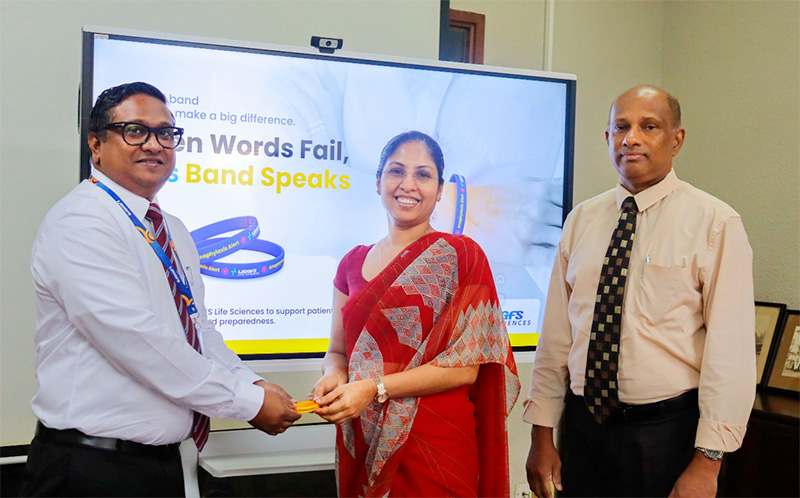
LAUGFS Life Sciences, in collaboration with the Medical Research Institute (MRI), Colombo, has launched Sri Lanka’s first-ever publicly driven allergy awareness wristbands, a groundbreaking initiative aimed at improving patient safety and preparedness in medical emergencies. The wristbands provide essential information about drug sensitivities, allowing healthcare professionals to respond quickly and effectively when time is critical.
The official handover ceremony featured distinguished medical experts, including Dr. Dhanushka Dassanayake, Consultant Immunologist and Head of the Department of Immunology – MRI, Dr. Rajiva De Silva, Senior Consultant Immunologist – MRI and Dr. Prabath Amerasinghe, Deputy Director – MRI, marking a historic milestone in patient care in the country.
Commenting on the initiative, Dr. Rajiv Perera, CEO of LAUGFS Life Sciences, said, we are proud to partner with the Medical Research Institute to launch Sri Lanka’s first-ever publicly driven allergy awareness wristbands. This initiative underscores our commitment to patient-centric healthcare by providing critical information that can save lives during emergencies. We believe that thoughtful collaborations like this can have a meaningful impact on patient safety, and we look forward to expanding the program to cover additional drugs and allergens, further advancing healthcare standards across the country.

The Ceylon Motor Traders’ Association (CMTA), the senior-most automotive association in South Asia affiliated with the Ceylon Chamber of Commerce, has called on the government of Sri Lanka to abolish the 15% depreciation that is currently granted on used vehicle imports.
The CMTA emphasizes that this policy not only lacks any plausible justification but also results in significant revenue losses to the government. While no official announcement has been made in regard to the removal of the 15% depreciation, the CMTA has consistently raised this issue through multiple budget proposals, submitted by the Ceylon Chamber of Commerce.
The Association maintains that the depreciation should not be applied to used vehicle imports. The reason being that most of the used vehicles imported, have virtually zero milage and are priced almost on par with brand-new vehicles, when considering Cost, Insurance and Freight (CIF) value.

Three dead, five injured in head-on collision

Lakmal, Pravina win trophies at Eagles Monsoon Cup Golf Tournament

When will we learn?

PSTA: Terrorism without terror continues

ROCK meets REGGAE 2026

IRCSL launches ambitious mission to transform Sri Lanka’s insurance sector

‘Dates have the highest sugar content to fight Coronavirus’

Sunday Island 27 December – Headlines

#SundayIsland 17th December – Headlines

Sunday Island – 28th March

Sunday Island Headlines – 21 March

Sunday Island – 21st February – Headlines
-

 News2 days ago
Sajith: Ashoka Chakra replaces Dharmachakra in Buddhism textbook
-

 Business2 days ago
Dialog and UnionPay International Join Forces to Elevate Sri Lanka’s Digital Payment Landscape
-

 Features2 days ago
The Paradox of Trump Power: Contested Authoritarian at Home, Uncontested Bully Abroad
-

 Features2 days ago
Subject:Whatever happened to (my) three million dollars?
-

 News2 days ago
Level I landslide early warnings issued to the Districts of Badulla, Kandy, Matale and Nuwara-Eliya extended
-
 News7 days ago
Broad support emerges for Faiszer’s sweeping proposals on long- delayed divorce and personal law reforms
-

 News2 days ago
National Communication Programme for Child Health Promotion (SBCC) has been launched. – PM
-

 News2 days ago
65 withdrawn cases re-filed by Govt, PM tells Parliament