
News
DEW urges Sri Lanka to deviate from neo-liberal economic strategy

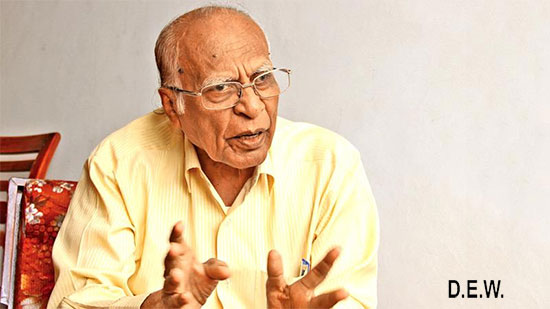
Former General Secretary of the Communist Party D.E.W. Gunasekera, has said the current economic crisis couldn’t be resolved unless Sri Lanka deviates from the neo-liberal strategy.
The former lawmaker said so at the opening of the 22nd National Congress of the Sri Lanka Communist Party recently. “44 years of experience is more than enough. We must embark upon a strategy of planning – market – state intervention. The strategy of Import and Consumption should make way for export-oriented, domestic production and national savings strategy. Our exports need diversification. Human resource development is the best guarantee for mixed foreign remittances. We must make our country the best tourist destination in the world. We must stop borrowing forthwith money from the international money market. We must go in for concessionary loans from our friendly countries. We must make best use of the new Silk Road Economic Project.
The most important element needed is national unity and religious harmony. This is the best guarantee for foreign capital. We missed the great opportunity offered to us by termination of anti-terrorist war.
The only way to ensure a new economic strategy is the unity of left, radical, nationalist forces. There is no other alternative.”
Excerpts of the speech: “National Congresses of our Party has always been eventful, colourful, and fruitful. It has immensely contributed towards raising political consciousness, enhancing political thinking, and formulating policies. Our Party, formed in 1943, in the midst of World War II, is the second oldest Party in the country.
At the outset, I wish to remember with great respect, honour, and gratitude the six founding leaders of our Party namely, Dr. Sugeeshwara Wickremasinghe, Pieter Keuneman, M.G. Mendis, Ven. Udakandewela Sri Saranankara, A. Vayithyalingam, and P. Kandaiah.
“The 22nd National Congress is being held at a time of a deep, profound, and decisive economic crisis. We had to postpone this Congress several times owing to the Corona Pandemic. Even today, we are holding it amidst health restrictions.
“We have presented a political thesis incorporating all aspects of the crisis for discussion and debate. We are now in the process of formulating economic policy and programme for the Country, taking into account the global developments, decisive changes, and also taking into account the successes and failures of our past Policies.
“Our last economic policy document, adopted by the 5th National Congress, was a long-term strategy and policies presented by the then General Secretary Dr. S.A. Wickremasinghe. It was the first and last Policy presented and ever introduced to the Country by a Political Party. It is still relevant which has now become a Study Course used by the Universities. New Economic Policy will be presented to the people in due course, after approval by a Special Congress.
“First, I would like to touch on the current international situation: We entered the 21st Century, with a new changing world economic order and also a changing new balance of power with a rise of the Asian economy. There is no longer a unipolar or bipolar world.
“There have emerged new regional economic centres – North American, EU, Asian, African Union, Latin American CELAC, emerging new Euro Asia, East Asia, North Asia, South Asia, and the Middle East, etc. This is an unprecedented development in economic history. The National Liberation Movement, Economic Globalisation, Scientific and Technological Revolution have brought about this reality.
“The second feature of world development is the decline of imperialism. The birth of modern imperialism took place in and around 1880, according to historian142 years have elapsed. The leadership changed from Great Britain to the US with World War II. With neo-liberalism in crisis, imperialism is passing through a period of decay and decline on all fronts after China became the second economic power as from 2010.
China has made two landmark achievements, namely alleviation of abject poverty and the new Silk Road Economic Project or the Belt and Road Initiative (BRI) comprising 140 odd countries. Argentina is the latest partner in the BRI.
“Imperialism is today left with three options. i.e., confrontation, competition, and corporation with 10 nuclear nations. Imperialism cannot again choose world war as a political solution to an economic crisis. That is why China and Russia appeal to the US, choosing competition or co-operation, preferably co-operation.
“We have to formulate our Economic Strategy in this world context.
“Thirdly, of late we are facing a geopolitical challenge here in the Indo-Pacific Zone relevant to Sri Lanka and South Asia.
“In my view, South Asia is more united and peaceful than ever before. We must strengthen this trend. We must continue with our non-aligned policy of dynamic neutrality. That is our appeal to all South Asian States. The emergence of two military organisations as “QUAD” and white Imperialist AUKUS. NATO has entered the Indo-Pacific Zone. It is making a similar attempt with the Ukrainian crisis expanding the frontiers to Eastern Europe. This is in line with the choice of “Confrontation Policy”. Our Congress condemned this attempt with all vehemence. We appeal to India to come back to its traditional policy of non-alignment.”



Former first lady Shiranthi Rajapaksa, wife of former President Mahinda Rajapaksa was produced before the Hulftsdorp court, after being arrested by officers of the Commission to Investigate Allegations of Bribery or Corruption (CIABOC) and produce
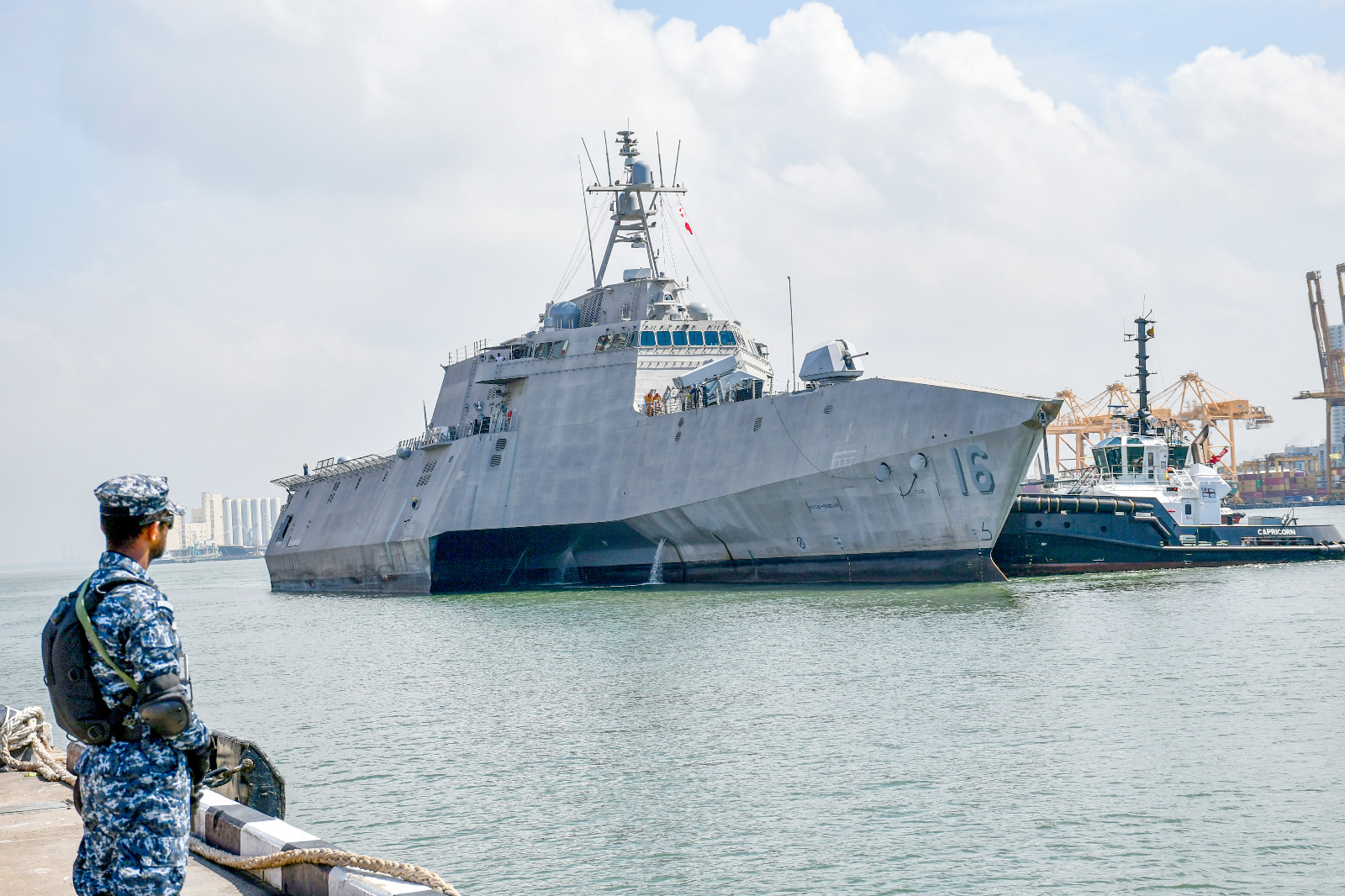
The U.S. Navy ship USS Tulsa (LCS 16) arrived at the Port of Colombo this morning, 7 October 2026 for replenishment purposes.
The visiting ship was welcomed by the Sri Lanka Navy in accordance with naval traditions.
The 127.7-metre-long platform is a Littoral Combat Ship commanded by Commander BM Wanier. Commissioned on 16 February 2019, USS Tulsa has since been in service with the US Navy.
The ship previously made a port call in Sri Lanka on 27 August 2025.
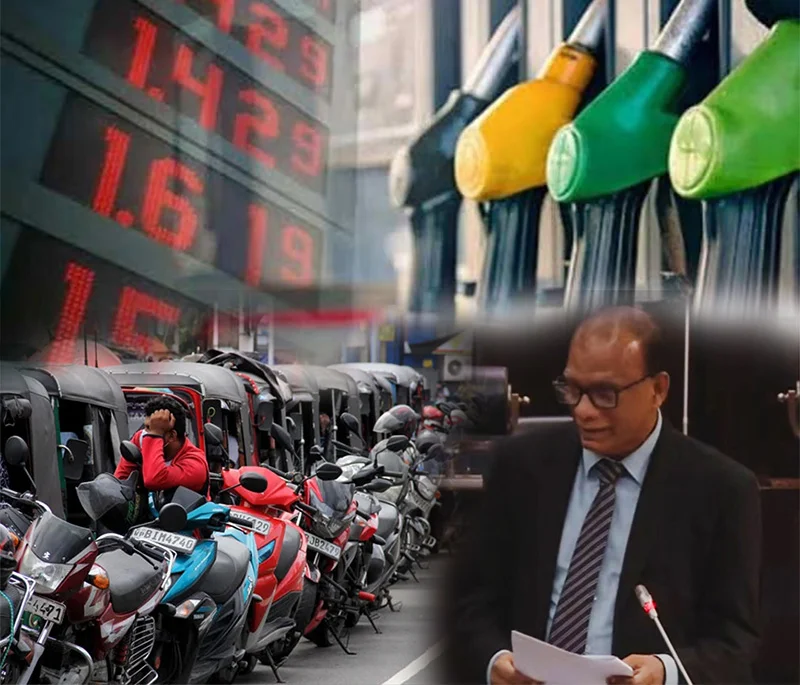
Govt. tells fuel distributors to maintain stocks to ensure uninterrupted supplies
by Saman Indrajith and Norman Palihawadane
The government had instructed private fuel distributors to maintain minimum stocks and ensure uninterrupted supplies to the market, Energy Minister Anura Karunathilaka told Parliament yesterday (06).
Karunathilaka said the Ministry of Energy Secretary had notified the relevant companies of the requirement, following a reduction in supplies by some private distributors, amid higher international fuel prices.
The Minister said private companies had informed the government that they were facing losses because international prices had risen while fuel was being sold, locally, at prevailing prices. As a result, some companies had reduced the volumes released to the market.
The reduced supplies had increased the burden on the Ceylon Petroleum Corporation (CPC), whose share of the diesel market had risen from about 54% to 82%, the Minister said.
“The CPC currently holds an 82% share of the market,” he said, adding that it had increased its supplies, compared with February, to compensate for the reduction by private distributors.
Karunathilaka said the government could not, under the existing agreements with private companies, specify the quantities they should supply to individual filling stations. However, it could require them to maintain minimum stocks in the country.
The Minister said the Energy Ministry had already instructed companies that had failed to maintain the required stocks to take steps to prevent supply disruptions.
The Minister attributed the queues reported at some filling stations to reduced supplies from private distributors, as well as normal variations in fuel distribution. He also said demand for CPC fuel had increased because private companies generally did not provide fuel to dealers on credit, while the CPC offered a three-day credit facility.
“We expect that, as the Ceylon Petroleum Corporation takes on this additional burden, the problem will ease to some extent by Wednesday or Thursday,” Karunathilaka said.
He said instructions had also been issued to increase supplies to CPC filling stations. A special discussion on the issue is scheduled for today (07), with officials of the Energy Ministry and CPC expected to participate,
along with President Anura Kumara Dissanayake.
Meanwhile, Petroleum Dealers’ Association officials have called for an early solution to the supply issue. Association Chairman D.V. Shantha Silva said queues had been reported at many filling stations, mainly those operated by private distributors.
He said the situation was not due to an overall shortage of fuel, but was linked to reduced orders by Lanka IOC, Sinopec and R.M. Parks amid concerns over losses incurred on fuel sales.
The Ceylon Petroleum Private Tanker Owners Association has urged motorists to refrain from panic buying, saying there was no nationwide disruption to fuel supplies.
The government earlier increased fuel prices and introduced a per-litre diesel subsidy following concerns raised by distributors over rising international prices.

Former first lady Shiranthi Rajapaksa arrested by CIABOC

U.S. Navy ship USS Tulsa arrives in Colombo for replenishment visit

Smriti Mandhana appointed India captain across formats

Ronaldo apologizes for Portugal walkout; says Jesus broke promise

Showers in the Western, Sabaragamuwa, Central, Uva, North-western and Southern provinces and in Anuradhapura and Mannar districts

Fuel crunch looms

‘Dates have the highest sugar content to fight Coronavirus’

Sunday Island 27 December – Headlines

#SundayIsland 17th December – Headlines

Sunday Island – 28th March

Sunday Island Headlines – 21 March

Sunday Island – 21st February – Headlines
-

 News7 days ago
US-assisted ‘Ice’ detection: NPC to examine IGP’s move to transfer drug-busting team
-

 Editorial6 days ago
Colombo Port drug bust: The plot thickens
-

 Editorial7 days ago
Drug busting, transfers and trust deficit
-

 Features4 days ago
The first woman in the foreign service or Ceylon Overseas Service it was then called
-
 News7 days ago
Sri Lankan facing death penalty in Saudi Arabia: Mano G appeals to Crown Prince
-

 Editorial5 days ago
Fuelling discontent and protest
-

 News3 days ago
Geneva takes up Sallay’s case and govt. ignores opportunity to answer accusations
-

 Latest News4 days ago
Tharindu Rathnayake, bowlers secure Asian Games Bronze for Sri Lanka