
Midweek Review
Deep divisions over Rohingya ‘refugees’

By Shamindra Ferdinando
Sri Lanka must address the developing issue of Rohingya refugees cautiously. Whatever the domestic politics, or divisions within political parties represented in Parliament, the country shouldn’t, under any circumstances, encourage more Rohingyas to seek refuge here or use northern Sri Lanka as a transit point.
Unless the National People’s Power (NPP) government reaches a consensus with the main Opposition Samagi Jana Balawegaya (SJB) in this regard, swiftly, interested parties here, and in Myanmar, are likely to exploit the situation to their advantage.
Bankrupt Sri Lanka, beset with political, economic and social problems, cannot afford to accommodate boat loads of Rohingyas.
Rohingyas are an ethnic group, the majority of whom are Muslims hailing from Bangladesh, but denied citizenship in Myanmar since 1982. The move has effectively rendered them stateless. Alleging constant persecution over the years by the Myanmar government, Rohingyas have sought refuge elsewhere.
The Rohingya issue attracted fresh public attention after the Navy rescued 115 persons found adrift on a fishing trawler off Mullaitivu on 19 Dec., last year. Although Rohingya shad reached Sri Lankan waters previously, it was not a favoured destination, with majority Muslim Malaysia and Indonesia being their major destinations.
Public Security and Parliamentary Affairs Minister Ananda Wijepala, on 08 January, warned Parliament that as many as 100,000 Rohingyas could reach Sri Lankan waters.
The former Private Secretary to the then JVP Parliamentarian Anura Kumara Dissanayake, and the new entrant to Parliament, based his claim on intelligence services’ assessments. Responding to a query by The Island, Minister Wijepala declared that the government wouldn’t give into human traffickers and various other interested parties, peddling the Rohingya issue, but would conduct a thorough investigation to establish the truth.
The Human Rights Commission of Sri Lanka (HRCSL) on 27 Dec., 2024, took up the Rohingya issue with President Anura Kumara Dissanayake. The HRCSL found fault with the government for not allowing the HRCSL team to visit the Rohingyas held at the Kepapilavu Air Force camp in Mullaitivu. The HRCSL made its highly publicized intervention within 24 hours after the Air Force denied entry to its team.
HRCSL Chairman, retired Supreme Court Justice L.T.B. Dehideniya, in his letter dated 27 Dec., 2024, reminded President Dissanayake that, according to section 11(d) of the HRCSL Act, No. 21 of 1996, the powers and functions of the Commission extend not only to Sri Lankan citizens but to “any person” detained within Sri Lanka.
Therefore, the Commission has the statutory authority to access the said Air Force Camp and monitor the detention conditions of all asylum seekers, including the children present, Dehideniya declared.
Strangely Justice Dehideniya, however, gave a lame excuse last year not to probe serious allegation made by former Speaker Abeywardena about external involvement in President Gotabaya Rajapaksa’s forced ouster when he said that Speaker Mahinda Yapa Abeywardena’s claim of foreign interventions could be inquired into only if he received a complaint.
The Rohingya issue should receive the NPP government’s priority. The government cannot absolve itself of the responsibility for thwarting organized attempts by human traffickers to use Northern Sri Lanka to receive Rohingyas. Of the 115 rescued off Mullaitivu, the 12-member crew had been remanded by Trincomalee Acting Magistrate, Abdul Saleem, pending further investigations.
The issue at hand is whether the destination of the trawler was Sri Lanka or the vessel, after engine breakdown, and due to inclement weather, simply drifted towards Vellamullivaikkal, the scene of fierce fighting during the last phase of the ground offensive against the Liberation Tigers of Tamil Eelam (LTTE).
Let me stress that this journey is not the first boat to reach Sri Lanka, situated about 1,750km (1,100 miles) across open seas, southwest of Myanmar. In Dec., 2022, the Navy rescued another boat carrying over 100 Rohingyas, during Wickremesinghe’s presidency.
Large groups of Rohingyas had fled Myanmar, over the past years, due to military action, but in the recent past the Myanmar government recruited some Rohingyas to the military. Myanmar turned to Rohingyas to strengthen its Army fighting the ethnic terrorist group, called the Arakan Army, in Rakhine state.
Rohingya issue taken up in Parliament
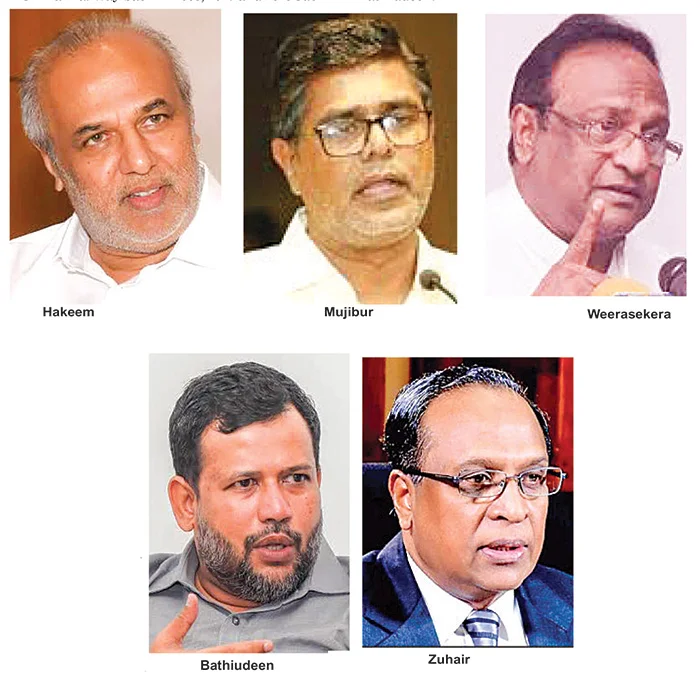
Sri Lanka Muslim Congress (SLMC) leader Rauf Hakeem raised the Rohingya issue in Parliament. Attorney-at-Law Hakeem condemned the NPP administration for its response to the latest arrival of Rohingyas.
Lawmaker Hakeem discussed the issue against the backdrop of Myanmar facing a genocide trial at the International Court of Justice, in The Hague, over its treatment of the Rohingyas.
All Ceylon Makkal Congress (ACMC) leader Rishad Bathiudeen, SJB MP Mujibur Rahuman, as well as former MP, senior state counsel and ex-Ambassador in Tehran M.M. Zuhair, PC, intervened on behalf of Rohingyas. Lawmakers took up the issue in Parliament. A section of the civil society, too, intervened.
Some found fault with SJB leader Sajith Premadasa for the stand taken up by Hakeem, Bathiudeen and Rahuman as they were elected to Parliament on the SJB ticket.
Referring to the Air Force depriving HRCSL of an opportunity to visit the Rohingyas on 26 Dec., 2024, the Commission brought the incident to President Dissanayake.
Lawmaker Hakeem, in a fiery speech delivered in Parliament, threw his weight behind the HRCSL. Hakeem declared: “The HRCSL has the right to go and inspect any place where there is a report about maltreatment and ill-treatment of individuals. This is not the first time refugees from Myanmar arrived in Sri Lanka. Way back in 2008, 2017 and 2018 such people came here”
The Air Force action is a total violation of the HRCSL Act, the one-time Justice Minister alleged, warning the Air Force could be held in contempt.
The Kandy district lawmaker also referred to the strong statement issued by PC Zuhair in this regard. Hakeem slammed Public Security Minister Wijepala for the government’s stand on the developing issue. He questioned the rationale in the NPP government consulting the Myanmar government responsible for the massive exodus of people.
Alleging that Myanmar relentlessly persecuted the Rohingyas, the SLMC leader declared that hundreds of thousands of people had left the country. Hakeem estimated the number of Rohingya refugees in Bangladesh and Malaysia almost at a million and nearly 500,000, respectively. Indonesia, the UAE and Saudi Arabia, as well as Western countries, had given them refuge, the ex-Minister said. Hakeem censured Minister Wijepala for calling the Rohingya refugees human traffickers. “How dare you say this? How dare you say this? Do you forget your own members, way back in the ’70s ’80s, when you were persecuted and you took refuge in Italy, in the UK, France, all over, and in Lebanon? How many JVP activists were there as refugees?’
Hakeem was referring to the 1971 and 1987-1990 JVP-led terror campaigns that were ruthlessly suppressed by the SLFP and UNP administrations, respectively.
The SLMCer also found fault with the Public Security Minister and his Deputy Attorney-at-Law Sunil Watagala for simply acting on the advice of officials without realizing the responsibility on their part to properly function as MPs.
Hakeem demanded that the government act in accordance with international law and UNHCR must be asked to provide the necessary security. “The government is bound under humanitarian law and under UN declaration of human rights, where specific sections have been highlighted.”
The SLMC leader asked the government not to forcefully repatriate the Rohingyas. The right of Hakeem, Bathiudeen, Rahuman and Zuhair to represent the interests of the Rohingyas cannot be disputed.
Eminent lawyer Zuhair pointed out that the Universal Declaration of Human Rights (UDHR) of 1948, in Article 14 states, “Everyone has the right to seek and to enjoy in other countries asylum from persecution”. Sri Lanka is a party to this United Nations sponsored international convention. Persecution in Myanmar is well known. Violent persecution of Rohingyas is well documented and established beyond debate.
The ex-Ambassador said that the HRCSL should be allowed to operate in terms of article 14 of the UDHR and related provisions of the applicable treaties. Amidst the continuing controversy over the Rohingya refugees, The Island carried hard-hitting statements issued by Zuhair, Rahuman and Bathiudeen.
SJB’s stance questioned
Political analyst Shenali Waduge blamed the SJB’s stand on the Rohingya issue. Referring to a Rohingya refugee woman delivering a baby boy at Mullaitivu hospital on 21 January, 2025, Ms. Waduge sarcastically said that the SJB could adopt the child.
The prolific writer questioned the SJB pursuing a politically motivated strategy meant to encourage more boat loads of Rohingyas. She warned of dire consequences unless political parties represented in Parliament took a national stand instead of seeking political advantage. The crux of the matter is the possibility of external elements having influence over a political party represented in Parliament or individual lawmakers.
The bottom line is Sri Lanka lacked the wherewithal to engage in such a risky project. In other words, Sri Lanka shouldn’t get entangled in the Rohingya matter. Let the government address this issue in consultation with the Myanmar government and UNHCR.
The Rohingya issue took a different turn when the North-East Coordination Committee spearheaded a protest in Mullaitivu demanding that the refugees shouldn’t be deported. Jesumaney Yartan Figurado, the joint co-ordinator of the grouping, was among the participants. The CID’s Human Trafficking and Maritime Crime Division recorded a statement from Figurado regarding his involvement in the protest.
It would be pertinent to mention that the North-East Coordination Committee campaigns for permanent devolution of power to the North and East. The Committee has repeatedly urged Tamil political parties not to pursue strategies that may undermine their efforts to secure international recognition.
Obviously various interested parties cooperate on movement of refugees across national boundaries. The recent actions taken by US President Donald Trump underscores the importance the new Republican administration attaches to protecting US borders. Over the past several decades, for want of cohesive international cooperation against organized but illegal and lucrative movement of various people gathered momentum with America, Canada and Europe being flooded with uninvited guests.
Australia is one of the countries that has adopted a tough military-led initiative called ‘Operation Sovereign Borders’ launched in 2013 to curb illegals reaching land. In spite of the change of governments, both here and Australia, successive administrations remained fully committed to the high profile operation that facilitated the forceful repatriation of Sri Lankan illegals.
Sri Lanka needs a national policy to address the contentious issue of illegals. Australia has underscored that their policy in this regard is beyond party politics.
Over the past several decades EU countries, the UK, Canada, Scandinavian countries and the US, have accommodated thousands of ex-Sri Lankan terrorists, including those who had received weapons training in India, and in Sri Lanka also by Indian instructors. Foreign governments granted them citizenship on the pretext of them being political refugees.
The possibility of wanted men being among those Rohingyas who had fled to different countries cannot be ruled out.
Let us remind our readers of the case of Antonythasan Jesuthasan, the male star of renowned French filmmaker Jacques Audiard’s Deepan that won the Palme d’Or at the 2015 Cannes Film Festival. Jesuthasan, an ex-Sri Lankan terrorist, and most probably still categorized as missing/disappeared from here, is on record as having revealed how he inflicted injury on himself to secure political asylum.
In an interview with Tom Seymour (TS) posted in The Guardian nearly a decade ago, in the wake of Palme d’Or, Jesuthasan, while revealing what TS called a dense lattice of scars, said: “I did those to myself.” Having mimicked running a blade across his skin, Jesuthasan told TS. “I was 22, and I had spent years trying to come to the west. I wanted to get a fake French passport, but I had to be accepted as a refugee. I went to the UNHCR [the UN High Commissioner for Refugees], but they wouldn’t believe my story. So I cut myself, and held up my arm, and said to them: ‘Look at my blood. This is my word.”
Jesuthasan’s story is not different from millions of similar tales. They are all beneficiaries of governments which knowingly accepted fake documents and clandestine operations of illegal traffickers. That is the truth some do not want to accept.
SW’s take on Rohingya
Former Public Security Minister and retired Rear Admiral Sarath Weerasekera emphasized the responsibility on the part of the government to counter propaganda meant to compel the country to accept groups of Rohingya. Some people with vested interests questioned the government’s authority to hold a group of Rohingyas in an Air Force camp, the former Navy Chief of Staff pointed out.
Acknowledging that Rohingyas had been brutally treated by the Myanmar military over the years, the former lawmaker emphasized that the violence therein should be examined against the backdrop of attacks on 30 Myanmar military camps in August 2017 carried out by ARSA (Arakan Rohingya Salvation Army).
Quoting Amnesty International, Weerasekera said that armed Rohingyas carried out attacks on Hindus in August 2017, killing 99 persons over the latter’s refusal to embrace Islam.
The former Minister pointed out that Premier Narendra Modi ordered the deportation of Rohingyas who entered India following the 2021 military coup. Referring to different Asian governments’ response to the Myanmar crisis, Weerasekera urged the government to be extra cautious in addressing this issue.
It would be a great mistake on Sri Lanka’s part if the government failed to reach a consensus on this vexed issue as quickly as possible, the ex-Minister said.
Political parties represented in Parliament hadn’t been able to reach an agreement on major national issues. There cannot be a better example than their failure to agree on the need to defeat terrorism that caused immense death and destruction for three decades.
The executive, legislature and judiciary should work collectively to address major issues that may spiral out of control unless dealt swiftly and decisively. Regardless of party politics and whatever differences among political parties represented in Parliament, MPs couldn’t act regardless of collective responsibility towards the wellbeing of the country.

President Anura Kumara Dissanayake’s (AKD) recent visit to Jaffna received significant social media attention due to posting of a less than a minute-long video of him going for a walk there.
An unarmed soldier was captured walking beside AKD who is also the Commander-in-Chief of the armed forces in addition to being the Defence Minister. A soldier carrying an assault rifle was seen walking behind AKD. There was another soldier in a pair of shorts walking just behind the President. AKD’s Personal Security Officer (PSO) was not on that video. By January 26th morning that video received 378 K ‘hits’ and 9.8 K reactions.
AKD was in a pair of shorts and running shoes. There hadn’t been a previous occasion in which AKD was captured in a pair of shorts during his time as a lawmaker or the President. AKD was there on a two-day visit that coincided with Thai Pongal.
AKD’s latest visit to Jaffna for Thai Pongal caused a huge controversy when he declared that those who visited Buddhist shrines there influenced and encouraged hate. “Coming to Jaffna to observe sil on a Poya Day, while passing the Sri Maha Bodhi, is not virtue, but hatred,” AKD declared. The utterly uncalled for declaration received the wrath of the Buddhists. What made AKD, the leader of the JVP, a generally avowed agnostics, as well as NPP, to make such an unsubstantiated statement?
Opposition political parties did not waste much time to exploit AKD’s Jaffna visit to their advantage. They accused AKD of betraying the majority Buddhists in the country. Those who peruse social media know how much AKD’s Jaffna talk angered the vast majority of people aware of the sacrifices made by the armed forces and police to eradicate terrorism.
If not for the armed forces triumph over the LTTE in May 2009, AKD would never have ended up in the Office of the President. That is the undeniable truth. Whatever, various interested parties say, the vast majority of people remember the huge battlefield sacrifices made by the country’s armed forces that made the destruction of the LTTE’s conventional military power possible. Although some speculated that the LTTE may retain the capability to conduct hit and run attacks, years after the loss of its conventional capacity, the group couldn’t stage a comeback, thanks to eternal vigilance and the severity of its defeat.
AKD’s attention-grabbing Jaffna walk is nothing but a timely reminder that separatist Tamil terrorism had been defeated, conclusively. Of course, various interested parties may still propagate separatist views and propaganda but Eelam wouldn’t be a reality unless the government – whichever political party is in power – created an environment conducive for such an eventuality.
The JVP/NPP handsomely won both the presidential and parliamentary polls in Sept. and Nov. 2024, respectively. Their unprecedented triumph in the Northern and Eastern provinces emboldened their top leadership to further consolidate their position therein at any cost. However, an unexpected and strong comeback made by one-time LTTE ally, the TNA, appeared to have unnerved the ruling party. On the other hand, the TNA, too, seems to be alarmed over AKD’s political strategy meant to consolidate and enhance his political power in the North.
Perhaps, against the backdrop of AKD’s Jaffna walk, we should recollect the capture of Jaffna, the heart of the separatist campaign during President Chandrika Bandaranaike Kumaratunga’s time. Jaffna town was regained in the first week of December, 1995, 11 years before the outbreak of Eelam War IV (August 2006 to May 2009).
Operation Riviresa
In the run-up to the January 2015 presidential election, Kumaratunga, who served two terms as President (1994 to 1999 and 2001 to 2005), declared that her administration liberated 75% of the territory held by the LTTE. That claim was made in support of Maithripala Sirisena’s candidature at the then presidential election. Kumaratunga joined hands with the UNP’s Ranil Wickremesinghe, the JVP (NPP was formed in 2019), the SLMC and the TNA to ensure Sirisena’s victory.
Liberating 75% of territory held by the LTTE was nothing but a blatant lie. That claim was meant to dispute war-winning President Mahinda Rajapaksa’s bid for a third term. Ahead of the 2005 presidential election, Kumaratunga’s administration lost the capacity to conduct large-scale ground offensives in the Northern theatre of operations. In fact, the last major offensive, codenamed Agni Kheelsa in April 2001, had been undertaken in the Jaffna peninsula where the Army suffered debilitating losses, both in men and material. That was President Kumaratunga’s last attempt to flex military muscle. But, she should be credited for whole-heartedly supporting Operation Riviresa (Aug. to Dec. 1995) that brought back Jaffna under government control.
In spite of several major attempts by the LTTE to drive the Army out of Jaffna, the military held on. The largest ever combined security forces offensive, under President Mahinda Rajapaksa, with the Navy and Air Force initiating strategic action against the LTTE and the triumph over separatist terrorism in two months short of three years, should be examined taking into consideration the liberation of the Jaffna peninsula and the islands.
If President Kumaratunga failed to bring Jaffna under government control in 1995 and sustain the military presence there, regardless of enormous challenges, the war wouldn’t have lasted till 2006 and the outcome of the war could have gone the other way much earlier. Whatever the criticism of Kumaratunga’s rule, liberating the Jaffna peninsula is her greatest achievement. Regardless of financial constraints, Kumaratunga and her clever and intrepid Treasury Secretary, the late A.S. Jayawardena, provided the wherewithal for the armed forces to go on the offensive. After the successful capture of Jaffna, by the end of 1995, Kumaratunga ordered Kfirs and MiG 27s, and a range of other weapons, including Multi Barrel Rocket Launchers (MBRLs), to enhance the fire power, but the military couldn’t achieve the desired results. While she provided any amount of jaw, jaw, it was Amarananda Somasiri Jayawardena who ensured that the armed forces were provided with the necessary wherewithal, under difficult circumstances, especially in the aftermath of the later humiliating Wanni debacle, when he was the Central Bank Governor.
AKD is certainly privileged to engage in morning exercises in a terrain where some of the fiercest battles of the Eelam conflict were fought, involving the Indian Army, as well as other Tamil groups, sponsored by New Delhi, in the ’80s.
When the Army secured Jaffna, in 1995, and lost Elephant Pass in 2000, the forward defence lines had to be re-established and defended at great cost to both men and material. By then, the Vanni had become the LTTE stronghold and successful ground offensive seemed impossible but under President Mahinda Rajapaksa’s political leadership the combined armed forces achieved the unthinkable – the annihilation of the LTTE in a way it couldn’t make a comeback at any level. AKD’s post that went viral recently is evidence that peace has been restored and maintained for the Commander-in-Chief to take a walk on a Jaffna street.
Social media comments on AKD’s Jaffna walk reflected public thinking, especially against the backdrop of that unwarranted claim regarding Buddhists influencing hatred by visiting Jaffna on a Poya Day to observe sil, having passed the Sri Maha Bodhi.
UK anti-SL campaign
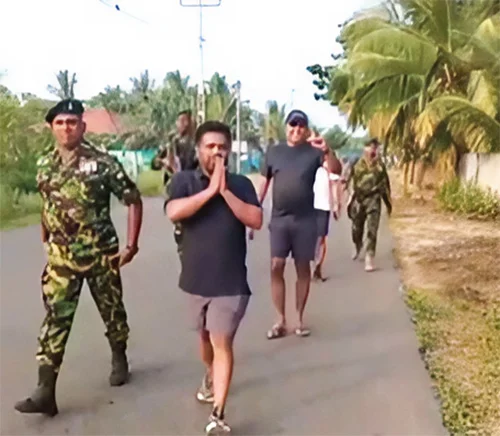
President Dissanayake taking a walk
It would be pertinent to ask the Sri Lanka High Commission in the UK regarding action taken to counter the continuing propaganda campaign against the country. Sri Lankan HC in the UK Nimal Senadheera owed an explanation as UK politicians seemed to be engaged in a stepped-up Sri Lanka bashing with the NPP government not making any effort to counter such propaganda against our country.
Interestingly, the UK government is on a collision course with no less a person than President Donald Trump over his recent humiliating comments on NATO troops who fought alongside the Americans in Afghanistan.
British Prime Minister Keir Starmer is on record as having said that President Trump’s comments were “insulting and frankly appalling.” Starmer suggested the US President apologise for his remarks. Amidst strong protests by humiliated NATO countries, President Trump retracted his derogatory comments.
But the UK’s position with regard to Tamil terrorism that also claimed the lives of nearly 1,500 Indian officers and men seemed different. The UK continues to ignore crimes perpetrated by the LTTE, including rival Tamil groups, political parties and Tamil civilians.
The Labour Party that promoted and encouraged terrorism throughout the war here raised the post-war Sri Lanka situation again.
The Labour Party questioned the British government in the House of Commons recently on what action it was taking to support Tamils seeking justice for past and ongoing abuses in Sri Lanka.
Raising the issue on 20 January 2026, Peter Lamb, the Labour MP for Crawley, asked: “What action is the UK Government taking to support Tamils in seeking justice for past and current injustices?”
Responding on behalf of the government, Hamish Falconer, Parliamentary Under-Secretary of State at the Foreign, Commonwealth and Development Office, said the UK remained actively engaged in accountability for crimes committed against the Tamil people.
“The UK is active in seeking justice and accountability for Sri Lanka’s Tamil community,” Falconer told the House. He said Britain continues to play a leading role at the United Nations Human Rights Council on resolutions addressing Sri Lanka’s human rights record.
Falconer added that the UK had taken concrete steps in recent years, including imposing sanctions. “Last year, we sanctioned Sri Lankans for human rights violations in the civil war,” he said, referring to measures targeting individuals implicated in serious abuses.
He also stated that the UK had communicated its expectations directly to Colombo. “We have made clear to the Sri Lankan Government the importance of improved human rights for all in Sri Lanka, as well as reconciliation,” Falconer said.
Concluding his response, Falconer marked the Tamil harvest festival, adding, “Let me take the opportunity to wish the Tamil community a happy Thai Pongal.”
The UK cannot be unaware that quite a number of ex-terrorists today carry British passports.
David Lammy’s promise
Our High Commissioner in London Nimal Senadheera, in consultation with the Foreign Ministry in Colombo, should take up the Parliamentary Under-Secretary of State at the Foreign, Commonwealth and Development Office Hamish Falconer’s comment on sanctions imposed on Sri Lankans in March 2025. Falconer was referring to General (retd.) Shavendra Silva, Admiral of the Fleet Wasantha Karannagoda, General (retd), Jagath Jayasuriya and one-time LTTE commander Vinayagamoorthy Muralitharan, aka Karuna Amman.
The then Secretary of State for Foreign, Commonwealth and Development Affairs, David Lammy, declared in March 2025 that the above-mentioned Sri Lankans were sanctioned in line with election promises. A UK government statement quoted Lammy as having said: “I made a commitment during the election campaign to ensure those responsible are not allowed impunity. This decision ensures that those responsible for past human rights violations and abuses are held accountable.”
Since then David Lammy has received the appointment as Lord Chancellor, Secretary of State for Justice and Deputy Prime Minister.
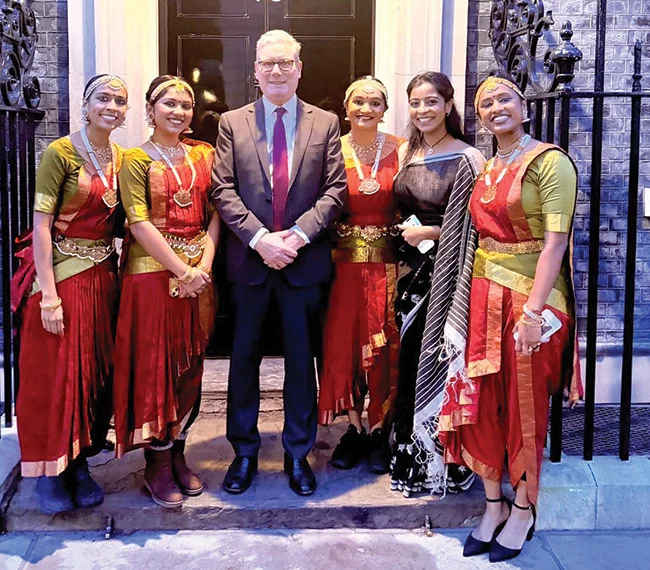
Recent Thai Pongal celebrations held at 10 Downing Street for the second consecutive year, too, was used to disparage Sri Lanka with reference to genocide and Tamils fleeing the country. They have conveniently forgotten the origins of terrorism in Sri Lanka and how the UK, throughout the murderous campaign, backed terrorism by giving refuge to terrorists.
The British had no qualms in granting citizenship to Anton Balasingham, one-time translator at the British HC in Colombo and one of those who had direct access to LTTE leader Velupillai Prabhakaran. Balasingham’s second wife, Australian-born Adele, too, promoted terrorism and, after her husband’s demise in Dec 2006, she lives comfortably in the UK.
Adele had been captured in LTTE fatigues with LTTE women cadres. The possibility of her knowing the LTTE suicide attack on former Indian Prime Minister Rajiv Gandhi in May 1991 can never be ruled out.
With the British PM accommodating those campaigning against Sri Lanka at 10 Downing Street and the Deputy PM openly playing politics with the issues at hand, Sri Lanka is definitely on a difficult wicket.
Sri Lanka has chosen to appease all at the expense of the war-winning military. The NPP government never made a genuine effort to convince Britain to rescind sanctions imposed on three senior ex-military officers and Karuna. The British found fault with Karuna because he switched allegiance to the Sri Lankan military in 2004. The former eastern commander’s unexpected move weakened the LTTE, not only in the eastern theatre of operations but in Vanni as well. Therefore, the British in a bid to placate voters of Sri Lankan origin, sanctioned Karuna while accommodating Adele whose murderous relationship with the LTTE is known both in and outside the UK Parliament.
Some British lawmakers, in a shameless and disgraceful manner, propagated lies in the UK Parliament for obvious reasons. Successive governments failed to counter British propaganda over the years but such despicable efforts, on behalf of the LTTE, largely went unanswered. Our governments lacked the political will to defend the war-winning armed forces. Instead, the treacherous UNP and the SLFP got together, in 2015, to back a US-led accountability resolution that sought to haul Sri Lanka up before the Geneva-based United Nations Human Rights Council (UNHRC).
The possibility of those who propagated lies receiving monetary benefits from interested parties cannot be ruled out. Sri Lanka never bothered to counter unsubstantiated allegations. Sri Lanka actually facilitated such contemptible projects by turning a blind eye to what was going on.
The Canadian Parliament declaration that Sri Lanka perpetrated genocide during the conflict didn’t surprise anyone. The 2022 May announcement underscored Sri Lanka’s pathetic failure on the ‘human rights’ front. The Gotabaya Rajapaksa government struggling to cope with the massive protest campaign (Aragalaya) never really addressed that issue. Ranil Wickremesinghe, who succeeded Gotabaya Rajapaksa in July 2022, too, failed to take it up with Canada. The NPP obviously has no interest in fighting back western lies.
The Canada Parliament is the first national body to condemn Sri Lanka over genocide. It wouldn’t be the only parliament to take such a drastic step unless Sri Lanka, at least now, makes a genuine effort to set the record straight. Political parties, representing our Parliament, never reached a consensus regarding the need to defeat terrorism in the North or in the South. Of those elected representatives backed terrorism in the North as well as terroirism in the South. Perhaps, they have collectively forgotten the JVP terrorism that targeted President JRJ and the entire UNP Parliamentary group. The JVP attack on the UNP, in parliament, in August 1987, is a reminder of a period of terror that may not have materialised if not for the Indian intervention.
By Shamindra Ferdinando
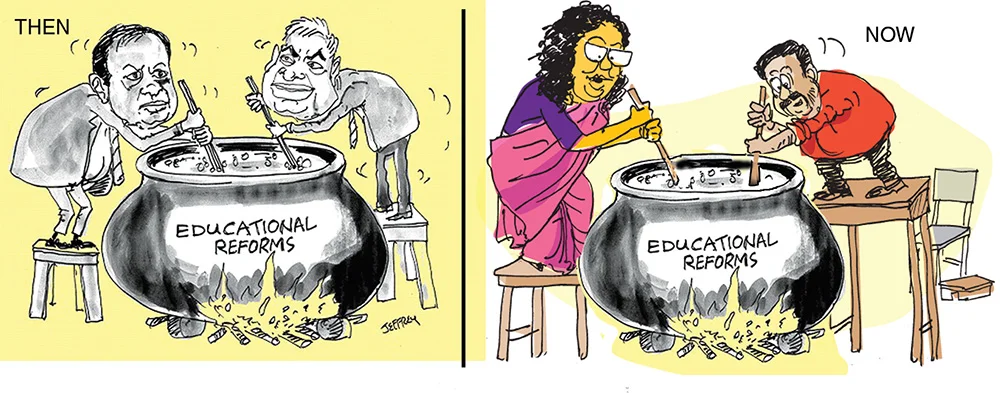
The term education originates from the Latin words ‘educare’, meaning ‘to bring up’, and educere, meaning ‘to bring forth’. The precise definition of education is disputed. But if it is linked with the obvious expected outcome of it – learning, then the definition of education changes to a resultant outcome of ‘a change in behaviour’.
Let me say this at the outset. I am not going to get embroiled in the nitty-gritty pros and cons of the current controversies hogging the headlines today. Except to say this. As every discerning and informed person says, we need educational reforms. There is near unanimity on that. It is the process – a long, and even tedious process – that needs to be carried out that gives rise to disagreements and controversy. A public discussion, stakeholder viewpoints and expert opinion should be given due time and consideration.
Sex education – “the birds and bees” to start with – has to be gradually introduced into school curricular. When? is the critical question that needs specific answers. Do we need to go by Western standards and practices or by a deep understanding of our cultural milieu and civilisational norms? One thing is clear in my mind. Introduction of sex education into school curricular must not be used – or abused – to make it a ‘freeway’ for indiscriminate enforcement of the whole human sexual spectrum before the binary concepts of human sexuality has been clearly understood by children – especially during their pre-pubertal and immediate post-pubertal adolescent years. I have explicitly argued this issue extensively in an academic oration and in an article published in The Island, under the title, “The child is a person”.
Having said that, let me get on to some of my heretical thoughts.
Radical thinkers
Some radical thinkers are of the view that education, particularly collective education in a regulated and organised school system, is systematic streamlined indoctrination rather than fostering critical thinking. These disagreements impact how to identify, measure, and enhance various forms of education. Essentially, what they argue is that education channels children into pliant members of society by instilling existing or dominant socio-cultural values and norms and equipping them with the skills necessary to become ‘productive’ members of that given society. Productive, in the same sense of an efficient factory production line.
This concept was critiqued in detail by one of my favourite thinkers, Ivan Illych. Ivan Illich (1926 – 2002) was an Austrian philosopher known for his radical polemics arguing that the benefits of many modern technologies and social arrangements were illusory and that, still further, such developments undermined humans’ image of self-sufficiency, freedom, and dignity. Mass education and the modern medical establishment were two of his main targets, and he accused both of institutionalising and manipulating basic aspects of life.
One of his books that stormed into the bookshelves that retains particular relevance even today is the monumental heretical thought ‘Deschooling Society’ published in 1971 which became his best-known and most influential book. It was a polemic against what he called the “world-wide cargo cult” of government schooling. Illich articulated his highly radical ideas about schooling and education. Drawing on his historical and philosophical training as well as his years of experience as an educator, he presented schools as places where consumerism and obedience to authority were paramount. Illich had come to observe and experience state education during his time in Puerto Rico, as a form of “structured injustice.”
‘Meaningless credentials’
Ilych said that “genuine learning was replaced by a process of advancement through institutional hierarchies accompanied by the accumulation of largely meaningless credentials”. In place of compulsory mass schooling, Illich suggested, “it would be preferable to adopt a model of learning in which knowledge and skills were transmitted through networks of informal and voluntary relationships”. Talking of ‘meaningless credentials’ it has become the great cash-cow of the education industry the world over today – offering ‘honorary PhDs’ and ‘Dr’ titles almost over the counter. For a fee, of course. I wrote a facebook post titled “Its raining PhDs!”.
Mass education and the modern medical establishment were two of his main targets, and he accused both of institutionalising and manipulating basic aspects of life. I first got to ‘know’ of him through his more radical treatise “Medical Nemesis: The expropriation of Health”, that congealed many a thought that had traversed my mind chaotically without direction. He wrote that “The medical establishment has become a major threat to health. The disabling impact of professional control over medicine has reached the proportions of an iatrogenic epidemic”. But it was too radical a thought, far worse than ‘Deschooling Society’. The critics were many. But that is not our topic for the day.
The other more politically radical views on education comes from Paul Freire. Paul Freire (1921 – 1997) was a Brazilian educator and Marxist philosopher whose work revolutionised global thought on education. He is best known for his 1968 book “Pedagogy of the Oppressed” in which he reimagines teaching as a “collaborative act of liberation rather than transmission”. A founder of critical pedagogy, Freire’s influence spans literary movements, liberation theology, postcolonial education, Marxism, and contemporary theories of social justice and learning. He is widely regarded as one of the most important educational theorists of the twentieth century.
Neutral education process?
Richard Shaull, in his introduction to the 13th edition of ‘Pedagogy of the Oppressed’ wrote: “There is no such thing as a neutral education process. Education either functions as an instrument which is used to facilitate the integration of generations into the logic of the present system and bring about conformity to it, or it becomes the “practice of freedom”, the means by which men and women deal critically with reality and discover how to participate in the transformation of their world”.
Here are a few quotes from Paul Freire before I revert to the topic I began to write on: “Liberating education consists in acts of cognition, not transferals of information.”; he believed that “true liberation comes from the oppressed taking agency and actively participating in the transformation of society”; he viewed “education as a political act for liberation – as the practice of freedom for the oppressed.”; He said that “traditional education is inherently oppressive because it serves the interests of the elite. It helps in the maintenance of the status quo.”
Where does our own ‘educational reforms’ stand? Is it transference, transformative, liberating or an attempt at maintaining the status quo with the help of the ADB? The history of educational reforms in Sri Lanka has been long. A quick check on the internet elicited the following:
Colonial Era (Pre-1940s): Colebrooke-Cameron Commission (1830s): Promoted English and standardised curriculum, laying groundwork for modern systems.
Buddhist Revival: Efforts by Anagarika Dharmapala to establish schools with Buddhist principles and English education.
The Kannangara Reforms (1940s): 1943 – Minister C.W.W. Kannangara introduced free education for all funded by general taxes; 1947 – introduced it from kindergarten to university. Central Schools (Madhya Maha Vidyalayas) established high-quality secondary schools in rural areas to ensure equitable access. Medium of Instruction was mandated to be the national languages (Sinhala and Tamil) for primary education.
Nationalisation and Standardisation
Nationalisation and Standardisation (1960s-1970s): 1961 – Denominational schools were taken over by the government to create a national education system. 1972 – New attempts at reform introduced following the 1971 youth uprising, focusing on democratising education and practical skills through a common curriculum and a national policy, responding to socio-economic needs. Introduction of language-based standardisation that in all likelihood triggered the ‘separatist war’. 1978 – change from language-based standardisation to district-based standardisation on a quota system for university entrance that was first introduced with a promise for only ten years, but persists until today, for nearly 50 years. No government dares to touch it as it is politically explosive.
Focus on quality and access (1980s-1990s): White Paper on Education (1981) – aimed to modernise the system together with components of privatising higher education. It faced severe criticism and public protests for its clear neoliberal leanings. And it never got off the ground. The National Colleges of Education (1986) were established.
1987 – Devolution of education power to provincial councils. 1991 – Establishment of The National Education Commission created to formulate long-term national policies. 1997 – Comprehensive reforms through a Presidential Task Force to overhaul the general education system (Grades 1-13), including early childhood development and special and adult education.
21st Century Reforms (2000s-Present): Mid-1990s-early 2000s – focused on transforming education from rote learning to competency-based, problem-solving skills; emphasising ICT, English, equity, and aligning education with labour market needs; introducing school restructuring (junior/senior schools) and compulsory education for ages 5-14; and aiming for national development through development of human capital.
Modernising education
2019 educational reforms focused on modernising education by shifting towards a modular, credit-based system with career pathways, reducing exam burdens, integrating vocational skills, and making education more equitable, though implementation details and debates around cultural alignment continued. Key changes included introducing soft skills and vocational streams from Grade 9/10; streamlining subjects, and ensuring every child completes 13 years of education; and moving away from an excessive focus on elite schools and competitive examinations.
This government is currently implementing the 2019 reforms in the National Education Policy Framework (2023–2033), which marks a radical departure from traditional methods. Module-Based System and a shift from exam-centric education to a module-based assessment system starting in 2026.
Already we have seen multi-pronged criticisms of these reforms. These mainly hinge on the inclusion – accidentally or intentionally – of a website for adult male friend groups. The CID is investigating whether it was sabotage.
Restricting access to social media
When there is a global concern on the use of smartphones and internet by children, and where Australia has already implemented a new law in December 2025 banning under-16s from major social media platforms to protect children from cyberbullying, grooming, and addiction, requiring tech companies to use age verification.
The U.S. does not have a federal law banning smartphones for under-16s, but a major movement, fuelled by the US Surgeon-General warnings and research on youth mental health, is pushing for restrictions, leading many individual states (like California, Florida, Virginia) to enact laws or guidelines for school-day bans or limits for students, focusing on classroom distraction and social media risks, with some advocates pushing for no smartphones before high school or age 16.
The UK doesn’t currently have a legal ban on smartphones for under-16s, but there’s significant political and public pressure for restrictions, with debates focusing on social media access and potential school bans, with some politicians and experts advocating bans similar to Australia’s, while others push for stronger regulations under the existing Online Safety Act to protect children from addictive algorithms and harm.
Sweden is implementing a nationwide ban on mobile phones in schools for students aged 7 to 16, starting in autumn 2026, requiring devices to be handed in until the school day ends to improve focus, security, and academic performance, as part of a major education reform. This national law, not just a recommendation, aims to reduce distractions and promote traditional learning methods like books and physical activity, addressing concerns about excessive screen time affecting children’s health and development.
Norway doesn’t have a complete smartphone ban for under-16s but is moving to raise the minimum age for social media access to 15 and has implemented strong recommendations, including a ban on phones in schools to protect children from harmful content and digital overexposure, with studies showing positive impacts on focus and well-being. The government aims to shield kids from online harms like abuse and exploitation, working with the EU to develop age verification for platforms like TikTok and Instagram.
Finland implemented a law in August 2025 restricting smartphone use for students aged 7-16 during the school day, empowering teachers to ban devices in classrooms, meals, and breaks, except for educational or health reasons, to combat distractions, improve focus, and support student well-being and social skills. The move aims to create calmer learning environments, reduce cyberbullying, and encourage more in-person interaction, giving teachers control to confiscate disruptive phones, though digital tools remain part of education.
Trend in liberal west
When this is the trend in the ‘liberal West’ on the use of smartphones by children in schools, did not our educational reform initiators, experts and pundits in the NIE not been observing and following these worldwide trends? How could they recommend grade 6 children to go to (even a harmless legitimate) website? Have they been in hibernation when such ‘friend/chat room’ sites have been the haunt of predatory paedophile adults? Where have they been while all this has been developing for the past decade or more? Who suggested the idea of children being initiated into internet friends chat rooms through websites? I think this is not only an irresponsible act, but a criminal one.
Even if children are given guided, supervised access to the internet in a school environment, what about access to rural children? What about equity on this issue? Are nationwide institutional and structural facilities available in all secondary schools before children are initiated into using the internet and websites? What kind of supervision of such activities have been put in place at school (at least) to ensure that children are safe from the evils of chat rooms and becoming innocent victims of paedophiles?
We are told that the new modular systems to be initiated will shift assessments from an exam-centric model to a modular-based, continuous assessment system designed to prioritise skill development, reduce stress, and promote active learning. The new reforms, supposed to begin in 2026, will introduce smaller, self-contained learning modules (covering specific topics or themes) with integrated, ongoing assessments.
Modular assessment and favouritism
I will not go into these modular assessments in schools in any detail. Favouritism in schools is a well-known problem already. 30% of final assessments to be entrusted to the class teacher is a treacherous minefield tempting teachers into corrupt practices. The stories emanating from the best of schools are too many to retell. Having intimate knowledge of what happens to student assignment assessments in universities, what could happen in schools is, to me, unimaginable. Where do the NIE experts live? In Sri Lanka? Or are they living in ideal and isolated ivory towers? Our country is teeming with corruption at every level. Are teachers and principals immune from it? Recently, I saw a news item when a reputed alumnus of “the best school of all” wrote a letter to the President citing rampant financial corruption in the school.
This article is already too long. So, before I wind up, let me get on to a conspiracy theory. Why have the World Bank and the ADB been pumping millions of USD into ‘improving’ our education system?
World Bank
The World Bank is the largest source of external financing for education in developing countries, maintaining an active portfolio of approximately $26 billion in 94 countries reaching an estimated 425 million students— roughly one-third of all students in low- and middle-income countries.
The World Bank funds education globally through loans, grants, and technical assistance to improve access, quality, and equity, focusing on areas like teacher training, digital infrastructure, and learning outcomes, with significant recent investment in Fragile, Conflict, and Violence (FCV) settings and pandemic recovery efforts. Funding supports national education strategies, like modernising systems in Sri Lanka, and tackles specific challenges such as learning loss, with approaches including results-based financing and supporting resilient systems. Note this phrase – ” … with significant recent investment in Fragile, Conflict, and Violence (FCV) settings ….”. The funds are monumental for FCV Settings – $7 billion invested in Fragile, Conflict, and Violence settings, with plans for $1.2 billion more in 2024-25. Now with our Ditwah disaster, it is highly fertile ground for their FCV investments.
Read Naomi Kline’s epic “The Shock Doctrine: The rise of disaster capitalism”. It tells it all. It must be read and digested to understand the psychology of funding for FCV settings.
The 40.3 million USD World Bank’s IRQUE (Improving Relevance and Quality of Undergraduate Education) Project in Sri Lanka (circa 2003-2009) was a key initiative to modernize the country’s higher education by boosting quality, accountability, and relevance to the job market, introducing competitive funding (QEF), establishing Quality Assurance (QA) functions for the first time, and increasing market-oriented skills, significantly reducing graduate unemployment. I was intimately involved in that project as both Dean/Medicine and then VC of University of Ruhuna. Again, the keywords ‘relevance to the job market’ comes to mind.
The Asian Development Bank (ADB) is heavily funding education reform in Sri Lanka, notably with a significant $400 million loan (Secondary Education Sector Improvement Program – SESIP) to transform secondary education, aligning it with global knowledge economy demands, improving curriculum, teacher training, and infrastructure for quality access. ADB also provides ongoing support, emphasising teacher training, digital tech, and infrastructure, viewing Sri Lanka’s youth and education as crucial for development. The keywords are ‘aligning it with global knowledge economy demands’. As of 2019, ADB loans for education totalled approximately $1.1 billion, with cumulative funding for pre-primary, primary, and secondary education exceeding $7.4 billion since 1970 in the Asia-Pacific region.
Radical view of IMF and WB
A radical view of the Bretton Woods twins – the International Monetary Fund (IMF) and the World Bank – and the ADB characterises them not as neutral facilitators of global economic stability and egalitarian economic development in poor countries, but as tools of Western hegemony, neoliberal imposition, and institutionalized inequality. From this perspective, these institutions, created to manage the post-WWII economic order, have evolved into instruments that perpetuate the dominance of the Global North over the Global South.
The World Bank and the ADB (in our part of the world) have been investing heavily on education reform in poor countries in Asia and Africa. Why? Surely, they are not ‘charity organisations’? What returns are they expecting for their investments? Let me make a wild guess. The long-term objective of WB/ADB is to have ‘employable graduates in the global job market’. A pliant skilled workforce for exploitation of their labour. Not for “education as a political act for liberation” as Paul Freire put it.
I need to wind up my heretical thoughts on educational reform. For those of us who wish to believe that the WB and ADB is there to save us from illiteracy, poverty and oppression, I say, dream on.
“Don’t let schooling interfere with your education. Education consists mainly of what we have unlearned.” – Mark Twain
by Susirith Mendis
Susmend2610@gmail.com
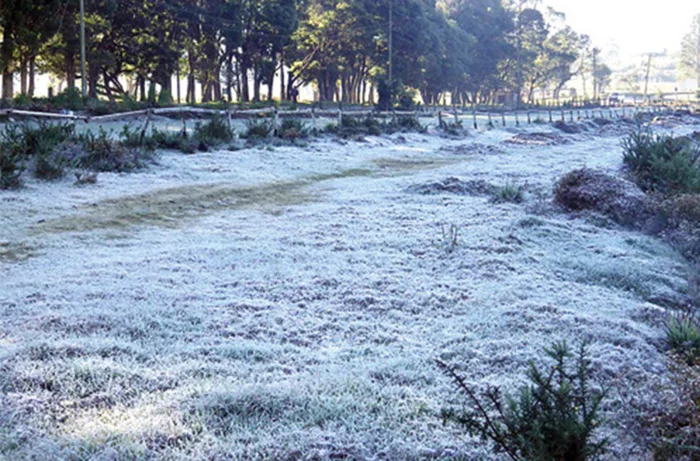
They are on a leisurely uphill crawl,
These shiny, cumbrous city cars,
Beholding in goggle-eyed wonder,
Snow gathering on mountain tops,
Imagining a once-in-a-lifetime photo-op,
But the battered land lying outside,
Gives the bigger picture for the noting eye,
Of wattle-and-daub hut denizens,
Keeping down slowly rising anger,
On being deprived the promised morsel.
By Lynn Ockersz

India qualify for Under-19 World Cup semi-finals, Pakistan knocked out

Tom Banton fifty steers DLS chase to seal series for England

Pakistan to boycott T20 World Cup group match against India

England to bowl first in Pallekelle

No child should be deprived of vocational or higher education due to poverty – PM

Ireland thump Thailand to qualify for 2026 women’s T20 World Cup

‘Dates have the highest sugar content to fight Coronavirus’

Sunday Island 27 December – Headlines

#SundayIsland 17th December – Headlines

Sunday Island – 28th March

Sunday Island Headlines – 21 March

Sunday Island – 21st February – Headlines
-
 Business7 days ago
ComBank, UnionPay launch SplendorPlus Card for travelers to China
-
 Business4 days ago
Climate risks, poverty, and recovery financing in focus at CEPA policy panel
-
 Opinion3 days ago
Sri Lanka, the Stars,and statesmen
-

 Business2 days ago
Hayleys Mobility ushering in a new era of premium sustainable mobility
-
 Opinion7 days ago
Luck knocks at your door every day
-
 Business2 days ago
Advice Lab unveils new 13,000+ sqft office, marking major expansion in financial services BPO to Australia
-
 Business2 days ago
Arpico NextGen Mattress gains recognition for innovation
-
 Business23 hours ago
Altair issues over 100+ title deeds post ownership change