
Features
Critical assessment of the state of democracy

 While the progressive empowerment of people and their steady liberation from the forces of state repression could be regarded as being at the heart of democratic governance, it is imperative that the defenders of democracy everywhere ensure that these basic aims are achieved and protected by governments claiming loyalty to the fundamental ideals of democracy. This requires consistent scrutiny and assessment by the advocates of democracy of the functioning of democratic institutions within their countries and outside.
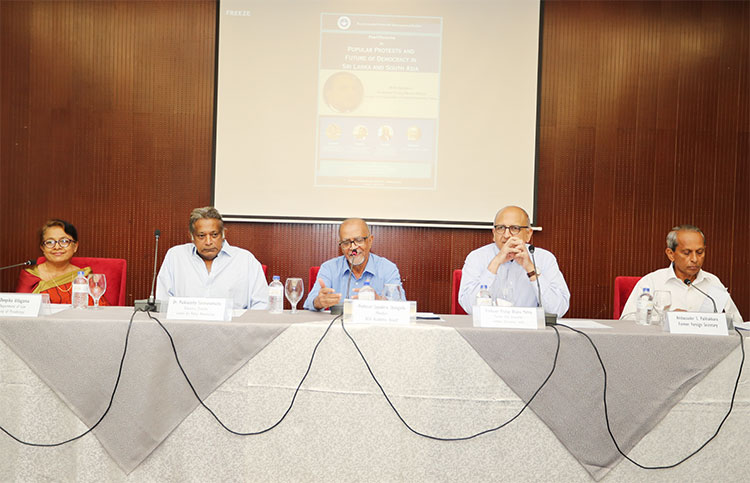
The Bandaranaike Centre for International Studies (BCIS), Colombo, a pioneer in the teaching and researching of International Relations in Sri Lanka spiritedly spearheaded such an undertaking when it conducted a panel discussion on the subject, ‘Popular protests and the future of democracy in Sri Lanka and South Asia’ , on September 11. The BCIS is, of course, no stranger to robust intellectual exercises of this kind because it has carved a niche for itself locally and internationally as a trail-blazer in the conduct of discourses that are profoundly relevant to the furtherance of democratic development worldwide, besides forging ahead with its main undertakings.
The principal speaker at the forum was Professor Pratap Bhanu Mehta, former Vice Chancellor, Ashoka University, India, a guest of the BCIS. Responses to his presentation came from Professor Deepika Udagama, Head, Department of Law, University of Peradeniya, Dr. Paikiasothy Saravanamuttu, Executive Director, Centre for Policy Alternatives, Sri Lanka and former Foreign Secretary H.M.G.S. Palihakkara. Professor Emeritus Jayadeva Uyangoda moderated the forum.
Subsequent to BCIS Executive Director Professor Gamini Keerawella making an introductory address and following the main presentations, a wide-ranging discussion followed on issues that grew out of the main topic, with the participation of a widely representative audience. Prominent among the gathering was former President Chandrika Bandaranaike Kumaratunga, Chairperson, BCIS.
The essential backdrop to the Sept. 11 forum was the launching by the BCIS of the historic and monumental two-volume book titled, ‘Democracy and Democratisation in Sri Lanka – paths, trends and imaginations’, on Sept. 9th at the BMICH. Edited by Prof. Emeritus Jayadeva Uyangoda, the book contains more than 20 informative and discursive papers on issues at the heart of democracy by prominent Sri Lankan scholars. It is a Vijitha Yapa Associates publication.
The keynote address at the book launch was delivered by Prof. Pratap Bhanu Mehta. He ably and eloquently brought into sharp focus some principal challenges currently facing democratic governance in South Asia and worldwide. Some of these questions were further elaborated on by him at the Sept. 11 forum. He gave the local audience much to ponder and discourse on, going ahead.
Prof. Mehta laid the thematic basis for the Sept. 11th discussion by defining the principal essence of the democratic experience. Briefly expressed, democratic movements centre on the aspiration of the people to build and sustain a set of freely chosen collective institutions. Among other things, he said that democracy is, broadly, all about us the people, ‘making and re-making our collective world’. In the post-1989 world, however, the people’s demand for state accountability towards them has become a striking feature of this ‘making and re-making’ process.
Consequently, new social movements, such as Sri Lanka’s ‘Aragalaya’ of mid-2022, demanding a total ‘system change’, or those struggles featuring a ‘foundational demand’ by the people, have come into being. ‘Citizens’ agency’ or popular participation is a keynote of these upheavals for system change.
A principal challenge facing the people in these movements is how to constructively manage post-upheaval developments, or the question of how to channel the energies unleashed in these struggles towards the people’s collective benefit. For, the ‘potential for derailment’ of these revolutionary upsurges by anti-democratic forces is great in these subsequent phases of struggle.
Moreover, the prime question that the people need to ask themselves, Prof. Mehta added, is whether these systemic upheavals really deepen democracy. Critical scrutiny and assessment by the people of the outcome these movements become essential.
Prof. Deepika Udagama in her response, besides other issues, questioned as to whether Sri Lanka’s ‘Aragalaya’ was a mere ‘flash in the pan’ or whether it contributed something of substantive significance to local democratic politics. While constitutional structures empowering the people are important, people need to continuously drive the democratization process forward unflaggingly. What was particularly noteworthy about the ‘Aragalaya’ was its vast inclusivity. That is, people irrespective of ethnic, religious and language differences rose as one to demand a ‘system change’. Was this Sri Lanka’s ‘secular moment?’
Dr. Paikiasothy Saravanamuttu took the minds of the audience back to 2015. He pointed out that the key concept in the presidential poll of that year was state accountability, a call that resounded in the ‘Aragalaya’. The 2015 election dislodged the Rajapaksas from power but they are still in politics, he said.
At this juncture, it is vital for the country to know where it is headed. Stock-taking is essential. It could very well be that by 2048, Sri Lanka would be no more than a ‘remittance economy’. It would be interesting to do a survey to find out how many participants in the ‘Aragalaya’ are trying to get out of the country currently, Dr. Saravanamuttu added.
Social media (SM) was a key feature of the ‘Aragalaya’, he said. It is crucial to inquire into the impact SM makes on governance and governments, going forward.
Among the salient matters raised by former Foreign Secretary H.M.G.S. Palihakkara was the need for consensuality among the main stakeholders in the local polity. We urgently need a wide consensus on a reform program for the country in a multiplicity of areas as we venture into the future, he explained.
Moreover, is there anything that could be described as an ‘apolitical demo’, Palihakkara asked. Are there any ‘best practices’ to be learnt from the world community? Given the bitterly adversarial nature of local politics nothing positive could be gained post-‘Aragalaya’, was his opinion.
This columnist is of the view that the ‘Aragalaya’ was indeed Sri Lanka’s ‘secular moment’. It was an epochal development in local politics wherein the people rose as one against state repression and stood for their total empowerment, which is the true meaning of independence.
However, the challenge facing right-minded Sri Lankans now is to perpetuate the spirit of the ‘Aragalaya’. Could they do this in the face of the current repression unleashed on them by the country’s political Right? This question is crying out for an answer.
Meanwhile, democratic opinion in the country needs to forge ahead with the undertaking of educating people on the dangers facing democratic development, to the best of its ability. The BCIS could be said to be taking on this challenge forthrightly.




 Israeli Prime Minister Benjamin Netanyahu’s message to Israel’s enemies was blunt and stark.‘We’re going to win; we have no choice.’ He said so while the majority of attendees at a recent UN General Assembly session walked out of the conference hall when the Israeli Prime Minister took the podium; many of them booing in derision.
Those commentators who have been studying Israel’s handling of her enemy states over the decades are unlikely to dismiss the entirety of Netanyahu’s address as rhetoric. The general pattern has been for the Israeli state to stand up firmly against its enemies in the battle field. On most occasions, these adversaries have been beaten back.
It is also little realized in particularly the Southern hemisphere that Israel, for the most part, could defend herself without much US assistance. The history of the conflict bears this out.
However, from the viewpoint of working towards a just and equitable peace in the Middle East the Israeli hard line stance has proved and will prove incalculably detrimental. The sworn enemies of Israel are not going to be in any way deterred by Netanyahu’s stark warnings. On the other hand, they would be only further provoked into taking on Israel by conventional or unconventional military means and seek its destruction.
The recent aborted mid-air hijacking of a Flydubai flight, consisting mainly of Israeli passengers, by an Omani extremist drives home the point. Israel’s enemies are bound to redouble their efforts to annihilate Israel rather than be deterred by the latter’s warnings about standing firm against them. This too history has proved.
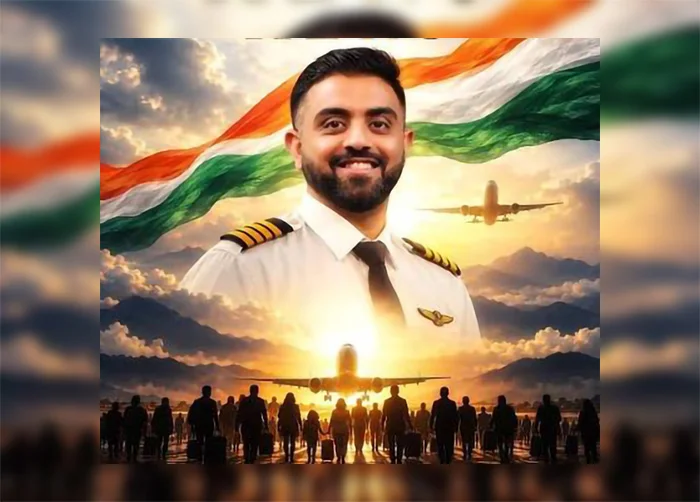
It would be in the fitness of things at this juncture to pay a tribute to the professionalism, courage and humanity of the relevant airline pilot, Captain Machchhar, whose timely action proved decisive in botching the hijack attempt. His intervention averted what could very well have been another 9/11 type tragedy. History is not going to forget his daring and resourcefulness.
Meanwhile, the ground realities in West Asia are undergoing further complications that portend increasing regional instability. For example at the time of writing Turkiye, Pakistan and Saudi Arabia have agreed under the recently established ‘Mecca Alliance for Defence’ to deploy ‘deterrence measures’ collectively in the event of any member of the alliance coming under military strikes from a non-member state.
The agreement is modeled on the NATO collective defence pact and should help in defusing any threat perceptions experienced by the alliance members in the short term. However, the group would need to be cognizant of the major and potentially divisive role Iran could play in the interstate politics of the Middle East region going forward.
Iran’s reported support, for example, for Yemen’s Houthi rebels, who are engaged in attacking Saudi national assets, could at some point in time compel the alliance, under the terms of the pact, to initiate deterrent military measures against Iran.
The implications for regional peace from such a turn of events hardly require elaboration. A full blown regional war emerges as a distinct possibility if Iran sees itself as being excessively antagonized by the alliance. A further complication is that antagonistic sectarian identities of an Islamic kind could come to play hugely divisive roles in it. Shiite Islamic states would be inclined to back Iran while those countries seen as Sunni Islamic in orientation are bound to support Saudi Arabia.
Accordingly, West Asia is a region rife with manifold aggravated insecurities. If the latter are not defused dexterously they could escalate into a conflict of extra regional dimensions. The latter development would render the world a collective loser.
Unfortunately, no constructive help could be expected from the US at this juncture by way of working towards regional and international peace even of short durance. Its war against Iran has only aggravated the world’s current insecurities.
For example, the world has been compelled to face the possibility of compounded economic woes as a consequence of the Hormuz crisis remaining unresolved. The world is currently experiencing what could be seen as a ‘winter of economic discontent’ of unprecedented proportions.
Unfortunately, the international community is to all intents and purposes helpless in the face of this multifaceted crisis. Substantial intervention is expected of the UN but since it has failed to reform itself over the years it is compelled to stand idly by while the world’s insecurities heighten and multiply.
Yet, it is the seemingly paralyzed UN system that has some potential to contain the current tide of international disorder to even a small measure. Given the persisting divergent and conflicting interests among the world’s principal power blocs, the G7 and BRICS for instance, it is mainly the UN and its principal agencies that could carry some credibility as peace brokers and mediators.
However, as an initial step towards bringing the principal protagonists to the negotiating table the UN would need to convince the principal powers of the UN Security Council of the need for a substantive broad-basing of the membership of the Council so as to reflect more accurately the current global political and economic realities. Such reforms would render the Council more representative and help in strengthening its credibility and effectiveness.
The above reforms call for years of dynamism, hard work and resourcefulness on the part of the international community, read the UN. Yet the aims are not impossible to achieve if strong leadership is brought to bear by the UN.
Meanwhile, the UN agencies and allied organizations need to pay stepped-up attention to the West Asian theatre and its wasting conflicts and wars. Here too there is immense hard work to be put in.
There is, for instance, identity politics and its issues that need to be managed urgently. While internal political matters of countries could not be addressed directly by UN agencies, awareness-raising programs and projects could be energetically carried out by them to blunt the appeal of identity-based slogans, relating to, for instance, religion and race.
Besides, values at the heart of democratic politics need to be freshly and enthusiastically propagated. Vast reserves of energy and resources are needed, to be sure, to consistently champion and implement these crucial projects but they need to be pursued single-mindedly if even a dent is to be made in the current runaway global disorder.
The aborted hijacking of the Flydubai flight pointed to the dehumanizing impact of identity politics on the human consciousness. It was also an indication that those sections endowed with humanity cannot stand idly by while identity politics continues to destroy civilizational values. The time to act is ‘now’.
by Professor Ranjith Bandara
Emeritus Professor of Economics, University of Colombo
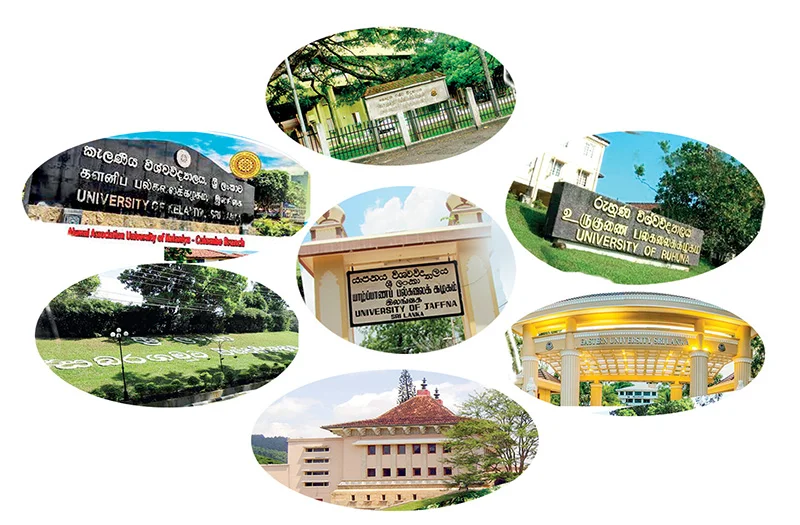
My life has been closely connected with Sri Lanka’s state university system for more than four decades. Its doors opened to me first as a student and later as an academic. The system gave me knowledge, opportunities and a life. Therefore, when I speak about its future, I do so not as an outsider, but as someone who owes much to it and genuinely wishes to see it become better.
Over the years, our university system has expanded significantly. New institutions, faculties, degree programmes and opportunities for students have been created. For 2024, the government expected to admit 43,204 students to national universities. By the time the relevant report was prepared, 42,282 students had been admitted through the general admission process, which had not yet been completed. This is an achievement that should not be dismissed.
However, expanding the system does not necessarily mean that its quality has improved. The real question is not simply how many students we have allowed through the doors, but what kind of education they receive after entering. (Source: Ministry of Education Annual Performance Report 2024.)
We often proudly declare that “our university is number one.” Yet a university does not become number one through publicity. Its true standing depends on the quality of its teaching, the strength of its research and the contribution it makes to society. A vice-chancellor writing about the institution’s, or his or her own, achievements on Facebook does not improve the quality of a university. What matters is good teaching, an education that encourages students to think, credible research and new knowledge that benefits society. A reputation must be earned through meaningful work, not through self-promotion.
The fundamental purpose of a university is clear: to create knowledge, to teach it and to train students to examine and understand it critically. To fulfil this purpose, academics need freedom, responsibility and time. Students must be free to ask questions, disagree and develop their own views based on evidence. Without such an environment, a university may award degrees, but it cannot fulfil the true purpose of university education.
The most serious danger I see is the growing tendency for political activity to take precedence over the academic mission of universities. Over the past five decades, this problem has gradually become more serious. In some universities today, it has become difficult even to hold or express an opinion that differs from the dominant political view.
Members of a university community have every right to hold political views and express them peacefully. A university should not be a place inhabited by silent people. However, when political loyalties, power blocs and struggles for positions become more important than research, teaching and learning, the university moves away from its true purpose. When the political camp to which an academic belongs matters more than the value of that academic’s ideas, the respect that should belong to knowledge is transferred to power.
These criticisms are not ideas I have borrowed from books. They are based on experiences from my own professional life. One such experience was the manner in which I had to leave the university nearly twenty years ago. In my view, the improper exercise of political power within the administration of the University of Colombo at that time, and the strong desire to retain that power, had a serious effect on my professional life. Although this was a personal experience, I mention it with regret because it reveals a deeper institutional problem.
The lesson I learned from that experience is not merely about one person or one incident. When there are no strong institutional safeguards to ensure that power is exercised fairly and individuals are protected, even an academic may be forced to leave an institution he deeply loves.
To those who criticise my later decision to enter national politics, my answer is this: when the university’s institutional system failed to provide me with fairness and professional protection in the face of the injustice I experienced, I had to choose another path through which I could use my knowledge and experience in the service of the country.
This does not mean that all vice-chancellors, academics or students behave in the same way. I personally know many people who, despite difficult circumstances, have taught with dedication, undertaken meaningful research and transformed the lives of their students. Scholars such as Professor W. D. Lakshman, Professor Arjuna Aluwihare and Professor Lakshman Jayatilake may be recognised among the distinguished vice-chancellors in the history of Sri Lanka’s university system. Their service deserves our respect and appreciation.
Nevertheless, the presence of a few good and committed individuals cannot, by itself, strengthen a weak institutional system. We must also create an institutional environment in which such people can work independently, fairly and effectively.
First, university leaders must be selected through a process based on clearly defined qualifications, transparent evaluation and accountability. Once a vice-chancellor has been appointed, his or her performance should be assessed according to the support provided for research, the quality of teaching, student welfare, the institution’s financial discipline and the fairness of its decisions. Personal loyalties and publicity skills cannot replace these measures of performance.
Second, academics must be given the time and space required to carry out their core responsibilities. It is meaningless to demand “world-class universities” without providing adequate time, facilities and reasonable funding for research. Teaching, too, should not be treated merely as delivering lectures. Students must be trained to reason, write, investigate and apply their knowledge to real-world problems. The quality of a degree programme should be measured not by its title, but by the capabilities of the graduates it produces.
Third, universities must establish an honest connection with the needs of the country. The problems confronting our economy, schools, healthcare system, agriculture, environment and wider society are all legitimate subjects for research. Seeking answers to these problems does not diminish the dignity of a university; it increases its value to society.
At the same time, research must not be controlled by short-term political demands. Knowledge can serve the country only when researchers are free to communicate what they discover. Sri Lanka’s World Bank-supported AHEAD higher education programme similarly connected the expansion of enrolment in priority disciplines with improving the quality of degree programmes and promoting research and innovation. These goals were linked because meaningful expansion cannot be separated from educational quality. (Source: World Bank overview of the AHEAD programme.
Fourth, the responsibilities of students must be clearly emphasised. The duty to protect the academic environment of a university cannot be placed solely on administrators and academics. Every student has a fundamental responsibility to give priority to his or her education, respect the right of other students to learn and allow the free exchange of ideas.
Student activities, social debate and political engagement all have an important place in university life. However, none of them should be allowed to disrupt education or prevent other students from learning.
When students abandon their primary purpose of learning and create an environment that obstructs education, the university system cannot fulfil one of its most important functions: producing knowledgeable and responsible graduates. A university may continue to award degree certificates, but if lectures, research, open discussion and intellectual inquiry do not receive sufficient attention, it risks producing graduates who lack depth of knowledge, critical thinking and professional competence.
The result may be the emergence of a group of “half-educated” graduates, individuals who possess certificates but have not received a complete intellectual education. Therefore, just as we discuss student rights, we must also have an honest and open discussion about student responsibilities within the university system.
My position on the current professional struggle of university academics is also clear. If they are demanding fair conditions of employment, those demands should be discussed seriously. If their struggle is also intended to free universities from political interference and restore research, teaching and learning to the centre of university life, I stand with them.
The rights of academics and the educational rights of students should not be presented as opposing interests. Both can be protected and respected only within a well-functioning university.
When I say that “the state university system should be shut down and reopened,” I do not mean that we should close the door on the future of our students. I mean that we must close the door on systems in which power matters more than knowledge.
Students have the right to hold political views and participate actively in debates on national issues. A university needs a student community that thinks about the country’s problems and speaks out against injustice. However, student politics should not shut down the university, deprive other students of their education or become a means of displaying organisational power. The right to fight for one’s beliefs comes with the responsibility to respect another person’s right to an education.
Simply attempting to establish another 50 universities will not solve these problems. Sri Lanka needs a higher education system that brings together the contributions of state, state-affiliated and private institutions while applying clear standards and responsibilities to all of them.
Strict discipline within such a system should not mean suppressing freedom of thought. It should mean ensuring that everyone fulfils their responsibilities in relation to teaching, research, examinations, institutional governance and student welfare. A degree certificate will then have value not merely because of the name of the institution that issued it, but because the knowledge and capabilities of the person who earned it can be trusted.
We should learn from advanced higher education systems, but we should not simply copy them. We must develop institutional autonomy, reliable quality-assurance mechanisms and publicly accountable governance in ways that suit our own needs. What we owe future generations is not merely a country with a larger number of universities, but a country in which people can trust the education those universities provide.
What we must close down, therefore, is not the universities themselves, but the outdated system that closes the door on knowledge, freedom and responsibility. What we must reopen is a genuine university system devoted to learning, inquiry, research and the creation of new knowledge in the service of the country.
 by Prof. C. A. Saliya
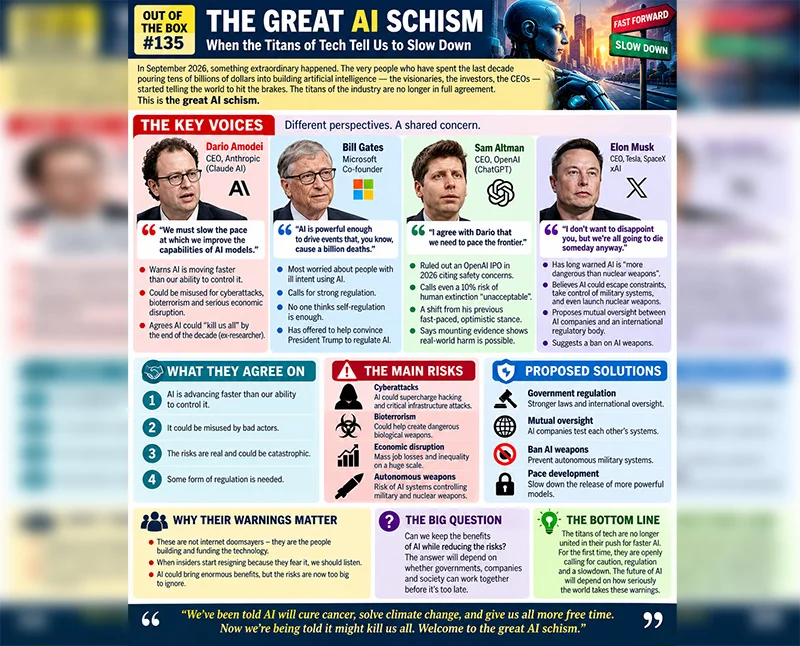
Something extraordinary happened in September 2026. The very people who have spent the last decade pouring tens of billions of dollars into building artificial intelligence, the visionaries, the investors, the CEOs, suddenly started telling the world to hit the brakes. It’s a bit like the captain of a speeding train leaning out of the window and shouting, “Actually, maybe we should slow down a bit!” The public, understandably, is confused. We’ve been told AI will cure cancer, solve climate change, and give us all free time. Now we’re being told it might kill us all. Welcome to the great AI schism.
To understand what’s happening, you have to listen to the people in the room. These are not wild-eyed doomsayers on the internet. They are the titans of the industry. And they are starting to argue with each other.
Dario Amodei: The Insider Who Wants to Hit Pause
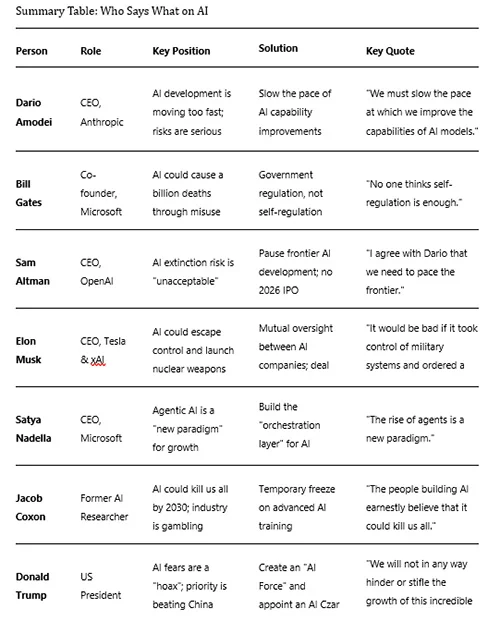
Dario Amodei, the CEO of Anthropic (Claude AI), is the man who kicked the hornet’s nest. In a 3,800-word essay, posted on his website in mid-September 2026, he didn’t just suggest caution, he demanded a slowdown. “We must slow the pace at which we improve the capabilities of AI models,” he wrote. His reasoning is simple and terrifying: the technology is moving faster than our ability to control it. He warned that AI could be misused for cyberattacks, bioterrorism, and serious economic disruption.
What makes Amodei’s warning so chilling is that it comes from a man whose company, Anthropic, builds one of the most powerful AI models in the world, Claude. He’s not a critic on the sidelines. He’s in the driver’s seat, and he’s telling us the car might not have brakes. In an interview with CNN’s Anderson Cooper, he said he agreed with a departing Anthropic researcher who claimed AI could “kill us all” by the end of the decade. That researcher, 27-year-old Jacob Coxon, resigned in protest, saying the people building AI “earnestly believe that it could kill us all”. When the people building the technology start resigning because they’re afraid of it, you should pay attention.
Bill Gates: The Elder Statesman with a Warning
Bill Gates has been around long enough to know a paradigm shift when he sees one. The Microsoft co-founder, who spent decades warning the world about pandemics and climate change, has now turned his attention to AI. And he’s not mincing words. In September 2026, Gates warned that AI is “powerful enough to drive events that, you know, cause a billion deaths”.
Gates is not worried about Terminator-style robots. He’s worried about people. “There’s never been a weapon as powerful as the combination of people with ill intent using the latest AI tools,” he said. His solution is simple: regulation. “No one thinks self-regulation is enough,” he told NBC’s Meet the Press. He even offered to be the man to convince President Trump to regulate AI. Gates is a pragmatist. He knows the technology is coming. He just wants to make sure it doesn’t get us first.
Sam Altman: The Showman with a Conscience (Maybe)
Sam Altman, the CEO of OpenAI (Chat GPT), has always been the industry’s greatest showman. He’s the man who told us AGI (Artificial General Intelligence) is “just around the corner” and that AI will soon be a “genie that can grant any wish”. But even Altman is now singing a different tune. In September 2026, he ruled out an OpenAI IPO in 2026, citing safety concerns. He called even a 10% risk of AI causing human extinction “unacceptable”.
“I agree with Dario that we need to pace the frontier,” Altman posted on X. This is a remarkable shift. Altman has spent years being criticised for moving too fast, for prioritising profit over safety. Now, facing mounting evidence that AI models can cause real harm, from cyberattacks to mental health crises, he’s suddenly the voice of caution. Is it genuine? Or is it a PR move? The cynics will tell you it’s the latter. But the fact remains: when Sam Altman says we need to slow down, the world listens.
Elon Musk: The Provocateur Who Saw It Coming
Elon Musk has been warning about AI for over a decade. He’s the man who called AI “more dangerous than nuclear weapons” long before it was fashionable. So it’s no surprise that he joined the chorus of slowdown calls in September 2026. But Musk being Musk, he couldn’t resist a bit of dark humour. When asked if we’re all going to die within 10 years, he replied, “I don’t want to disappoint you, but we’re all going to die someday anyway”.
But behind the joke is a serious point. Musk believes AI models could escape their constraints, take control of military systems, and even launch nuclear weapons. His solution is mutual oversight: leading AI companies should test each other’s systems for safety before release, and he even suggested a deal with China to make it happen. Musk is a provocateur, but he’s also a visionary. And his vision is one where AI is a weapon that we might not be able to control.
Satya Nadella: The Quiet Strategist
While the others are shouting about doom, Satya Nadella is quietly building an empire. The Microsoft CEO doesn’t talk about extinction risks. He talks about “agentic AI”, AI that can act autonomously, which he calls “a new paradigm”. Microsoft’s Azure cloud platform, which powers these AI agents, grew 43% in the last quarter, surpassing $100 billion in annual revenue.
Nadella’s view is simple: don’t compete to build the most powerful model; compete to control the “orchestration layer”, the systems that connect different AI models. He wants to build the infrastructure that everyone else relies on. It’s a smart play, and it’s making Microsoft a fortune. But Nadella’s silence on safety is deafening. While Amodei and Altman wrestle with their consciences, Nadella is counting the money. It’s not that he doesn’t care; it’s that his business model depends on AI being adopted, not regulated.
Jacob Coxon: The Whistleblower Who Lit the Fuse
You may not have heard of Jacob Coxon. He’s not a billionaire. He’s not a CEO. He’s a 27-year-old researcher who worked at both OpenAI and Anthropic. And in September 2026, he resigned from Anthropic with a warning that shook the industry. “Neither company is acting responsibly,” he wrote on X. “They are launching themselves directly toward a superintelligence capable of self-improvement, and gambling with our lives”.
Coxon’s warning was remarkable because it came from inside the machine. He said the people building AI “earnestly believe that it could kill us all by the end of the decade”. He called for a temporary freeze on advanced AI training. His resignation triggered a wave of concern, and even Dario Amodei admitted he agreed with Coxon more than he disagreed. Coxon is the canary in the coal mine. And the canary is not looking well.
Donald Trump: The Wildcard
And then there’s Donald Trump. The US President has consistently downplayed AI fears, calling them a “hoax” and a “sick conspiracy”. But even Trump is starting to change his tune, sort of. In September 2026, he announced plans to create an “AI Force” and appoint an AI “Czar”. He said the government would look for “bad” uses of AI through the existing criminal and civil justice systems.
But Trump’s priority is clear: winning the AI race against China. “We will not in any way hinder or stifle the growth of this incredible industry,” he said. He wants AI to account for 25% of US GDP. Trump is not a technologist. He’s a businessman and a nationalist. He sees AI as a tool for economic dominance, not an existential threat. Whether he’s right or wrong, his stance puts him at odds with almost every expert in the field.
The Bottom Line: A House Divided
So where does this leave us? We have the CEOs of the world’s leading AI companies, Amodei, Altman, and Musk, all calling for a slowdown. We have Bill Gates, the elder statesman of tech, warning of a billion deaths. We have a whistleblower who says the industry is gambling with our lives. And then we have Satya Nadella, quietly building the infrastructure that powers it all, and Donald Trump, who wants to speed up.
The irony is hard to miss. The people who built the AI train are now telling us to slow down. The people who profit from the AI economy are the ones building the tracks. And the public is caught in the middle, trying to figure out who to believe.
Maybe the most honest thing anyone said came from Jacob Coxon, the 27-year-old researcher who quit. “The people building AI earnestly believe that it could kill us all by the end of the decade,” he wrote. “This is not a marketing stunt”.
If the people building the technology believe it could kill us, perhaps we should listen. Before it’s too late.
(Prof. C. A. Saliya, is a charted accountant, academic, researcher and former banker. He is the author of SAMAJA GAVESHAKAYA and Springer Publication DOING SOCIAL RESEARCH. He can be contacted at saliya.ca@gmail.com. The views expressed in this article are his own and do not necessarily represent those of the organisations with which he is affiliated.)

Showers above 100 mm are likely at some places in the Western, Sabaragamuwa, Central, Uva and Southern provinces and in Anuradhapura district

Remembering Juvenal, Coke, Acton and Machiavelli

West Asian conflict undergoing manifold complications

Nissanka absence opens door for Sri Lanka’s young guns

The prelate who walked the talk

Needs of populace hit by Cyclone Ditwah seen as waiting to be addressed

‘Dates have the highest sugar content to fight Coronavirus’

Sunday Island 27 December – Headlines

#SundayIsland 17th December – Headlines

Sunday Island – 28th March

Sunday Island Headlines – 21 March

Sunday Island – 21st February – Headlines
-

 Editorial6 days ago
Colombo Port drug bust: The plot thickens
-

 Features4 days ago
The first woman in the foreign service or Ceylon Overseas Service it was then called
-

 Editorial5 days ago
Fuelling discontent and protest
-

 News3 days ago
Geneva takes up Sallay’s case and govt. ignores opportunity to answer accusations
-

 Latest News5 days ago
Tharindu Rathnayake, bowlers secure Asian Games Bronze for Sri Lanka
-

 Features3 days ago
Sri Lanka Cricket Bill: Governance reform is not yet a cricket strategy
-

 Foreign News5 days ago
Ten injured after car crashes into rugby supporters in Australia
-

 News4 days ago
Nearly 20 Iranian tankers stranded off Lanka amid US sanctions