
News
Coronavirus far more prevalent than indicated by PCR testing statistics

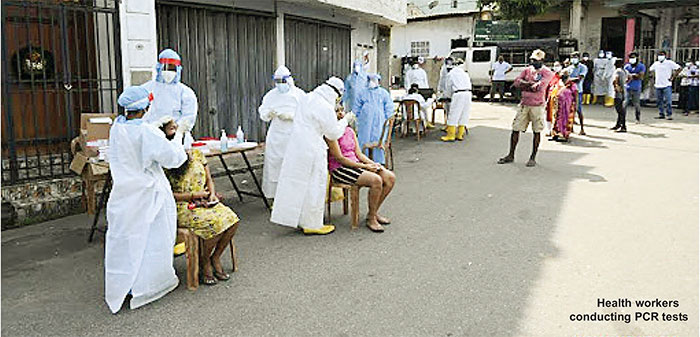
A seroprevalence rate of 24.5% was seen in all age groups in the CMC in the end of January 2021, a research carried by Sri Lankan and British researchers has revealed. This is a much higher number than what the PCR tests indicated.
The research was carried out in the Colombo city, which experienced the highest number of coronavirus cases until the end of January 2021, the researchers have said. Although Sri Lanka had successfully contained the pandemic until the end of September, with no locally detected cases from August to September 2020, an explosive spread began during early October, which rapidly spread across the country.
“However, as Colombo is the commercial capital of the country, and also due to extremely overcrowded living conditions, 32,346/89,817 (36.01%) locally detected cases by the end of March 2021, were from Colombo. Of the cases in the Colombo District, 14,416 (44.6%) were identified within the city. We carried out a serosurvey prior to initiation of the vaccination programme to understand the extent of the SARS-CoV-2 outbreak”, they said.
The researchers added that although the seropositivity rate was highest in the 10–20 age group (34.03%), the PCR positivity rate was 9.80%. Therefore, the PCR positivity rates appear to underestimate the true extent of the outbreak and the age groups which were infected. They said that in many countries, the reported number of cases did not necessarily reflect the extent of the outbreak, age groups infected and groups at risk, as the majority of infections were asymptomatic and limitations in carrying out quantitative real-time PCR for SARS-CoV2. It has been estimated that surveillance of SARS- CoV2 with qRT-PCR alone may underestimate the true prevalence by tenfold.
“Differences in the PCR positivity rates and seropositivity rates were also seen in 60–70-year-olds (8.90 vs 30.4%) and in individuals 70 years (4.10 vs. 1.20%). The seropositivity rate of the females was 29.70% (290/976), which was significantly higher than in males 21.2% (333/1,571), the researchers said.
It is important to carry out serosurveillance studies to understand the true extent of an outbreak in order to understand the future outbreaks that may occur in a particular area and to further understand transmission dynamics and duration of immunity, the researchers have said.
“Based on the seropositivity rates of 24.46%, 138,276 individuals are likely to have been infected, compared to the reported PCR positive cases of 14,416. Therefore, infection detection rates by PCR appeared to have underestimated the actual number of infections by 9.59-fold, which is not surprising as the random PCRs were mainly carried out in the working population and less frequently in those who were confined to their houses.” They claimed that as samples for PCR were obtained on only certain days of the week when the team visited the housing complexes and residential areas, the population who underwent PCRs on most days mainly represented the working population. Blood samples were obtained from these participants at the same time when samples were taken from them for these routine random PCR testing for SARS-CoV-2. None of the participants had any symptoms at the time of obtaining blood samples and were not previously diagnosed as been infected with the SARS-CoV-2 virus.
The researchers further claimed that the Colombo city was divided into six districts: namely D1, D2A, D2B, D3, D4, and D5. Although the overall seroprevalence was 24.46%, certain districts in the CMC (D2A, D2B, and D3) had higher seroprevalence rates (26.2–39%) compared to D4 which only had a seroprevalence rate of 3.33%. These overall differences between the districts reflected the population density and the housing conditions in these districts, with the districts with high seroprevalence having more overcrowded areas, with poor housing conditions. The differences in the seroprevalence rates in different districts could also be due to differences in the control measured adopted. For instance, in D1, although the seroprevalence was 14.76%, certain areas in this district had a very high infection rate as determined by PCR positivity. Due to early detection of SARS-CoV-2 infection in certain areas in this district, these areas were isolated very early, and therefore, it would have curtailed the spread to the rest of the D1 district resulting in fewer infections. Such similar differences have been observed in many states in India, where the slum areas reported seroprevalence rates between 52.6 to 58.7% compared to 12–17.9% in non-slum areas Although the overall seroprevalence rates in the CMC was less than urban areas in India, it was higher than many areas in Europe (Spain, Sweden, Switzerland, and Germany), which reported a seroprevalence between 5 to 13.6% and Iran (22.16%), which reported higher infection rates (14–17). However, the use of different antibody assays, which had a varying degree of sensitivity and specificities in these different studies could result in such differences.
Chandima Jeewandara, Dinuka Guruge, Inoka Sepali Abyrathna, Saubhagya Danasekara, Banuri Gunasekera, Pradeep Darshana Pushpakumara, Deshan Madhusanka, Deshni Jayathilaka, Thushali Ranasinghe, Gayasha Somathilake, Shyrar Tanussiya, Tibutius Tanesh Jayadas, Heshan Kuruppu, Nimasha Thashmi, Michael Harvie, Ruwan Wijayamuni, Lisa Schimanski, T. K. Tan, Pramila Rijal, Julie Xiao, Graham S. Ogg, Alain Townsend and Gathsaurie Neelika Malavige were the researchers involved. (RK)



Former first lady Shiranthi Rajapaksa, wife of former President Mahinda Rajapaksa was produced before the Hulftsdorp court, after being arrested by officers of the Commission to Investigate Allegations of Bribery or Corruption (CIABOC) and produce
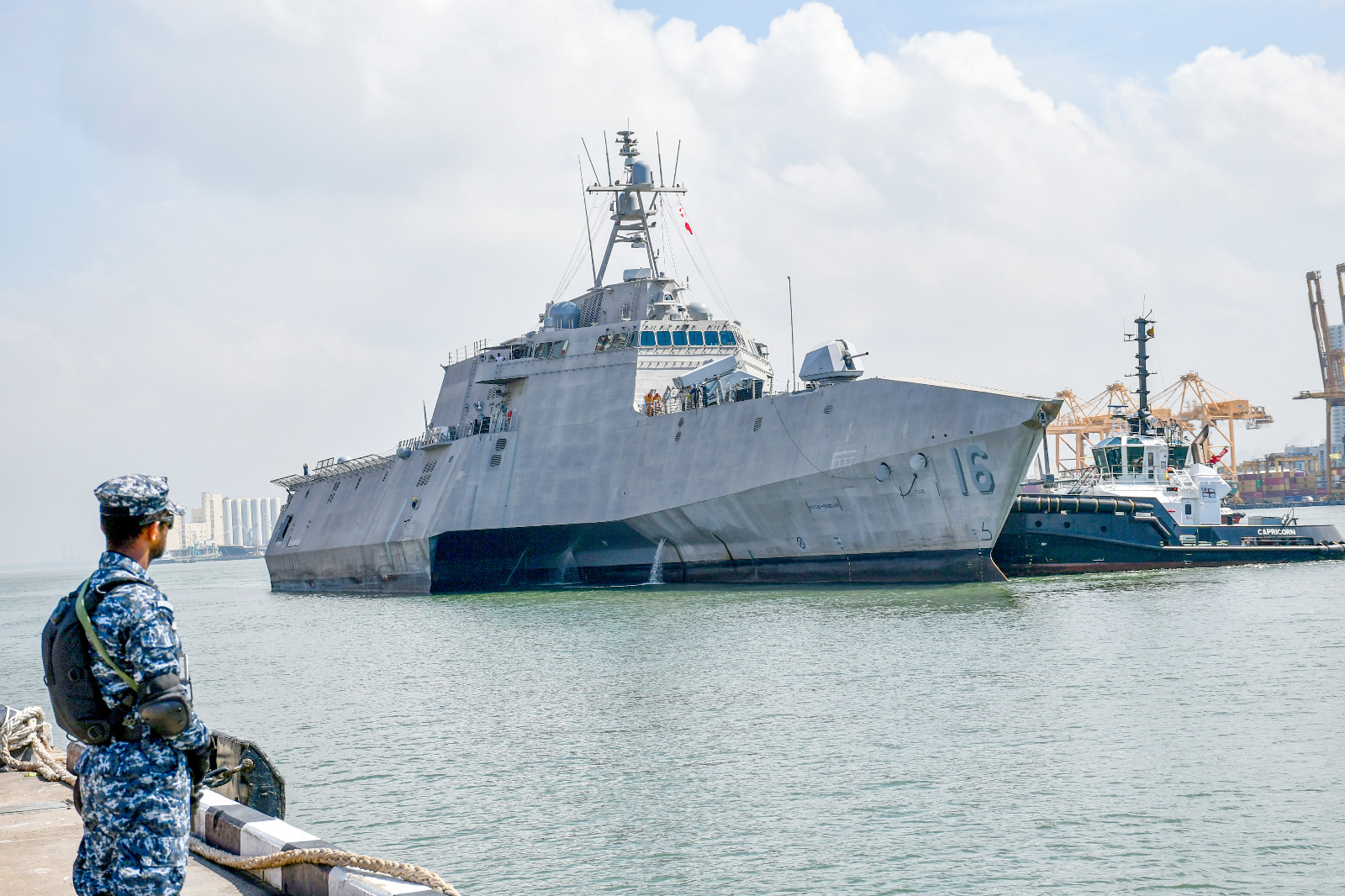
The U.S. Navy ship USS Tulsa (LCS 16) arrived at the Port of Colombo this morning, 7 October 2026 for replenishment purposes.
The visiting ship was welcomed by the Sri Lanka Navy in accordance with naval traditions.
The 127.7-metre-long platform is a Littoral Combat Ship commanded by Commander BM Wanier. Commissioned on 16 February 2019, USS Tulsa has since been in service with the US Navy.
The ship previously made a port call in Sri Lanka on 27 August 2025.

Govt. tells fuel distributors to maintain stocks to ensure uninterrupted supplies
by Saman Indrajith and Norman Palihawadane
The government had instructed private fuel distributors to maintain minimum stocks and ensure uninterrupted supplies to the market, Energy Minister Anura Karunathilaka told Parliament yesterday (06).
Karunathilaka said the Ministry of Energy Secretary had notified the relevant companies of the requirement, following a reduction in supplies by some private distributors, amid higher international fuel prices.
The Minister said private companies had informed the government that they were facing losses because international prices had risen while fuel was being sold, locally, at prevailing prices. As a result, some companies had reduced the volumes released to the market.
The reduced supplies had increased the burden on the Ceylon Petroleum Corporation (CPC), whose share of the diesel market had risen from about 54% to 82%, the Minister said.
“The CPC currently holds an 82% share of the market,” he said, adding that it had increased its supplies, compared with February, to compensate for the reduction by private distributors.
Karunathilaka said the government could not, under the existing agreements with private companies, specify the quantities they should supply to individual filling stations. However, it could require them to maintain minimum stocks in the country.
The Minister said the Energy Ministry had already instructed companies that had failed to maintain the required stocks to take steps to prevent supply disruptions.
The Minister attributed the queues reported at some filling stations to reduced supplies from private distributors, as well as normal variations in fuel distribution. He also said demand for CPC fuel had increased because private companies generally did not provide fuel to dealers on credit, while the CPC offered a three-day credit facility.
“We expect that, as the Ceylon Petroleum Corporation takes on this additional burden, the problem will ease to some extent by Wednesday or Thursday,” Karunathilaka said.
He said instructions had also been issued to increase supplies to CPC filling stations. A special discussion on the issue is scheduled for today (07), with officials of the Energy Ministry and CPC expected to participate,
along with President Anura Kumara Dissanayake.
Meanwhile, Petroleum Dealers’ Association officials have called for an early solution to the supply issue. Association Chairman D.V. Shantha Silva said queues had been reported at many filling stations, mainly those operated by private distributors.
He said the situation was not due to an overall shortage of fuel, but was linked to reduced orders by Lanka IOC, Sinopec and R.M. Parks amid concerns over losses incurred on fuel sales.
The Ceylon Petroleum Private Tanker Owners Association has urged motorists to refrain from panic buying, saying there was no nationwide disruption to fuel supplies.
The government earlier increased fuel prices and introduced a per-litre diesel subsidy following concerns raised by distributors over rising international prices.

Former first lady Shiranthi Rajapaksa arrested by CIABOC

U.S. Navy ship USS Tulsa arrives in Colombo for replenishment visit

Smriti Mandhana appointed India captain across formats

Ronaldo apologizes for Portugal walkout; says Jesus broke promise

Showers in the Western, Sabaragamuwa, Central, Uva, North-western and Southern provinces and in Anuradhapura and Mannar districts

Fuel crunch looms

‘Dates have the highest sugar content to fight Coronavirus’

Sunday Island 27 December – Headlines

#SundayIsland 17th December – Headlines

Sunday Island – 28th March

Sunday Island Headlines – 21 March

Sunday Island – 21st February – Headlines
-

 News7 days ago
US-assisted ‘Ice’ detection: NPC to examine IGP’s move to transfer drug-busting team
-

 Editorial6 days ago
Colombo Port drug bust: The plot thickens
-

 Editorial7 days ago
Drug busting, transfers and trust deficit
-

 Features4 days ago
The first woman in the foreign service or Ceylon Overseas Service it was then called
-

 News7 days ago
Sri Lankan facing death penalty in Saudi Arabia: Mano G appeals to Crown Prince
-

 Editorial5 days ago
Fuelling discontent and protest
-

 News3 days ago
Geneva takes up Sallay’s case and govt. ignores opportunity to answer accusations
-

 Latest News5 days ago
Tharindu Rathnayake, bowlers secure Asian Games Bronze for Sri Lanka