
Business
‘Continuation of corruption-free policy, a must for greater German investments’


At present more than 300 German brands are available in Sri Lanka due to bilateral trade and investment and more investments could be attracted to this country, if the local bureaucracy acts faster, the “corruption-free policy, good governance continue and investments are properly protected, German ambassador to Sri Lanka, Dr. Felix Neumann said.
“This was the feedback I received from German companies operating in Sri Lanka and therefore German firms often compare Sri Lanka’s conditions with those of other countries in the region before committing to investments, Dr Neumann said while delivering remarks at the monthly ‘Ambassadors’ Roundtable Discussion’ organized by the Pathfinder Foundation. The event was held at the Colombo Club, Taj Samudra Hotel on Tuesday. It was presided over by Pathfinder Foundation Chairman Ambassador Bernard Gunathilake.
Ambassador Neumann said that ‘Stability and Global Order’ constitute a primary policy pillar for his government, emphasizing Germany’s commitment to safeguarding peace in Europe and beyond. “The second pillar, ‘Freedom: Upholding the Rule of Law and Human Rights’, is the foundation for lasting stability, he said. The ambassador emphasized that societies governed by the Rule of Law are inherently more stable and just than those led by power or force. Germany, he said, stands with those who rely on the Rule of Law.
The ambassador, highlighted that human rights, democracy and justice form the core of Germany’s foreign policy and international engagement.
He emphasized the importance of the Indian Ocean to global trade. “Sri Lanka’s strategic location and democratic stability contribute to peace and stability in the Indian Ocean region. Modern security extends beyond defence, encompassing energy, food and climate security, he said.
‘Security’, he identified as one of the three pillars of German foreign policy—alongside ‘wealth’ and ‘freedom’.
“Some German companies have to wait long to obtain licenses for production or to install plants here. German companies may look elsewhere if Sri Lanka’s approval processes are not made faster, the ambassador said.
Neumann added: “The Indian Ocean is a peaceful region. There is an existing principle of freedom of navigation throughout the Indian Ocean. Sri Lanka is not the biggest state in the region, but it is located at the very centre of the Indian Ocean, along some of the world’s most important international shipping routes.
“Thanks to nature, Sri Lanka has deep-sea harbours that are essential for these global trade lines. Therefore, Germany’s security is linked to the security of Sri Lanka. A stable, democratic Sri Lanka with the Rule of Law and a prosperous society contribute to stability at this key point in the Indian Ocean.
“I know there is a Sri Lankan policy position. It is fine. It is a friend to all and enemy to none. We have a country that has decided to be fair to everyone. That aligns with the international principle of freedom of navigation.”
Dr. Neumann further emphasized that Sri Lanka is among the few countries that enjoy a trade surplus with Germany.
“We export less to Sri Lanka than Sri Lanka exports to Germany. Germany is at the centre of Europe, and our wealth is largely based on access to the European market. Though Germany covers only one percent of the global surface, it represents the world’s third-largest economic power. For this, we need partners who engage with us in a common market. That is why I often say Germany is ‘Team Europe.’ Within the European Union, our goal is to keep the EU as open as possible to our partners,” he explained.
By Hiran H.Senewiratne


The Cabinet of Ministers has approved the resolution furnished by the Minister of Industry and Entrepreneurship Development to impose the necessary legal provisions to prevent the export of scrap metal in a manner detrimental to domestic industries.
Business
SriLankan Airlines records revenue increase with AI and ML-powered Revenue Management System
SriLankan Airlines has recorded a revenue increase following the implementation of a next-generation, AI and Machine-Learning (ML) powered Origin and Destination (O&D) revenue management platform. The system enables dynamic pricing and smarter inventory optimisation, while delivering a superior passenger experience across all sales channels through real-time seat availability and predictive analytics.
Kshanaka Saparamadu, Head of Revenue Management at SriLankan Airlines, remarked, “Embracing the latest revenue management technology is a testament to our commitment to continuous innovation and digital transformation. With the introduction of PROS Revenue Management Advantage and Amadeus Revenue Availability and Active Valuation, we are not only refining our current processes but also positioning ourselves for long-term success in modern airline retailing, ensuring we stay ahead in a rapidly changing industry.”
Chamara Perera, Group Head of IT at SriLankan Airlines, added, “This transition to a dynamic, integrated revenue management system reflects our strategic focus on remaining agile in an increasingly competitive and fast-evolving airline industry. As the aviation sector undergoes rapid digital transformation, SriLankan Airlines is enhancing its ability to respond swiftly to market fluctuations and meet the evolving demands of today’s travelers.”
Powered by PROS’ AI-driven Revenue Management Advantage (RMA) and Amadeus Revenue Availability and Active Valuation (RAAV), the platform leverages AI algorithms and ML models to improve alignment of capacity and demand, optimise premium seat allocation and respond swiftly to market shifts. These capabilities deliver unmatched agility and scalability, boost yield and position SriLankan Airlines at the forefront of digital transformation in aviation.
Industry benchmarks show that O&D-based revenue optimisation models typically deliver a 3%-5% increase in passenger revenue, underscoring the new revenue management system as a key driver, among other strategic factors, to the 13% growth recorded by SriLankan Airlines during the first three quarters of the 2025-2026 financial year.
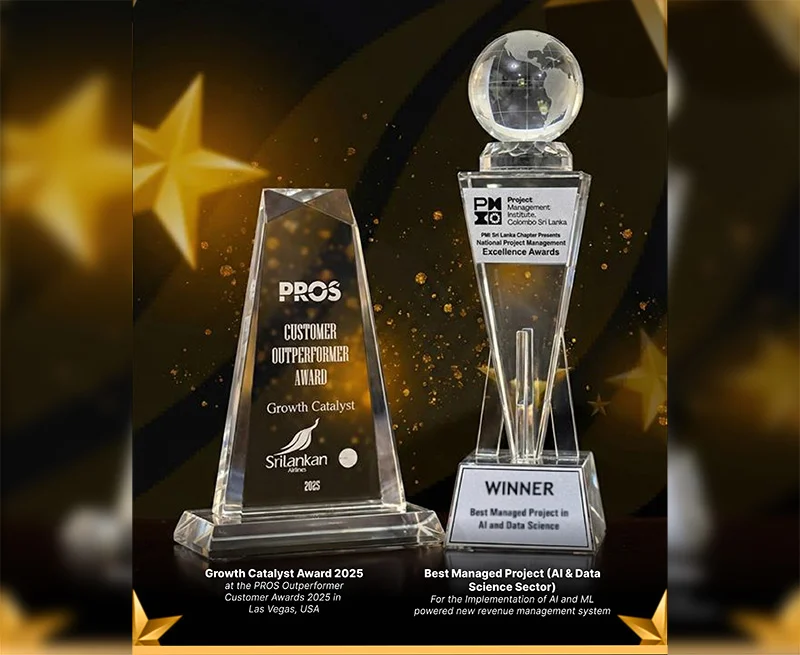
This initiative has not only enhanced SriLankan Airlines’ agility, scalability, and competitiveness in a dynamic global aviation market, but also strengthened collaboration between pricing, demand and flight analyst teams, earning two awards in the process. It was recognised with the Growth Catalyst Award at the Outperformer Customer Awards 2025 in Las Vegas by PROS, as well as the Silver Award in the AI and Data Science category at the National Project Management Excellence Awards 2025 in Colombo by the Project Management Institute Sri Lanka Chapter.
As SriLankan Airlines continues its modernisation journey, the new integrated revenue management platform will significantly improve SriLankan Airlines’ global market position, its ability to attract and retain high value connecting passengers, and competitiveness in the global aviation landscape.(SriLankan Airlines)
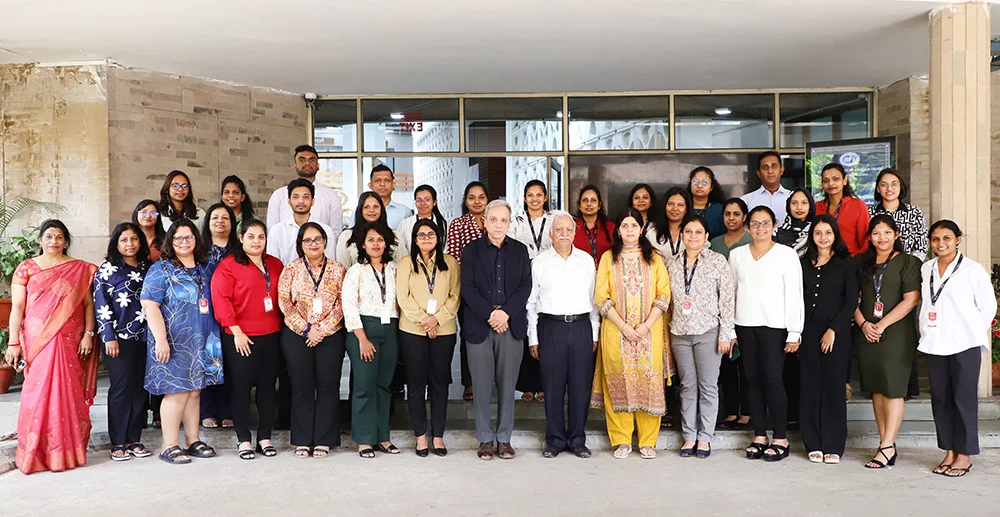
A delegation of 30 professionals from the Ceylon Chamber of Commerce recently completed a specialised residential training programme on International Trade Facilitation at the Indian Institute of Foreign Trade (IIFT) in New Delhi.
Hosted by the Indian Institute of Foreign Trade, a premier institution established under India’s Ministry of Commerce and widely regarded as a leading centre of excellence in international trade education and research, the programme also included engagements with several of India’s most prominent trade and diplomacy institutions. These included the Directorate General of Foreign Trade (DGFT), the government authority responsible for shaping and implementing India’s foreign trade policy; the Sushma Swaraj Institute of Foreign Service, the country’s premier training institution for diplomats; the Federation of Indian Export Organisations (FIEO), the apex body representing India’s exporting community; and the Confederation of Indian Industry (CII), one of India’s most influential industry associations. Together, these engagements offered participants valuable insights into how policy, diplomacy, and industry interact in a robust manner to facilitate trade and economic progress.
Over nine days, participants explored key aspects of global commerce, including the international trading system, trade negotiations, economic intelligence, trade finance, and emerging issues such as AI, cyber risk, and digital transformation.
The programme offered valuable insights into the evolving dynamics of international trade and the systems that support it, while highlighting ways in which chambers of commerce can further leverage their existing role in supporting businesses navigate global markets, contributing to policy discussions, and strengthen the broader trade ecosystem.
The programme was designed and overseen by Dr. Rohit Mehtani, Dean at IIFT and a widely respected expert in international trade diplomacy and negotiations, whose academic work and advisory experience have contributed to international trade discourse.

Vesak week from 27 May to 02 June
Free Tourist Visas for Passport Holders of 39 Countries
Implementation of the “Diviyata Saviyak” Housing Programme
Export of scrap metal required for domestic industry to be banned
National Climate and Nature-Positive Investment Fund to be eatablished
New Circular on admission of students to Grades 2 to 11, excluding Grades 5 and 6, in Schools to be issued

‘Dates have the highest sugar content to fight Coronavirus’

Sunday Island 27 December – Headlines

#SundayIsland 17th December – Headlines

Sunday Island – 28th March

Sunday Island Headlines – 21 March

Sunday Island – 21st February – Headlines
-

 News7 days ago
Senior citizens above 70 years to receive March allowances on Thursday (26)
-

 Features4 days ago
A World Order in Crisis: War, Power, and Resistance
-

 News5 days ago
Energy Minister indicted on corruption charges ahead of no-faith motion against him
-

 News6 days ago
US dodges question on AKD’s claim SL denied permission for military aircraft to land
-

 Business6 days ago
Dialog Unveils Dialog Play Mini with Netflix and Apple TV
-

 News7 days ago
CEB Engineers warn public to be prepared for power cuts after New Year
-

 Sports5 days ago
SLC to hold EGM in April
-
 Latest News5 days ago
A strong Technical and Vocational Education and Training (TVET) system equips individuals with practical, relevant, and future-oriented skills helping to innovate responsibly towards a greener and sustainable future – PM