
Opinion
Considerations for higher education reforms

Submitted by Udari Abeyasinghe, Farzana Haniffa, Ahilan Kadirgamar, Anushka Kahandagama, Ramya Kumar, Shamala Kumar, Hasini Lecamwasam, Kaushalya Perera, Aruni Samarakoon, Sivamohan Sumathy, Mahendran Thiruvarangan
Decades of underfunding have left our education system, overall, fractured and in urgent need of rebuilding. The virtual lack of public early childhood education, the years of neglected vocational training, and the scale of problems facing general education (widespread staff shortages, stark disparities in resources, among other things) mean that these subsectors demand immediate attention. Therefore, despite the opaqueness of the consultative process and questions we have about the content of the reforms, the ongoing action on reforming general education and vocational education by the Ministry of Education is a welcome move. No part of the system operates in isolation, however. Even if reforms focus on early, general, or vocational education, higher education must remain part of the conversation. Democratising higher education and making it accessible to a larger number of people will strengthen the entire education system. Such reforms have to be undertaken together with other actions through a consultative process. Waiting until other sectors are ‘in better shape’ will only deepen existing fragmentation.
What is needed is a comprehensive plan that serves all sectors of education and builds a more integrated system capable of addressing each subsector’s specific needs. Only then can we create an education system equipped to meet the challenges ahead. We are concerned that recent higher education reforms in Sri Lanka are emulating the market-based model that has failed elsewhere. One of the basic principles of our higher education system has been free education supported by the state, but of late this principle has been given to serious erosion. Successive governments have defunded our state university system–a lower-cost and more equitable model of tertiary education–while supporting the expansion of private higher education. Universities are compelled to function as businesses, generating their own funds. Inequalities in access are widening with university admissions increasingly favouring the privileged.
In an effort to contribute to the conversation on education taking place currently, we outline issues of concern and actions the government could take to strengthen the state university system.
* Funding state universities
Public spending on education (as a % of GDP) in Sri Lanka is among the lowest in the world. It is being increasingly replaced by project-based funds from external organisations, particularly the World Bank, compelling reforms modeled on market-friendly designs. Our universities must now generate funds, primarily through fees from postgraduate courses and international student enrollment. Students and their families are increasingly expected to spend on their undergraduate education, eroding the Free Education policy.
* Increase the budget allocation for state universities; halt the push toward self-generated funds.
* Halt the introduction of fee-levying undergraduate courses (e.g., School of Open Learning, University of Peradeniya; plans to enrol fee-levying medical students at University of Vavuniya).
* Curtail initiatives that subsidise private and foreign degrees. The rapid expansion of private and foreign degrees, often supported by state subsidies, including student loans, results in the extraction of resources from public education to support private interests.
* Critically examine and reduce reliance on project-based funding. The World Bank in particular uses funding initiatives to institute their agendas into our systems of education. Decades of such interventions have substantially transformed higher education.
* Democratising university administrations
University administration has become increasingly hierarchical, with authority filtering from the University Grants Commission (UGC) to Vice Chancellors and Deans. While administrative mandates insist on student friendly pedagogy that foster critical thinking, actual practices take away authority from the lower ranks of the academic community, importantly, the teacher. Power is increasingly vested in Vice Chancellors, Councils and the UGC, which does little to advance the cause of education, or the wellbeing of students and staff.
* A participatory and dialogue based governance model should be promoted by strengthening the authority of participatory bodies like Faculty Boards, Senates and Statutory Committees. Administrative bodies should be concerned largely with procedure and feasibility.
* Concerns regarding curriculum and curriculum revision need to be led by departments and faculties, and a greater degree of independence granted to the academic community in administrative matters.
* Improving fairness and transparency in appointments and recruitment
The recent decision to bring an end to political appointments in the non-academic staff cadre is welcome. However, the current system of making appointments to UGC committees, University Councils and other university/faculty level committees by government officials lacks transparency and is subject to manipulation. Committed academics and others who want to advance knowledge and have involvement in specific areas of interest may not make it to the relevant decision making forums. The schemes of recruitment of academic staff are outdated and often impede the recruitment of well-qualified candidates. There have been numerous reports highlighting the increasing politicisation of academic recruitment processes.
* Create transparent processes regarding higher level appointments to commissions and councils.
* Update the schemes of recruitment to reflect present-day realities of inter-disciplinary and multi-disciplinary training in order to recruit suitably qualified candidates.
* Ensure recruitment processes are made transparent by university administrations.
* Change bond regulations to be more just, in order to retain better qualified academics.
* Strengthening existing degree programmes
Out-migration of academics has created a dire shortage of university teachers. Degree programmes offered by peripheral universities have a dearth of staff. STEM programmes at state universities are well-supported as they are presumed to produce students with ‘marketable skills’ for the industry, while the social sciences and humanities (SSH) are given less priority despite their having the highest student intakes and serving the most underprivileged sections of society. Lecturers who work after hours and on weekends teaching in fee-levying courses are poorly compensated in certain disciplines.
* Remove the freeze on hires so that academic and other staff vacancies can be filled; increase academic cadre positions, especially in peripheral universities.
* Recruit adequate academic staff for ongoing programmes and implement minimum staff requirements to commence new programmes.
* Halt the trend of employing contracted workers, which leads to a work climate where there is no buildup of capacities and less commitment to scholarship, teaching and the institution.
* Ensure recruitment data, including student to staff ratios, are accessible for public scrutiny (they were accessible until 2022).
* Allocate funds to strengthen SSH.
* Reevaluate the emphasis on English-medium instruction in SSH, and approach the issue with greater sensitivity, keeping in mind the great inequalities any arbitrary decision may create. It is imperative that Sinhala and Tamil medium instruction is supported and well-funded.
* Strengthen English language instruction, without prioritising English medium education. Transition to English medium should take into consideration the availability of teachers and resources within the universities to help students improve their English language competency.
* Review payment structures of fee levying courses (graduate and undergraduate) that are run by departments. Remove the limits on compensation amounts for lecturers pressured to work after hours and on weekends.
* Promoting fairness in university admissions
Students attending university are not always prepared for tertiary education; they are compelled to select their subject stream at the Ordinary Level. There are wide disparities based on districts in admissions to certain courses. Once admitted, students pursuing STEM education do not have opportunities to explore the social sciences and humanities and vice versa.
* Institute a formal process of collaboration between secondary, tertiary and vocational education to streamline transitions between these types of education.
* Strengthen the district quota system to ensure equity of access to higher education. Ensure that the system reflects present-day demographic patterns and resource maldistribution.
* Support the development of pathways for interdisciplinary collaboration in degree programmes.
* Reviewing the quality assurance framework
Significant resources are channeled towards quality assurance activities. These activities take up much time and effort of academics, but it is unclear whether the quality of academic programmes at universities have improved as a result. Further, quality assurance processes are conducted in a top-down manner, with directives coming from the UGC with little flexibility for faculties and programmes to design their own procedures. The emphasis is on gathering ‘evidence’ with very little critical thinking on how to actually improve degree programmes.
* Review the quality assurance programme in place today and the extent and nature of its impact on curriculum development
* Revise it, so that it functions as a guide to a consultative process that supports the development of alternative approaches to quality assurance designed within universities and faculties and not as a restrictive monitoring mechanism.
* Include mechanisms of downward accountability to make universities answerable to students and local communities.
* Promoting research and scholarship
Owing to the emphasis on evaluations of research and publications that emphasise quantity, or numerically value quality, the research culture within state universities has changed. Researchers report various bottlenecks in receiving and using research funds, and various malpractices related to citation gaming can also be seen (e.g., badly reviewed journals, publishing in predatory journals, salami publications, etc.).
* Relax the bureaucracy related to the initiation of relationships with foreign research institutions and universities.
* Revise the national financial regulations and leave procedures that at present create bottlenecks for research collaborations and participation at international forums for academics.
* De-emphasise the commercialization of research which has led to a rise in instrumentalist research and the devaluing of social-justice oriented research in all fields, but especially the humanities and social sciences.
* Shift the emphasis from working towards improving state universities’ standing in global university rankings to promoting rigorous scholarship that is relevant to our setting.
* Creating open and inclusive universities
Interventions to rid university spaces of violence and harassment usually target the issue of ragging. There is less recognition of other forms of violence and the subculture of the university that breeds violence through its various hierarchies and exclusions. Violence cannot be expunged from the system in the absence of inclusive university spaces that encourage dialogue and discussion on these important issues.
* Create policies and bylaws that provide a course of action that supports and brings a measure of justice to victims. Strengthen existing grievance mechanisms in ways that ensure independence and protection of complainants and witnesses.
* Introduce basic codes of conduct across the university system for administrators, supervisors, academics and others.
* Implement the national language policy at all universities with regards to both teaching and administration and ensure that all communications from university administrations are conveyed in Sinhala, Tamil and English. The state should also ensure instruction in both Tamil and Sinhala of a similar standard and quality are available for students at all state universities.
* Support universities to explore opportunities to integrate social cohesion, gender sensitivity, and reconciliation through curricula and other forums. Prioritise and provide training opportunities for staff on the above issues. Support the introduction of opportunities for students to engage in political participation and democratic processes.
* Upholding academic freedom
Teachers and students should have the freedom to teach, study, pursue research without unreasonable interference or restriction. Media policies, job insecurities, policies for financing research and other university activities, usurpation of powers from lower-level authorities and committees by centralized authoritative command are some mechanisms which have had a stifling effect on academic freedom.
* Create an independent body at the national level that serves to protect academic freedom within universities and investigate attempts to thwart the exercise of academic freedom. This body could be similar to committees addressing violence and harassment complaints and quality concerns.
* Strengthening student services and promoting wellbeing
The recent increase in the Mahapola Scholarship disbursement is welcome. However, basic student welfare and support services are in a woeful state. Student intakes have increased without parallel investments in student residences and other facilities. Despite the rise in mental health problems among young people, there are no dedicated staff or facilities to support students who require additional support. Student counsellors and other academics need to juggle student welfare- duties with various other commitments.
* Allocate funds to build student residences across state universities and/or request universities to do so. Residences should include cooking facilities.
* Introduce policies to address the welfare of women students who are a growing proportion in most faculties, e.g., residential facilities, washrooms, sexual health facilities, etc.
* Allocate university cadres whose primary role will be in the area of student welfare, including professional counsellors, disability services, ombudspersons.

Opinion
Monument to H.C.P. Bell and Bell Party: Unsung Labour Force of Early Archaeological Surveys – II
by Lokubanda Tillakaratne
Nature of Bell Party work
Villagers and the headmen mostly provided information about these potential digging sites. Since the start of the archaeological projects, the Bell Party was probably the first to see our ancient monuments there, by the mileposts of history, frozen before disappearing, holding their last breath beneath the earth, for reasons known and unknown.
Sinhala Bell Party members often passed up digging out a Buddha statue for superstitious reasons and fear of yakkas believed to haunt (guard?) Buddhist ruins, statues, and ancient artifacts. But Bell found Tamil workers showed no such traits.
Often, a village muladeni, usually the arachchirala, joined a traveling Bell Party and came to the vadiya to help with excavations. Once, Korala of Kahatagasdigiliya came to the Bell’s vadiya at Konwewa to help. Muladeniya usually provided accouterments and food for the Bell Party at excavation sites within his weikkiya, jurisdiction.
Although they were no Archaeologists, Bell’s guidance led the Party men to push forward with sheer determination to rebuild and restore these ancient structures on stone stylobates, piece by piece, connecting them to the present.
Bell wrote that the Party’s work involved exploring “backwoods in the wildest and most inaccessible nooks and corners of Ceylon.” After thinning trees and brush, and general weeding and digging, they looked for evidence of statues, sculptured stone pillars, engravings, relief carvings, and inscriptions on rocks covering areas as big as Melville’s whale, paintings, ceramic material, coins, gems, seals, jewels, arms, tools, ornaments, lamps, and any item of antiquarian interest. The Party also helped Bell with archaeological conservation and epigraphical work.
Seeing a buried Buddha statue, restoring it to its former luster, and probably hearing its hummingbird heartbeat must have been like seeing the Buddha alive. How satisfying for the Party to see remnants of stone pillars they raised back to life as grand temples, in a lovely and telling shape?
But when sarong- and amuda-clad men dug up a serene Buddha statue or an ornamental moonstone, sandakadapahana, with relief figures of animals parading from horizon to horizon, Disney illustrators or Old Masters at the Louvre would have envied the chance to see such superb artistry.
The bulk of the work was done while Bell and other contractors stood around and directed. During rainy days, soggy earth made the Bell Party’s work difficult. They dug ditches to drain water from the swampy site and reach the submerged ruins. At Sigiriya, when they restored the pond, they first used a yotta, a long scoop hung on a crossbar, to remove water.
Drowned in a furry forest, unfrequented and alone, often weeks away from the civilisation, Bell, his assistants, and the Bell Party enjoyed untainted freedom. Bell once chimed to a friend about his independence. He wrote, “After all it is good to be Head Man, even in Hell!”
In a letter Bell wrote to the Colonial Secretary in the annexure to the Third Progress Report in 1890, he stressed the Bell Party’s struggles to excavate Buddhist Railings near Abhayagiriya. To begin excavations, the Party had to remove about 50 large weera trees, which took 10 days. The excavation then reached 10 ft wide and 3-4 ft deep to expose the base and recover scattered railing plinths, posts, and coping.
Raising the 7 ft. tall, sedentary Buddha statue at Pankuliya required 50 Bell Party members and 6 Europeans in 1892. Another Buddha statue, which Bell described as having “soft expression, symmetry and repose of the body,” … and “finest brought to light” at Toluwila between Anuradhapura Railway Station and the Nuwara Wewa bund, was 7.6 ft tall and 7 ft across, weighing like a large CAT excavator at a construction site.
Bell Party did all the lifting of this statue using wood beams the size of street lamp-posts and deer-skin ropes, waramadhu, and pulleys. It now adorns the entrance to the Colombo Museum. We must thank the Bell Party for this stunning representation of Sri Lankan history, literally at the doorstep of its repository.
When Bell had to read an inscription on a rock face 20ft above ground, the Party members climbed up the rock and built a hanging platform. One writer saw them crawling like cats on a sloping rock. At Ritigala, the Bell Party managed to get a rope across a deep crevice between two rocks for Bell to cross the chasm.
Some statues escaped Bell’s eye. I know one instance when villagers and the area arachchirala did not notify the authorities about archaeological items in their neighborhood. An example is the little-known 4 ft tall seated Buddha at Rame (රරාමේ) near Kahapathwilagama, my father’s village, described in Echoes of the Millstone (Lokubanda Tillakaratne, 2013). After a villager leading a herd of buffaloes stumbled upon it, the elders decided to keep it a secret for fear that Bell Mahattaya would take it as a museum piece. Meanwhile Toluwila villagers lost their Buddha statue which connected them to their long and proud history.
Travelling
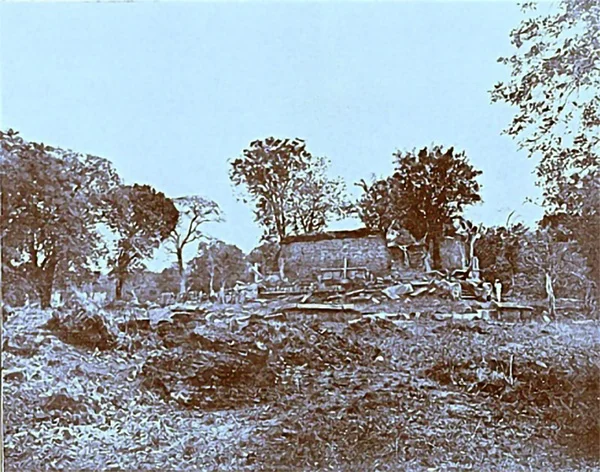
Watada Ge, Polonnaruwa (1907) before restoration (H.C.P. Bell)
The mode of transport of the Bell Party was unlike that of some storied migrants who crossed the North American continent in covered wagons in the 19th century. In their treks through scrub and thorn jungle, the Party had no street signs to follow. Mostly, the sun, moon, stars, and large and aging trees that witnessed the ruins in their better days fueled the men with a collective instinct to keep moving. While walking through the trackless forest, they often got lost. Then a Party member climbed a tree to retrace their route. Some days they walked 20 miles to reach a site.
Bell Party walked while Bell Mahattaya usually rode on a horse or a bullock cart on hastily cleared paths just enough for the yoke to proceed. When convenient, bullock carts owned by the Archaeological Department or loaned by a arachchirala transported supplies and equipment on these trips. On some days, an advance party of men carried supplies ahead on pack animals, while others followed a day later. Usually, a muladeni in the area was always there to help with logistics.
The Party carried tools, camping equipment like tarpaulin, cameras, pickaxes, mamoties, cooking supplies and utensils, and drinking water. In some instances, they were lucky to get water from a Pin-thaliya, a roadside pot of drinking water on a waist-high pedestal conveniently set up by villagers for travellers. These drinking pots also appeared on major roadways, reflecting the caring and sharing character of Sri Lankan people. In Remembered Yesterdays (1927), Maha Mudaliyar Solomon Dias Bandaranayake writes about the Pin-thaliya he set up on Kandy Road in front of his Horagolla residence in 1887 to commemorate the Queen Victoria Jubilee celebrations.
On long treks, when night fell, Bell slept on his tarpaulin shed, a gaman vadiya, erected by the Party on site or at a nearby village. Others in the Party just slept under the stars watching celestial streaming shows – shooting stars spilling out into the night sky. Often the dreary cry of Ula Lena, the mysterious nocturnal animal believed to be a lizard or a bird, woke them up sweating. There were times when Bell slept on an altar slab unearthed during the day.
Mosquitoes and other night critters serenaded the tired group. Walking through the rank forest involved encounters with caterpillars and other poison-skinned creatures swinging from silvery strands. One or two party members stood guard against quadruped thieves – bears, boars, and porcupines who would follow the smell of dry food men carried from a mile away. When they had to cross a swollen creek, they often felled a tree across the water to pass through. Finally, emerging from the dense woods, they reached an open villu, where a deafening hush stretched across its entire span. With a drying slough, which probably was an ancient river bed in the middle of the villu, it mimicked a half-ripen papaya half.
For comparison, let me describe how His Excellency the Governor Henry Ward went on circuits. In 1856, a little over three decades before the creation of the Bell Party, he took an extensive circuit covering nearly every big town from Polonnaruwa to Jaffna. His party consisted of 120 coolies, five elephants, 13 horses, and five tents. He stopped at Mihintale to telegraph Colombo to get his watch recalibrated.
Decades later, Bell out in Komarkiwala, in a large swath of uninhabited forest between Kahatagasdigiliya and Huruluwewa, had no such convenience keeping his chronograph in shape. He probably used his own sundial – his midday shadow – to adjust his watch as most did at the time.
Bell Party, accompanying their boss without the luxury of the governor, carried basic accouterments enough for weeks in the jungle to conduct excavations. It was quite a sight – Bell on a horse leading the Party along a tank bund overgrown with brush or crossing its bed as it too seemed to have been emaciated years ago.
A native leader led the way in the forest. The sight of bare-bodied men walking in a line through close-set jungle or along a footpath as shadows moved between dimmed forest patches on either side is easier to imagine than describe. Often they used buffalo tracks, or pushed forward in trackless wilderness, hanging twigs as markers to guide them back. They waded across swollen creeks and rivulets to these sites, passing areas of forest separating villages by leagues. These men are used to such walks. They have seen it all while on honey-collecting excursions in their spare time in miles of forest.
Writing in the The Island newspaper in 1987, A.T.G.A. Wickramasuriya revealed the hardship his father, P. Don Ambrose, based in Anuradhapura, endured in the early decades of the 20th century carrying the salaries of the Bell Party workers in Polonnaruwa, 100 km southeast. With a trunk full of money, Ambrose takes the morning train from Anuradhapura and transfers to the Kandy-Matale train at Polgahawela. From Matale he rode a Trincomalee-bound horse-drawn Mail Coach to Habarana. It is already midnight. From there, he hops on a bullock cart and arrives at Polonnaruwa at dawn, covering a cool 306 km, 24 hours after he started.
Sights and Scenes
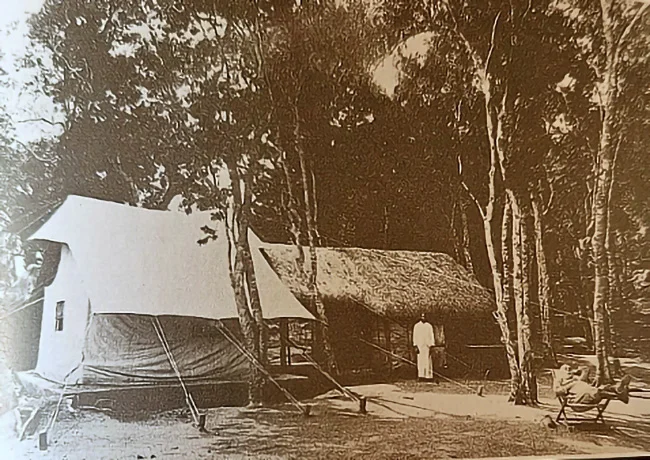
Bell camped out in a village (Bethia N, and Heather M Bell)
In every outing, the eyes of the Bell Party feasted on sights others see only decades later or never. They were the first to feel the touch of heavenly ladies marooned on a cave wall in Sigiriya, the most dangerous and demanding site the Bell Party worked. In contrast to this perilous adventure, Bell once wrote how Kaludiya Pokuna, a large black-water pool by the Mihintale hill, came into view before their eyes taking up a “delightful glen, as it suddenly bursts on the charmed gaze, entrancing in its quiet picturesqueness. A perfect sanctuary could not be found anywhere throughout the length and breadth of Ceylon. … Fringed by umbrageous trees, which dip their boughs in its placid depths, as hills offered inviting shade.” Bell then tweaked the 13th-century Indo-Persian poet Amir Kushrau: “Oh! If there be an Elysium on earth, it is this, it is this.”
But nothing matches an incident the Bell Party saw at Sigiriya in 1906, involving the Governor – the king’s representative and his Royal entourage. While the Governor and the Royal Duchess, sister-in-law of His Majesty, climbed down to the base of the Sigiriya rock ahead of others, the Bell Party was still on the top working on the ruins. Suddenly, the Governor’s daughter and the Bell Party workers saw over the precipice a bald man chasing and beating the princess with his hat. They were confused and alarmed.
Only later would they learn that the Governor was trying to protect the princess from an angry swarm of giant bees (bambaru) that descended and circled over her head. Probably, the workers at Sigiriya did a bad job of sedating the beehive with vedi dodan – a ball of leaves with various aromatic characteristics set on fire to burn slowly, generating smoke to sedate the bees.
A Monument for the Bell Party
A short essay like this does not do justice to memorialize the workers of the Bell Party. Far out where evidence of ancient settlements and structures existed, the work of this Party is a fond memory. In my village, it is not just a sobriquet, probably public knowledge of a valued tradition conferred from kings’ times.
Their story did not cross the pen of history and literary apostles in 19th- and 20th-century Sri Lanka because the Bell Party consisted of a bunch of coolies from distant villages. But they were the luckiest to find and raise the ancient monuments Sri Lankan kings fought wars to build and protect. Sadly, there isn’t even a lifeless fresco or a sign depicting their work beside the granite paneling near an ancient temple they reconstructed. The peaceful Toluwila Buddha sits at a museum entrance in Colombo over a hundred kilometers away from home, waiting to hear the names of the men and women of the Bell Party who helped it back to sit in its meditative state.
Although the collective pulsation of these men and women as they raised stone pillars and serene sages has become a welcoming breeze in the old city of Anuradhapura, kings standing arrayed in coronation ornaments, granite paneling reconnecting royal guard houses, and inscriptions on stone surfaces whispering elegancies of our past all thank the Bell Party for making all that a reality.
They worked with mechanics that would raise eyebrows among the Romans. Even with his passion, curiosity, and persistence, Bell would not have completed half of his pioneering work without Bell Party help.
We hardly find kings etching their names on these ancient structures they supervised building. In those days, they must have thought, rightly so, that it was a weird practice to engrave on a structure the name of the king, who I bet never got down to a mud pit to make a single brick. That’s probably why we don’t see King Kasyapa’s name anywhere near Sigiriya today.
The Bell Party stood by this ancient practice and did not scratch something as small as an initial on a brick they placed in mortar to reify an ancient wall. Until the Bell Party came around, history looked on as these great works fell into decay and those who built them remained nameless.
And yet.
The times have changed. The faddish trend now is to etch the names of the prominent few on a stone slab by a people- funded structure, rather than the actual workers who mixed concrete and set stones in place. Let it be known that none of this prominent few dropped something as a fistful of sand into the cement bucket to build it or offered a can of cold soda to a worker whenever they happened to pass by the site.
Therefore, to celebrate the group of exceptional Nuwarakalaviya villagers in the Bell Party, known on record as coolies, earth men, earth party, basket men, and warriors, and their headman, the incomparable H.C.P. Bell himself, I now request that the Archaeological Commissioner erect a 2 ft x 2 ft monument with appropriate wording celebrating their gracious contribution. It is the right thing to do, and not a bridge too far to cross.
Walk of Fame of Archaeological Survey
I cannot think of a better spot for this monument to go up than on what I call Sri Lanka’s Walk of Fame of Archaeological Survey – the cobblestone path connecting the Sri Maha Bodhi and the Ruwanweli Seya in the old city of Anuradhapura. Then present and future generations will know that a spirited group of labourers called the Bell Party worked to bring back the brilliance of our lost past. (Concluded).
The writer is the author of Pulse of the Jungle (Dayawansa Jayakody, 2000) and Ratashabhawa of Nuwarakalviya, grew up among several Bell Party members in Nuwarakalaviya.

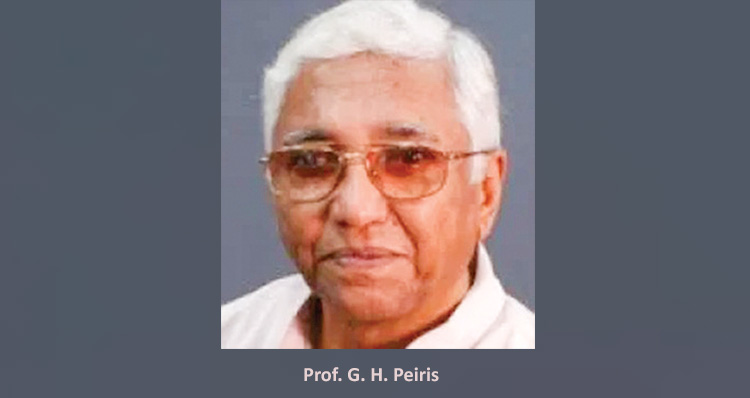
Prof. G. H. Peiris PhD, Emeritus Professor, University of Peradeniya, passed away on the 20th September 2026. His mortal remains were donated to the Anatomy Department, Faculty of Medicine, University of Peradeniya, according to his wishes. He was born on 30th January, 1938, in Junagaha, close to Negombo, and entered the University of Ceylon, at the age of 17 years. After obtaining a first class honours degree in Geography, the first to do so in the history of the University, he joined the staff of the Geography Department, Peradeniya University, and soon proceeded to Cambridge University to read for his doctorate.
Prof. Peiris excelled in academic work in teaching and research while serving the University for 43 long years. His research delved deeply into land reforms, economic and social change, irrigated agriculture, university education and ethnic conflict. He held visiting professorial appointments in Australia, Canada, the United States and Norway, and has undertaken sponsored study tours in the Philippines and the United States. His consultancy assignments include those conducted for the ILO, WHO and UNICEF. He has collaborated with scholars from India, Pakistan, Bangladesh, Nepal, Syria, the Netherlands and the United States in major research projects.
Based on his research, he debunked the homeland theory concocted by separatists.
Prof Peiris was appointed to the committee to draft a new constitution by the Gotabaya Rajapaksa government in 2020. He did not agree with the views of several members of the committee on the matter of federalism as a solution to the ethnic conflict. He held that the best solution would be devolution at the district level and consequently he submitted a dissenting report to the final draft constitution. In his extensive academic work and policy stances, such as his thesis Federalism and the ‘Federal Option’ for Sri Lanka, he argued that shifting from a unitary to a federal structure would not resolve ethnic tensions. Instead, he characterised federalism in the Sri Lankan context as an “absurdity,” given the island’s small geographic size.
He firmly contested the concept of a combined Northern and Eastern Province acting as a federal unit. He vocally opposed the “Traditional Tamil Homeland” hypothesis, arguing that merging these provinces, along ethnic lines, created severe risks to the country’s territorial integrity and ethnic harmony. Peiris maintained that supreme political power must be confined to the government.
After retirement, in 2003, Prof. Peiris authored and edited several major books focusing on socio-economic development, land policy, and ethnic conflict and these include; Sri Lanka: Challenges of the New Millennium (2006), Twilight of the Tigers: Peace Efforts and Power Struggles in Sri Lanka (2009), Political Conflict in South Asia (2013), Sri Lanka: Land Policy for Sustainable Development – To Strengthen the Struggle for Survival (2016/2017).
His book, in Sinhala, titled “Ganaduraka Sihivatana” (Memories of an Era of Darkness), a 307-page work, focuses heavily on the political history, ethnic conflicts, and peace efforts involving the Liberation Tigers of Tamil Eelam. In it, he draws from his extensive research career to provide a highly detailed critique of the LTTE’s secessionist campaigns, territorial claims, and the broader socio-political ramifications of the conflict in Sri Lanka.
Prof Peiris served as a member of the Council of the University of Peradeniya, from 2014 until he was appointed the Chancellor of the University in 2022, a post he held until 2025, when ill health forced him to step down. In the Council he consistently provided a mature viewpoint on many contentious issues and took up a balanced position that often helped the Council to arrive at an acceptable decision.
Prof. Peiris occupied the exalted seat of Chancellor of the University with much aplomb and dignity. It was so unfortunate that his tenure was cut short due to ill health.
He leaves his loving wife, Yasa, whom he had met in the University, a daughter, Indumathi, who is a Professor in Physiology in the Medical Faculty, Peradeniya, and a son, Manjula, who is a surgeon attached to the Department of Surgery, Faculty of Medicine Peradeniya. It gave him much happiness that his children and their spouses were all members of the academic staff of the University that he loved so much.
May he rest in peace!
Prof. N. A. de S. Amaratunga PhD, DSc, DLitt

An archetypal journey of life towards self-discovery
By Dr Siri Galhenage,
Psychiatrist [Retd]
The Odyssey is a narrative poem by Homer, the revered Greek poet of antiquity. Along with its forerunner, The Iliad, it is regarded as one of the foundational works of Western Literature. Both epics were transmitted for generations through the oral tradition by travelling bards before being committed to writing several centuries later. In 2026, it has received a major cinematic adaptation, and is currently being screened in theatres around the world. Written and directed by Christopher Nolan, the movie has a renowned ensemble cast including Matt Damon and Anne Hathaway, and is expected to top the charts this year.
The enduring interest in the Odyssey is reflected in its continuing reinterpretation across the arts and psychology. My interest in the epic is in the deeper meaning to the narrative – ‘the subterranean flow’ – which I have endeavoured to explore in light of the theoretical concepts developed by pioneer psychiatrists Sigmund Freud and Carl Jung, mainly the latter, while also appreciating the aesthetic dimensions of its cinematic presentation. My attempt, admittedly, is no road less travelled; yet each journey along it may reveal something new beneath the surface of the narrative!
Applicable Psychoanalytical Concepts
The psychoanalytical concepts developed by Freud and Jung concerning the structure and workings of the human mind are complex, but I shall restrict myself to outlining those aspects that are relevant to exploring the deeper meaning of the narrative in The Odyssey.
In psychoanalytical terms the human mind is divided into two domains – the conscious and the unconscious. Sigmund Freud’s structural model of the psyche was primarily applied to the individual. It consists of the ‘personal unconscious’, which harbours experiences that have been repressed or kept beneath the ‘conscious’ level.
In contrast, Carl Jung, Freud’s junior colleague, conceived the idea of a ‘collective unconscious’ as a deeper and a universal layer of the psyche shared by humanity as a whole. It contains innate patterns of psychological experience, which Jung called archetypes. An archetype may therefore be understood as an underlying psychic pattern or predisposition. In a narrative, such a pattern may appear in the form of a character, theme, image or symbol that becomes recognisable to consciousness. It is capable of presenting in different cultures and historical periods. What we encounter in a narrative, therefore, are archetypal manifestations rather than the archetype itself.
The Narrative
The Odyssey is a mythical tale; its setting and characters probably would have been familiar to the original Greek audience. A modern day audience, however, may find it ludicrous!
It is the story of Odysseus, King of Ithaca, and his struggle to return home after the victory at Troy, longing to be united with his wife, Penelope, and son, Telemachus. Meanwhile, in Ithaca, Penelope is besieged by a group of conceited suitors who pressure her to remarry, assuming that Odysseus is dead. Telemachus, now grown up, sets out in search of news of his father.
Odysseus embarks on a perilous journey across the Mediterranean Sea with his fellow soldiers, but his homeward voyage becomes a ten year ordeal as he encounters not only the forces of nature but also an array of hostile gods and mythical creatures.
The journey had a calamitous start with a raid on the Cicones at Ismarus where Odysseus loses many of his men. Soon afterwards, storms drive them to the land of the Lotus-Eaters, where some of his crew consume the intoxicating lotus and lose all desire to return home.
Odysseus rouses his men from their lethargy and moves on to confront the Cyclops, particularly the gigantic Polyphemus, son of the sea god Poseidon. Odysseus blinds Polyphemus who is blocking the cave they were trapped in, and escapes by clinging beneath a flock of sheep. It provokes the enduring wrath of Poseidon, god of the sea.
As the fleet sailed on, lost across the vast seas, Aeolus, keeper of the winds, gives Odysseus a bag of winds that might carry them home. While Odysseus sleeps, however, his suspicious crew opens the bag, believing it contains treasure. The released winds drive the ship away from their planned direction.
They next encounter the Laestrygonians, a race of gigantic cannibals who destroy most of the fleet. Odysseus escapes, but grimly continues his voyage.
He then reaches the island of Circe, where the powerful enchantress transforms some of his men into swine, who indulge in gluttony. Odysseus overcomes her spell, and Circe becomes his ally. At her direction, he consults the prophet Tiresias in the Underworld, who warns him about the continued hostility of Poseidon and advises him to refrain from harming the sacred cattle of the sun god Helios.
Returning to the sea, Odysseus encounters the Sirens, who use alluring sounds to lure sailors to their deaths. Forewarned by Circe, he orders his men to plug their ears with wax and bind him tightly to the mast so that he can hear their songs without steering the ship towards them.
He then navigates between Scylla, a six-headed sea monster, and Charybdis, a terrifying whirlpool. Choosing the lesser danger, he loses six of his men to Scylla. The incident becomes one of the most painful episodes of his journey.
With the surviving crew, Odysseus reaches the island of Thrinacia, where his starving men slaughter the sacred cattle of Helios, against the wishes of the prophet Tiresias, while he is asleep. In response to Helios’s demand, Zeus destroys their ship with a thunderbolt, killing all the men except Odysseus.
Odysseus is subsequently washed ashore on the island of Ogygia, where the nymph Calypso keeps him captive because she loves him. She commands the waves to wash him back to shore, each time he tries to make a raft and sail to sea. Odysseus turns down her offer to make him immortal if he remains with her. He longs to return home. At the command of Zeus, the God of the Heavens, Calypso eventually releases him, and Odysseus sets sail once more.
Angered by the release, Poseidon, the god of the seas, summons the winds and smashes Odysseus’s raft. Thrown overboard, an exhausted Odysseus manages to swim ashore in the land of the Phaeacians, a peaceful people living in relative isolation. With the help of Athena, the goddess of wisdom, he is brought before their king and queen. Moved by his story, they offer him hospitality and provide him with a ship, which finally carries him safely to Ithaca.
In Ithaca, Penelope has been besieged by numerous suitors, who have consumed his wealth and assumed that he was dead. With the help of Athena, he disguises himself as a beggar and secretly returns to his palace. Penelope meanwhile remains faithful to Odysseus, and has devised strategies to postpone remarriage. She announces that she will marry the man who can string Odysseus’s great bow and shoot an arrow through a series of axe-heads. None of the suitors succeeds. The disguised Odysseus effortlessly strings the bow and reveals his identity. With Telemachus and a few loyal servants, he kills the suitors and restores order to his household and reunites with Penelope.
Exploration of the ‘Subterranean Flow’ of the Narrative
Derived from the Greek root odussia, the word odyssey has entered the English language, meaning ‘long adventurous journey’ while, interestingly, some linguists argue that it is also linked to the word odyne meaning ‘pain and suffering, distress or consuming grief’.
The Odyssey can be understood as more than an adventure story. It is an archetype of the journey through life itself: departure, ordeal, wandering, self-discovery and return.
The narrative embodies three archetypal elements – a character [a hero], a theme [his journey] and a symbolic destination [home]
The character of Odysseus represents a pattern of struggle, confrontation with danger and transformation. He emerges as the archetypal ‘hero’, fighting the Trojan War to secure the release of Helen, who has been taken from her husband, Menelaus, the king of the allied nation of Sparta. Helen came to be known as ‘Helen of Troy’, an enduring archetypal image of feminine beauty. The war was brought to a dramatic conclusion by Odysseus’s ingenious stratagem: he and his men concealed themselves inside a giant wooden horse which was brought into Troy enabling them to launch a surprise attack. The ‘Trojan Horse’ has since become a lasting allegory for deception and cunning.
Odysseus is characterised as a ‘hero’, not only due to his military prowess, but also to the courage, resourcefulness and perseverance he displays throughout his archetypal journey home. Tested by forces both external and within, he endures suffering, confronts his limitations and undergoes a process of transformation before finding his way home.
He encounters storms, monsters, seductive enchantresses, intoxicating flora [lotuses: the ‘lotus eaters’ becoming an allegory for Indulgence in idle pleasure], enthralling music and the supernatural world – a realm divided between forces that protect, obstruct, tempt and test him. Yet his journey is not without errors of judgement or disagreement with his fellow crew members, and he must face the consequences of his actions, and most poignantly, the loss of his companions. His greatest challenge, however, is not merely survival, but the preservation of his identity and sense of purpose. He must resist the temptations that threaten to keep him from home, recognise the limits of his own pride and ingenuity, and ultimately learn the value of humility. The theme represents, in varying degree, a recurring pattern or journey of human experience, transformation and self-discovery, beyond its literary presentation.
Ithaca becomes not merely a geographical destination but an archetypal ‘home’, a symbol of selfhood, continuity and the restoration of order after chaos and suffering. One must not overlook the crucial role played by Penelope in preserving the home, enduring her own trials, sustaining the household and preserving its continuity against overwhelming odds.
In essence, the archetypal pattern beneath the narrative in Homer’s Odyssey is the human journey home – through danger, temptation, loss and transformation – towards identity, belonging and restoration.
Conclusion
A good piece of Art – literary or cinematic – much like Psychology, seeks to illuminate the complexities of human experience. In this regard, The Odyssey can be seen as a timeless metaphor for the human journey – the difficulties, hardships, setbacks and emotional challenges that people inevitably encounter throughout their lives: the trials and tribulations that may alter the course of a life. Such trials are not merely tests of character in the face of suffering but, more importantly, they may serve as opportunities for self-discovery, growth and transformation.
As Carl Jung, the renowned psychiatrist, postulated, much of this experience is rooted in the ‘collective unconscious’, a deeper layer of the psyche beneath conscious thought and individual experience. It is perhaps this deeper, often unspoken dimension of our shared humanity that enables The Odyssey to transcend its ancient origins and continue to resonate universally, across cultures and generations.
[sirigalhenage@gmail.com]

Establishment of an Institutional Framework to Inagurate Upper Hydro Catchment Areas Management Authority
Introduction of Flora and Fauna (Regulation of actions of the Indigenous Community within the nominated areas) Regulations
M. M. D. J. Senarathne, appointed Director General of the Department of National Botanical Gardens

Harmanpreet Kaur steps down as India captain

Turkiye, Pakistan agree Saudi Arabia military deployment under Mecca pact

Rumesh Tharanga among nominees announced for World Athlete of the Year 2026

‘Dates have the highest sugar content to fight Coronavirus’

Sunday Island 27 December – Headlines

#SundayIsland 17th December – Headlines

Sunday Island – 28th March

Sunday Island Headlines – 21 March

Sunday Island – 21st February – Headlines
-

 Latest News7 days ago
Gold winner Tharanga gets brand-new Honda Vezel from SLAAJ
-

 News6 days ago
US-assisted ‘Ice’ detection: NPC to examine IGP’s move to transfer drug-busting team
-

 Features7 days ago
Why Sri Lanka needs an Inclusive Civic Nationalism – urgently
-

 Editorial5 days ago
Colombo Port drug bust: The plot thickens
-

 News7 days ago
Civil society activist accuses govt. of favouring Ven. Gnanasara
-
 Midweek Review7 days ago
Dappula’s Easter Sunday ‘grand conspiracy’ claim demolished
-

 Editorial7 days ago
When crime bosses rise above law and shrines
-
Editorial6 days ago
Drug busting, transfers and trust deficit