
Business
ComBank wins 6 awards at Asian Banking and Finance Awards in Singapore


The Commercial Bank of Ceylon won a remarkable six awards presented in three separate segments recently by Asian Banking and Finance (ABF) at a single event in Singapore – the 2024 edition of the magazine’s annual awards ceremony.
Commercial Bank won two awards in each of the three segments – the ABF Retail Banking Awards, the ABF Corporate & Investment Awards, and the ABF Fintech awards, demonstrating its versatility in different spheres of banking and finance.
The Bank received the awards for ‘Digital Consumer Banking Initiative of the Year’ and ‘SME Bank of the Year’ in the Retail Banking Awards segment; the awards for ‘Corporate Client Initiative of the Year’ and ‘Debt Deal of the Year’ in the Corporate & Investment Awards segment; and the Ecosystem Collaboration Award and Payments Solution Award in the Fintech Awards segment.
ABF’s Digital Consumer Banking Initiative of the Year award was won by ComBank Digital, Commercial Bank’s flagship digital product, and Sri Lanka’s most-used digital banking platform. The award recognizes the introduction of more than 10 new features in 2023, a strategic initiative to place Digital Services Associates (DSAs) at branches to promote digital products and the growth achieved, with app downloads more than doubling over two years, transactions growing more than three-fold in that time and transaction values growing more than five-fold.
The SME Bank of the Year award acknowledges Commercial Bank’s status as the largest lender to the SME sector in Sri Lanka as well as the numerous initiatives launched by the Bank to engage with and empower entrepreneurs with the knowledge and access they need to grow their business and to facilitate their transition to digital platforms and reach international markets.
The Corporate Client Initiative of the Year award was won by Commercial Bank for its ‘Treasury FX Portal’ – a pioneering initiative aimed at modernizing and digitizing foreign exchange rate requests. The Treasury FX Portal serves as a real-time web interface, empowering branches and departments to request preferential rates efficiently. This innovative solution has replaced the traditional manual processes of phone calls and emails, offering a seamless and user-friendly platform for initiating FX transactions.
Meanwhile, the Debt Deal of the Year award was presented to the Bank’s Rs 12 billion listed Basel III compliant Debenture Issue of December 2023, which was the largest sum raised through the public markets for listed Debt instruments in 2023.
The Ecosystem Collaboration Award was won for Commercial Bank LEAP GlobalLinker, a digital business ecosystem designed for small and medium-sized enterprises (SMEs). This initiative, developed through a partnership with GlobalLinker and guided by advisory support from the International Finance Corporation (IFC), aims to bolster SMEs by offering a dynamic platform at zero cost. At the end of the first quarter of 2024, the platform had 9,560 SME customers, 1,774 trading customers, 817 Women SME customers and 773 eStores.
The Payments Solution Award was presented to RemitPlus, Commercial Bank’s innovative, cost-effective, and real-time online money transfer service. With a vast network of agents across 130 countries, RemitPlus enables transparent, secure, and efficient remittances for expatriates, demonstrating the Bank’s commitment to financial inclusion, customer satisfaction, and economic contribution.
Sri Lanka’s first 100% carbon neutral bank, Commercial Bank is the largest private sector bank in Sri Lanka and the first Sri Lankan bank to be listed among the Top 1000 Banks of the World. The Bank is the largest lender to Sri Lanka’s SME sector, and is a leader in digital innovation in the country’s Banking sector. Commercial Bank operates a strategically-located network of branches and 966 automated machines island-wide, and has the widest international footprint among Sri Lankan Banks, with 20 outlets in Bangladesh, a Microfinance company in Nay Pyi Taw, Myanmar, and a fully-fledged Tier I Bank with a majority stake in the Maldives.


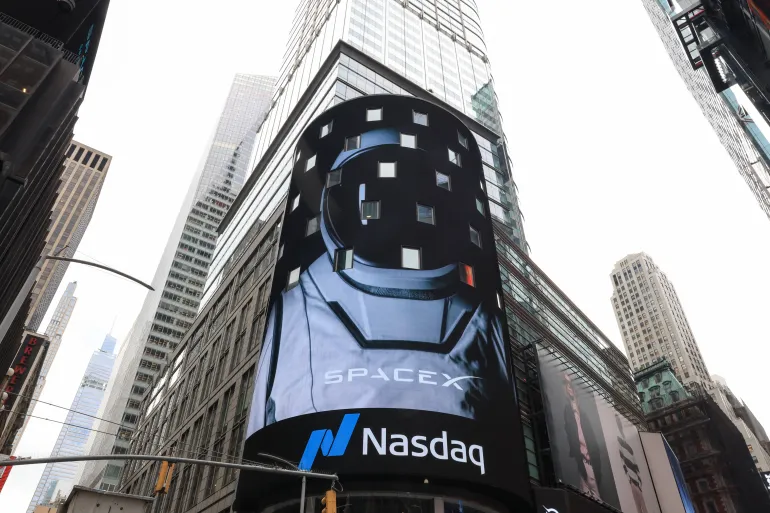
SpaceX has debuted on US markets with a market valuation of more than $2 trillion, minting CEO Elon Musk as the world’s first trillionaire.
Shares opened on Friday at $150 per share, marking a 11 percent increase from the initial public offering (IPO) price of $135, valuing the company at $1.96 trillion and putting the aerospace company on track to become the sixth-largest company in the United States.
The stock surged 18 percent to $159 per share, up from the $135 it had been priced at, as the trading day came to a close.
Markets more broadly ticked higher amid a possible interim peace deal between the United States and Iran that could open the Strait of Hormuz. The Dow Jones Industrial Average is up 0.6 percent, the Nasdaq is up 0.2 percent, and the S&P 500 is up 0.35 percent as trading wraps up for the week.
The company sold $75bn in shares, immediately valuing it at $1.77 trillion. The IPO was oversubscribed four times higher than was otherwise expected, according to the Reuters news agency.
Of the institutional investors allocated, according to Bloomberg News, as much as 70 percent went to what are called long-only investments — a strategy in which holders buy assets based on the expectation that their value will grow over time — and sovereign wealth funds, including those from Saudi Arabia and Kuwait as well.
SpaceX President Gwynne Shotwell and Chief Financial Officer Bret Johnsen rang the opening bell at Nasdaq MarketSite in New York City at 9:30am local time as US markets opened.
On Thursday, protesters gathered outside the MarketSite to protest the IPO amid continued allegations that Grok, part of xAI, a subsidiary of SpaceX, allowed users to create non-consensual deepfake sexualised images before the IPO debut.
Shares of SpaceX did not trade until the middle of the trading day as the exchange collected buy and sell orders and underwriters delayed trading until supply and demand were balanced.
“We would expect SpaceX to see an immediate pop in trading due to the hype around the deal, north of 20 percent perhaps,” said Samuel Kerr, global head of equity capital markets at Mergermarket. “Anything lower would actually make me nervous.”
Exchanges and trading firms are eager to avoid the technical mishaps that marred Meta’s 2012 debut. With SpaceX widely viewed as a dress rehearsal for a new generation of mega-listings, market participants will also be watching for signals on investor appetite in advance of forthcoming IPOs for AI heavyweights Anthropic and OpenAI.
The landmark listing cemented Musk’s status as the first trillionaire ever and propelled SpaceX into the ranks of the world’s most valuable companies — even though the firm posted a loss of nearly $5bn last year and generated only a fraction of the revenue brought in by similarly valued tech giants.
The surge comes amid growth driven by its Starlink subsidiary, which drives as much as 80 percent of its revenue.
On Friday, SpaceX launched its Falcon 9 rocket with 29 satellites into space from Cape Canaveral in Florida.
[Aljazeera]
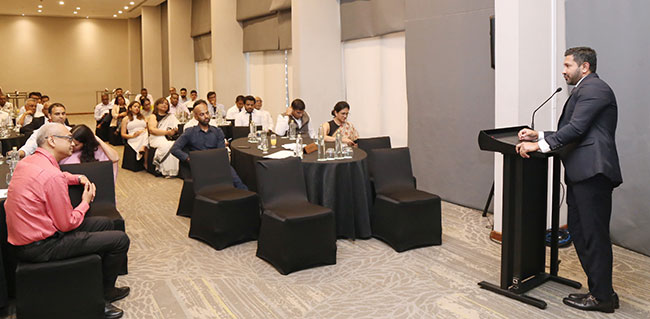
The Indo-Lanka Chamber of Commerce & Industry (ILCCI), affiliated to The Ceylon Chamber of Commerce, hosted an interactive session on Sri Lanka’s Investment Future: Policy, Opportunity & Growth at Jetwing Colombo Seven. The session was attended by Dr. Satyanjal Pandey as Chief Guest, while Aritha Wickramasinghe delivered the keynote address in his capacity as Chief of Staff to the Office of the Presidential Special Envoy on Foreign Investment, Hanif Yusoof.
ILCCI President M. Raghuraman, in his remarks, expressed appreciation to Dr. Pandey for his service during his tenure in Sri Lanka and underscored the timeliness and importance of the session topic in the context of the current global economic and geopolitical climate.
Addressing the gathering, Dr. Pandey observed that in a period marked by geopolitical and economic turbulence – reliability, trustworthiness, and secure supply chains have become increasingly important. He also highlighted the strong and growing economic partnership between India and Sri Lanka, noting several significant Indian investments in Sri Lanka, including those by ITC Limited and CEAT Limited, while indicating that further investments are expected in the future.
As a representative of the state, Aritha Wickramasinghe stated that it is the responsibility of the government to ensure that, even amid global turbulence, Sri Lanka remains stable in its policy direction, credible in its economic management, and consistent in its engagement with investors. He also emphasised the opportunities available to the Sri Lankan economy through deeper engagement with India’s fast-growing economy, noting that while India and Sri Lanka are neighbours, the relationship is regarded as one of family rather than mere proximity.
The session which included a highly engaging and interactive Q&A session with the audience, concluded with a productive exchange of views between the distinguished guests, speakers and participants, reaffirming the importance of continued dialogue and collaboration in strengthening investment and economic ties between Sri Lanka and India.
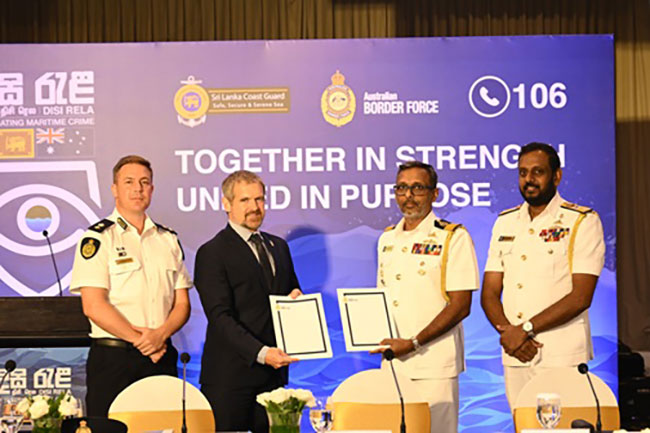
The Australian Border Force and Sri Lanka Coast Guard have launched Disi Rela 2026, marking the third consecutive year of the joint maritime security initiative aimed at strengthening maritime surveillance, operational capability, and public awareness across Sri Lanka’s coastal regions.
This year, Disi Rela 2026 expands its community engagement and public awareness activities to Sri Lanka’s Eastern Province, following successful activations conducted in the Western and Southern Provinces in previous years.
Meaning “keeping a watchful eye over the maritime environment,” Disi Rela reflects the continued partnership between Australia and Sri Lanka to strengthen maritime security, combat transnational maritime crime, and promote safer seas across the region. Through intelligence sharing, operational cooperation, advanced equipment support, and public awareness initiatives, both countries continue to work together to address threats including people smuggling, drug trafficking, illegal fishing, and other unlawful maritime activities.
Over the past three years, the Australian Government has supported Sri Lanka’s maritime security efforts under the Disi Rela initiative through the donation of 24 surveillance drones, three all-terrain vehicles (ATVs), three Stabicraft patrol vessels, and the establishment of a dedicated 24/7 hotline number — 106.
Further strengthening Sri Lanka Coast Guard’s operational capability, the Australian Government will donate an additional five all-terrain vehicles (ATVs) under Disi Rela 2026 to support coastal surveillance and rapid response operations.
In reflecting upon the continued partnership and shared commitment of both nations to safeguard Sri Lanka’s maritime boundaries and coastal communities, the Director General of the Sri Lanka Coast Guard,

Special Dengue Prevention Week declared in Colombo District from June 15 to 21

The leader of the indigenous Vedda community Uru Warige Wannila Aththo Meets Prime Minister Dr. Harini Amarasuriya

SpaceX IPO debuts in US markets, Musk becomes world’s first trillionaire

Fans on concourses instead of in seats, claims FIFA

Co-hosts Canada begin 2026 World Cup campaign with a draw against Bosnia-Herzegovina.

Showers will occur at times in the Western, Sabaragamuwa and North-western provinces and in Galle, Matara, Kandy and Nuwara-Eliya districts

‘Dates have the highest sugar content to fight Coronavirus’

Sunday Island 27 December – Headlines

#SundayIsland 17th December – Headlines

Sunday Island – 28th March

Sunday Island Headlines – 21 March

Sunday Island – 21st February – Headlines
-

 News6 days ago
Women’s T20 World Cup 2026 warm-up: Chamari Athapaththu’s 94 helps Sri Lanka beat Pakistan
-

 News6 days ago
Lankan-Canadian inducted to Toronto Sports Hall of Fame
-

 Editorial5 days ago
Probe Sallay’s complaint
-
 News3 days ago
Local firms move millions of dollars overseas for phantom imports: Govt.
-

 Editorial6 days ago
Prez in the dock
-

 Features6 days ago
Entering MIT for my Ph.D program, coping with harsh Boston winter and breasting the tape
-
 Midweek Review3 days ago
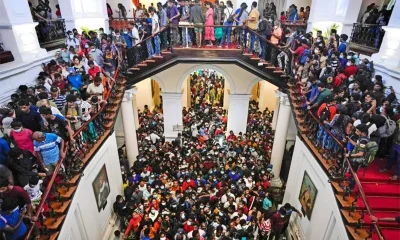
July 09: An inexcusable overall security failure and exceptional contingency plan
-

 Opinion4 days ago
Could Sri Lanka once again face an economic crisis similar to 2022?