
Business
Indo-Lanka Chamber hosts dialogue on Sri Lanka’s investment future

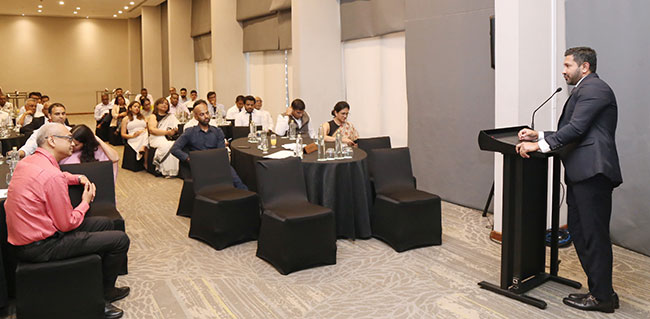
The Indo-Lanka Chamber of Commerce & Industry (ILCCI), affiliated to The Ceylon Chamber of Commerce, hosted an interactive session on Sri Lanka’s Investment Future: Policy, Opportunity & Growth at Jetwing Colombo Seven. The session was attended by Dr. Satyanjal Pandey as Chief Guest, while Aritha Wickramasinghe delivered the keynote address in his capacity as Chief of Staff to the Office of the Presidential Special Envoy on Foreign Investment, Hanif Yusoof.
ILCCI President M. Raghuraman, in his remarks, expressed appreciation to Dr. Pandey for his service during his tenure in Sri Lanka and underscored the timeliness and importance of the session topic in the context of the current global economic and geopolitical climate.
Addressing the gathering, Dr. Pandey observed that in a period marked by geopolitical and economic turbulence – reliability, trustworthiness, and secure supply chains have become increasingly important. He also highlighted the strong and growing economic partnership between India and Sri Lanka, noting several significant Indian investments in Sri Lanka, including those by ITC Limited and CEAT Limited, while indicating that further investments are expected in the future.
As a representative of the state, Aritha Wickramasinghe stated that it is the responsibility of the government to ensure that, even amid global turbulence, Sri Lanka remains stable in its policy direction, credible in its economic management, and consistent in its engagement with investors. He also emphasised the opportunities available to the Sri Lankan economy through deeper engagement with India’s fast-growing economy, noting that while India and Sri Lanka are neighbours, the relationship is regarded as one of family rather than mere proximity.
The session which included a highly engaging and interactive Q&A session with the audience, concluded with a productive exchange of views between the distinguished guests, speakers and participants, reaffirming the importance of continued dialogue and collaboration in strengthening investment and economic ties between Sri Lanka and India.

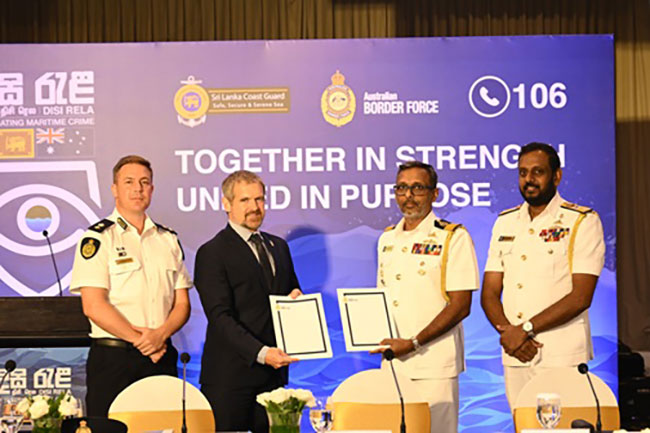
The Australian Border Force and Sri Lanka Coast Guard have launched Disi Rela 2026, marking the third consecutive year of the joint maritime security initiative aimed at strengthening maritime surveillance, operational capability, and public awareness across Sri Lanka’s coastal regions.
This year, Disi Rela 2026 expands its community engagement and public awareness activities to Sri Lanka’s Eastern Province, following successful activations conducted in the Western and Southern Provinces in previous years.
Meaning “keeping a watchful eye over the maritime environment,” Disi Rela reflects the continued partnership between Australia and Sri Lanka to strengthen maritime security, combat transnational maritime crime, and promote safer seas across the region. Through intelligence sharing, operational cooperation, advanced equipment support, and public awareness initiatives, both countries continue to work together to address threats including people smuggling, drug trafficking, illegal fishing, and other unlawful maritime activities.
Over the past three years, the Australian Government has supported Sri Lanka’s maritime security efforts under the Disi Rela initiative through the donation of 24 surveillance drones, three all-terrain vehicles (ATVs), three Stabicraft patrol vessels, and the establishment of a dedicated 24/7 hotline number — 106.
Further strengthening Sri Lanka Coast Guard’s operational capability, the Australian Government will donate an additional five all-terrain vehicles (ATVs) under Disi Rela 2026 to support coastal surveillance and rapid response operations.
In reflecting upon the continued partnership and shared commitment of both nations to safeguard Sri Lanka’s maritime boundaries and coastal communities, the Director General of the Sri Lanka Coast Guard,

The Sri Lanka Chamber of Small and Medium Industries (SLCSMI) and the National Chamber of Commerce of Sri Lanka (NCCSL) have jointly announced the National SME Revival Programme, a forum dedicated to identifying practical challenges, opportunities, and strategic pathways for the growth and sustainability of micro, small, and medium enterprises (MSMEs) across Sri Lanka.
The programme is scheduled for 16th June 2026 from 2.00 p.m. to 5.00 p.m., at the Auditorium of the National Chamber of Commerce, 450, D. R. Wijewardena Mawatha, Colombo 10. The forum will bring together MSMEs from diverse sectors and regions to engage in substantive dialogue on competitiveness, sustainability, and their contributions to the national economy, both locally and in global markets.
The programme will feature two eminent guest speakers who bring deep expertise in economics, business strategy, and financial management: Talal Rafi is an Economist; Former Consultant to the Asian Development Bank and the European Union; Former Director, Ernst & Young. Rafi brings extensive international experience in economic policy and development finance, having advised leading multilateral institutions on growth and reform initiatives. Chaaminda Kumarasiri is a Senior Chartered Accountant, Management Consultant, and Business Advisor. Kumarasiri is a distinguished professional with a strong track record in financial management and strategic advisory services for businesses across multiple sectors.
The initiative reflects a shared commitment by both organisations to support Sri Lanka’s SME sector, which forms the backbone of the national economy. Interested participants are encouraged to reach out to +94 762 555707/ 11 4741788 (Nishanthi) or +94 77 4586940 (Gerard).

Sri Lanka’s decision to phase out oil palm cultivation has been shaped by perception rather than policy. At the center of the debate lies a powerful claim: that oil palm poses a significant threat to biodiversity and the environment. Scientific evidence however, suggests the contrary.
The current footprint of oil palm in Sri Lanka is relatively small – around 11,000 hectares and has largely been established through the conversion of rubber lands rather than forests. This distinction is critical. Unlike major oil palm-producing countries where forest clearing has driven expansion, Sri Lanka’s context is fundamentally different. The biodiversity implications of converting rubber to oil palm are not equivalent to those of deforestation-driven plantation expansion.
A landscape already transformed
Sri Lanka’s biodiversity narrative cannot be separated from its long history of land-use change. From the hydraulic civilization era to colonial plantation expansion, forests have been systematically cleared and re-purposed for agriculture. Today, tea, rubber and coconut plantations together occupy nearly 800,000 hectares, all originally carved out of forested landscapes.
Large-scale development projects such as the Mahaweli Scheme have also contributed to continued clearing of forest. Against this backdrop, oil palm represents a relatively recent and limited land use change, in a landscape that has already undergone profound ecological transformation.
This raises an important question: is oil palm uniquely responsible for biodiversity loss, or is it being evaluated in isolation from the broader history of land-use change?
Understanding biodiversity beyond perception
Biodiversity is not a static concept. It encompasses genetic, species and ecosystem diversity, all of which are shaped by both natural and human influences. Every land-use system, whether forest or plantation, supports some form of biodiversity, though the composition and complexity differ significantly.
Forests, with their multi-layered structures, naturally support the highest levels of biodiversity. In contrast, plantation systems whether tea, rubber, coconut or oil palm represent simplified ecosystems.
The argument that oil palm plantations or any agricultural plantation for that matter, supports lower biodiversity than primary forests is undisputed in ecology.
Only a few comparative studies have been done in Sri Lanka on biodiversity associated with different plantation crops. These studies indicate that differences among plantation types are often less pronounced than commonly assumed. Species assemblages in oil palm, rubber and tea plantations tend to be broadly similar, dominated by common species rather than rare or endemic ones.
In this context, converting one plantation crop to another does not result in dramatic biodiversity shifts, particularly when the original land use is already a managed agricultural system rather than a natural forest.
What the data actually shows
Forest ecosystems consistently outperform all plantation systems in terms of species richness, density and conservation value. This is unsurprising given their structural complexity. However, when comparing plantation crops, oil palm does not emerge as a clear outlier in terms of ecological harm.
Oil palm plantations have demonstrated comparable or even higher levels of certain biodiversity indicators relative to other crops. For example, studies on leaf litter fauna show that oil palm can support higher densities of such organisms than tea, and similar levels to rubber.
Additionally, the unique architecture of oil palm trees creates microhabitats that support above-ground and below-ground biodiversity. The accumulation of organic material in frond axils forms “suspended soils,” which host diverse communities of microorganisms and small fauna, an ecological feature not commonly observed in other plantation systems.
These findings negate the notion that oil palm is inherently more damaging than alternative plantation crops.
The role of management practices
Biodiversity outcomes are shaped less by the crop itself and more by how the land is managed.
Practices such as heavy herbicide use, removal of understory vegetation and poor water management can significantly reduce biodiversity across all plantation types. Conversely, more sustainable practices such as maintaining ground cover, preserving riparian buffers and reducing chemical inputs can enhance ecological outcomes.
Studies have also shown that increasing understory vegetation in oil palm plantations improves soil biodiversity and ecosystem functioning without compromising productivity.
Similarly, the presence of forest patches and waterway buffers within plantation landscapes can support a wider range of species, including mammals and birds.
Therefore, the debate should shift from crop selection alone to a broader focus on landscape management and best practices.
Ecosystem trade-offs
Oil palm plantations, like all agricultural systems, involve trade-offs. Compared to forests, they provide lower levels of ecosystem services such as climate regulation, habitat provision and biodiversity conservation. However, they deliver economic value through the production of marketable goods. The challenge, therefore, is not to eliminate trade-offs entirely but to manage them effectively.
The most significant ecological impacts occur during the conversion of land particularly when forests are cleared. In Sri Lanka’s case, where oil palm expansion has largely replaced existing plantations, these impacts may be less severe.
A policy debate in need of recalibration
The decision to ban oil palm cultivation appears to have been influenced by concerns that may not be fully supported by local empirical evidence. While environmental safeguards are essential, policy responses must be grounded in context-specific data rather than generalized global narratives.
The evidence suggests that:
All plantation systems support lower biodiversity than forests;
Differences between plantation crops are relatively modest;
Management practices play a critical role in determining ecological outcomes.
This raises a broader policy dilemma: whether restricting a single crop addresses the underlying challenges, or whether a more integrated approach to sustainable land management is required.
The path forward
Sri Lanka’s plantation sector sits at the intersection of environmental sustainability and economic necessity. Any policy decision must balance these competing priorities.
Rather than viewing oil palm solely through a binary lens of “harmful” or “acceptable,” there is a case for a more nuanced approach one that emphasises:
Evidence-based decision-making;
Improved plantation management practices;
Landscape-level biodiversity conservation strategies.
Ultimately, the question is not just about oil palm. It is about how Sri Lanka manages its agricultural landscapes in a way that sustains both ecological integrity and economic viability.
In a policy environment increasingly shaped by sustainability concerns, the ability to align science, practice and regulation will determine whether the country can move beyond debate toward durable solutions.
By Professor Devaka Weerakoon, Department of Zoology and Environment Science, University of Colombo

Commonwealth lawyers urge Lanka to uphold rule of law

122 drowning deaths so far this year

Former SP Chief Minister released on bail

AG tells court no decision taken to arrest or detain SDIG Waruna Jayasundara under PTA

Police move to curb wild driving behaviour

Indo-Lanka Chamber hosts dialogue on Sri Lanka’s investment future

‘Dates have the highest sugar content to fight Coronavirus’

Sunday Island 27 December – Headlines

#SundayIsland 17th December – Headlines

Sunday Island – 28th March

Sunday Island Headlines – 21 March

Sunday Island – 21st February – Headlines
-

 News6 days ago
Women’s T20 World Cup 2026 warm-up: Chamari Athapaththu’s 94 helps Sri Lanka beat Pakistan
-

 News6 days ago
Lankan-Canadian inducted to Toronto Sports Hall of Fame
-

 Editorial5 days ago
Probe Sallay’s complaint
-

 News3 days ago
Local firms move millions of dollars overseas for phantom imports: Govt.
-

 Editorial6 days ago
Prez in the dock
-

 Features6 days ago
Entering MIT for my Ph.D program, coping with harsh Boston winter and breasting the tape
-

 Midweek Review3 days ago
July 09: An inexcusable overall security failure and exceptional contingency plan
-

 Opinion4 days ago
Could Sri Lanka once again face an economic crisis similar to 2022?