
News
Colombo HC lawyers slam TT, police over recent mayhem

… demand probe into lawmaker’s killing
By Shamindra Ferdinando
President of the Colombo High Court Lawyers’ Association Lakshman Perera yesterday (13) said that Sri Lanka’s fate depended on the success of the ongoing efforts to stabilise its economy.
Attorney-at-Law Perera said all political parties, represented in Parliament and outside, including the civil society, should realise the country was in such a bad state there would be anarchy if the bid to form an interim administration failed.
Asked whether Perera, in his capacity as the President of the Colombo High Court Lawyers’ Association, endorsed the swearing in of UNP leader Ranil Wickremesinghe as the Prime Minister, the spokesperson said that he couldn’t take a position on the issue without consulting the membership.
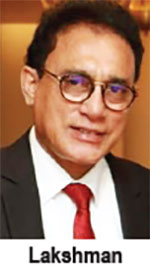
Perera, however, acknowledged the responsibility on the part of all stakeholders, both in and outside the political mainstream, to reach a consensus on a viable agreement on the developing economic-political-social crisis.
The official asserted that the violence unleashed on those who had been demanding the resignation of President Gotabaya Rajapaksa and the entire Cabinet of Ministers, including the Prime Minister, on Monday (09) in Kollupitiya and Fort police areas and retaliatory attacks were a grim reminder to those wielding political power at different levels.
Lawyer Perera said that an explosive situation created by unprovoked attacks carried out by those who had been at a meeting chaired by then Prime Minister Mahinda Rajapaksa were now threatening to ruin the country unless consensus on a political settlement could be reached soon.
The association, in a statement that had been issued by its President Lakshman Perera and Secretary Sarath Ekanayake before the swearing in of Wickremesinghe as the Premier roundly condemned the Sri Lanka Podujana Peramuna (SLPP) for the wanton attack on protesting public.
Estimating the number of persons wounded in indiscriminate attacks at 150, they held the Colombo police responsible for their failure to thwart the Temple Trees project. The lawyers asserted that the police had been irresponsible in their conduct therefore guilty of what they called inadequate discharge of duty.
The lawyers’ association questioned the failure on the part of the police to anticipate serious breach of peace in the wake of such a large gathering at Temple Trees or receive advance warning from the intelligence services.
In the harshest recent criticism of the police by them, the Colombo High Court Lawyers’ Association alleged that the Colombo police had unashamedly served the interests of Temple Trees rather than enforcing laws.
Following Attorney General Sanjaya Rajaratnam’s intervention, IGP C.D. Wickremaratne directed the DIG, in charge of the CID to investigate May 09 incidents.
Commenting on the police and the Special Task Force (STF) deployed at Temple Trees on the day of the incidents, the lawyers alleged that law enforcement authorities turned a blind eye to brutal attacks on protesters. They intervened only after the first wave of attacks, the lawyers alleged, urging the IGP to take responsibility and resign forthwith.
The lawyers insisted that the attacks could have been prevented by the IGP.
Warning of further escalation of protests unless growing public grievances weren’t addressed, the grouping of lawyers declared that they didn’t have faith in Prasanna Ranatunga, who served as the Public Security Minister at the time of the incidents.
Ranatunga succeeded retired Rear Admiral Sarath Weerasekera at the last round of cabinet appointments.
They alleged Ranatunga lacked the capacity to handle the May 09 attacks that triggered a spate of incidents in areas outside the Northern and Eastern Provinces. Mobs set ablaze Ranatunga’s residence in Gampaha.
The association also underscored the responsibility on the part of the government to investigate the killing of Polonnaruwa District SLPP lawmaker Amarakeerthi Atukorale in the Nittambuwa police area and his police bodyguard.
The slain MP was on his way home after attending the Temple Trees meeting when vigilantes intercepted his vehicle.
The association declared six demands namely (1) resignation of the IGP (2) legal action against Senior DIG in charge of the Western Province Deshabandu Tennakoon (3) a transparent and thorough investigation into May 09 attacks carried out on those demanding the change of government (4) Fully cooperate with the HRCSL (Human Rights Commission of Sri Lanka) (5) establish rule of law (06) implementation of the Constitution and international instruments pertaining to human rights.
Warning that the public were suffering as a result of the pathetic failure of the political party system, the association said the situation would be further aggravated if those who wield political power sought to protect their interests at the expense of the national interests. The association declared that it wouldn’t hesitate to support what it called a progressive movement to establish democracy and rule of law in case the current political party system continued to fail the country.



Former first lady Shiranthi Rajapaksa, wife of former President Mahinda Rajapaksa was produced before the Hulftsdorp court, after being arrested by officers of the Commission to Investigate Allegations of Bribery or Corruption (CIABOC) and produce
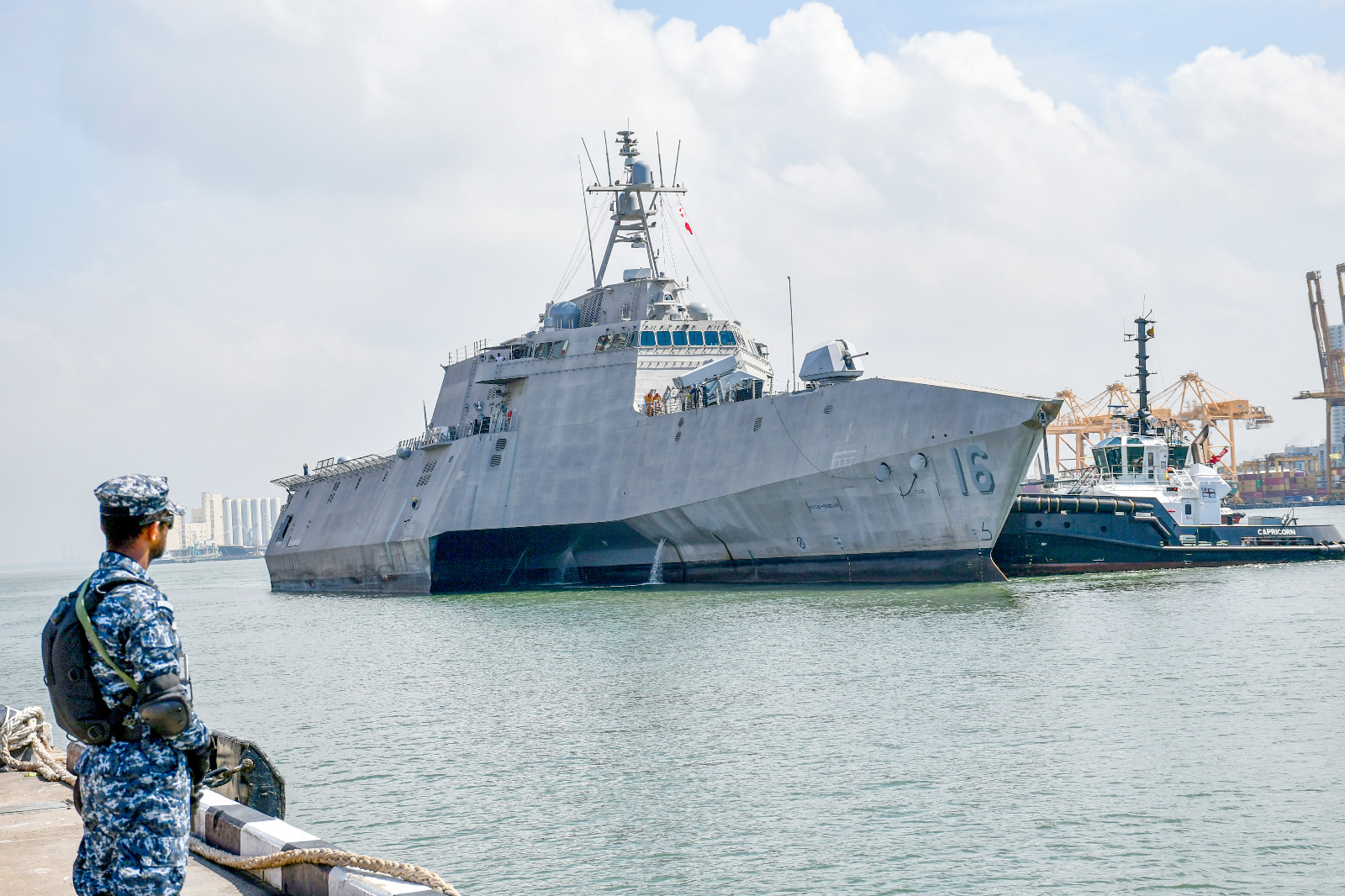
The U.S. Navy ship USS Tulsa (LCS 16) arrived at the Port of Colombo this morning, 7 October 2026 for replenishment purposes.
The visiting ship was welcomed by the Sri Lanka Navy in accordance with naval traditions.
The 127.7-metre-long platform is a Littoral Combat Ship commanded by Commander BM Wanier. Commissioned on 16 February 2019, USS Tulsa has since been in service with the US Navy.
The ship previously made a port call in Sri Lanka on 27 August 2025.
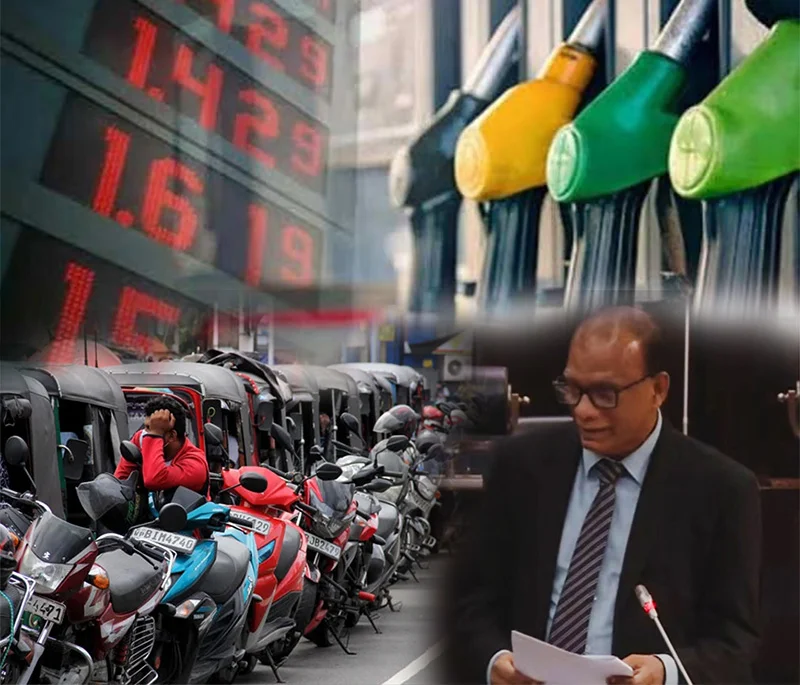
Govt. tells fuel distributors to maintain stocks to ensure uninterrupted supplies
by Saman Indrajith and Norman Palihawadane
The government had instructed private fuel distributors to maintain minimum stocks and ensure uninterrupted supplies to the market, Energy Minister Anura Karunathilaka told Parliament yesterday (06).
Karunathilaka said the Ministry of Energy Secretary had notified the relevant companies of the requirement, following a reduction in supplies by some private distributors, amid higher international fuel prices.
The Minister said private companies had informed the government that they were facing losses because international prices had risen while fuel was being sold, locally, at prevailing prices. As a result, some companies had reduced the volumes released to the market.
The reduced supplies had increased the burden on the Ceylon Petroleum Corporation (CPC), whose share of the diesel market had risen from about 54% to 82%, the Minister said.
“The CPC currently holds an 82% share of the market,” he said, adding that it had increased its supplies, compared with February, to compensate for the reduction by private distributors.
Karunathilaka said the government could not, under the existing agreements with private companies, specify the quantities they should supply to individual filling stations. However, it could require them to maintain minimum stocks in the country.
The Minister said the Energy Ministry had already instructed companies that had failed to maintain the required stocks to take steps to prevent supply disruptions.
The Minister attributed the queues reported at some filling stations to reduced supplies from private distributors, as well as normal variations in fuel distribution. He also said demand for CPC fuel had increased because private companies generally did not provide fuel to dealers on credit, while the CPC offered a three-day credit facility.
“We expect that, as the Ceylon Petroleum Corporation takes on this additional burden, the problem will ease to some extent by Wednesday or Thursday,” Karunathilaka said.
He said instructions had also been issued to increase supplies to CPC filling stations. A special discussion on the issue is scheduled for today (07), with officials of the Energy Ministry and CPC expected to participate,
along with President Anura Kumara Dissanayake.
Meanwhile, Petroleum Dealers’ Association officials have called for an early solution to the supply issue. Association Chairman D.V. Shantha Silva said queues had been reported at many filling stations, mainly those operated by private distributors.
He said the situation was not due to an overall shortage of fuel, but was linked to reduced orders by Lanka IOC, Sinopec and R.M. Parks amid concerns over losses incurred on fuel sales.
The Ceylon Petroleum Private Tanker Owners Association has urged motorists to refrain from panic buying, saying there was no nationwide disruption to fuel supplies.
The government earlier increased fuel prices and introduced a per-litre diesel subsidy following concerns raised by distributors over rising international prices.

Former first lady Shiranthi Rajapaksa arrested by CIABOC

U.S. Navy ship USS Tulsa arrives in Colombo for replenishment visit

Smriti Mandhana appointed India captain across formats

Ronaldo apologizes for Portugal walkout; says Jesus broke promise

Showers in the Western, Sabaragamuwa, Central, Uva, North-western and Southern provinces and in Anuradhapura and Mannar districts

Fuel crunch looms

‘Dates have the highest sugar content to fight Coronavirus’

Sunday Island 27 December – Headlines

#SundayIsland 17th December – Headlines

Sunday Island – 28th March

Sunday Island Headlines – 21 March

Sunday Island – 21st February – Headlines
-

 News7 days ago
US-assisted ‘Ice’ detection: NPC to examine IGP’s move to transfer drug-busting team
-

 Editorial6 days ago
Colombo Port drug bust: The plot thickens
-

 Editorial7 days ago
Drug busting, transfers and trust deficit
-

 Features4 days ago
The first woman in the foreign service or Ceylon Overseas Service it was then called
-
 News7 days ago
Sri Lankan facing death penalty in Saudi Arabia: Mano G appeals to Crown Prince
-

 Editorial5 days ago
Fuelling discontent and protest
-

 News3 days ago
Geneva takes up Sallay’s case and govt. ignores opportunity to answer accusations
-

 Latest News5 days ago
Tharindu Rathnayake, bowlers secure Asian Games Bronze for Sri Lanka