
News
Colombo asks India to send six bisons to reintroduce them in Lanka after 3 centuries

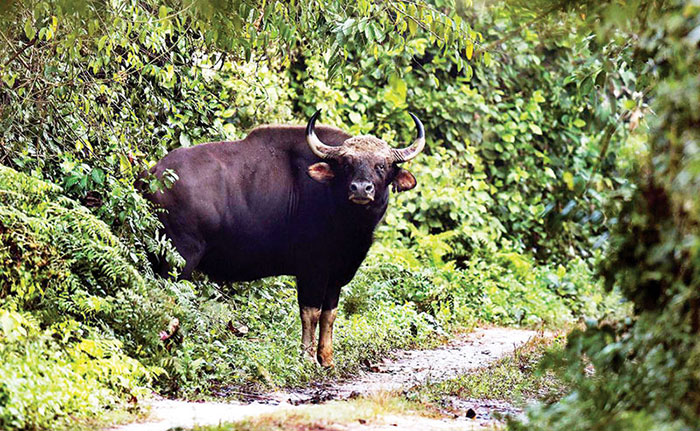
As wildlife diplomacy takes wing, government considers Lankan proposal for translocating gaurs
By Suhasini Haidar
and Jacob Koshy
New Delhi October 15, 2022: Close on the heels of the project that translocated cheetahs from Namibia, the Indian government is considering a proposal from Colombo to export a number of gaurs, or Indian bisons, to Sri Lanka to revive the population of gavaras that have been extinct in the island since the end of the 17th century. If the project is cleared, it would be the first such agreement between India and Sri Lanka, and part of a global trend of “wildlife or zoological diplomacy”, say experts.
Sources said the Ministry of External Affairs (MEA), which received the request in August, has now forwarded it to the Ministry of Environment and Forests (MoEF), “seeking comments” on the proposal to transport at least six specimens, including a bull and three to five cows. According to the written proposal, the Sri Lankan Department of Zoological Gardens would then carry out “captive breeding a herd of about a dozen specimens over a five-year period before trial reintroduction to the wild could take place in accordance with [internationally mandated] guidelines for reintroductions”.
S.P. Yadav, Director, National Tiger Conservation Authority, said the proposal was being studied. “We’ll have to evaluate if the conditions for translocation are right, such that the animal can sustainably thrive over there,” he told The Hindu, estimating the evaluation could take a few months.The suggestion for the proposal came from world-renowned Sri Lankan conservationist Rohan Pethiyagoda, who was awarded the Linnean medal 2022 (U.K. -based equivalent of the Nobel prize for zoology) for his work on restoring fresh water and forest biodiversity.
“As a scientific and cultural collaboration between our two countries, I felt this could be an immensely valuable initiative. But I know it is fraught with difficulties,” said Sri Lankan High Commissioner to India Milinda Moragoda who handed over the preliminary request on the basis of Mr. Pethiyagoda’s suggestion. “India is without a doubt Sri Lanka’s closest friend, supporter and trading partner. We have a shared history, shared cultural identity, and shared gene. We even got Buddhism, on whose traditions we derive our national values, from India,” he added.
Experts say that while “zoological diplomacy” had been practised worldwide, they draw a distinction between “gifts or loans” of animals in captivity to translocation and reintroduction of a species, particularly between neighbouring countries with similar eco-systems. For example, American bison herds were supplemented with animals from Canada after the U.S. herds were almost all wiped out, The U.K. has recently introduced the European bison (Wisent) after an estimated 10,000 years in June 2022(its extinct relative the Steppe Bison was believed to have lived there many centuries ago).
Israel has for decades pursued reintroductions, including of Persian fallow deer. Arabian oryx and other species have been released into the Negev desert, and South Africa has recently used the export of cheetahs to other African countries as a diplomatic tool during the post-apartheid era. More recently, Cambodia has requested translocating tigers from India, which is under consideration.
“Much depends on whether the conditions that caused the extinction have been removed, but reintroduction is known and has frequently been taken up between countries where the range is contiguous,” explained Mahesh Rangaran, Professor of History and Environmental Studies at Ashoka University who has studied conservation history, including such attempts. “In that sense, the animal plays a role as a zoological ambassador between nation states,” he added.
Sri Lankan officials say the gaur, called the gavara in Sinhala, was once widespread and archaeological remains in ancient caves in the island included the remains of the animal. By the end of the 17th century, however, the species appears to have been extirpated in Sri Lanka, although they remain prominent in iconography and mythological stories.The Indian gaur, a reclusive beast that lives in the wild, is the largest wild bovine that is a protected species and included in Schedule I of the Wild Life Protection Act, 1972 and listed as vulnerable in the International Union for Conservation of Nature (IUCN) Red List. There are about 13,000 to 30,000 gaurs in the world with approximately 85% of the population present in India. It is also found in Burma and Thailand.
The first-ever population estimation exercise of the Indian gaur carried out in the Nilgiris Forest Division in February 2020 estimated around 2,000 Indian gaurs to be inhabiting the division. This came after instances of people being attacked or injured by the bison primarily in and around plantations came to light. In 2019, for which the most recent numbers are available, three people were killed and seven injured in attacks by gaurs.
(The Hindu)









The Ministry of Industries and Entrepreneurship Development has recommended the establishment of Sri Lankan Standards, i.e. the import testing methodology for imported tires used for passenger cars and pneumatic tires for three-wheelers with the aim of ensuring a fair competitive environment for local
manufactures and ensuring consumer safety and security.
Taking into the said recommendations, “Import and Export (control regulations N0.08 of the 2026)” has been enacted to amend the existing regulations by means of the Extraordinary Gazette Notification No. 2508/27 dated 2026-10-01, prescribing Sri Lanka standard 1212 for the import of passenger types (HS Code 4011.10.90) and Sri Lanka standard 1347 for the import of
pneumatic tires for three – wheeled vehicles (HS Code 4011.90.10).
Accordingly, the Cabinet of Ministers has approved the resolution furnished by the President in his capacity as the Minister of Finance, Planning, and Economic Development to submit the aforementioned regulations to Parliament for approval.
Approval of the Cabinet of Ministers was granted at their meeting held on 02.06.2025 to introduce a new act to promote and providing legal provisions for facilitating the Public Private Joint Enterprises within Sri Lanka as well as the establishment of the National Agency for Public Private Partnership Joint Enterprises.
Accordingly, the Legal Draftsman has formulated the relevant draft bill and the Attorney General has given his clearance to the said draft bill.
The Cabinet of Ministers approved the resolution furnished by the President in his capacity as the Minister of Finance, Planning and Economic Development to publish the said
draft bill in the government gazette notification and thereby submit it to the Parliament for its concurrence.
Regulation, development and control of indigenous medical sector in Sri Lanka comprised of Ayurvedha, Sidhdha, Unani, Local Therapies are carried out under the provisions of Ayurvedha Act No. 31 of 1961.
Although amendments were made to the act from time to time as per the requirements, the necessity of further amending the Ayurvedha Act has been identified to enable efficiently maintaining all activities of local medical field productively, further formalizing the regulation of the sector, taking actions to providing licenses applicable to export of local medicines, and achieving the progress and sustainable development goals in the local medical sector.
Based on the said factors, the Cabinet of Ministers granted approval to the resolution furnished by the Minister of Health and Mass Media to direct the Legal Draftsman to formulate a draft bill to amend the Ayurvedha Act No. 31 of 1961.

Import and Export (Control) Regulations No. 08 of 2026
Draft Bill of the Public Private Partnership Enterprises Act to be gazzetted
Amendment of the Ayurvedha Act No. 31 of 1961

Cabinet nod to amend the Sri Lanka Development Administration Institute Act No. 9 of 1982
Establishment of the National Higher Performance Centre
State patronage for the cremation ceremony of the late deputy prelate (Anu Nayaka Thero) of the Sri Laka Ramangya Maha Nikaya, Gatambe Rajopawanramadhipatha, Siri Chandawimala Wanshalankara, Chandrakeerthi Sri Amarawansha, Sadhdharmawageeshwara, Shasanashobhanna Most Venerable Keppetiyagoda Siriwimalabhidhana Thero

‘Dates have the highest sugar content to fight Coronavirus’

Sunday Island 27 December – Headlines

#SundayIsland 17th December – Headlines

Sunday Island – 28th March

Sunday Island Headlines – 21 March

Sunday Island – 21st February – Headlines
-

 Features3 days ago
Kotahena:A Small Enclave, An Extraordinary Legacy
-

 News7 days ago
Sri Lanka, India caught in US-Iran ship crisis
-
 News4 days ago
Asgiri Mahanayake calls for immediate release of Gnanasara Thera
-

 Latest News7 days ago
Missiles intercepted near Riyadh after Saudi coalition hits Yemen fuel depot
-

 Latest News7 days ago
Kusal Mendis’ unbeaten 87 hands Sri Lanka consolation win
-

 News3 days ago
Record 1,600 students take Russian Classical Ballet examination in Sri Lanka
-

 News6 days ago
AC President recuses himself from hearing prison attire case pertaining to Gnanasara Thera
-

 News5 days ago
Naval officer testifies Yoshitha received Rs. 5.15 mn in salaries during SLN service