
News
Colombo asks India to send six bisons to reintroduce them in Lanka after 3 centuries

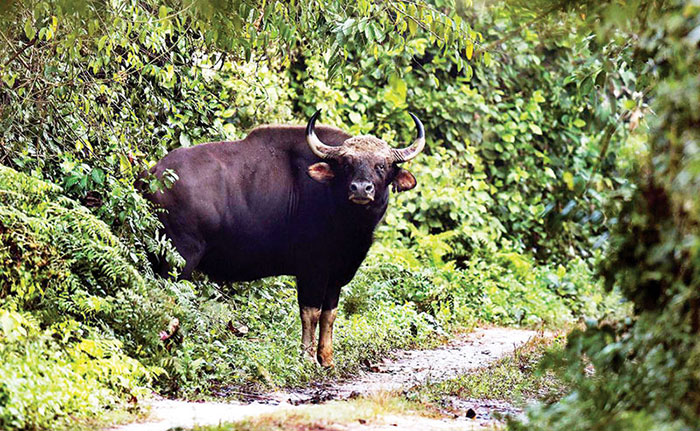
As wildlife diplomacy takes wing, government considers Lankan proposal for translocating gaurs
By Suhasini Haidar
and Jacob Koshy
New Delhi October 15, 2022: Close on the heels of the project that translocated cheetahs from Namibia, the Indian government is considering a proposal from Colombo to export a number of gaurs, or Indian bisons, to Sri Lanka to revive the population of gavaras that have been extinct in the island since the end of the 17th century. If the project is cleared, it would be the first such agreement between India and Sri Lanka, and part of a global trend of “wildlife or zoological diplomacy”, say experts.
Sources said the Ministry of External Affairs (MEA), which received the request in August, has now forwarded it to the Ministry of Environment and Forests (MoEF), “seeking comments” on the proposal to transport at least six specimens, including a bull and three to five cows. According to the written proposal, the Sri Lankan Department of Zoological Gardens would then carry out “captive breeding a herd of about a dozen specimens over a five-year period before trial reintroduction to the wild could take place in accordance with [internationally mandated] guidelines for reintroductions”.
S.P. Yadav, Director, National Tiger Conservation Authority, said the proposal was being studied. “We’ll have to evaluate if the conditions for translocation are right, such that the animal can sustainably thrive over there,” he told The Hindu, estimating the evaluation could take a few months.The suggestion for the proposal came from world-renowned Sri Lankan conservationist Rohan Pethiyagoda, who was awarded the Linnean medal 2022 (U.K. -based equivalent of the Nobel prize for zoology) for his work on restoring fresh water and forest biodiversity.
“As a scientific and cultural collaboration between our two countries, I felt this could be an immensely valuable initiative. But I know it is fraught with difficulties,” said Sri Lankan High Commissioner to India Milinda Moragoda who handed over the preliminary request on the basis of Mr. Pethiyagoda’s suggestion. “India is without a doubt Sri Lanka’s closest friend, supporter and trading partner. We have a shared history, shared cultural identity, and shared gene. We even got Buddhism, on whose traditions we derive our national values, from India,” he added.
Experts say that while “zoological diplomacy” had been practised worldwide, they draw a distinction between “gifts or loans” of animals in captivity to translocation and reintroduction of a species, particularly between neighbouring countries with similar eco-systems. For example, American bison herds were supplemented with animals from Canada after the U.S. herds were almost all wiped out, The U.K. has recently introduced the European bison (Wisent) after an estimated 10,000 years in June 2022(its extinct relative the Steppe Bison was believed to have lived there many centuries ago).
Israel has for decades pursued reintroductions, including of Persian fallow deer. Arabian oryx and other species have been released into the Negev desert, and South Africa has recently used the export of cheetahs to other African countries as a diplomatic tool during the post-apartheid era. More recently, Cambodia has requested translocating tigers from India, which is under consideration.
“Much depends on whether the conditions that caused the extinction have been removed, but reintroduction is known and has frequently been taken up between countries where the range is contiguous,” explained Mahesh Rangaran, Professor of History and Environmental Studies at Ashoka University who has studied conservation history, including such attempts. “In that sense, the animal plays a role as a zoological ambassador between nation states,” he added.
Sri Lankan officials say the gaur, called the gavara in Sinhala, was once widespread and archaeological remains in ancient caves in the island included the remains of the animal. By the end of the 17th century, however, the species appears to have been extirpated in Sri Lanka, although they remain prominent in iconography and mythological stories.The Indian gaur, a reclusive beast that lives in the wild, is the largest wild bovine that is a protected species and included in Schedule I of the Wild Life Protection Act, 1972 and listed as vulnerable in the International Union for Conservation of Nature (IUCN) Red List. There are about 13,000 to 30,000 gaurs in the world with approximately 85% of the population present in India. It is also found in Burma and Thailand.
The first-ever population estimation exercise of the Indian gaur carried out in the Nilgiris Forest Division in February 2020 estimated around 2,000 Indian gaurs to be inhabiting the division. This came after instances of people being attacked or injured by the bison primarily in and around plantations came to light. In 2019, for which the most recent numbers are available, three people were killed and seven injured in attacks by gaurs.
(The Hindu)








News
The book “Intimidated?” presents a significant and timely contribution to understanding challenges, resilience, and innovation in the modern world, offering valuable insights for education, research, and social transformation – PM


Prime Minister Dr. Harini Amarasuriya made these remarks while participating in the book launch of “Intimidated?” authored by Professor Suranga Nanayakkara, Head of Department at the National University of Singapore, held on Saturday 28 March 2026 at the Lotus Hall of BMICH.
Authored by Professor Suranga Nanayakkara, the book “Intimidated?” reflects on contemporary global and personal challenges, innovation, and the importance of resilience, offering readers a thoughtful and inspiring perspective grounded in academic experience and global exposure. The publication, along with its English translation, was ceremonially presented to the Prime Minister during the event.
Congratulating the author on this important publication, the Prime Minister stated that such scholarly work plays a vital role in inspiring future generations, particularly students and young researchers, to think critically, embrace challenges, and contribute meaningfully to society. She further emphasized the importance of knowledge-sharing and innovation in shaping a progressive and inclusive educational environment in Sri Lanka.
The Prime Minister also ceremonially launched the programme to distribute 5,000 copies of the book free of charge to students and educational institutions, highlighting the importance of making knowledge accessible to a wider audience.
The event was attended by Deputy Minister of Digital Economy Eranga Weeraratne, Secretary to the Ministry of Education Nalaka Kaluwewa, family members of Professor Suranga Nanayakkara, university Vice Chancellors, professors and lecturers, senior officials of the Ministry of Education, school principals, students, and invited guests.
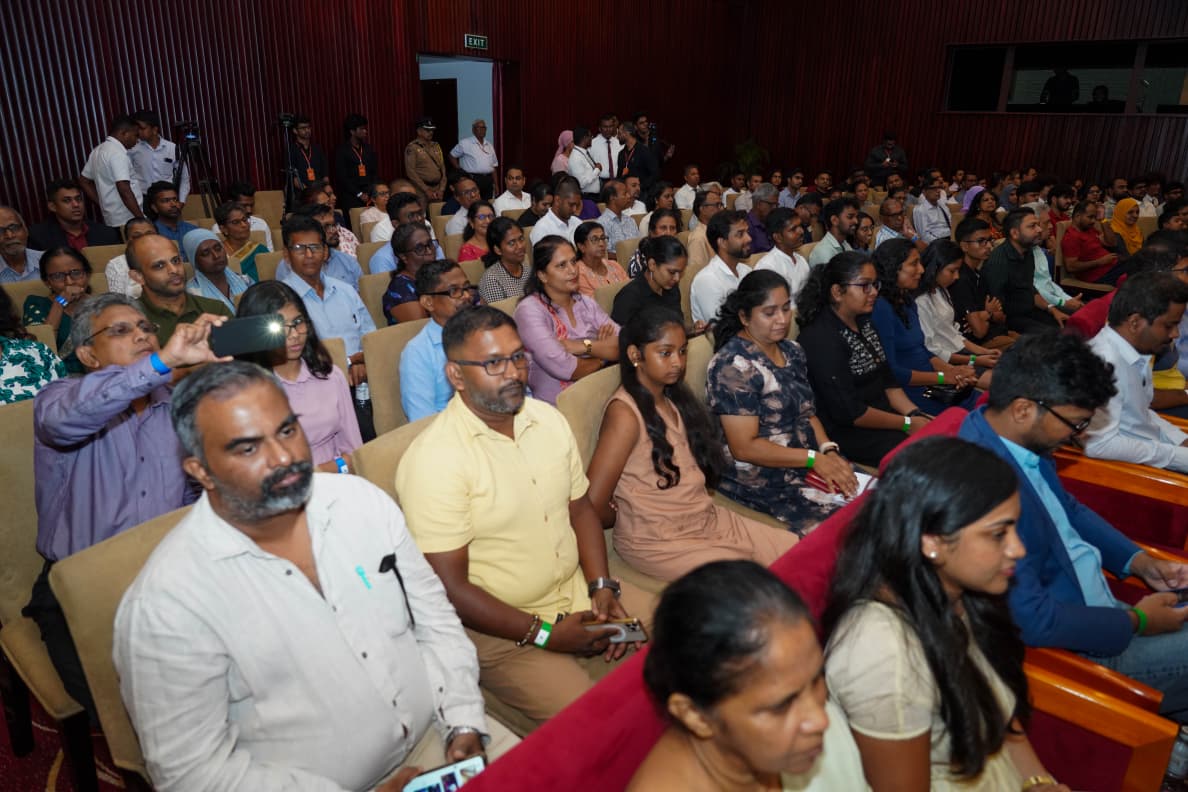

(Prime Minister’s Media Division)
News
It is the government’s objective to create an education system that provides every child with access to modern technological opportunities — Prime Minister

Prime Minister, Dr. Harini Amarasuriya, stated that it is the government’s objective to establish an education system that ensures every child has access to modern technological opportunities.
The Prime Minister made these remarks while attending the opening ceremony of the National Competition of the World Robot Olympiad (WRO), that aims to elevate the technological skills of Sri Lanka’s younger generation to international standards, held on Saturday (28) at Burhani Serendib College in Colombo.
A total of 66 teams from schools across the island participated in this year’s competition, marking a threefold increase compared to last year. The event was held under the theme “Robots Meet Culture,” and over 500 students, presented creations blending local culture with modern engineering concepts.
Expressing her views, the Prime Minister stated:
“In today’s rapidly evolving world, giving priority to the fields of Science, Technology, Engineering, and Mathematics (STEM) should be a national priority.
Platforms such as the World Robot Olympiad provide opportunities for our younger generation to develop essential skills such as logical thinking, innovation, and teamwork”,
Sri Lanka participated in the International Robot Olympiad held in Singapore in 2025, with two teams representing the country, which marked a highly significant and enriching experience for our children.
The Prime Minister further emphasized that the government remains committed to building an education system that enables every child to benefit from such technological opportunities.
The event was attended by the Secretary to the Prime Minister, Pradeep Saputhanthri, officials from the Indian High Commission, government officials, and school students.

(Prime Minister’s Media Division)
Latest News
Heat Index likely to increase up to ‘Caution level’ at some places in the Western, Sabaragamuwa, Southern, Eastern, North-western, Northern and North-central provinces and in Monaragala district

Warm Weather Advisory
Issued by the Natural Hazards Early Warning Centre
Issued at 3.30 p.m. on 29 March 2026, valid for 30 March 2026.
The Heat index, the temperature felt on human body is likely to increase up to ‘Caution level’ at some places in the Western, Sabaragamuwa, Southern, Eastern, North-western, Northern and North-central provinces and in Monaragala district.
The Heat Index Forecast is calculated by using relative humidity and maximum temperature and this is the condition that is felt on your body. This is not the forecast of maximum temperature. It is generated by the Department of Meteorology for the next day period and prepared by using global numerical weather prediction model data.

Effect of the heat index on human body is mentioned in the above table and it is prepared on the advice of the Ministry of Health and Indigenous Medical Services.
ACTION REQUIRED
Job sites: Stay hydrated and takes breaks in the shade as often as possible.
Indoors: Check up on the elderly and the sick.
Vehicles: Never leave children unattended.
Outdoors: Limit strenuous outdoor activities, find shade and stay hydrated.
Dress: Wear lightweight and white or light-colored clothing.
Note:
In addition, please refer to advisories issued by the Disaster Preparedness & Response Division, Ministry of Health in this regard as well. For further clarifications please contact 011-7446491.

The book “Intimidated?” presents a significant and timely contribution to understanding challenges, resilience, and innovation in the modern world, offering valuable insights for education, research, and social transformation – PM

It is the government’s objective to create an education system that provides every child with access to modern technological opportunities — Prime Minister

Caf general secretary resigns amid Afcon final fallout

Heat Index likely to increase up to ‘Caution level’ at some places in the Western, Sabaragamuwa, Southern, Eastern, North-western, Northern and North-central provinces and in Monaragala district

National Namal Uyana Declared a ‘National Heritage of Sri Lanka’

Philippine transport strikers say Marcos Jr failing to control oil prices

‘Dates have the highest sugar content to fight Coronavirus’

Sunday Island 27 December – Headlines

#SundayIsland 17th December – Headlines

Sunday Island – 28th March

Sunday Island Headlines – 21 March

Sunday Island – 21st February – Headlines
-

 News5 days ago
Senior citizens above 70 years to receive March allowances on Thursday (26)
-

 Features2 days ago
A World Order in Crisis: War, Power, and Resistance
-

 Features7 days ago
Trincomalee oil tank farm: An engineering marvel
-

 News3 days ago
Energy Minister indicted on corruption charges ahead of no-faith motion against him
-

 News4 days ago
US dodges question on AKD’s claim SL denied permission for military aircraft to land
-

 Features7 days ago
The scientist who was finally heard
-

 Business4 days ago
Dialog Unveils Dialog Play Mini with Netflix and Apple TV
-

 Sports3 days ago
SLC to hold EGM in April