
Features
Clara Heath meets Kewal Motwani in Kentucky

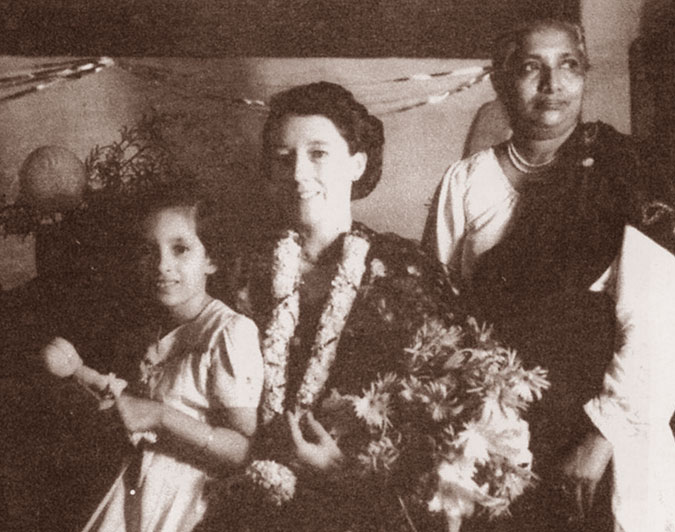
Excerpted from Goolbai Gunasekera’s Chosen Ground first published in 2006
(Continued from last week)
In Louisville, Kentucky, my mother, Clara Heath, was growing up meanwhile in what might be considered an unusually protected atmosphere for the average American child of her time. Her ambitious Southern reared mother was a kind of early 20th century Steel Magnolia, and intended that her daughters should have the finest education obtainable in the State of Kentucky.
Catholic schools in Louisville were believed to provide a better-than current education for girls, and though my poor grandfather was strongly against sending his two girls away (for one thing the family was not of the Catholic faith, and for another, he would miss them) what my grandmother said went!
Accordingly the two girls (eleven months apart, and treated virtually as twins) went to Presentation Academy in Louisville as boarders in a nun-run Catholic school.I wear Mother’s class ring to this very day. Boarding schools are not as common in the USA as they are in Britain and my grandmother’s decision to board her two daughters was unusual. Going to an American boarding school was the best thing that could have happened to Clara: without intending any such thing, my grandmother, Eva, was preparing her for a life in a more laid back country.
Mother loved the calm, unhurried life of the Convent, where her curricula included Latin, French and a smattering of Spanish. The gentle nuns were very much to her liking. Known only to God and the Fates, Mother was being well trained for her eventual career as Principal of a conservative Buddhist school in Ceylon. From the nuns at Presentation, Mother acquired a genuine love of study, a stern moral code, a strict sense of discipline and a lifelong abhorrence of a lady ever showing her knees.
When she became Principal of Visakha Vidyalaya in Colombo, one of the first things on her agenda was to make sure that hemlines were worn half way down the calf. Visakhians learnt, to their surprise, that no lady ever crossed her legs except at the ankle. Since the Queen of England was doing likewise on every Pathe Newsreel, they assumed that Mother knew what she was talking about.
Shortly after taking over the Principalship of Visakha, Mother was electrified by the newspaper picture of a girl from Bishop’s College (the secondary school to which I eventually went myself) taking a running jump over a high pole. Mother had a spasm at this ‘unladylike’ photograph which was, according to less biased accounts, an extremely modest one.
Nonetheless, Mother’s convent training had her banning athletics at Visakha and it was only after she left the school that Visakhians began winning honours in this line. Tennis, netball and table tennis were games that were acceptable to her Victorian code. Needless to say, while the girls of the fashionable missionary Schools wore `divided skirts’, Mother’s little Visakhians donned Greek robes and did Eurhythmics.
They were also encouraged to study Home Science — a subject introduced for the very first time into the curriculum of Ceylon’s schools. All this gave Visakhians a certain cachet. At last Buddhist girls’ education under Mother, and other school principals who had been trained in the West (such as Mrs. Hilda Kularatne in Panadura and Mrs. Doreen Wickremasinghe in Matara), began to give the older missionary schools a run for their money. Conservative Buddhist parents were well pleased with their young Principal from America — so highly qualified, so eminently tradition-minded, so totally sympathetic to the national aspirations of the Buddhist majority.
But more about Visakha later. As a schoolgirl herself, Mother’s life was delightfully serene and quite uneventful. She was a fine musician and took a Degree in music as well as Languages and Education. Her sister, my aunt Arline, was far more feisty, practical and pushy than the dreamy Clara. This polarization of personalities meant they got on very well together, although it also meant that Arline did all the housework while Mother drifted off to practise the piano for two to three hours every evening.
“Really,” Arline would explode, “Clara does NOTHING around the house, does she!”
Grandma Eva did not believe in household democracy. Each daughter did whatever she was good at doing, and Arline was a superlative cook and housekeeper. So gentle, so very appreciative was Clara each morning when she was handed perfectly laundered stockings and immaculately ironed clothes that Arline had so efficiently organized for her, that any words of protest from her sister died still-born.
Apparently Mother would get up feeling bright and perky, having completed all her homework the previous evening, to say nothing of those three hours of piano practice and say to her sister,
“Are my stockings on the bed or in my drawer, Arline?”
With a resigned air Arline would produce them neatly folded and ready to wear.
“My dear,” Auntie Arline said to me on one of my trips to the USA to see my American grandparents, “there are two kinds of people in the world. There are those for whom someone is ALWAYS on hand to smooth things out, and there are those like you and me who have to do the humdrum work themselves. I leave you to work out to which group your dear Mother belongs.”
“Didn’t you ever have an American boyfriend at any time?” we would ask Mother in Auntie Arline’s presence. Mother would look vague and Arline would snort:
“Of course she had lots of admirers, but your Mother simply never got the message.”
Apparently one smitten young man would drop by ostensibly to practice the violin while Mother played the piano accompaniment. Grandma would have milk and cookies ready for the couple to enjoy
at the end of their labours. Mother gave the poor young swain no chance. The minute the last note had been played she shut the piano, shook hands with her fellow musician in the accepted convent-taught manner and said ‘Goodnight!’
“And another romance,” Auntie would continue, while Mother looked apprehensive, “was that young Professor who kept offering her a lift home from University. Your mother – ” and Auntie accented the word – “took many a detour so that their paths did not cross.”

The Motwanis in Bandarawela
My sister and I screamed.
“I do wish you wouldn’t repeat these highly exaggerated tales, Arline,” Mother would tell Arline in exasperation.
“Well, what happened when the dear Professor phoned, please tell?”
“I really can’t remember,” said Mother.
But of course, Mother remembered very well her first meeting with her future husband … and their eventual marriage illustrates that truth can often be more romantic than fiction. The tale as told by Mother was factual and lacked Father’s teasing sidelines.Sir Jamshed Mehra had met my American grandmother at a Theosophical conference in the USA. Learning that Mrs Heath had two teenage daughters at home, he suggested that one of them might like to write to his young ward who was just finishing his B.A and was probably going on to England for postgraduate study.
My Aunt Arline was not in the slightest bit interested in Theosophy, so the task of writing to a young Indian ten years her senior fell to Mother. The correspondence flourished although, given Mother’s convent training, those letters must have been models of decorous writing. Su and I have never been given so much as a glance at them, although Father kept them stored away in the go-downs he owned in Karachi. Until the Partition of India, those go-downs gave Father a comfortable income situated, as they were, near the docks.
When Father decided to register at Yale (having hated Oxford) the correspondence speeded up and my grandmother realized that this lonely young Indian, so far from home, would be spending a summer vacation all on his own. Returning to India was out of the question since those were not days of convenient air travel. Accordingly, she invited him to spend the summer in their home. She probably regretted doing so for Father fell instantly in love with the 17-year-old girl to whom he had been writing.
Their romance was complicated by the fact that Mother lived in Kentucky and an Asian, however fair his skin might be, was practically a Black to her relatives who lived south of the Mason-Dixon line. To say that her aunts, uncles and cousins were unhappy would be an understatement. They were aghast.
This unlikely union, strangely enough, did not encounter opposition from my grandparents. They had met many Indians and did not share in the feelings of horror that so many of their friends experienced when they were told that Clara was marrying a non-Caucasian and one from a barbaric Asian nation at that.
My grandmother spent many irate hours explaining to her near and dear that the culture and civilization of India was superior by far to any in the West. When Father heard the family views he laughed as he usually did whenever he encountered ignorance of the East.
When Mother went to say goodbye to the nuns of her old school she took Father with her. They were quite charmed by him but Reverend Mother’s last words to Clara were a heartfelt: “I shall pray for you my dear.”
When Mother was packing to leave her home in Kentucky for India she stood helplessly by while Father sorted out the clothes she would need for the tropics, ruthlessly discarding winter apparel. Mother looked expectantly at her sister, who resignedly set about packing what she hoped would be the last bag she ever packed for Clara. In point of fact, she was to do it whenever Mother visited the USA on later occasions.
“I can’t think WHAT you are going to do aboard that ship,” Arline told Mother worriedly.
Mother’s response was predictable. “Oh, I’ll get the steward or someone to help,” she said vaguely.
Arline tch tched, and continued worrying. But she stopped this useless exercise after Mother’s happy letters home told her that Father was a whiz at getting a mountain of clothes into a tiny, tiny space. Later on two Sinhalese maids, Nimal and Cathleen, swam into Mother’s life. They took full charge of all household affairs — even to eventually regulating the day-to-day problem of looking after the physical needs of Clara’s two daughters. Cathleen remained with us all her life to become, not a maid but a friend.
She worked with us for 62 years — 30 of them in the USA, where (after bringing us up) she went to look after our Grandmother Eva. Auntie Arline was in the American Foreign Service. She never married, and so when Grandmother died Cathleen simply stayed on with Auntie Arline as a highly efficient maid. Cathleen also got to globe-trot with my aunt who was an inveterate travel bug. Whenever Auntie got a posting abroad Cathleen kept house for her in exotic places like Amman, Jaipur and South America.
Auntie Arline died in 2004, just after Khulsum (my daughter) and I had visited her in Arizona where she had retired. Cathleen died a few months later, following her return to Sri Lanka.
(To be continued)


 ‘Adapt, shrink or die’ – thus runs the warning issued by the Trump administration to UN humanitarian agencies with brute insensitivity in the wake of its recent decision to drastically reduce to $2bn its humanitarian aid to the UN system. This is a substantial climb down from the $17bn the US usually provided to the UN for its humanitarian operations.
Considering that the US has hitherto been the UN’s biggest aid provider, it need hardly be said that the US decision would pose a daunting challenge to the UN’s humanitarian operations around the world. This would indeed mean that, among other things, people living in poverty and stifling material hardships, in particularly the Southern hemisphere, could dramatically increase. Coming on top of the US decision to bring to an end USAID operations, the poor of the world could be said to have been left to their devices as a consequence of these morally insensitive policy rethinks of the Trump administration.
Earlier, the UN had warned that it would be compelled to reduce its aid programs in the face of ‘the deepest funding cuts ever.’ In fact the UN is on record as requesting the world for $23bn for its 2026 aid operations.
If this UN appeal happens to go unheeded, the possibilities are that the UN would not be in a position to uphold the status it has hitherto held as the world’s foremost humanitarian aid provider. It would not be incorrect to state that a substantial part of the rationale for the UN’s existence could come in for questioning if its humanitarian identity is thus eroded.
Inherent in these developments is a challenge for those sections of the international community that wish to stand up and be counted as humanists and the ‘Conscience of the World.’ A responsibility is cast on them to not only keep the UN system going but to also ensure its increased efficiency as a humanitarian aid provider to particularly the poorest of the poor.
It is unfortunate that the US is increasingly opting for a position of international isolation. Such a policy position was adopted by it in the decades leading to World War Two and the consequences for the world as a result for this policy posture were most disquieting. For instance, it opened the door to the flourishing of dictatorial regimes in the West, such as that led by Adolph Hitler in Germany, which nearly paved the way for the subjugation of a good part of Europe by the Nazis.
If the US had not intervened militarily in the war on the side of the Allies, the West would have faced the distressing prospect of coming under the sway of the Nazis and as a result earned indefinite political and military repression. By entering World War Two the US helped to ward off these bleak outcomes and indeed helped the major democracies of Western Europe to hold their own and thrive against fascism and dictatorial rule.
Republican administrations in the US in particular have not proved the greatest defenders of democratic rule the world over, but by helping to keep the international power balance in favour of democracy and fundamental human rights they could keep under a tight leash fascism and linked anti-democratic forces even in contemporary times. Russia’s invasion and continued occupation of parts of Ukraine reminds us starkly that the democracy versus fascism battle is far from over.
Right now, the US needs to remain on the side of the rest of the West very firmly, lest fascism enjoys another unfettered lease of life through the absence of countervailing and substantial military and political power.
However, by reducing its financial support for the UN and backing away from sustaining its humanitarian programs the world over the US could be laying the ground work for an aggravation of poverty in the South in particular and its accompaniments, such as, political repression, runaway social discontent and anarchy.
What should not go unnoticed by the US is the fact that peace and social stability in the South and the flourishing of the same conditions in the global North are symbiotically linked, although not so apparent at first blush. For instance, if illegal migration from the South to the US is a major problem for the US today, it is because poor countries are not receiving development assistance from the UN system to the required degree. Such deprivation on the part of the South leads to aggravating social discontent in the latter and consequences such as illegal migratory movements from South to North.
Accordingly, it will be in the North’s best interests to ensure that the South is not deprived of sustained development assistance since the latter is an essential condition for social contentment and stable governance, which factors in turn would guard against the emergence of phenomena such as illegal migration.
Meanwhile, democratic sections of the rest of the world in particular need to consider it a matter of conscience to ensure the sustenance and flourishing of the UN system. To be sure, the UN system is considerably flawed but at present it could be called the most equitable and fair among international development organizations and the most far-flung one. Without it world poverty would have proved unmanageable along with the ills that come along with it.
Dehumanizing poverty is an indictment on humanity. It stands to reason that the world community should rally round the UN and ensure its survival lest the abomination which is poverty flourishes. In this undertaking the world needs to stand united. Ambiguities on this score could be self-defeating for the world community.
For example, all groupings of countries that could demonstrate economic muscle need to figure prominently in this initiative. One such grouping is BRICS. Inasmuch as the US and the West should shrug aside Realpolitik considerations in this enterprise, the same goes for organizations such as BRICS.
The arrival at the above international consensus would be greatly facilitated by stepped up dialogue among states on the continued importance of the UN system. Fresh efforts to speed-up UN reform would prove major catalysts in bringing about these positive changes as well. Also requiring to be shunned is the blind pursuit of narrow national interests.

 Hi! Great to be back after my Christmas break.
Thought of starting this week with egg white.
Yes, eggs are brimming with nutrients beneficial for your overall health and wellness, but did you know that eggs, especially the whites, are excellent for your complexion?
OK, if you have no idea about how to use egg whites for your face, read on.
Egg White, Lemon, Honey:
Separate the yolk from the egg white and add about a teaspoon of freshly squeezed lemon juice and about one and a half teaspoons of organic honey. Whisk all the ingredients together until they are mixed well.
Apply this mixture to your face and allow it to rest for about 15 minutes before cleansing your face with a gentle face wash.
Don’t forget to apply your favourite moisturiser, after using this face mask, to help seal in all the goodness.
Egg White, Avocado:
In a clean mixing bowl, start by mashing the avocado, until it turns into a soft, lump-free paste, and then add the whites of one egg, a teaspoon of yoghurt and mix everything together until it looks like a creamy paste.
Apply this mixture all over your face and neck area, and leave it on for about 20 to 30 minutes before washing it off with cold water and a gentle face wash.
Egg White, Cucumber, Yoghurt:
In a bowl, add one egg white, one teaspoon each of yoghurt, fresh cucumber juice and organic honey. Mix all the ingredients together until it forms a thick paste.
Apply this paste all over your face and neck area and leave it on for at least 20 minutes and then gently rinse off this face mask with lukewarm water and immediately follow it up with a gentle and nourishing moisturiser.
Egg White, Aloe Vera, Castor Oil:
To the egg white, add about a teaspoon each of aloe vera gel and castor oil and then mix all the ingredients together and apply it all over your face and neck area in a thin, even layer.
Leave it on for about 20 minutes and wash it off with a gentle face wash and some cold water. Follow it up with your favourite moisturiser.

 Superlatives galore were used, especially on social media, to highlight R&B singer Ne-Yo’s trip to Sri Lanka: Global superstar Ne-Yo to perform live in Colombo this December; Ne-Yo concert puts Sri Lanka back on the global entertainment map; A global music sensation is coming to Sri Lanka … and there were lots more!
At an official press conference, held at a five-star venue, in Colombo, it was indicated that the gathering marked a defining moment for Sri Lanka’s entertainment industry as international R&B powerhouse and three-time Grammy Award winner Ne-Yo prepares to take the stage in Colombo this December.
What’s more, the occasion was graced by the presence of Sunil Kumara Gamage, Minister of Sports & Youth Affairs of Sri Lanka, and Professor Ruwan Ranasinghe, Deputy Minister of Tourism, alongside distinguished dignitaries, sponsors, and members of the media.

Shah Rukh Khan: Disappointed his fans in Sri Lanka
According to reports, the concert had received the official endorsement of the Sri Lanka Tourism Promotion Bureau, recognising it as a flagship initiative in developing the country’s concert economy by attracting fans, and media, from all over South Asia.

Nick Carter: His concert, too, was cancelled due to “Unforeseen circumstances
However, I had that strange feeling that this concert would not become a reality, keeping in mind what happened to Nick Carter’s Colombo concert – cancelled at the very last moment.
Carter issued a video message announcing he had to return to the USA due to “unforeseen circumstances” and a “family emergency”.
Though “unforeseen circumstances” was the official reason provided by Carter and the local organisers, there was speculation that low ticket sales may also have been a factor in the cancellation.
Well, “Unforeseen Circumstances” has cropped up again!
In a brief statement, via social media, the organisers of the Ne-Yo concert said the decision was taken due to “unforeseen circumstances and factors beyond their control.”
Ne-Yo, too, subsequently made an announcement, citing “Unforeseen circumstances.”
The public has a right to know what these “unforeseen circumstances” are, and who is to be blamed – the organisers or Ne-Yo!
Ne-Yo’s management certainly need to come out with the truth.
However, those who are aware of some of the happenings in the setup here put it down to poor ticket sales, mentioning that the tickets for the concert, and a meet-and-greet event, were exorbitantly high, considering that Ne-Yo is not a current mega star.
We also had a cancellation coming our way from Shah Rukh Khan, who was scheduled to visit Sri Lanka for the City of Dreams resort launch, and then this was received: “Unfortunately due to unforeseen personal reasons beyond his control, Mr. Khan is no longer able to attend.”
Referring to this kind of mess up, a leading showbiz personality said that it will only make people reluctant to buy their tickets, online.
“Tickets will go mostly at the gate and it will be very bad for the industry,” he added.

Zohran Mamdani sworn in as New York City mayor

In pictures: New Year welcomed around the world

Foreign warships commended for their assistance during weather disaster in Sri Lanka

Machu Picchu train crash leaves one dead and dozens injured

I invite you to step into 2026 with renewed energy, hope, and determination – PM

Fairly heavy showers about 75 mm are likely at some places in the Central and Uva provinces and in Batticaloa and Ampara districts

‘Dates have the highest sugar content to fight Coronavirus’

Sunday Island 27 December – Headlines

#SundayIsland 17th December – Headlines

Sunday Island – 28th March

Sunday Island Headlines – 21 March

Sunday Island – 21st February – Headlines
-
 News7 days ago
Street vendors banned from Kandy City
-

 Sports4 days ago
Gurusinha’s Boxing Day hundred celebrated in Melbourne
-

 News7 days ago
Lankan aircrew fly daring UN Medevac in hostile conditions in Africa
-
 News2 days ago
Leading the Nation’s Connectivity Recovery Amid Unprecedented Challenges
-

 Sports5 days ago
Time to close the Dickwella chapter
-

 Features3 days ago
It’s all over for Maxi Rozairo
-

 Features7 days ago
Rethinking post-disaster urban planning: Lessons from Peradeniya
-

 Opinion7 days ago
Are we reading the sky wrong?