
Opinion
Chira takes his ‘final flight west’

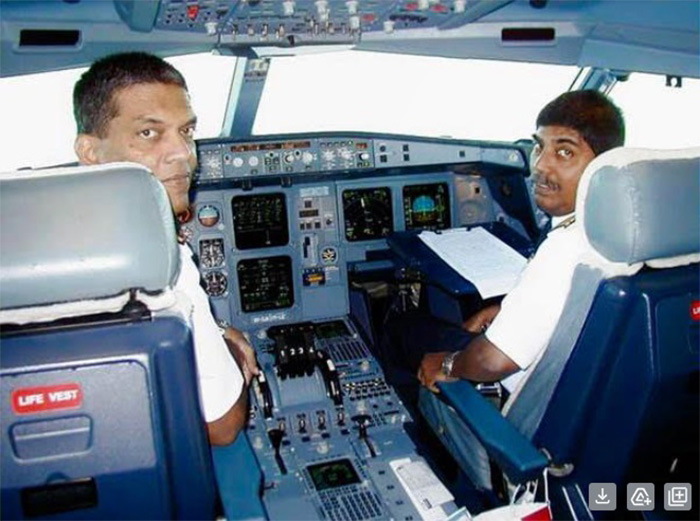
by Roger Thiedeman
On Friday, September 27, 2024, Sri Lanka lost its longest-surviving, most versatile and experienced aviator. That was the day Capt. Chira Fernando, a former military, commercial and recreational pilot, took his ‘final flight west’ (to paraphrase an unknown aviation writer); a flight all pilots must take for their ‘final check’.
Hemendra Chirananda Fernando , better known as ‘Chira’ or ‘Captain Chira’, was born on October 22, 1946 to Hector Francis Campbell Fernando and his wife Merlyn Anne Catherine née Fonseka. He was the fourth of their five children. Hector was an optician of renown, while his wife taught in the Lower School at S. Thomas’ College, Mt. Lavinia.
Indeed, it was at S. Thomas’ College (STC), where Chira and his older and younger brothers, Eksith and Gihan, respectively, received their primary and secondary education.
The aviation bug bit Chira at an early age when his godfather presented him with a flimsy cardboard-and-balsa-wood Spitfire model powered by a wound-up rubber band. With encouragement from their father, the Fernando boys progressed to building and flying more sophisticated model airplanes with miniature working engines, some designed by Chira himself. They also enjoyed reading tales of aerial warfare in Air Ace Picture Library and ‘Battler Britton’ comic books. Most weekends saw Chira and a group of likeminded friends flying their homebuilt models at STC’s Small Club sports ground.
Although Eksith was caught up in the flying fervour with his two brothers, it was youngest sibling Gihan who became as single-mindedly enthusiastic as Chira about all things aeronautical. Almost inevitably ‘GAF’ followed his next older brother into life as a flyer, albeit via a different ‘flight path’, forging a long and successful career as an airline pilot until retirement as a senior Captain with SriLankan Airlines at the compulsory age of 65 in 2014.
Reverting to Chira, he passed his GCE Advanced Level examinations and had only just commenced a General Science course at the University of Colombo when he was selected to join the then Royal Ceylon Air Force (RCyAF) in 1965 for training as an Officer Cadet at the prestigious and historic Royal Air Force (RAF) Cranwell College in England.
But first he had to undergo the physical training challenges of parade ground drills, battle courses and night marches at the RCyAF’s primary ground combat training base in Diyatalawa. On completion of that rigorous programme Chira left for the UK by ship in February 1966.
During his RAF officer training, while participating in a two-week ‘escape and evasion’ training exercise at Gütersloh, Germany in September 1968, Chira fell and badly injured a knee. Following treatment, he was sent to RAF Headley Court at Loughborough, England for convalescence.
That unfortunate accident turned out be a life-changing blessing in disguise for Chira. Because he had missed six weeks of his officer cadet training course, Chira was informed by his Flight Commander that he would have to start afresh with the next intake of cadets. Alternatively, he could join the General Duties (Pilot) Branch for testing and selection as a trainee pilot. The decision was a no-brainer for flying fanatic Chira … and the rest is history.
He was sent to RAF Biggin Hill for a flying aptitude test, which he passed. Leaving Headley Court as a Flight Cadet in the 94th entry of RAF College Cranwell, Chira commenced training on the Hunting Percival Jet Provost.
Soloing for the first time in a Jet Provost Mk.4 on October 11, 1967, and following further training, Flight Cadet Chira Fernando was eventually awarded his pilot’s wings by the RAF on August 2, 1968; becoming, as it turned out, the last Ceylonese flight cadet to graduate from Cranwell College.
Returning to Ceylon, Chira was commissioned as a Pilot Officer in the RCyAF. He was posted to No. 4 Helicopter Flight of No. 2 Squadron, commencing ground and flight studies on the Westland (Sikorsky) WS-51 Dragonfly helicopter under the supervision of Flt. Lt. Milroy de Zoysa. This was Chira’s first introduction to rotary-wing aircraft, which would stand him in good stead as his air force career progressed through other helicopter types, as well as a wide variety of fixed-wing aeroplanes small, large, and everything in between.
On September 3, 1970, Chira was certified as a Qualified Flight Instructor (QFI) to conduct flying training at China Bay, Trincomalee on the British-built de Havilland Canada DHC-1 Chipmunk T.10 two-seat trainer. This appointment, at age 24, earned Chira a further distinction as the RCyAF’s youngest flight instructor at that time. A rating (endorsement to fly) on the de Havilland Heron four-engine transport followed.
When the JVP uprising began on April 5, 1971, Chira’s RCyAF flying duties shifted into high gear. In Bell 206 JetRangers and the Bell OH-13 Sioux, a British militarised and armed version of the famous US-built Bell 47G helicopter, Chira flew numerous sorties, not just for reconnaissance but on offensive missions too. Covering territory in such areas as Elpitiya, Anuradhapura, Potuhera and Kegalle he saw the ugly face of that bloody rebellion.
Another writer has said that “the gritty realism of the senseless struggle had a profound effect on Chira”, especially while on patrol in a JetRanger he watched helplessly as a Jet Provost flown by Sgt. Pilot Ranjith Wijetunga lost power on approach to China Bay and crashed on land near Thampalagamam Bay. Wijetunga failed to eject from the falling aircraft, so Chira immediately headed for the crash site and landed close to the wreckage. Pulling Wijetunga off the ejection seat, Chira dragged him out of the mangled Jet Provost and airlifted the gravely wounded airman to China Bay. But in vain, as Wijetunga soon succumbed to his injuries.
When the insurgency petered out, Chira returned to flight instructor duties at China Bay. On December 10, 1971, he added the de Havilland Dove, a twin-engine transport, to his growing list of type endorsements.
Ceylon achieved republic status in 1972 and the country’s name was changed to Sri Lanka. Concurrently the RCyAF became the Sri Lanka Air Force (SLAF). The same year six Cessna 150 and four Cessna 337 Skymaster airplanes were donated to the SLAF by the US government. With the 150s replacing the Chipmunk as the air force’s basic trainer at China Bay, the new Cessnas gave Chira the opportunity to add these types to his logbook while teaching new pilots to fly them.
In 1974 Chira was endorsed on the SLAF’s Soviet-built MiG-15 and MiG-17 jet fighters. Posted as Commanding Officer of No. 6 MiG Squadron at Katunayake – he was the youngest CO of a SLAF squadron at the time – Chira took every opportunity to fly alongside his fellow MiG pilots as often as the squadron’s meagre fuel allocation allowed. He even formed a MiG aerobatic team with Nihal Tudugalle, Shan Vadivel, Cecil Marambe and Fahir Wahab, for the primary purpose of maintaining their jet-flying skills.
With SLAF jet activity at a low ebb in 1975, Chira took advantage of the downtime to study for and pass the examination for the UK’s Airline Transport Pilots Licence (ATPL). To satisfy the practical component of that civil qualification he took his flight test in the SLAF’s Convair 440 twin-engine transport. That led to, at the instigation of SLAF Commander Air Vice-Marshal (AVM) ‘Paddy’ Mendis, Chira being seconded to fly the Air Maldives Convair 440 on commercial services between Colombo and Malé, a welcome diversion which lasted from 1975 to 1977.
During that period Chira converted to other types in the SLAF’s inventory, ranging from the SIAI-Marchetti SF.260, the venerable Douglas DC-3 Dakota (taken over from Air Ceylon), through to the Riley Heron (an upgraded version of the standard Heron). Various postings and promotions followed in 1977 and 1978 before Chira left the air force with the rank of Squadron Leader in June 1981, having qualified on 20 different fixed-wing and helicopter types during his 16 years of service as a pilot in the RAF and RCyAF/SLAF.
No longer a military flyer, in December 1981 Chira turned his attention to civil aviation and flight training. In partnership with another retired air force officer he founded a private flight training school, Air Taxi Ltd, at Ratmalana airport. A subsidiary of the Capital Maharaja Group, the company trained pilots on a variety of Cessna and Piper single- and twin-engine airplanes. Chira also found time to add to his logbook the Lake Buccaneer LA-4-200 single-engine amphibian, a type he flew to various parts of the island on behalf of its owner Consolidated Marine Engineering of Colombo.
A major move in Chira’s career occurred when he joined Air Lanka (precursor of SriLankan Airlines) in June 1982. Qualifying as a First Officer on the Lockheed L-1011 TriStar, after five years he was promoted to Captain and, later still, Line Training Captain and L-1011 ‘Synthetic’ Flight Instructor. Meanwhile he continued to train aspiring private pilots at Ratmalana in addition to serving as an examiner and consultant to the Civil Aviation Authority-Sri Lanka (CAASL).
In 1987, Chira and his future wife Asankthi (‘Ashi’), herself a pilot, bought a Piper PA-28 in Dubai for their flying school and ferried it to Sri Lanka via Oman, Pakistan and India. Chira’s published account of that epic journey makes interesting, sometimes nerve-wracking, and amusing reading – especially his description of how he and Ashi coped with answering the number one of nature’s two calls during their long hours aloft in the cramped confines of the Piper’s cockpit!
Another marathon ferry flight followed in October 1991 when Chira and David Pieris piloted the latter’s newly acquired Beechcraft Baron 55 from Lisbon to Sri Lanka with stops en route at Athens, Luxor, Bahrain, and Mumbai.
In December 1992, a year after Chira was appointed as Air Lanka’s Manager-Flight Operations (MFO), the airline acquired the first of its Airbus A320s, followed in 1994 by the larger A340. Chira had the honour of ferrying both new types from Toulouse to Colombo. Not only was Air Lanka the first airline in South Asia and Far East to take delivery of the A340, Chira and his co-pilot Ravi Thampapillai were the first pilots to fly the four-engine jetliner in those regions.
In 1997, after successfully introducing employment of women pilots by Air Lanka, Chira left the national airline to join Gulf Air, with occasional postings to Philippine Airlines who were wet-leasing A340s from the Bahrain-based carrier.
However, this phase was short-lived, because in 1998 Chira was hired by Singapore Airlines as Captain on the A340. He subsequently served as a line instructor on the company’s Boeing 777 fleet and participated in its Operation Safety Group – while acquiring a Master of Technology degree from Swinburne University, Australia – until retirement from airline flying in October 2006.
But Chira was not yet done with the airline industry. He spent the next three years as an A320 instructor at Boeing’s Alteon simulator training facility in Singapore, before ST Aerospace Aviation in Singapore recruited him as its Head of Training. During the ensuing ten-year tenure Chira was instrumental in developing Singapore’s Multi-crew Pilot Licence (MPL) in collaboration with various government and private aviation entities including Singapore-based Tigerair (later merged into Scoot).
So much for Chira Fernando the aviator. What of his life away from the cockpit? On July 30, 1971 he married Violet Maurine de Silva with whom he had two sons and a daughter: Kamal Mututantri; Anouk Mututantri; and Chira Fernando Jr.
Chira and Violet were divorced in 1989, and on March 7, 1990 he married Menaka ‘Ashi’.
Not surprisingly, Chira’s aeronautical DNA was inherited by his eldest son Kamal, who, after employment with Singapore’s former Tigerair, is now a Captain with Qatar Airways.
Throughout his stellar military and commercial career and even afterward, Chira was actively associated, often with Ashi, an experienced flyer in her own right as his able lieutenant, in general aviation, sport flying, ab initio and advanced training, and private and recreational flying of homebuilt experimental light ’planes and rotorcraft.
Chira was always happy to share his passion for the air with other aviation enthusiasts, even those like this writer who was never a pilot. For example, on the morning of May 24, 1995, while I was holidaying in Sri Lanka and Chira phoned to ask if I would like to accompany him, in a few hours’ time, in David Pieris’s Beech Baron while he checked out David for his Instrument Rating renewal.
My decision was another no-brainer – just as Chira’s was when his Cranwell commander asked whether he wished to transfer from the Officer Cadet course to be trained as a pilot. Soon, I was seated enthralled in the back of the Baron, next to David’s wife Esther, as we took off from Ratmalana and headed for Katunayake. There, mixing it with big jets arriving at and departing from BIA, David executed two or three ILS touch-and-go approaches under Chira’s watchful eye and the sound of his calm, reassuring but firm instructor’s ‘patter’.
Another time, in Singapore in May 2010, at Chira’s invitation I sat in the left seat of an A320 simulator while he taught me how to carry out a few basic manoeuvres ‘in the air’ with the aid of autopilot and side-stick controller, plus deployment of flaps, airbrakes, etc. After a trainee pilot in the right seat performed the approach and landing, Chira talked me through taxiing to the gate with clever tips on how to ‘follow the line’. Again, his natural gift as an instructor made me feel I was already a taxiing expert, if not a taxi or (Air)bus driver!
Chira’s death, a month short of what would have been his 78th birthday, was mourned by loved ones and the multitude of his friends and colleagues within and outside the world of aviation, including enthusiasts like me who were in awe of Chira’s talents as an aviator and grateful for his, and Ashi’s, friendship.
At the conclusion of Chira’s funerary rites on Tuesday, October 1, a solitary Piper Tomahawk trainer flew over the Kanatte precinct in Chira’s honour. The flypast was unavoidably both brief and a low-profile event. But as his brother ‘GAF’ said later: “In a way it was good … He wouldn’t have wanted too much fanfare anyway.”
As mourners watched the Tomahawk bidding a final farewell to Capt. Chira Fernando, along with those of us viewing a video clip from afar, the following excerpted words of Anglo-American aviator and poet John Gillespie Magee, Jr never seemed more appropriate: “[he] slipped the surly bonds of Earth and danced the skies on laughter-silvered wings; sunward he climbed, and joined the tumbling mirth of sun-split clouds – and did a hundred things others have not dreamed of – wheeled and soared and swung high in the sunlit silence … Up, up the long delirious burning blue he topped the wind-swept heights with easy grace where never lark or even eagle flew.”
Rest in Peace, Chira!
(With acknowledgment to https://everipedia.org/wiki/lang_en/captain-chira-fernando )



I have no intention of even implicitly commenting on the legality of the ongoing incarceration of Douglas Devananda.
I’ve no legal background, and that’s because having been selected for the Law faculty at the University of Colombo on the basis of my A level results, I opted to study Political Science instead. I did so because I had an acute sense of the asymmetry between the law and justice and had developed a growing compulsion on issues of ethics—issues of right and wrong, good and evil.
However, as someone who has had a book published in the UK on political ethics, I have no compunction is saying that as a country, as a society, there has to be a better way than this.
It is morally and ethically wrong, indeed a travesty, that Douglas, a wounded hero of the anti-LTTE war, should spend New Year 2026 in the dreaded Mahara prison.
Douglas should be honoured as a rare example of a young man, who having quite understandably taken up arms to fight against Sinhala racism and for the Tamil people, decided while still a young man to opt to fight on the side of the democratic Sri Lankan state and to campaign for devolution for the North and East within the framework of a united Sri Lanka and its Constitution.
Douglas was an admired young leader of the PLA, the military wing of the Marxist EPRLF when he began to be known.
Nothing is more ironic than the historical fact that in July 1983 he survived the horrifying Welikada prison massacres, during which Sinhala prisoners, instigated and incentivized from outside (Gonawela Sunil is a name that transpired), slaughtered Tamil prisoners and gauged out their eyes.
Having escaped from jail in Batticaloa, Douglas came back to Sri Lanka in 1989, having had a change of heart after hundreds of youngsters belonging to the EPRLF, PLOT, and TELO had been massacred from 1986 onwards by the hardcore separatist, totalitarian Tigers. He was welcomed by President Premadasa and Minister Ranjan Wijeratne who took him and his ‘boys’ under their wing. There are photos of Douglas in shorts and carrying an automatic weapon, accompanying Ranjan Wijeratne and the Sri Lankan armed forces after the liberation of the islands off Jaffna from the Tiger grip.
It is Douglas who kept those vital islands safe, together with the Navy, throughout the war.
Douglas stayed with the democratic Sri Lankan state, remaining loyal to the elected president of the day, without ever turning on his or her predecessor. He probably still wears, as he did for decades, the fountain pen that President Premadasa gifted him.
During the LTTE’s offensive on Jaffna after the fall of Elephant Pass, the mass base built up by Douglas which gave the EPDP many municipal seats, helped keep Jaffna itself safe, with more Tamil civilians fleeing into Jaffna than out of it. I recall President Chandrika Bandaranaike Kumaratunga giving him a satellite phone. Army Chief Lionel Balagalle gave him a pair of mini-Uzis for his safety.
Douglas was no paramilitary leader, pure and simple. His public speech on the occasion of the 50th anniversary of the founding of the Sri Lanka Freedom Party, delivered without a teleprompter, is an excellent roadmap for the graduated implementation of the 13th amendment and the attainment of maximum devolution within a unitary state.
Like Chandrika, Douglas has had his sight severely impaired by the LTTE. As a Minister he had visited Tamil detainees imprisoned in wartime, and been set upon by a group of LTTE prisoners who had planned for his visit, concealing sharpened handles of steel buckets in the ceiling, and slammed the pointed metal through his skull. Douglas still needs repeated daily medication for his eyes which were miraculously saved by the Sri Lankan surgeons who repaired his skull, but at a subsequent stage, he was also treated by surgeons overseas.
No Sri Lankan, Sinhala or Tamil, civilian politician or military brass, has survived as many attempted assassinations by the Tigers as has Douglas. I believe the count is eleven. There’s a video somewhere of a suicide bomber blasting herself in his office, yards away from him.
Under no previous Sri Lankan administration since the early 1980s has Douglas found himself behind bars. He has served and/or supported seven democratic Presidents: Premadasa, Wijetunga, Chandrika, Mahinda, Sirisena, Gotabaya and Wickremesinghe. He has been a Minister over decades and a parliamentarian for longer.
He was a firm frontline ally of the Sri Lankan state and its armed forces during the worst challenge the country faced from the worst enemy it had since Independence.
During my tenure as Sri Lanka’s ambassador/Permanent representative to the UN Geneva, Douglas Devananda came from Colombo to defend Sri Lanka in discussions with high level UN officials including UN Human Rights High Commissioner Navanethem Pillay. This was in April 23, mere weeks before the decisive battle of the UN HRC Special session on Sri Lanka which we won handsomely. The media release on his visit reads as follows:
A high-level delegation led by the Hon. Minister Douglas Devananda, Minister of Social Services and Social Welfare, which also included the Hon. Rishad Bathiudeen, Minister of Resettlement and Disaster Relief Services, H.E. Dr. Dayan Jayatilleka, Ambassador/ Permanent Representative of Sri Lanka to the United Nations Office in Geneva, Prof. Rajiva Wijesinha, Secretary to the Ministry of Disaster Management and Human Rights, and Mr. Yasantha Kodagoda, Deputy Solicitor General, Attorney General’s Department, represented Sri Lanka at the Durban Review Conference.
“Organized by the United Nations, the Durban Review Conference provides an opportunity to assess and accelerate progress on implementation of measures adopted at the 2001 World Conference against Racism, including assessment of contemporary forms of racism, racial discrimination, xenophobia and related intolerance. On the opening day of this conference, Hon. Douglas Devananda made a statement behalf of the Government of Sri Lanka.
“On the sidelines of the Durban Review Conference which is being held from 20th to 24th of April 2009, the Sri Lankan delegation met with senior UN officials, and a number of dignitaries from diverse countries and updated them on the current situation in Sri Lanka against the backdrop of Sri Lanka’s fight against separatism and terrorism.
Hon. Devananda and Hon. Bathiudeen, along with the rest of the delegation, held meetings with Ms. Navanethem Pillai, UN High Commissioner for Human Rights, Mr. Antonio Guterres, UN High Commissioner for Refugees (and a former Prime Minister of Portugal) and Mr. Anders Johnsson, Secretary-General of the Inter-Parliamentary Union.’
(https://live.lankamission.org/index.php/human-rights/676-minister-devananda-meets-un-high-commissioners-for-human-rights-and-refugees-2.html)
In contemporary world history, a leader from a minority community who defends the unity of his country against a separatist terrorist force deriving from that minority is hailed as a hero. A leader who takes the side of the democratic state, arms in hand, against a totalitarian fascistic foe, is hailed as a hero. Evidently, not so in current-day Sri Lanka.
[Dayan Jayatilleka, Sri Lanka’s former Ambassador to the UN Geneva; France, Spain, Portugal and UNESCO; and the Russian Federation, was a Vice-President of the UN Human Rights Council and Chairman, ILO.]
by Dr Dayan Jayatilleka ✍️

A call to transform schools from shelters of safety into sanctuaries of solidarity
(Part I of this article appeared on 10 Dec. 2025— https://island.lk/a-national-post-cyclone-reflection-period/)
What Could NPCRP Look Like in School?
In the aftermath of Cyclone Ditwah, Sri Lankan schools can play a crucial role in helping children process their experiences, rebuild their sense of safety, and find meaning in collective healing. To achieve this, schools can employ a period of at least two or three weeks of continuous reflection and creative processing, a rich set of classroom, school-wide, and community-level activities, tailored to the needs of students in the post-disaster landscape.
Classroom Level: Beyond morning assemblies and daily curricular learning, classrooms can engage in reflection-based group projects that deepen understanding and reconstruct a sense of narrative around the disaster. Students may create timelines of the cyclone, maps of affected areas, and “hero stories” honoring rescuers, first responders, volunteers, teachers, parents, and neighbours. They can also explore environmental dimensions by studying land management, erosion, and deforestation—connecting personal trauma with broader ecological lessons. Using ordinary mobile phones, groups may produce mini documentaries capturing their community’s stories, strengthening both empathy and agency.
One powerful approach could be to dedicate the first period of each school day to guided sharing circles facilitated by teachers. During these sessions, students can explore gentle prompts such as: What did I experience? What did I witness? What am I feeling now—and why? What do I need to feel safe? How can I help my family or community? What have I or haven’t I done that would have contributed to natural disasters? What am I or am I not doing to contribute to environmental preservation? What more could I or couldn’t I do to avoid further ecological harm? Children may express themselves through spoken reflection, creative writing, drawing, painting, journaling, storytelling, role-play, poetry, song, or even handicrafts made from safely cleaned, recycled flood debris.
School Level: At the school level, exhibitions of student expressions, multi-faith remembrance ceremonies, guest talks by mental-health professionals, environmental awareness workshops, tree-planting memorials, disaster drills, and student-led volunteer clubs can bring the whole school community together in collective learning and restoration. Peer-support groups and simple grounding exercises can help students process emotions gently and safely. Collaborative murals and wall paintings portraying hope and resilience can serve as both an emotional outlet and a communal act of rebuilding.
Community Level: Beyond the school walls, community-based initiatives—such as joint parent-student rebuilding projects, clean-up campaigns, home-visit systems for affected families, partnerships with clergy and village leaders, parental sharing groups, and collaborations with NGOs for counselling and disaster training—help weave stronger bonds between families, educators, and local institutions.
Throughout the NPCRP process, teachers and parents can play an essential psychosocial role by observing children with quiet attentiveness. Signs such as withdrawal, silence, unusual aggression, disturbed sleep routines, anxiety triggered by rain or thunder, sudden academic decline, or persistent sadness may indicate deeper distress. Those showing significant symptoms can be gently referred to school counsellors, psychosocial officers, or local mental-health teams for additional support. Early identification can be life-changing, especially for children who may otherwise suffer in silence.
After the NPCRP period, schools might organize a simple but meaningful internal exhibition showcasing student artwork, posters on resilience and disaster preparedness, documentary videos, and a “wall of gratitude” dedicated to rescue workers and volunteers. A remembrance corner honoring victims and survivors can provide a quiet space for communal reflection. Parents, guardians, religious leaders, and community members may be invited to witness the strength and vulnerability of their young people and to reaffirm a shared commitment to rebuilding lives and landscapes.
The reflection period may culminate in a closing ceremony of remembrance and resolve—an inclusive event that reflects Sri Lanka’s multicultural and multi-religious identity. The program could include a moment of silence, the lighting of oil lamps or candles, blessings from clergy of different faith traditions, and the felicitation of survivors and volunteer responders. Schools may also unveil a small, simple memorial—perhaps a stone, a tree, or a bench—created collaboratively by students, parents, and teachers, bearing a message such as: “From suffering, we rise — Cyclone Ditwah, 2025.” Even the simplest symbol can become a powerful reminder of shared endurance and collective hope.
Finally, schools could document this entire journey by gathering student photographs, stories, artwork, and personal reflections into a printed booklet or digital archive. Such a record would serve not only as a testimony of what the children endured, but also as a chronicle of resilience, solidarity, and renewal, something future generations can look back on as they continue the work of building a safer, more compassionate, and more environmentally conscious Sri Lanka.
Why Does NPCRP Matter?
Creating space for reflection and healing after Cyclone Ditwah should not be an optional exercise, but a national imperative. Emotional healing is essential because children recover best when they are encouraged to express what they have lived through; silence, on the other hand, often deepens fear, while shared storytelling strengthens resilience. This process, when adhered to within an established framework such as the Canadian sharing model or Jesuit spiritual conversation, is therefore therapeutic, nurturing respect and community-building through active listening and intentional speaking. As young people hear one another’s experiences, they develop empathy, and empathy in turn strengthens social cohesion—the foundation of a healthy democracy. Psychosocial activities that students engaged in during this period further facilitate opportunities to identify and support those students who show early signs of distress, while transforming schools into nurturing spaces that form whole persons, not just exam-takers.
Crucially, this period allows schools to integrate values that often remain outside the syllabus—emotional intelligence, ecological responsibility, national solidarity, and ethical reflection—contributing to strengthening national identity, as young people from diverse ethnic, linguistic, and social backgrounds discover a common narrative of suffering and survival. Also, fostering an understanding of environmental responsibility encourages sustainable behaviors that benefit the nation’s ecosystems for decades to come. Ultimately, these efforts strengthen the triangle of school–home–community relationships, building trust networks that not only support healing now but fortify the Sri Lankan nation against the uncertainties of the future. In that light, the cyclone, devastating as it was, offers a real-world context through which these values can be meaningfully taught and internalized.
Just as early psychosocial support leads to healthier long-term mental health outcomes, preventing deep-seated trauma from taking root, the long-term benefits of reflection extend well beyond the current disaster. Sri Lanka’s increasing vulnerability to monsoons and cyclones underscores the need to prepare the next generation for future disasters; children who learn to respond proactively, intelligently, and compassionately today will grow into adults who can lead communities safely through tomorrow’s crises. Children who are given tools to process trauma today will mature into resilient, compassionate, and confident adults capable of leadership in difficult times. A culture of solidarity can begin to take root when young people learn to care for “the other”, helping to soften and heal the country’s longstanding divisions. Improved disaster preparedness becomes a natural by-product of an educated and emotionally informed younger generation, reducing future loss of life and enhancing community responsiveness.
Conclusion
Cyclone Ditwah has forced Sri Lanka into a moment of profound reckoning—one that goes beyond the damaged infrastructure and broken landscapes. It has confronted us with the emotional and moral responsibility we hold toward our children, who have witnessed, endured, and responded to this disaster in countless ways. As the nation embarks on the long road to recovery, the reopening of schools becomes more than a logistical necessity; it becomes a national act of renewal, a declaration that our commitment to healing is as strong as our commitment to rebuilding.
If we are courageous enough to embrace this moment, schools can become powerful spaces of transformation. Not only can they restore stability and routine, but they should be the first places to cultivate empathy, resilience, ecological responsibility, and a shared sense of belonging, the qualities that Sri Lanka urgently needs as it confronts both old and emerging challenges. By creating structured opportunities for reflection, dialogue, creativity, and community engagement, we ensure that our children do not merely “move on” but move forward with understanding, resilience, educated solidarity, and purpose.
To that end, if the experiences carried by Sri Lankan children today are met with guided reflection and compassionate mentorship at school, they can become the seeds of a more humane and united nation. But if ignored, suppressed, or treated with less urgency and priority, they risk hardening into private wounds that isolate rather than connect. This is why the Ministry of Education’s choices in the coming weeks matter so profoundly. Like NPCRP, an intentional, well-structured reflective period within schools is not a delay in learning; it is learning in its highest form. It is the education that acknowledges life, loss, dignity, and responsibility, the kind of education that prepares children not only for examinations but for citizenship. Reopening schools without systematically addressing the emotional and moral dimensions of this tragedy, therefore, would be a missed opportunity
Hence, let us allow this disaster to teach us something enduring: that Sri Lanka rises strongest not when it focuses solely on rebuilding walls and bridges, but when it rebuilds its people, beginning with the youngest among us. Let us empower children to speak, share, create, question, and hope. Let us help them connect their experiences to a greater moral and ecological awareness. Let us show them that solidarity is not a distant ideal but a lived reality, learned through compassion and strengthened through community.
In the months and years to come, a new story will be told about how Sri Lanka responded to Cyclone Ditwah. Let that story be one of unity, vision, and courage. Let it be said that we refused to let our children carry their fears alone. Let it be remembered that our schools became sanctuaries of healing and hubs of civic renewal. And let it be known that from the grief of 2025 emerged a generation—educated, empathetic, and resilient—capable of guiding Sri Lanka toward a more just, prepared, and environmentally conscious future. As the legendary image of the Phoenix reminds us, from mud, we rise, and from learning, we (re)build the Sri Lanka she was always meant to be. (Concluded)
Dr. Rashmi M. Fernando, S.J., is a Jesuit priest, educator, and special assistant to the provost at Loyola Marymount University, Los Angeles, California, USA.
by Dr. Rashmi M. Fernando, S.J. ✍️

It is with profound sadness that we received the shocking news of untimely passing of our dear leader Lakshman Balasuriya.
I first met Lakshman Balasuriya in 1988 while working at John Keells, which had been awarded an IT contract to computerise Senkadagala Finance. Thereafter, in 1992, I joined the E. W. Balasuriya Group of Companies and Senkadagala Finance when the organisation decided to bring its computerisation in-house.
Lakshman Balasuriya obtained his BSc from the University of London and his MSc from the University of Lancaster. He was not only intellectually brilliant, but also a highly practical and pragmatic individual, often sitting beside me to share instructions and ideas, which I would then translate directly into the software through code.
My first major assignment was to computerise the printing press. At the time, the systems in place were outdated, and modernisation was a challenging task. However, with the guidance, strong support, and decisive leadership of our boss, we were able to successfully transform the printing press into a modern, state-of-the-art operation.
He was a farsighted visionary who understood the value and impact of information technology well ahead of his time. He possessed a deep knowledge of the subject, which was rare during those early years. For instance, in the 1990s, Balasuriya engaged a Canadian consultant to conduct a cybersecurity audit—an extraordinary initiative at a time when cybersecurity was scarcely spoken of and far from mainstream.
During that period, Senkadagala Finance’s head office was based in Kandy, with no branch network. When the decision was made to open the first branch in Colombo, our IT team faced the challenge of adapting the software to support branch operations. It was him who proposed the innovative idea of creating logical branches—a concept well ahead of its time in IT thinking. This simple yet powerful idea enabled the company to expand rapidly, allowing branches to be added seamlessly to the system. Today, after many upgrades and continuous modernisation, Senkadagala Finance operates over 400 locations across the country with real-time online connectivity—a testament to his original vision.
In September 2013, we faced a critical challenge with a key system that required the development of an entirely new solution. A proof of concept was prepared and reviewed by Lakshman Balasuriya, who gave the green light to proceed. During the development phase, he remained deeply involved, offering ideas, insights, and constructive feedback. Within just four months, the system was successfully developed and went live—another example of his hands-on leadership and unwavering support for innovation.
These are only a few examples among many of the IT initiatives that were encouraged, supported, and championed by him. Information technology has played a pivotal role in the growth and success of the E. W. Balasuriya Group of Companies, including Senkadagala Finance PLC, and much of that credit goes to his foresight, trust, and leadership.
On a deeply personal note, I was not only a witness to, but also a recipient of, the kindness, humility, and humanity of Lakshman Balasuriya. There were occasions when I lost my temper and made unreasonable demands, yet he always responded with firmness tempered by gentleness. He never lost his own composure, nor did he ever harbour grudges. He had the rare ability to recognise people’s shortcomings and genuinely tried to guide them toward self-improvement.
He was not merely our boss. To many of us, he was like a father and a brother.
I will miss him immensely. His passing has left a void that can never be filled. Of all the people I have known in my life, Mr. Lakshman Balasuriya stands apart as one of the finest human beings.
He leaves behind his beloved wife, Janine, his children Amanthi and Keshav, and the four grandchildren.
May he rest in eternal peace!
Timothy De Silva
(Information Systems Officer at Senkadagala Finance.)

In pictures: New Year welcomed around the world

Foreign warships commended for their assistance during weather disaster in Sri Lanka

Machu Picchu train crash leaves one dead and dozens injured

I invite you to step into 2026 with renewed energy, hope, and determination – PM

Fairly heavy showers about 75 mm are likely at some places in the Central and Uva provinces and in Batticaloa and Ampara districts

National Audit Office reveals NHSL lapses

‘Dates have the highest sugar content to fight Coronavirus’

Sunday Island 27 December – Headlines

#SundayIsland 17th December – Headlines

Sunday Island – 28th March

Sunday Island Headlines – 21 March

Sunday Island – 21st February – Headlines
-
 News6 days ago
Street vendors banned from Kandy City
-

 Sports3 days ago
Gurusinha’s Boxing Day hundred celebrated in Melbourne
-

 News6 days ago
Lankan aircrew fly daring UN Medevac in hostile conditions in Africa
-
 News1 day ago
Leading the Nation’s Connectivity Recovery Amid Unprecedented Challenges
-

 Sports4 days ago
Time to close the Dickwella chapter
-

 Features6 days ago
Rethinking post-disaster urban planning: Lessons from Peradeniya
-

 Features2 days ago
It’s all over for Maxi Rozairo
-

 Opinion6 days ago
Are we reading the sky wrong?